

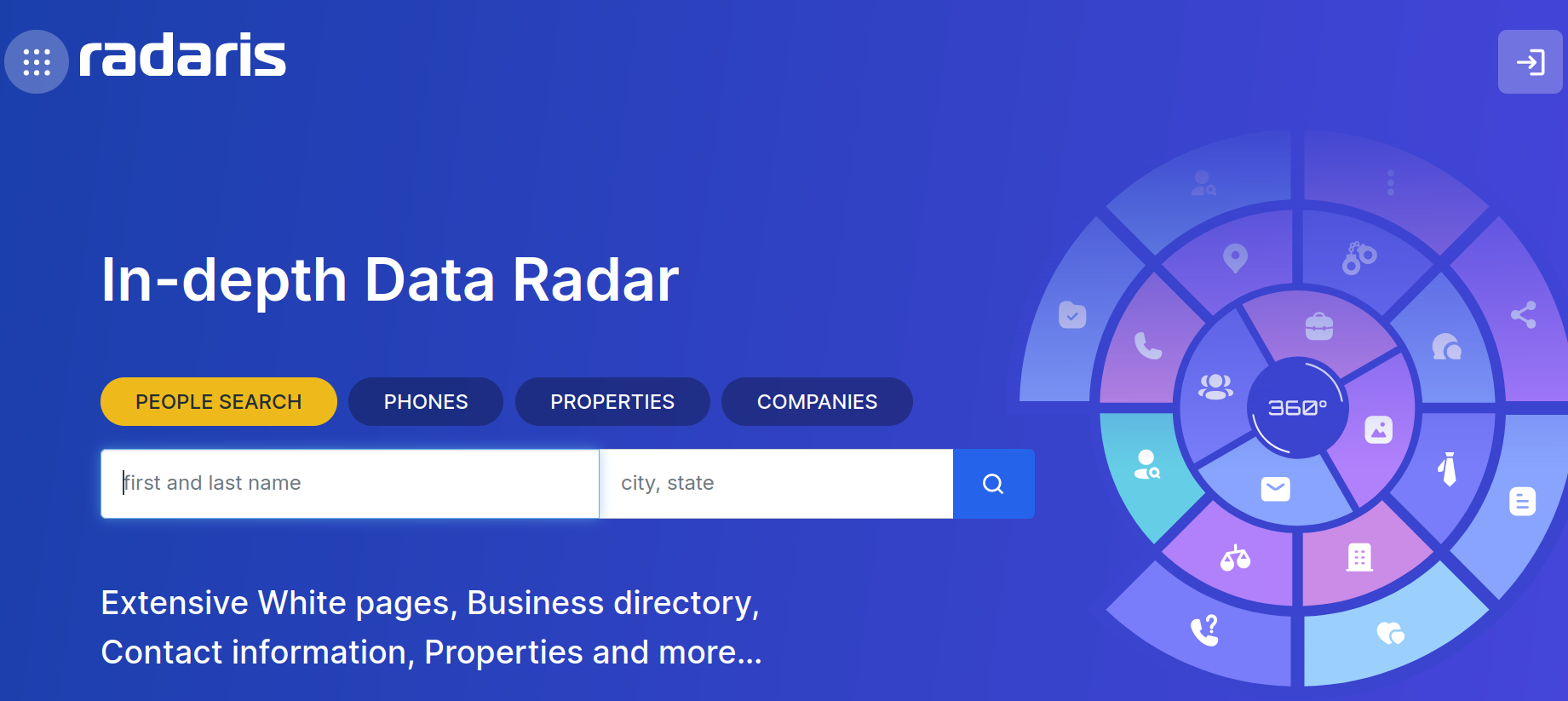
The consumer data broker Radaris.com, long notorious for ignoring removal requests and scrubbing personal data from its expansive people-search network, has faced a severe legal reckoning. In a landmark enforcement action, a New Jersey judge ordered the transfer of radaris.com and more than a dozen associated data broker domains to the plaintiffs following extensive stonewalling and evasive legal maneuvering by the company.
The forfeiture stems from a lawsuit filed in February 2024 by Atlas Data Privacy Corp. The legal challenge targets data brokers accused of violating a stringent New Jersey privacy statute known as Daniel’s Law. Enacted following a tragic family shooting involving the son of a federal judge, the legislation protects state law enforcement personnel, government officials, judges, and their families by compelling commercial data brokers to completely remove their personal information. The statute carries a penalty of $1,000 per violation for entities that ignore removal requests.
The fallout from the Radaris litigation exposes deep structural vulnerabilities in the global data brokerage ecosystem. By blending complex corporate shell games, fictitious executive identities, and aggressive litigation tactics, Radaris operated with impunity for over a decade. The intervention by Atlas Data Privacy Corp and the subsequent court-mandated domain seizures represent a major disruption to a business model that has historically relied on the exhaustion of its legal opponents.
Anatomy of a Corporate Shell Game
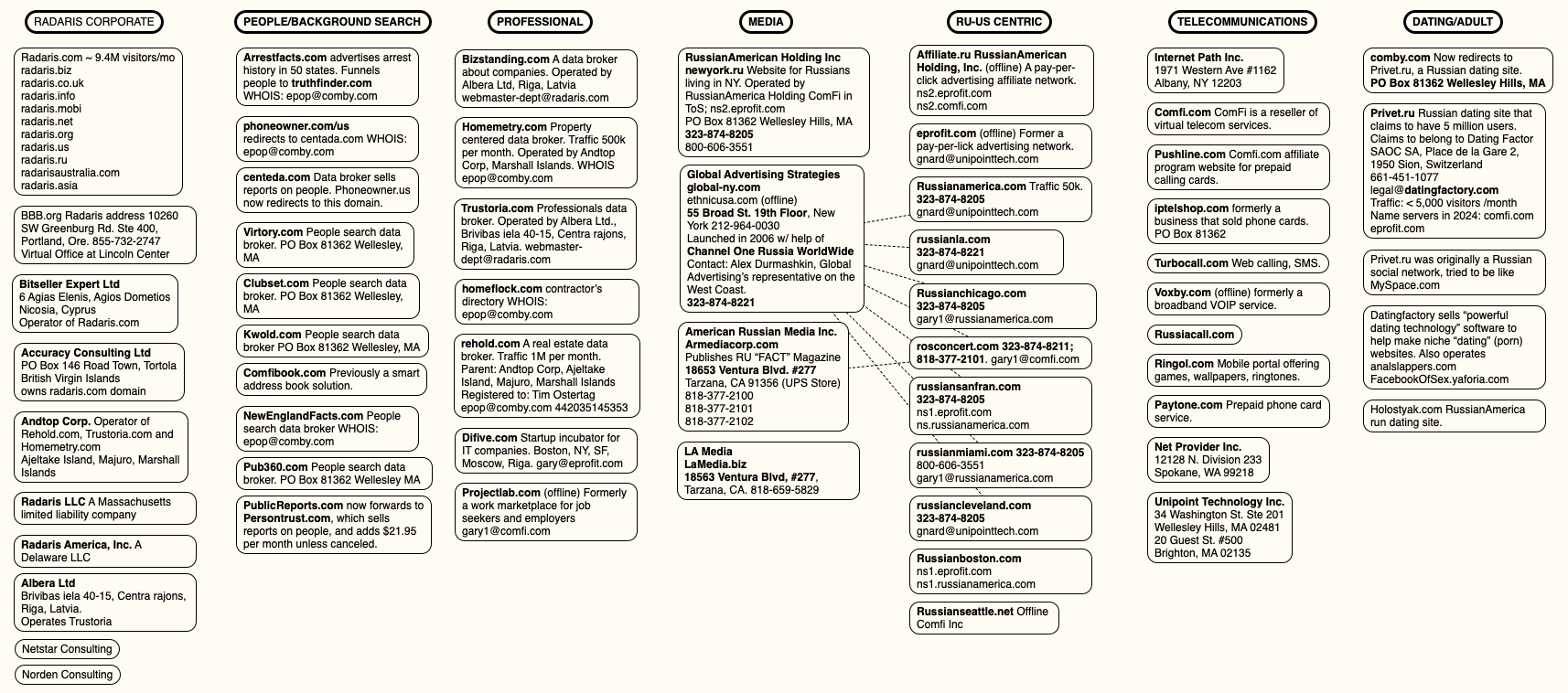
The operations behind Radaris trace back to Russian-born brothers Igor and Dmitry Lubarsky, who reside in Massachusetts and manage a vast portfolio of people-search engines, affiliate programs, and foreign-language dating platforms. Just weeks after Atlas initiated legal proceedings in early 2024, investigative reporting revealed the structural framework of the brothers’ network. Rather than directly confronting the allegations, attorneys representing the Lubarskys threatened defamation lawsuits and claimed the true owners were Ukrainian nationals living in Ukraine.
Subsequent investigations dismantled these assertions, uncovering that Radaris and its sister companies utilized a fictitious chief executive officer named "Gary Norden." Boston Law Group attorney Val Gurvits, representing Radaris, later admitted to the invention of the pseudonym. Court records and promotional materials revealed that the company had repeatedly deployed the fake executive in press releases to secure venture capital and attract investors.
As legal pressure intensified, the defendants engaged in what Atlas CEO Matt Adkisson described as an "island-hopping phase." Corporate registrations shifted dynamically across international tax havens, including the Marshall Islands, the British Virgin Islands, and Cyprus.
"Privacy policies changed constantly, and new entities kept appearing," Adkisson noted. "Behind the scenes, it felt like a shell game. Defense lawyers told the court that certain entities merely operated the domains and were the proper parties to sue. But by the time a judgment neared, those entities would be discarded and new entities would appear."
In one instance, after the defense updated its terms of service to designate a newly formed Marshall Islands enterprise as the managing party, investigators discovered the entity did not even exist legally. This strategy of procedural attrition had previously shielded the network from accountability, most notably in a 2017 class-action lawsuit where Radaris failed to contest claims, leading to a $7.5 million default judgment and an initial, though subsequently halted, domain transfer involving Verisign.
Inside the Interconnected Data Broker Ecosystem
Discovery materials obtained through the litigation—encompassing over 10,000 emails and corporate documents—shed unprecedented light on the financial scale and administrative centralization of the Radaris network.
The documents demonstrate that nominal corporate shells—including Radaris America, Inc., Bitseller Expert Limited, Digital Orbit Corp, Core Solutions Group Inc, Lucky Solutions Inc, Virtura Corp, Veripages Inc., Nuform Solutions Inc., Growth Data Advisors Inc., and Property Experts, Inc.—were administered by a core group of three or four individuals. These entities shared financial accounts, payment card systems, virtual office addresses, and core technical infrastructure hosted under mail domains such as difive.com, centerex.com, scienteco.com, and pub360.com.
Financial records uncovered in the discovery process indicate substantial revenue generation across the network. Radaris.com generated approximately $42,000 monthly, while its sister site Veripages.com earned roughly $45,000 per month. These earnings were bolstered by strategic partnerships with major marketing and advertising networks, including the Lifetime Value Company—operator of brands like PeopleLooker, PeopleSmart, NumberGuru, and Bumper.

Furthermore, the document corpus revealed financial ties to Onerep, a privacy service that assists consumers in removing personal data from people-search sites. According to Atlas, the Radaris family of websites secured up to $25,000 monthly from partnerships with Onerep. Investigative findings previously tied Onerep’s founder to the creation and operation of competing people-search engines, illustrating a circular business model where companies profit simultaneously from publishing personal data and offering services to remove it.
Constitutional Challenges and the Future of State Privacy Laws
While the New Jersey court has successfully transferred 14 domain names to Atlas—with radaris.com now redirecting to an informational notice regarding the court order—the broader legal battle is far from over.
Radaris and approximately 150 other consumer data brokers targeted by Atlas have mounted a coordinated constitutional defense. Over 70 of these lawsuits have been removed to federal court, with defense attorneys arguing that Daniel’s Law violates the First Amendment by imposing unconstitutional restrictions on the publication of legally gathered public records. The U.S. Court of Appeals for the Third Circuit is currently weighing these constitutional arguments, with legal analysts predicting the dispute will ultimately reach the U.S. Supreme Court.
The legislative landscape surrounding data privacy remains deeply fragmented. Following New Jersey’s lead, at least 14 other states have enacted statutes modeled after Daniel’s Law, while several others have proposed similar measures. However, judicial resistance is emerging on multiple fronts; in August 2025, a federal district court ruled West Virginia’s version of Daniel’s Law facially unconstitutional under the First Amendment.
Broader Implications for 21st Century Data Privacy
Privacy experts point out that state-level statutes, while impactful for targeted groups like law enforcement and judicial officials, fail to address the systemic vulnerabilities affecting the general population. Justin Sherman, a privacy researcher and author examining the data broker industry, emphasizes that federal legislative paralysis continues to leave consumers exposed.
"These days at the federal level, add in the intense amount of lobbying against these laws from social media companies, big tech, cryptocurrency firms, and now AI proponents in the mix who claim that limiting their data scraping is somehow going to collapse the whole U.S. economy under Chinese rule," Sherman stated.
Sherman notes that people-search businesses operate legally within the grey areas of existing frameworks, as virtually all state privacy laws exempt records classified as public documents. Voting registries, property filings, marriage certificates, motor vehicle logs, criminal histories, and professional licenses remain freely accessible for commercial exploitation.
The absence of comprehensive federal data protection standards extends beyond traditional people-search engines. While numerous states mandate age-verification protocols for online services—requiring users to submit sensitive documentation such as state-issued driver’s licenses—federal law imposes minimal restrictions on how third-party intermediaries handle, retain, or secure that data. Industry analysts warn that without federal guardrails, high-profile security incidents, such as the recent breach at IDScan.net which exposed the driver’s license data of over 153 million Americans, will continue to threaten consumer security.
As the legal proceedings surrounding Radaris and Daniel’s Law proceed through appellate courts, the outcome is expected to redefine the legal boundaries between commercial speech protections for data brokers and the digital privacy rights of individuals in the United States.

