
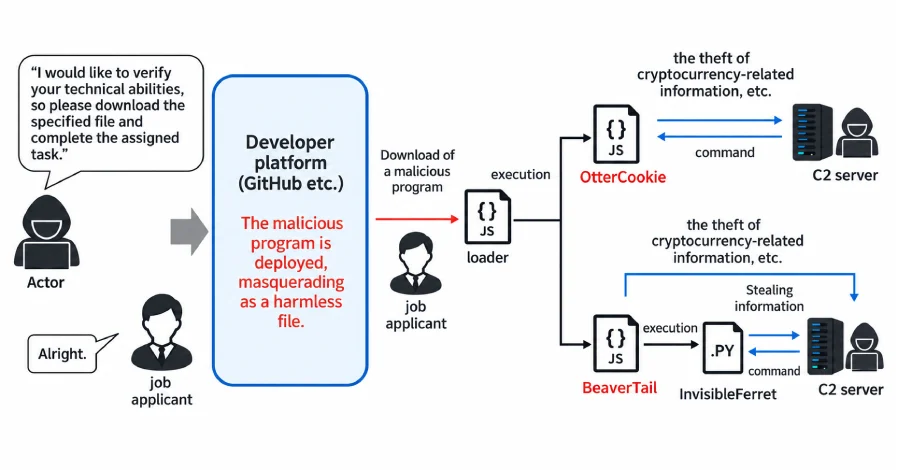
A sophisticated and persistent cyber-espionage and financial theft operation, orchestrated by North Korean state-sponsored threat actors, has reached a critical scale, compromising at least 30,000 devices across more than 100 countries. According to a landmark joint cybersecurity advisory released by intelligence agencies from the United States, Japan, Australia, and Germany, the campaign—colloquially known as "Contagious Interview"—has successfully siphoned over $10.71 million in cryptocurrency while compromising more than 7,000 digital wallets. This campaign represents a significant evolution in how the Democratic People’s Republic of Korea (DPRK) leverages cyber capabilities to generate illicit revenue and infiltrate Western corporate infrastructure.
The operation specifically targets individuals operating in high-value technical sectors, including web design, software engineering, and blockchain development. By masquerading as legitimate recruiters on professional networking platforms like LinkedIn, the threat actors initiate a dialogue with unsuspecting job seekers. Once trust is established, the attackers lure victims into a malicious "coding test" or "job assessment," which serves as the entry point for a multi-stage infection chain.
A Chronology of the Contagious Interview Campaign
The origins of the Contagious Interview campaign date back to at least 2022, though its sophistication has accelerated dramatically over the past 24 months. Initially identified by security researchers at Palo Alto Networks Unit 42, the campaign began as a relatively straightforward phishing operation. However, by mid-2025, it had matured into a highly organized industrial-scale endeavor.
In June 2025, U.S. authorities seized approximately $774 million in cryptocurrency linked to broader North Korean illicit activities, a move that likely forced the regime to diversify its tactics. By early 2026, the campaign had fully integrated with the broader "IT worker" program, a state-managed initiative designed to export labor to generate foreign currency. The most recent data from September 2026 confirms that the campaign is now deeply intertwined with the activities of multiple clusters, including those tracked under the aliases WaterPlum, PurpleBravo, and DEV#POPPER. The dismantling of a specialized "laptop farm" in Japan during the latter half of 2026 served as a major, albeit temporary, setback for the group’s logistics network.

The Technical Infrastructure of Deception
The threat actors operate with a high degree of operational security, frequently utilizing VPN services such as Astrill and Mullvad to mask their location and establish exit nodes in target countries. Research by Kudelski Security highlights that the primary objective of this infrastructure is to bypass regional security controls and geographic blocks that would otherwise flag connections originating from Pyongyang.
The malware deployed during these attacks is extensive and varied, reflecting a modular approach to infection. Once a victim downloads the "assessment" file, the attackers deploy a series of backdoors and remote access trojans (RATs). Notable payloads identified by investigators include:
- BeaverTail and FlexibleFerret: Used for initial credential harvesting from browsers and crypto-wallets.
- GolangGhost and PylangGhost: Specialized tools designed to maintain persistence in Linux and Windows environments.
- RATatouille and OtterCookie: Advanced trojans that allow for live monitoring of a victim’s screen and keystrokes.
- StoatWaffle: A sophisticated backdoor specifically designed to exploit Visual Studio Code extensions to gain lateral movement within corporate developer networks.
The integration of AI into these workflows has also been observed. Recent evidence suggests the use of AI-generated content to craft highly convincing, personalized job descriptions and interview scripts, making it increasingly difficult for experienced developers to distinguish between a legitimate recruiter and a state-sponsored operative.
The Evolution of the IT Worker Scheme
Beyond the immediate theft of assets, the North Korean regime has aggressively expanded its "IT worker" program to include a proxy hiring model. This strategy addresses the regime’s growing need to circumvent global "Know Your Customer" (KYC) and identity verification protocols.
Recent investigations by the security firm Silent Push uncovered a recruitment scam on the messaging platform Discord, titled "Mouse Review." In this scheme, the threat actors recruit foreign nationals in the U.S., the European Union, and Latin America to serve as "human proxies." These individuals are paid to attend video interviews and complete identity verification steps, while the North Korean actor performs the actual technical labor behind the scenes.

The financial incentive for these proxies is significant—often ranging from $3,000 to $5,000 per month—with a revenue split where the proxy receives 35% of the earnings and the North Korean operative retains 65%. This symbiotic relationship allows the regime to effectively "outsource" the risk of detection while maintaining full control over the technical output and access to sensitive corporate data.
Strategic Implications and Security Analysis
The implications of this campaign extend far beyond simple financial fraud. By infiltrating the workstations of engineers at cryptocurrency exchanges and tech firms, the North Korean actors gain a foothold into the internal networks of these organizations. This provides an ideal vantage point for intellectual property theft, corporate espionage, and the execution of high-impact supply chain attacks.
From a geopolitical perspective, this activity is a direct extension of the state-led labor programs that have been used by North Korea since the 1970s. While historically these programs involved physical labor in sectors like logging and construction, the modern shift to "cyber-labor" is far more lucrative and exponentially more difficult to monitor or sanction.
"The threat is no longer just about the theft of funds," noted one cybersecurity analyst familiar with the investigation. "It is about the systematic infiltration of the global digital supply chain. When a developer is compromised, the entire codebase they contribute to becomes a potential vector for future attacks."
Response and Mitigation Strategies
Government agencies and private security firms are urging organizations to implement stricter verification processes for new hires, particularly those in technical or privileged roles. Recommendations include:

- Strict Identity Verification: Organizations should mandate live video interviews and cross-reference candidate information with multiple independent sources.
- Endpoint Protection: Deploying advanced EDR (Endpoint Detection and Response) solutions that can identify and block the execution of suspicious scripts, particularly those disguised as coding assessments.
- Network Monitoring: Utilizing traffic analysis to identify connections to known VPN exit nodes or suspicious command-and-control (C2) infrastructure commonly used by North Korean threat clusters.
- Developer Security: Implementing "zero trust" access policies for development environments, ensuring that no single workstation has unrestricted access to production servers or critical blockchain infrastructure.
The persistence of the Contagious Interview campaign serves as a stark reminder of the evolving nature of nation-state threats. As long as the regime in Pyongyang finds the combination of cyber-theft and remote IT labor to be a viable path for revenue generation, organizations must remain vigilant. The blurring line between a routine hiring process and a state-sponsored cyber-attack necessitates a new standard of due diligence, where technical assessment is matched by rigorous human verification.
The international community continues to monitor the situation, with agencies in the U.S., Japan, and Europe emphasizing that global cooperation is the only effective defense against an adversary that treats the global job market as its personal playground for illicit gain. The recent dismantling of the Japanese laptop farm is viewed as a successful start, but experts caution that the decentralized nature of these operations means the threat will likely continue to adapt and re-emerge in new, unforeseen forms.

