

Two recently disclosed critical vulnerabilities within SonicWall’s SMA1000 Secure Mobile Access appliances were exploited in sophisticated zero-day attacks for a period spanning several weeks, enabling threat actors to install bespoke malware on compromised VPN devices. This alarming discovery highlights the persistent and evolving threat landscape facing critical network infrastructure, underscoring the urgency for robust patching and proactive security measures. The vulnerabilities, identified as a critical server-side request forgery (SSRF) and a high-severity command injection flaw, provided attackers with unauthenticated access and root privileges, leading to deep infiltration of targeted systems.
Unveiling a Covert Campaign: The Initial Disclosure
The initial warning came from SonicWall itself last week, alerting customers to active exploitation of previously undisclosed flaws affecting its SMA1000 Series VPN appliances. At that time, SonicWall urged immediate action, releasing patches for affected versions 12.4.3-03453 and 12.5.0-02835. However, the initial advisory was notably sparse on the specifics of the exploit chain or the nature of the compromise, leaving many organizations in the dark about the full extent of the threat. The affected models specifically included SMA1000 6210, 7210, and 8200v appliances, which are widely deployed by enterprises for secure remote access.
The two vulnerabilities at the heart of this campaign are tracked as CVE-2026-15409, a critical server-side request forgery (SSRF) vulnerability, and CVE-2026-15410, a high-severity command injection flaw. An SSRF vulnerability allows an attacker to induce the server-side application to make HTTP requests to an arbitrary domain of the attacker’s choosing. This seemingly innocuous capability can be leveraged for internal network reconnaissance, accessing sensitive data, or even triggering further attacks by interacting with internal services that are not directly exposed to the internet. Command injection, on the other hand, is a much more direct and immediately dangerous flaw, enabling an attacker to execute arbitrary commands on the host operating system, often with elevated privileges, by injecting malicious code into input fields that are not properly sanitized. The combination of these two vulnerabilities proved to be devastating, providing a clear path from initial unauthenticated access to full system compromise.
Volexity’s Deep Dive: Exposing the Full Attack Chain

The full gravity and technical intricacies of the attacks were brought to light through a comprehensive report issued by incident response firm Volexity. Volexity, which collaborated with SonicWall in the investigation, meticulously detailed the exploitation chain, revealing how threat actors managed to install custom malware on compromised SMA1000 appliances. This report painted a stark picture of a sophisticated and persistent threat actor operating with a high degree of technical prowess.
According to Volexity, the threat actor, which they track as UTA0533, initiated exploitation of these vulnerabilities as early as June 22, 2026. This critical detail means that organizations using vulnerable SonicWall SMA1000 devices were exposed to active compromise for weeks before SonicWall publicly disclosed the flaws and released patches. This timeline underscores the inherent danger of zero-day exploits, where defenders are often caught unaware with no readily available defenses. Volexity’s analysis was based on an exhaustive examination of logs, disk images, and memory from compromised appliances, providing undeniable evidence of the attacker’s presence and methods.
The Sophisticated Exploitation Process
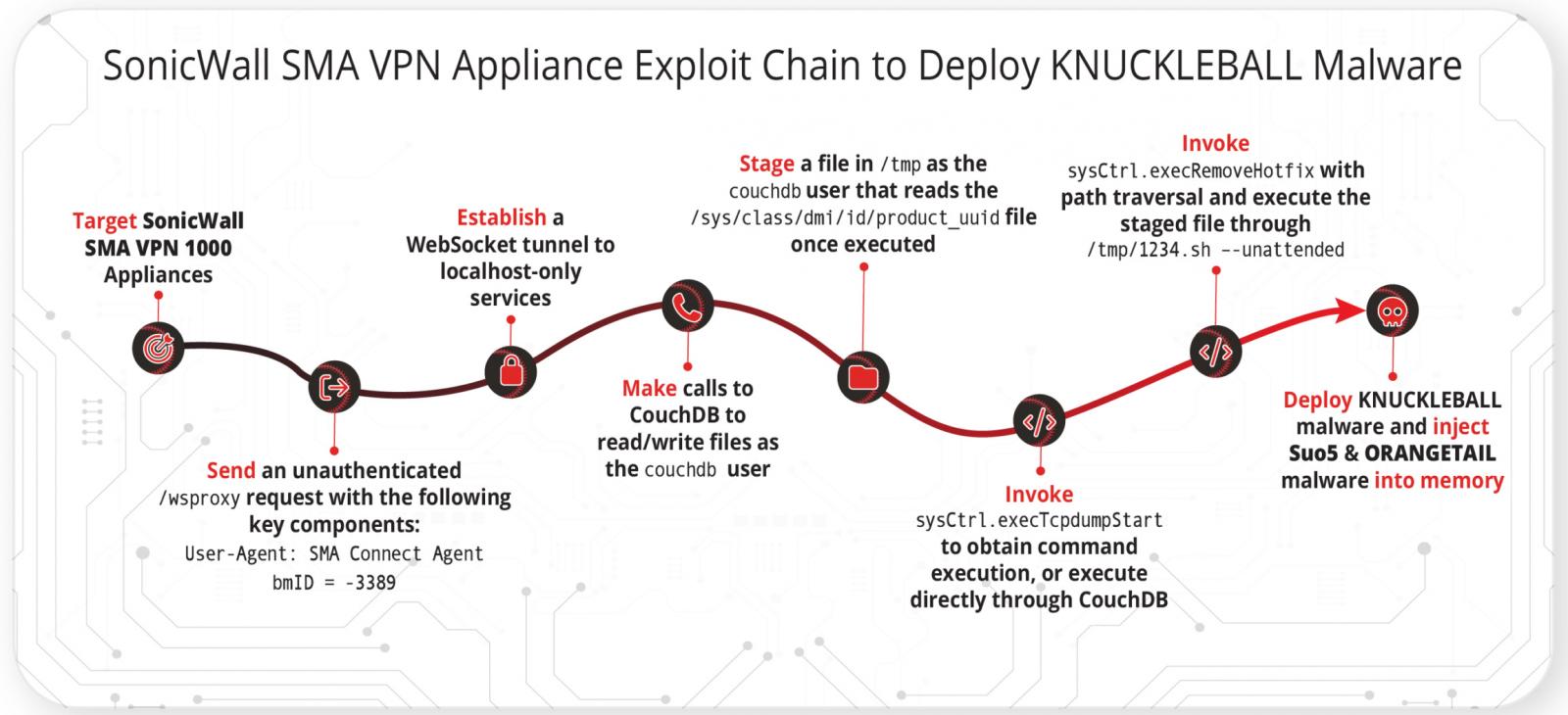
The attack chain, as meticulously reconstructed by Volexity, began with the exploitation of CVE-2026-15409, the critical SSRF vulnerability. UTA0533 leveraged this flaw to abuse the SMA1000’s /wsproxy endpoint. This endpoint, intended for legitimate internal proxying, was weaponized to establish unauthenticated WebSocket tunnels. Crucially, these tunnels allowed the attackers to gain access to services that should have been strictly confined to the appliance’s internal network, effectively bypassing perimeter defenses. This exposure included sensitive internal applications such as CouchDB, a NoSQL database often used by web applications, and the VPN device’s own management service.
With this newfound internal access, the attackers proceeded to query CouchDB. Their objective was to extract the appliance’s product_uuid, a unique identifier critical for the subsequent stages of their attack. While the precise method used to exploit CouchDB for this data exfiltration remains undisclosed by Volexity, its successful retrieval demonstrated the attackers’ ability to navigate and interact with internal system components.
The product_uuid served as the key to unlock the next phase of the assault: the exploitation of CVE-2026-15410, the high-severity command injection vulnerability. This flaw was exploited through the Appliance Management Console’s sysCtrl.execRemoveHotfix RPC method. By injecting malicious commands into this method, UTA0533 gained the ability to execute arbitrary commands with root privileges, effectively taking full control of the compromised appliance. Root access is the ultimate prize for attackers, granting them unrestricted control over the operating system, allowing for the installation of persistent backdoors, data manipulation, and further network penetration.

Deployment of Custom Malware: KNUCKLEBALL, Sou5, and ORANGETAIL
Once root access was established, UTA0533 wasted no time in installing a custom malware dropper, which Volexity aptly named KNUCKLEBALL. This dropper was observed under the filename deploy_new.py, indicating a Python-based script. KNUCKLEBALL’s primary function was to deploy two distinct Java-based malware families specifically designed for SonicWall SMA1000 appliances: Sou5 (identified as agent_wp8.jar) and ORANGETAIL (identified as agent_wp9.jar). The development of custom malware tailored to a specific target system underscores the advanced capabilities and focused intent of UTA0533.
- Sou5: This malware family functioned as a sophisticated reverse proxy. By establishing covert tunnels, Sou5 allowed the attackers to funnel traffic through the compromised SMA1000 appliance, thereby maintaining persistent and clandestine access to internal network resources. A reverse proxy can be incredibly effective for attackers, as it masks their true origin, blends malicious traffic with legitimate network activity, and allows them to bypass egress filtering rules that might otherwise block direct outbound connections.
- ORANGETAIL: Complementing Sou5, ORANGETAIL was a custom Java webshell. Webshells are persistent backdoors that provide remote administrative access to a compromised web server. In this case, ORANGETAIL enabled attackers to send encrypted Java payloads to the compromised appliance and dynamically execute them within an active HTTP session. This functionality granted UTA0533 real-time command and control, allowing for flexible and adaptable post-exploitation activities without needing to continually re-exploit the initial vulnerabilities.
Beyond these core malware components, Volexity also discovered that the attackers had modified the appliance’s nginx configuration. This modification was crucial for remotely exposing the ORANGETAIL webshell, ensuring that the attackers could access their backdoor from outside the network. Furthermore, the threat actors installed ROOTRUN, a privilege-escalation tool. While root access had already been achieved, ROOTRUN likely served as a persistent mechanism to regain or maintain root privileges, ensuring that even if certain processes were restarted or security measures attempted to demote their access, they could quickly re-escalate.
Broader Implications and the Threat Landscape
The campaign, while technically sophisticated in its exploitation and malware development, showed a mixed level of success in terms of lateral movement within victim networks. Volexity noted that UTA0533 was "less successful at spreading into victims’ internal networks" beyond the initial compromise of the SMA1000 appliances. This observation, while somewhat reassuring, does not diminish the severity of the initial breach or the potential for significant damage had the attackers been more aggressive or successful in their post-exploitation activities.
This incident highlights several critical aspects of the contemporary cybersecurity landscape:
- VPN Appliances as High-Value Targets: VPNs are gateways to an organization’s internal network, making them prime targets for sophisticated threat actors. A compromise of a VPN appliance can bypass layers of perimeter security, providing direct access to sensitive internal systems and data. The widespread reliance on VPNs for remote work and distributed operations further elevates their criticality.
- The Peril of Zero-Day Exploits: The fact that these vulnerabilities were exploited for weeks before public disclosure and patching underscores the immense challenge posed by zero-day threats. Organizations have no defense against such attacks until a patch is released and applied, emphasizing the need for robust threat hunting, anomaly detection, and advanced endpoint protection that can identify post-exploitation activities even if the initial breach was unknown.
- Sophistication of Threat Actors: The development of custom, tailored malware (KNUCKLEBALL, Sou5, ORANGETAIL) and the intricate multi-stage exploit chain demonstrate the high level of technical skill and resources possessed by groups like UTA0533. This signifies a move beyond off-the-shelf tools to highly specialized attack methodologies, making detection and attribution more challenging.
- Supply Chain Security: This event also touches upon the broader issue of supply chain security. As organizations increasingly rely on third-party hardware and software, vulnerabilities in these components become critical points of failure. Vendors like SonicWall bear a significant responsibility to rigorously test their products and respond swiftly and transparently to discovered flaws.
- Urgency of Patching and Proactive Defense: SonicWall’s urgent recommendation to patch immediately was well-founded. However, the period of active exploitation before patches were available serves as a potent reminder that patching, while crucial, is only one component of a comprehensive security strategy. Organizations must also invest in robust incident response capabilities, continuous monitoring, network segmentation, and user behavior analytics to detect and mitigate threats that bypass traditional defenses.
Official Responses and Industry Recommendations
Following Volexity’s detailed report, SonicWall reiterated its strong recommendation for all customers utilizing SMA1000 appliances to apply the latest patches (versions 12.4.3-03453 and 12.5.0-02835) without delay. While SonicWall had initially confirmed the zero-day nature of the attacks, Volexity’s findings provided the crucial operational intelligence needed for organizations to understand the full scope of compromise and potential indicators of compromise (IOCs) to search for within their environments.
Cybersecurity experts across the industry echoed these calls for immediate patching, alongside a broader set of recommendations. These include:
- Thorough Log Review: Organizations should review logs from their SMA1000 appliances and surrounding network infrastructure for any indicators of compromise (IOCs) provided by Volexity or other threat intelligence sources, dating back to at least June 2026.
- Network Segmentation: Isolating critical systems and data through network segmentation can limit the lateral movement of attackers, even if an initial compromise occurs.
- Multi-Factor Authentication (MFA): While the exploit bypassed authentication, strong MFA for all VPN and administrative access points remains a fundamental security control to prevent unauthorized access through other means.
- Endpoint Detection and Response (EDR): Implementing EDR solutions on internal endpoints can help detect unusual activity or the deployment of malicious payloads if attackers manage to move beyond the VPN appliance.
- Regular Security Audits and Penetration Testing: Proactive testing can help identify weaknesses before threat actors exploit them.
The SonicWall SMA1000 zero-day attacks serve as a potent reminder that the battle against cyber threats is continuous and ever-evolving. The sophistication demonstrated by UTA0533, coupled with the critical nature of the compromised infrastructure, underscores the imperative for organizations to maintain unwavering vigilance, prioritize rapid patching, and adopt a multi-layered, proactive approach to cybersecurity defense. The collaborative effort between vendors like SonicWall and incident response firms like Volexity is crucial in dissecting these complex attacks and providing the necessary intelligence to protect the global digital infrastructure.

