
The cryptocurrency landscape is once again abuzz with a high-profile dispute, this time between World Liberty Financial (WLFI) and Justin Sun, the prominent founder of TRON. The clash, which escalated over the past week, centers on critical questions of asset control and protocol governance within WLFI. As the tension persists, the price of WLFI has experienced a significant downturn, reflecting investor unease and the potential ramifications of these governance concerns.
Justin Sun Ignites Governance Debate, Questioning WLFI’s Asset Control Mechanisms
The core of the escalating conflict lies in Justin Sun’s direct challenge to World Liberty Financial’s internal governance structures. Sun, a figure with substantial influence in the blockchain space, has publicly accused WLFI of concentrating significant power in the hands of a single entity, thereby posing a risk to user assets. Specifically, he has raised concerns about a "guardian structure" that he alleges allows one address to freeze user assets. This assertion has sent ripples through the community, prompting a swift denial from World Liberty Financial, which maintains its controls are designed for user protection and platform stability.
In a series of pointed remarks on the social media platform X (formerly Twitter), Sun demanded transparency from World Liberty Financial regarding the identities of those controlling key governance mechanisms. He specifically called for disclosure of the "single guardian EOA" and the "3-of-5 multisig" that govern the WLFI smart contract. Sun articulated that investors have a fundamental right to know who possesses the authority to freeze their digital assets. His argument is rooted in his interpretation of on-chain data, which he claims shows a single, anonymous address that blacklisted his wallet after he acquired tokens linked to the project. Furthermore, he alleges that this same address controls a secondary "Guardian safe" with a remarkably low, single-signature threshold for action.
Sun’s detailed critique highlighted what he perceives as a critical flaw in WLFI’s governance model. He asserted that while asset seizure might theoretically require a collective decision through a 3-of-5 multisig vote, the act of freezing assets could be unilaterally executed by a single individual through the guardian EOA. This, he argued, renders the multi-signature voting mechanism largely ineffective and undermines the principles of decentralized governance. The implications of such a concentrated power, he suggested, are profound, as it could lead to arbitrary asset restrictions without broader community consensus or oversight.

World Liberty Financial’s Defense and Counter-Accusations
World Liberty Financial has not remained silent in the face of these serious allegations. The organization vehemently refuted Sun’s claims, characterizing them as baseless and misleading. WLFI issued a statement defending its risk management protocols, asserting that the wallet restrictions and freezing capabilities are exclusively implemented to combat abuse and detect suspicious activities. The company emphasized that these measures are not intended for the arbitrary seizure or control of user funds, but rather as a safeguard against malicious actors and illicit transactions.
Beyond the denial, World Liberty Financial escalated its response by hinting at potential legal action against Justin Sun for his public pronouncements. The company’s official communication characterized Sun’s approach as a predictable pattern of behavior: "Justin’s favorite move is playing the victim while making baseless allegations. Same playbook, different target. WLFI isn’t the first." This statement suggests that WLFI views Sun’s accusations as a tactic to destabilize the project, potentially for personal gain or to promote competing ecosystems.
Furthermore, WLFI addressed criticisms concerning a substantial borrowing position within its ecosystem, which had drawn scrutiny. The team reiterated that these lending activities are fully collateralized and that there is no immediate risk of liquidation. This defense aims to reassure investors about the financial health and operational stability of the WLFI platform, countering any perceptions of financial distress that might have been exacerbated by the governance dispute.
Market Reaction: WLFI Price Suffers Significant Losses
The intense public dispute between Justin Sun and World Liberty Financial has had a tangible impact on the market valuation of WLFI. Over the past week, the WLFI token has experienced a sharp decline, shedding over 20% of its value. This downturn adds further pressure to a token that had previously reached significant highs, suggesting that investor confidence has been severely shaken by the governance controversy.
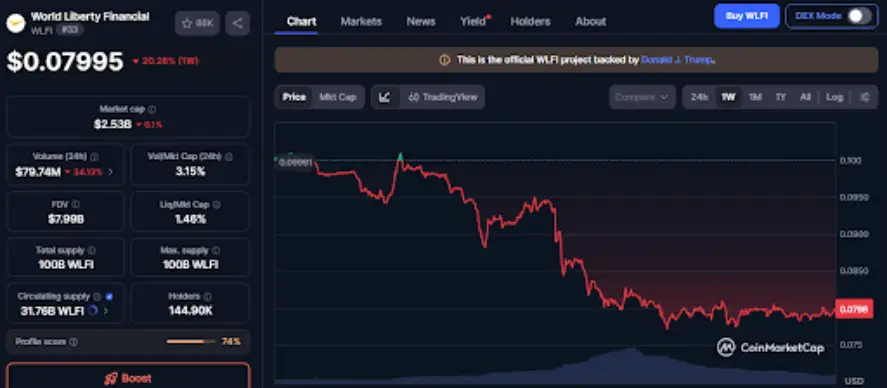
According to data from CoinMarketCap at the time of reporting, WLFI was trading at approximately $0.07995, marking a 20.28% decrease over the preceding seven days. The token’s price trajectory began near the $0.09991 mark at the start of the week and has since followed a consistent downward trend. This sustained slide indicates a lack of buying pressure and a prevailing bearish sentiment among market participants.
The price action analysis reveals a pattern of cascading losses, punctuated by brief, unsuccessful attempts at recovery. The initial slide was followed by short-lived rebounds that failed to alter the overall downward momentum. The token would briefly regain some ground, only to fall back into a weaker path, resuming its decline. A significant downward move occurred when the price dropped sharply below the $0.0900 threshold in the latter part of the week, representing the most pronounced bearish movement and widening the gap from earlier weekly levels. Following this break, the decline continued, albeit at a slower pace, with the price action consolidating in a narrower range near the lower end of the weekly spectrum. Despite minor upward fluctuations, these rebounds remained limited and insufficient to reignite positive momentum, leaving the token trading significantly below its earlier recovery points and at weaker levels.
Technical Analysis: Bears Hold Dominance, Signaling Further Downside Risk
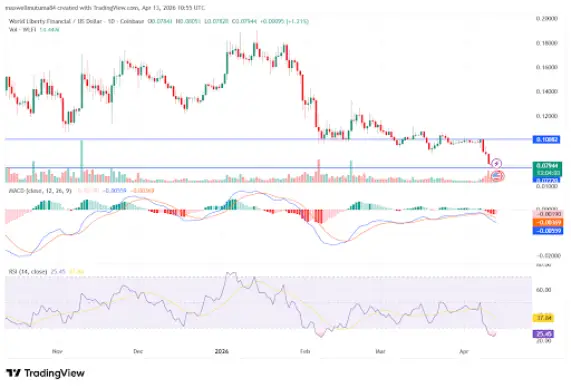
The current technical outlook for WLFI suggests that the bearish sentiment is likely to persist, with potential for further price depreciation. TradingView analysis indicates that the immediate support zone for WLFI is situated around the $0.07720 mark. Crucially, the token remains below the resistance level near $0.10082, effectively capping any potential recovery efforts and reinforcing the prevailing downward trend.
Further supporting the bearish thesis is the status of key technical indicators. The Moving Average Convergence Divergence (MACD) oscillator is positioned below its signal line, with both readings in negative territory. This configuration strongly suggests that sellers are currently in control of the market direction. The Relative Strength Index (RSI) also paints a grim picture, currently reading around 25.45. This places WLFI firmly within the oversold territory, a consequence of the recent downward price action. While oversold conditions can sometimes signal an impending rebound, in this context, they primarily highlight the extent of the price depreciation and the potential for further downward extension if buying pressure does not materialize.
The current market structure favors sellers as long as the WLFI price remains below the $0.1000 resistance level. A decisive break below the $0.07720 support zone would likely trigger another wave of selling pressure, prolonging the current bearish trend and potentially leading to new lows. While the oversold RSI might offer a temporary reprieve and allow for a short-term bounce towards nearby resistance levels, sustained upward momentum will depend on a significant shift in market sentiment and the resolution of the ongoing governance concerns. Until key indicators demonstrate a clear upward turn and the fundamental issues are addressed, the prevailing trend for WLFI appears to be one of continued weakness.
Broader Implications: Governance and Trust in Decentralized Systems
The dispute between Justin Sun and World Liberty Financial serves as a stark reminder of the critical importance of robust and transparent governance in the decentralized finance (DeFi) ecosystem. While the promise of decentralization lies in empowering users and distributing control, the reality can often be complex, with centralized points of control or opaque decision-making processes emerging.
Justin Sun’s accusations, regardless of their ultimate validity, highlight a legitimate concern within the crypto community: the need for clarity on who wields power and how it is exercised. When influential figures like Sun publicly question the safety and control of assets within a protocol, it erodes investor confidence and can have significant market repercussions. This incident underscores the ongoing challenge for DeFi projects to strike a balance between necessary security measures and the principles of open, decentralized governance.
The involvement of a prominent figure like Justin Sun also brings a significant spotlight to the issue. His direct engagement and public pronouncements can amplify concerns and influence market sentiment far more rapidly than a typical community discussion. The resulting price drop in WLFI is a direct consequence of this amplified scrutiny and the perceived risk associated with the project’s governance model.
For World Liberty Financial, the immediate challenge is to restore trust and provide irrefutable evidence that its governance structures are secure and aligned with user interests. The threat of legal action, while a strong stance, may do little to assuage investor fears if not accompanied by a clear and transparent explanation of their operational framework.
In the broader context of the cryptocurrency market, this event reinforces the need for rigorous due diligence by investors. Understanding a project’s governance mechanisms, the identities of key stakeholders, and the distribution of control is as crucial as analyzing its tokenomics or technological innovation. As the DeFi space continues to mature, the integrity and transparency of governance will increasingly become a defining factor in the long-term success and sustainability of blockchain projects. The WLFI-Sun saga is a potent case study in how governance disputes can directly translate into market volatility and a loss of investor faith, underscoring the delicate balance between innovation and the fundamental need for trust in digital asset ecosystems.
