
By Thomas Perfumo, Kraken Chief Economist
CME-listed Fed Funds futures are currently pricing in a nearly 70% probability that the U.S. Federal Open Market Committee (FOMC), the body responsible for setting benchmark interest rates, will maintain current rates unchanged through the end of 2026. This sentiment persists despite a backdrop of elevated geopolitical uncertainty and volatile market conditions, suggesting a prevailing market expectation of policy complacency from the FOMC. This expectation is particularly noteworthy as Jerome Powell’s tenure as Chairman is slated to conclude in May 2026, opening the door for potential shifts in the near-term policy vision under new leadership.
The current FOMC policy consensus, as characterized by the March 2026 meeting minutes, is often described as reactive, inflation-sensitive, and cautious. The critical question facing market participants and policymakers alike is whether this established modus operandi will endure a transition in leadership. Answering this necessitates a thorough examination of current committee dynamics and a closer look at Kevin Warsh, the current nominee to chair the U.S. Federal Reserve. Three likely scenarios have the potential to significantly alter the trajectory of risk assets for the foreseeable future, ranging from a continuation of the status quo to a fundamental reimagining of modern U.S. Federal Reserve policy. A series of near-term catalysts, including confirmation hearings, ongoing investigations, and future FOMC press conferences, will shed light on how a potential regime change at the U.S. Federal Reserve might impact risk assets throughout the remainder of 2026. Crypto investors, in particular, should prioritize shifts in policy concerning market liquidity and the Federal Reserve’s balance sheet.
Cracks in the Consensus: Rising Dissent Signals Shifting Dynamics
Recent FOMC voting records offer a glimpse into the evolving dynamics within the committee. Throughout 2025, the FOMC recorded nine dissenting votes, marking the highest tally in over a decade. The December 2025 meeting alone saw three dissenters, a six-year high for a single meeting. While not indicative of a crisis with twelve voting members, this increased level of dissent prompts consideration of whether a near-term leadership transition could precipitate a fundamental regime shift.
The FOMC is comprised of twelve voting members: seven members of the Board of Governors, the President of the Federal Reserve Bank of New York, and four presidents of other regional Federal Reserve Banks who serve on a rotating annual basis. Should Kevin Warsh be confirmed as the next Fed Chairman, he would assume the seat currently occupied on an interim basis by Stephen Miran. Warsh’s potential addition to the FOMC would place him alongside three other voting members whose past records suggest a dovish inclination: Bowman, Paulson, and Waller.
Four other members—Williams, Barr, Cook, and Jefferson—have consistently voted with the consensus, exhibiting a neutral stance. Including Warsh, this brings the total to eight members who lean neutral to dovish. The influence of the Chairman on FOMC policy cannot be overstated. The Chair sets meeting agendas, proposes policy actions, and plays a pivotal role in guiding the staff who prepare the analytical materials that inform the committee’s decisions. Policy is determined by a simple majority, requiring seven votes. Historically, the FOMC has never outvoted the Chair’s position, underscoring the structural influence inherent in the role. This composition offers Warsh a plausible pathway toward building consensus, potentially with a slight majority, further reinforced if Powell adheres to tradition and departs the Board of Governors entirely.
The Wild Card: Jerome Powell’s Exit and the Ongoing Probe
Jerome Powell’s term as Chairman is set to conclude on May 15, 2026. However, his term as a Governor on the FOMC extends until January 2028, leaving him the option to remain a voting member even after his chairmanship expires. This would be an unconventional move, as outgoing chairs typically step down to facilitate a clean transition for new leadership. The last instance of a Fed Chair transitioning out of the leadership role but remaining as an FOMC voting member dates back to the 1940s.
While Powell has remained publicly silent on his personal intentions, a criminal investigation by the Department of Justice into the U.S. Federal Reserve concerning renovation projects complicates his potential departure. During the March 2026 FOMC press conference, Powell indicated his intention to remain Chairman until his successor is confirmed and to stay on the Board of Governors until the investigation and related legal processes reach a resolution.
Separately, Republican Senator Thom Tillis, whose support is critical for advancing Warsh’s nomination through the Banking Committee, has reportedly demanded the dismissal of the criminal probe as a condition for his vote. As of April 14, 2026, prediction markets suggest a 62% likelihood that Powell will depart the Board of Governors this year. The ultimate decision rests with Powell. On one hand, his stated intention to remain seems more directly tied to the ongoing probe and the principle of Federal Reserve independence rather than a desire to exert further influence over monetary policy. In theory, these political matters could be resolved swiftly and with minimal cost. On the other hand, the unresolved nature of the issue and his potential continued presence on the Board of Governors, even after his chairmanship ends, could inadvertently entrench a coalition supporting the status quo. A favorable market reaction is anticipated if the probe is resolved and Powell commits to stepping down from the FOMC, clearing a path for Warsh to potentially build consensus around a more forward-looking and dovish near-term policy vision.
The $6.7 Trillion Question: Beyond the Fed Funds Rate
Markets often express a yearning for the liquidity-rich environment of the 2010s, characterized by zero interest rate policy. However, the current economic landscape presents a different set of challenges. Consumer inflation remains elevated, with the most recent core CPI print at +2.6% year-over-year, and unemployment remains low at 4.3%. In isolation, the case for immediate rate cuts appears relatively weak. Yet, fixation solely on the Fed Funds rate represents only half of the policy equation.
The trajectory of the Federal Reserve’s balance sheet is arguably more consequential, as the policy challenges facing the U.S. government and its citizens extend well beyond the overnight bank facility rate. It is through its balance sheet that the Federal Reserve possesses the ability to influence longer-term interest rates. As of April 2026, the Fed’s balance sheet stands at $6.7 trillion. Quantitative tightening, a multi-year initiative to reduce the size of the balance sheet, officially concluded in December 2025, and the Fed is currently purchasing approximately $40 billion per month in T-bills, particularly in anticipation of the April tax season.
Two prominent near-term challenges for the U.S. administration include a looming U.S. Treasury refinancing cliff and a housing market experiencing a significant slowdown. In 2026, approximately $9.6 trillion in U.S. government debt is scheduled to mature, representing over 25% of the total outstanding national debt. A substantial portion of this debt comprises short-term bills and notes issued during the pandemic era of 2020-2021, when the Fed maintained rates near zero. Rolling over this debt at rates three to four times higher is projected to push net interest payments past $1 trillion for the first time in history. Concurrently, Treasury Secretary Scott Bessent is financing deficits heavily through short-duration T-bills, with bill issuance now constituting 22% of total issuance, exceeding the Treasury Borrowing Advisory Committee’s recommended 20% ceiling. This strategy functions as a form of shadow monetary policy, concentrating refinancing risk in the near term under the assumption that interest rates will become more accommodating when the debt comes due for rollover. Meanwhile, persistently high 30-year mortgage rates have effectively frozen housing turnover, intensifying political pressure to ease credit conditions.
Should the U.S. Federal Reserve feel compelled to directly address some of these issues through monetary policy, it would necessitate employing the balance sheet in some form of yield curve control. Concerns about coordination compromising the independence of the U.S. Federal Reserve are often raised, but this argument can be considered a red herring. The U.S. President is responsible for appointing members of the Board of Governors and the Chairman. An inherent political bias exists in nominee selection, favoring individuals supportive of the President’s agenda. It is the responsibility of Congress, through its confirmation process and term limits, to ensure a high standard of independence. The nomination of Kevin Warsh likely aligns with the U.S. administration’s agenda, though historical context allows for varied interpretations.
Kevin Warsh: The Hawk Who Might Cut
Kevin Warsh’s public record suggests an element that the market may not have fully absorbed: a preference for genuine rate cuts. Warsh’s writings advocate for rate reductions alongside balance sheet discipline. He views AI-driven productivity gains as a medium- to long-term disinflationary force and has criticized the current Federal Reserve’s data-dependence framework as backward-looking and inadequate. In his view, interest rates can be lowered because the structural inflation outlook is poised to improve without necessitating a significant economic downturn. On the balance sheet front, Warsh’s supply-side vision calls for a deregulatory approach that structurally reduces the demand for reserves, thereby allowing the balance sheet to shrink over time.
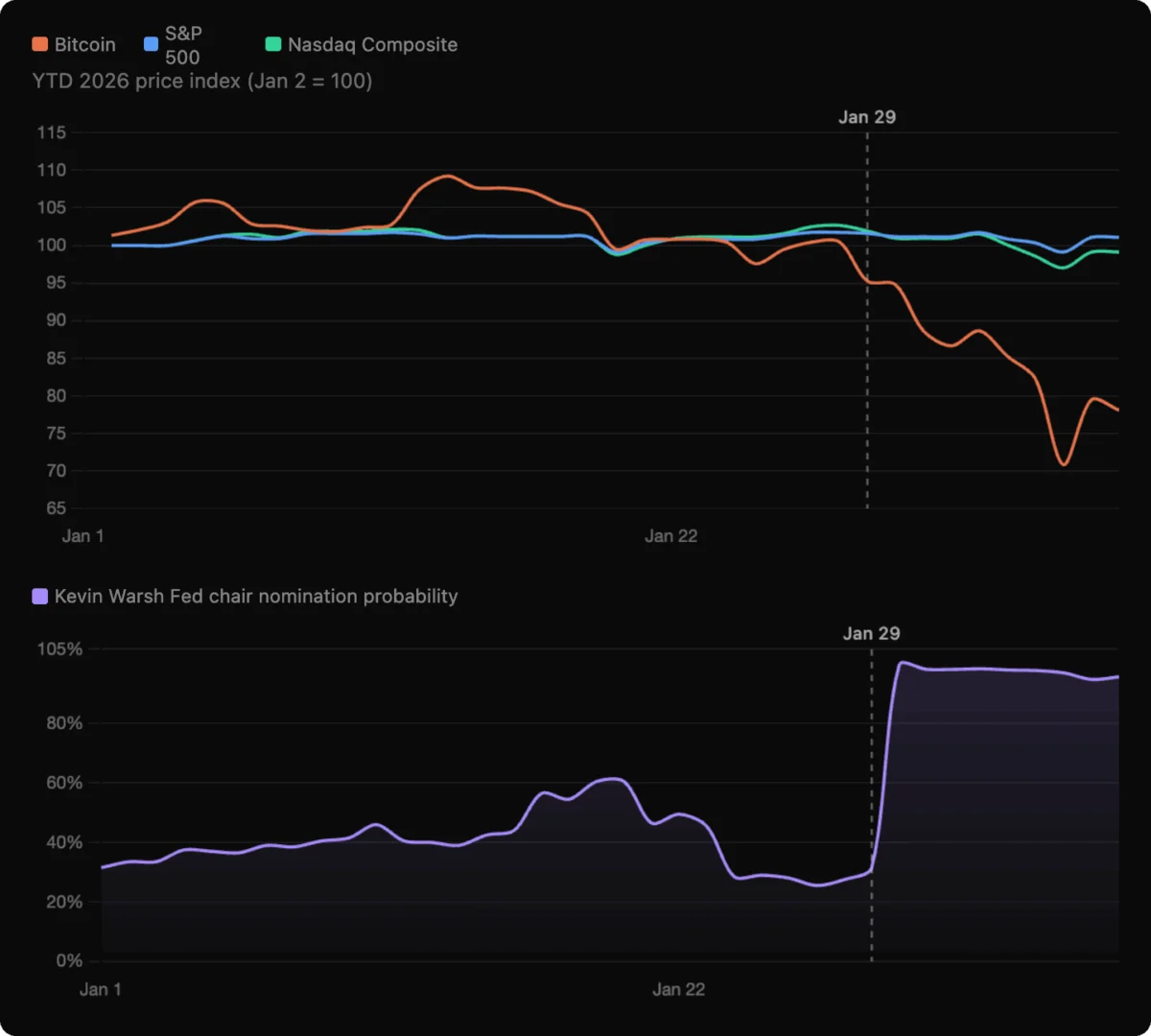
Warsh’s critical stance on balance sheet expansion dates back to his tenure as a Board Governor before his resignation in 2011. More recently, he has called for reducing what he terms the Federal Reserve’s "bloated balance sheet" and champions a deregulatory agenda to foster private sector growth. The market’s initial reaction to Warsh as a "hawk"—someone advocating for tighter monetary policy—appears reasonable. Between mid-January and early February 2026, Bitcoin experienced a roughly 20% decline, mirroring shifts in Polymarket odds favoring Warsh, while the S&P 500 and Nasdaq remained relatively stable.

Given Bitcoin’s historical correlation with liquidity, this recent performance validates the thesis that current market expectations are biased towards a tighter liquidity environment. However, this may represent an overreaction. One interpretation of Warsh’s vision suggests a consistent objective to bolster market liquidity in support of productive investments, including disruptive technologies like AI. This nuance is critical because a forward-looking agenda focused on investment and productivity growth is more likely to support risk assets in the long term, even if the mechanisms for achieving that goal—deregulation, balance sheet expansion, etc.—lean more heavily on the private sector.
Three Roads from Here: Navigating the Federal Reserve’s Future Path
In the context of a Warsh-led U.S. Federal Reserve, three distinct scenarios appear most probable. The first anticipates an extension of the status quo, a direction seemingly favored by current market expectations. The latter two scenarios involve a short-term easing of monetary policy, with variations in the aggressiveness of the shift away from the current framework.
1. The Grind (Status Quo)
In this scenario, the U.S. Fed Funds rate remains within the 3.25% to 3.75% range through the end of 2026, contingent on cooling inflation data in the latter half of the year. Balance sheet policy might involve some modest expansion through Treasury bill purchases, continuing the current approach. The dot plot is likely to continue indicating one or two rate cuts as the median forecast, but the actual execution of these cuts would be deferred to subsequent meetings. This outcome is underpinned by the weight of institutional inertia. The Fed’s revealed preference over the past year has been to defer action, and in the absence of a compelling catalyst, committees tend to preserve existing frameworks.
This is the "Grind": risk assets like equities would trade based on fundamental catalysts and macroeconomic headlines rather than significant shifts in liquidity conditions. Crypto markets would likely remain rangebound, with breakouts driven by crypto-specific catalysts such as progress on legislation like the CLARITY Act, changes in net investment flows from ETFs, or growth in stablecoins and tokenized assets.
Triggers:
- Persistent inflation above the 2% target, limiting the Fed’s room to cut rates.
- Lack of significant dovish shifts in the voting records of new FOMC members.
- Confirmation of Warsh, but with a lack of strong consensus for immediate policy shifts.
2. The Soft Pivot
In this scenario, Warsh is confirmed in a timely manner, and sufficient consensus emerges to support 2-3 rate cuts totaling 50 to 75 basis points by year-end, bringing the target range down to 2.75% to 3.25%. Similar to the status quo, the balance sheet would remain stable, with potential for modest expansion through a continuation of existing policy measures. Asset purchases might shift towards longer-duration Treasuries, representing a softer form of yield curve control. Changes in banking regulation and oversight would play a more central role in policymaking, substituting for aggressive balance sheet maneuvers.
This represents a constructive scenario for risk assets broadly. Equities are likely to rally on improved multiples due to reduced discount rates. Crypto would benefit from the expansionary policy narrative, though gains might be more measured compared to a full-blown quantitative easing cycle. Warsh’s commitment to balance sheet discipline would temper upside absent specific crypto-driven catalysts.
Triggers:

- Confirmation of Warsh with a clear mandate for a more accommodative stance.
- Evidence of moderating inflation and a stable labor market, creating space for cuts.
- Supportive rhetoric from a majority of FOMC members for a gradual easing cycle.
3. Run It Hot
In this scenario, Warsh is confirmed, and Powell steps down as Governor, creating another vacancy for the President to fill, potentially ahead of the midterm elections. U.S. Fed policy would become more forward-looking and coordinated with the U.S. Treasury, involving swift action to significantly reduce interest rates over the next twelve months, combined with looser balance sheet policies while deregulatory efforts are underway. The target U.S. Fed Funds rate would lean towards 3 rate cuts, or a target range of 2.75% to 3.00%. The U.S. Fed would explicitly shift to a framework willing to risk short-term inflation above its long-term 2% goal if it meaningfully eases credit conditions for consumers and ensures ample liquidity to fund productivity growth, particularly AI-related opportunities.
This scenario would be broadly supportive of risk assets, although inflation-sensitive assets might experience mixed results. These conditions would act as rocket fuel for equities and potentially even more generously for crypto, which would likely re-rate due to its heightened sensitivity to the liquidity narrative. This scenario also carries a greater risk of near-term volatility by potentially triggering a credibility crisis for the U.S. Fed if inflation reaccelerates significantly.
Triggers:
- Powell’s decisive departure from the Board of Governors, creating a vacancy.
- Strong economic headwinds, such as a significant slowdown or recessionary pressures, demanding aggressive action.
- Clear alignment between the Fed nominee and the administration’s economic agenda.
- A coordinated approach with the Treasury to address debt refinancing challenges.
What to Watch in the Coming Months
The next several months are replete with catalysts that will illuminate which of these scenarios is most probable. The potential impact of a regime shift at the U.S. Federal Reserve is likely to influence the trajectory of risk assets, including crypto, for the foreseeable future. Investors should closely monitor the following key events:
- Kevin Warsh’s Confirmation Hearing: The tenor and outcome of his testimony before the Senate Banking Committee will provide crucial insights into his policy priorities and his ability to garner support.
- Jerome Powell’s Decision on Board Departure: His explicit commitment to stepping down from the Board of Governors, or his decision to remain, will significantly shape the FOMC’s composition and potential policy leanings.
- Department of Justice Investigation Resolution: Any significant developments or a clear resolution to the probe could influence Powell’s decision and potentially Senator Tillis’s stance.
- Upcoming FOMC Meeting Minutes and Press Conferences: These will offer the clearest indication of the committee’s current thinking and any nascent shifts in policy direction.
- Treasury Refinancing Operations and Market Reactions: The U.S. Treasury’s borrowing strategy and the market’s response to it will highlight the urgency of potential Fed interventions.
- Inflation and Employment Data Releases: Continued adherence to or deviation from current trends in these key economic indicators will be paramount in shaping policy decisions.
- Statements from Fed Governors and Regional Reserve Bank Presidents: These public pronouncements often signal shifts in thinking or highlight areas of consensus and dissent within the FOMC.
By closely observing these events, investors can better position themselves to navigate the evolving landscape of U.S. monetary policy and its profound implications for risk assets.
Appendix
2026 FOMC Roster
The FOMC is composed of twelve voting members: seven members of the Board of Governors, one representative of the Federal Reserve Bank of New York, and four members of the remaining regional Federal Reserve Banks on annual rotation.
| # | Name | Role | Term | Lean |
|---|---|---|---|---|
| 1 | Jerome Powell | Board of Governors, Chairman | Chairman: May 15, 2026 Governor: Jan 31, 2028 |
Neutral – consistently voted with consensus |
| 2 | John Williams | New York | Feb 28, 2031 | Neutral – consistently voted with consensus |
| 3 | Michael Barr | Board of Governors | Jan 31, 2032 | Neutral – consistently voted with consensus |
| 4 | Michelle Bowman | Board of Governors | Jan 31, 2034 | Neutral / Skews Dovish – dissented in 2025 in favor of rate cuts, citing weakening employment dynamics |
| 5 | Lisa Cook | Board of Governors | Jan 31, 2038 | Neutral – consistently voted with consensus |
| 6 | Beth Hammack | Cleveland | Jan 2027 | Hawkish – dissented against a rate cut in late 2024, citing uneven progress toward the 2% target |
| 7 | Philip Jefferson | Board of Governors | Jan 31, 2036 | Neutral – consistently voted with consensus |
| 8 | Neel Kashkari | Minneapolis | Jan 2027 | Neutral / Skews Hawkish – has said policy is “close to neutral,” awaiting further data |
| 9 | Lorie Logan | Dallas | Jan 2027 | Neutral / Skews Hawkish – has indicated current stance is appropriate with risk of hotter inflation |
| 10 | Stephen Miran | Board of Governors | Jan 31, 2026 (awaiting replacement) | Dovish – dissented three times in 2025 and in January 2026, preferring more aggressive cuts |
| 11 | Anna Paulson | Philadelphia | Jan 2027 | Neutral / Skews Dovish – has described current policy as “slightly restrictive” |
| 12 | Christopher Waller | Board of Governors | Jan 31, 2030 | Dovish – dissented in January 2026 in favor of cutting rates |
