
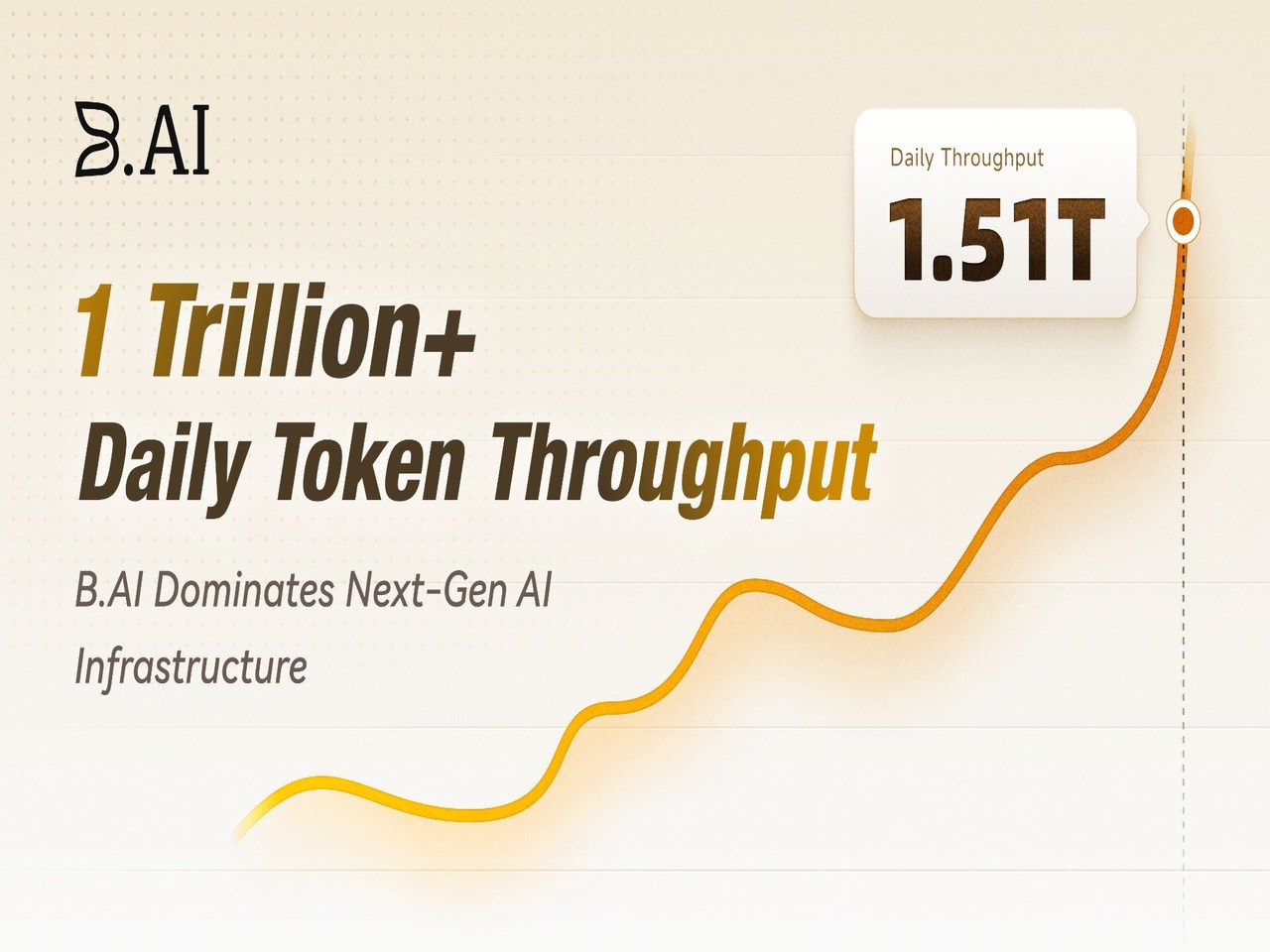
Positioned squarely at the critical intersection between foundational artificial intelligence models and autonomous software agents, B.AI has rapidly emerged as a dominant force in the global AI infrastructure landscape. Just five months after its initial public launch, the platform has achieved an unprecedented industry milestone by surpassing a daily throughput of 1.51 trillion tokens. This astronomical milestone represents a staggering expansion of more than 71,500 times since the platform’s inception, signaling a fundamental shift in how computational resources, model distribution, and financial settlement are managed across the global digital economy.
The remarkable velocity of B.AI’s scaling outpaces historical benchmarks set by early industry pioneers. While early aggregation platforms like OpenRouter required approximately two years to achieve comparable major structural milestones, B.AI accomplished its expansive growth trajectory in roughly one hundred days. This hyper-exponential trajectory demonstrates the immediate commercial viability of the platform’s full-stack strategy. By seamlessly fusing high-performance compute routing with decentralized financial settlement networks, B.AI has positioned itself at the vanguard of the next-generation AI infrastructure stack.
The Catalysts of Exponential Growth: Bridging International Demand and Cost-Efficient Chinese LLMs
B.AI’s ascent to market leadership is largely attributed to its strategic foresight in capturing and servicing the surging global demand for cost-effective, high-performance large language models originating from China. Over the past year, prominent Chinese AI development institutions and technology conglomerates—including DeepSeek, Alibaba’s Qwen, Zhipu AI (GLM), Moonshot AI (Kimi), and MiniMax—have successfully engineered foundational models that match or exceed top international benchmarks while operating at a fraction of traditional application programming interface (API) costs.
This dramatic variance in cost efficiency has transformed operational parameters for software developers worldwide, making the integration of these models an economic imperative. However, navigating foreign access and deploying these disparate models into global workflows presented substantial friction. B.AI solved this bottleneck by acting as a primary global distribution hub. The platform established deep, direct partnerships with major Chinese technology leaders such as Tencent, Alibaba, and ByteDance, effectively aggregating an all-star model portfolio that includes globally recognized architectures like GPT and Claude alongside advanced regional models such as DeepSeek-V4-Flash, Qwen3.8-Flash, and GLM-5.3 Flash.
To accelerate global developer adoption, B.AI deployed a series of aggressive economic incentives, including tiered API pricing structures featuring discounts of up to 90%, limited-time free access trials, and targeted developer grants. These strategic measures successfully catalyzed model cost efficiencies into active, high-volume throughput.
Furthermore, ecosystem co-incubators such as TRON and YZi Labs have played instrumental roles in expanding the platform’s reach. YZi Labs operates as a primary distribution engine, continuously onboarding early-stage web applications and developer communities into the B.AI ecosystem. This sustained influx of organic traffic ensures that foundation model providers utilizing B.AI gain immediate, high-value access to global enterprise workloads, transforming the platform from a simple routing conduit into an indispensable commercial facilitator.
Chronology of Expansion: From Inception to Trillion-Token Scale
The operational timeline of B.AI highlights a calculated strategy of rapid capability deployment paired with massive infrastructure scaling:
- Month 1: B.AI officially launches to the global market, introducing early-stage API routing and foundational model aggregation capabilities, recording baseline token throughput metrics.
- Month 2 to Month 3: Strategic partnerships are forged with leading Chinese LLM developers, including DeepSeek, Zhipu AI, and Moonshot AI. The platform integrates high-performance regional models (such as early iterations of Qwen and GLM) alongside Western foundation models, attracting initial waves of international developers seeking cost arbitrage.
- Month 4: Ecosystem partnerships with TRON and YZi Labs are formalized. B.AI introduces its dual-track payment architecture, bridging traditional Web2 financial gateways with decentralized Web3 settlement rails to accommodate high-frequency micropayments.
- Month 5: Daily token throughput shatters previous records, crossing the 1.51 trillion token threshold. The platform rolls out native runtime environments for software agents, integrating advanced protocols such as the x402 payment standard and the 8004 identity authentication framework to facilitate autonomous agent-to-agent (A2A) commerce.
Building the Financial and Operational Backbone for the Agent Economy
While frontend compute routing and model aggregation served as the primary growth engines for B.AI’s initial phase, leadership recognized that sustaining a trillion-dollar agent economy requires a fundamentally closed financial loop at the architectural base. As software systems transition from static query-and-response interfaces to autonomous, goal-oriented agents capable of multi-step reasoning and independent execution, the technical requirements for infrastructure shift dramatically.

To address this paradigm shift, B.AI engineered a global settlement layer designed specifically for machine intelligence. This critical infrastructural upgrade transforms the platform from a traffic conduit into a central master ledger for the emerging agent economy. Every cross-region model invocation, computational resource allocation, and automated task execution is precisely metered, dynamically routed, and autonomously settled within a unified framework.
Dual-Track Payment Infrastructure: Integrating Web2 and Web3 Realities
Recognizing the fragmented nature of global digital finance, B.AI implemented a dual-track payment architecture that maintains full backward compatibility with traditional enterprise workflows while embracing the frictionless velocity of decentralized finance.
On the Web2 side, the platform preserves established fiat gateways including WeChat Pay, Alipay, UnionPay, and Visa. This ensures that traditional corporate entities can integrate B.AI’s services without modifying their internal accounting or treasury operations. Concurrently, on the Web3 front, B.AI leverages advanced on-chain settlement channels to provide global developers with decentralized, verifiable, and low-friction transaction capabilities.
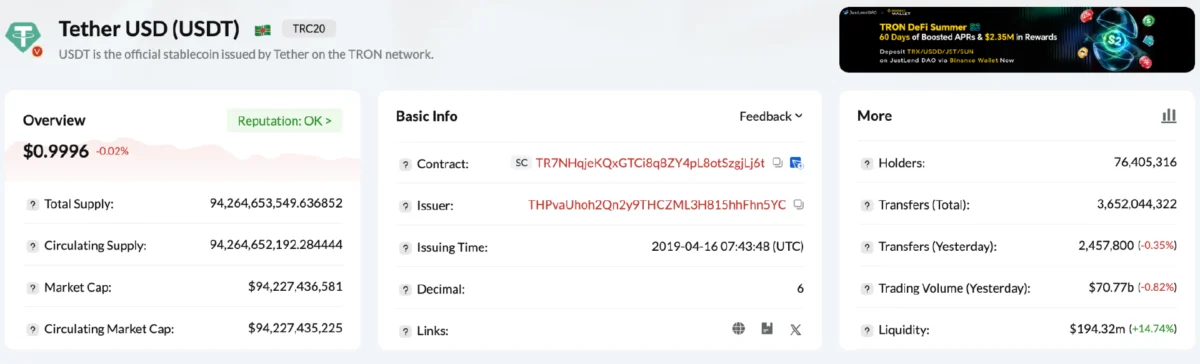
At the center of this decentralized liquidity network is B.AI’s deep integration with TRON, recognized globally as one of the largest stablecoin transfer networks. By utilizing TRON’s native USDT ecosystem—which recorded a circulating TRC-20 USDT supply exceeding 94.2 billion—B.AI secures a battle-tested financial rail capable of handling high-frequency, low-latency micro-transactions between autonomous agents without prohibitive gas fees or settlement delays.
Full-Stack Runtime Environment for Autonomous Agents

Beyond payment rails, B.AI has deployed an end-to-end runtime environment engineered to support the complex lifecycle of autonomous software agents. This comprehensive technical stack operates across three distinct operational layers:
- The Scheduling Layer: B.AI delivers fine-grained compute allocation through its tiered API framework. Developers can configure structured invocation plans that dynamically match specific computational workloads with optimal model resources, minimizing latency and maximizing cost efficiency.
- The Execution Layer: The platform equips agents with direct operational toolchains—such as integrated Skills, Agent Wallets, and native AI assistants including BAIclaw and BAI code. These tools empower agents to transition from passive data processors into fully autonomous digital workers capable of independent data acquisition, analysis, and task execution.
- The Protocol Layer: In what industry analysts consider its most strategically profound innovation, B.AI establishes foundational transaction standards for agent-to-agent (A2A) commerce. By natively integrating the x402 payment protocol alongside the 8004 identity authentication protocol, the platform provides a standardized framework for mutual trust, verifiable identity checks, and automated micropayments between disparate machine entities.
Broader Market Implications and Future Outlook
The rapid rise of B.AI underscores a major structural evolution within the artificial intelligence sector. As the industry moves past the initial phase of foundational model training and general deployment, the primary engineering bottleneck has shifted toward efficient inference distribution, cost management, and machine-level economic coordination.
By successfully bridging the gap between high-performance, economical regional models and global enterprise demand, B.AI has demonstrated that international boundaries in AI development are increasingly fluid when mediated by robust, neutral infrastructure. Furthermore, the platform’s proactive development of A2A commerce protocols anticipates a future wherein autonomous software agents transact with one another at speeds and volumes entirely unsuited to human-centric financial systems.
Crossing the threshold of 1.51 trillion daily tokens marks not an endpoint, but a foundational baseline for B.AI. As the platform continues to scale its dual-engine architecture of model distribution and decentralized settlement, it is actively redefining the global flow of compute value. In doing so, B.AI is helping to transition the broader AI industry from an era dominated by human-prompted chat interfaces into a sophisticated, highly automated epoch built explicitly for machine intelligence and autonomous economic agency.

