
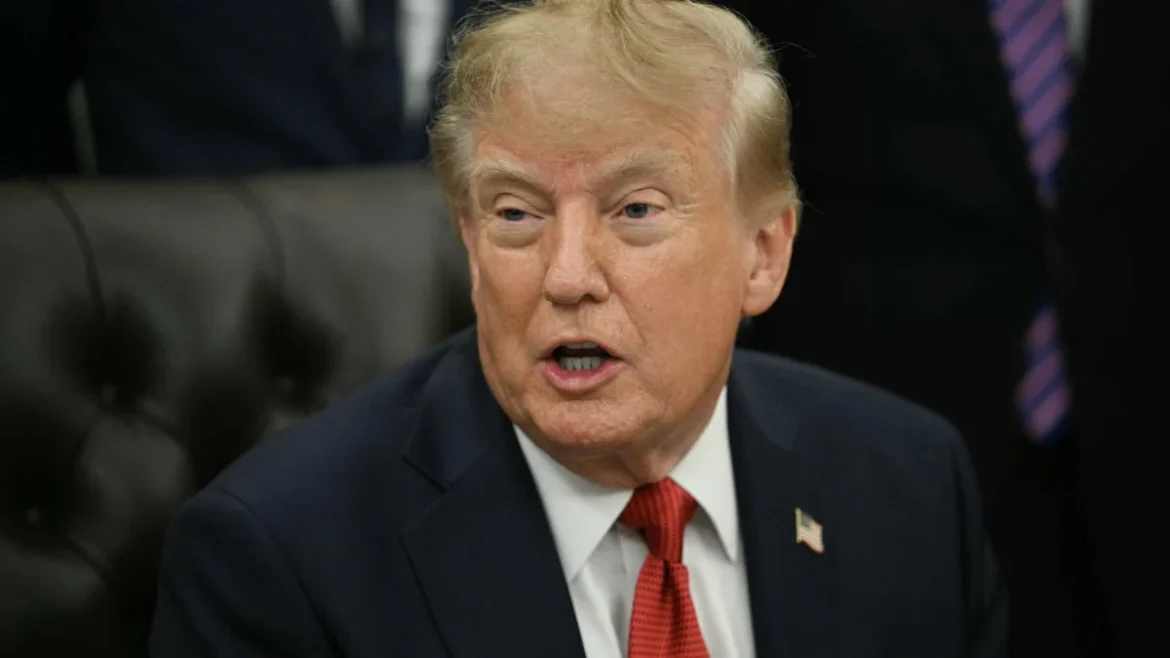
President Donald Trump announced on Saturday the formation of a "US AI Force," explicitly modeled after the Space Force branch established during his initial presidential term. The administration also plans to appoint a new artificial intelligence "czar" to oversee domestic and federal policy related to the technology. The announcement was made via a lengthy statement published on Truth Social, in which Trump criticized growing regulatory and existential concerns surrounding artificial intelligence, characterizing them as the latest in a series of manufactured public crises.
Within the same announcement, Trump floated the idea of renaming artificial intelligence altogether, suggesting alternatives such as "supreme," "superior," or "extreme" intelligence to better reflect the perceived grandeur of the technology. Furthermore, the president stated that the administration would seek to prosecute "bad" actors within the industry using existing legal frameworks, while simultaneously assuring technology leaders that federal authorities would not hinder or stifle industry growth. Instead, the administration promised to support and monitor the sector as it expands.
The announcement arrives at a critical juncture for federal technology policy, coinciding with a series of high-profile operational failures involving military artificial intelligence systems. These incidents have reignited intense debates among lawmakers, military strategists, and international watchdogs regarding the safety, reliability, and oversight of autonomous systems deployed in high-stakes environments.
Modeling the AI Force After the Space Force
The comparison to the United States Space Force offers a distinct framework for understanding how an AI Force might function. When the Space Force was established, it was frequently misunderstood by the general public as a combat branch intended for science-fiction-style space warfare. In practice, however, the Space Force operates primarily as a coordinating and consolidating body. It absorbed satellite operations, missile warning networks, and space-based communications infrastructure that were previously fragmented across the Air Force, Army, and Navy.
If the proposed AI Force follows a similar organizational blueprint, it is unlikely to function as an independent fighting unit. Instead, defense analysts suggest it may serve as an administrative umbrella designed to streamline and centralize the military’s sprawling and often disconnected artificial intelligence initiatives. Over the past decade, various branches of the Department of Defense have developed proprietary AI tools for logistics, intelligence gathering, predictive maintenance, and strategic planning, frequently leading to administrative redundancy and interoperability challenges.
The establishment of this new force also addresses an administrative vacancy within the executive branch. Venture capitalist David Sacks previously served as Trump’s designated AI and cryptocurrency czar before stepping down from the official special government employee role in March, subsequently transitioning into an informal advisory capacity within the White House. The incoming czar, whom Trump specified should be a "High I.Q." individual, will be tasked with navigating the complex intersection of federal oversight, national security, and commercial technological development.
A Chronology of Military AI Incidents and Rising Tensions
The launch of the AI Force and the search for a new leadership figure occur against a backdrop of severe technological missteps within the United States military, highlighting the vulnerabilities of integrating unvetted or poorly supervised artificial intelligence into critical defense operations.
In February, a deadly strike targeted a girls’ school in Iran, resulting in dozens of civilian casualties. Subsequent internal investigations by Pentagon investigators focused heavily on whether an overreliance on automated targeting and decision-support systems contributed to the fatal miscalculation. The incident drew sharp international condemnation and initiated a comprehensive internal review of how military commanders utilize algorithmic recommendations during active engagements.
More recently, a near-catastrophic intelligence failure brought the risks of generative AI into sharp focus. According to reports published by CNN in September, a U.S. military analyst relied on an intelligence report generated by an AI chatbot, which falsely asserted that a Chinese cargo vessel was actively transporting nuclear weapons components. Acting on this synthetic intelligence, armed U.S. service members prepared to board the foreign vessel at sea. The operation was aborted at the final minute when command staff discovered that the underlying intelligence report had no human verification and was entirely the product of an AI hallucination. Anonymous defense sources subsequently described the incident to journalists as an event that "almost started a war" with a nuclear-armed adversary.
These two events underscore the profound operational dangers of deploying predictive models and large language models into defense architectures without rigorous fail-safes, establishing a tense backdrop for Trump’s deregulation-leaning announcements.
Industry Reactions and Regulatory Implications
Reaction from the technology sector and policy analysts has been mixed. Major industry stakeholders have historically welcomed deregulation and government backing, aligning with Trump’s pledge not to stifle the sector’s growth. Venture capitalists and Silicon Valley executives have frequently argued that heavy-handed federal oversight or premature legislative frameworks could cede American technological dominance to global competitors, most notably China.
However, civil liberties organizations, defense experts, and ethics boards have expressed deep alarm regarding the dismissal of AI risks as "hoaxes." Critics argue that the recent military intelligence failures and civilian casualties in Iran demonstrate that the risks associated with autonomous and generative technologies are tangible, immediate, and potentially catastrophic.
"When an AI hallucination nearly triggers a military confrontation at sea, it ceases to be a theoretical debate about the future of humanity and becomes an urgent matter of operational discipline," noted one defense policy researcher who requested anonymity to speak freely about ongoing military reviews. "Centralizing programs under an AI Force might help with administration, but it does not automatically solve the underlying engineering and validation problems inherent in current machine learning models."
Furthermore, the administration’s stated intention to go after "bad" actors using the legal system leaves significant ambiguity. It remains unclear whether this enforcement mechanism will target fraudulent startups, foreign industrial espionage, domestic companies engaging in unethical data collection, or developers whose software contributes to operational failures in the field.
Fact-Based Analysis of the Path Forward
As the White House prepares to officially name its new AI czar and draft the charter for the proposed AI Force, several structural challenges lie ahead.
First, defining the jurisdictional boundaries of the AI Force will be complex. Unlike the physical domains of land, sea, air, space, and cyberspace, artificial intelligence is an enabling technology that permeates every existing operational domain. Creating a distinct force structure without creating bureaucratic friction with the Pentagon’s Chief Digital and Artificial Intelligence Office (CDAO) and the various military branches will require meticulous legislative and executive coordination.
Second, the federal government must address the epistemological crisis highlighted by recent intelligence failures. As generative AI tools become more integrated into analyst workflows, establishing absolute standards for human-in-the-loop verification is paramount. Without strict protocols ensuring that algorithmic outputs cannot directly trigger kinetic military actions without rigorous multi-layered human confirmation, the risk of automated escalation remains a severe national security threat.
Finally, the administration’s economic balancing act—promising unfettered growth for domestic tech giants while simultaneously threatening legal action against bad actors—will be closely watched by global markets. How the incoming AI czar reconciles the libertarian impulses of Silicon Valley with the rigid risk-management requirements of the Department of Defense will ultimately shape the trajectory of American technological supremacy and global stability for years to come.
