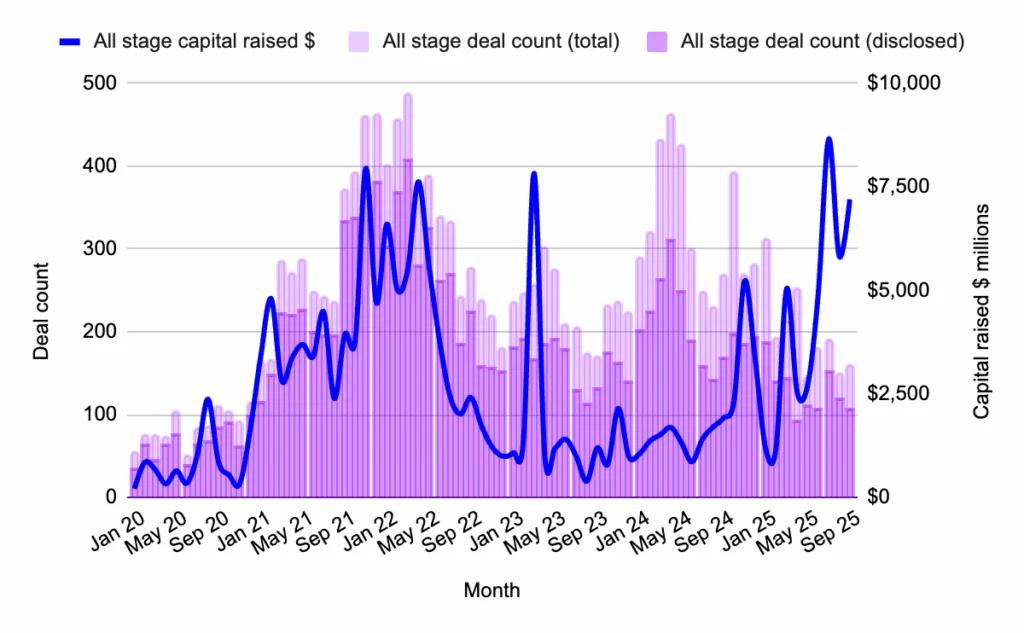
The global Web3 venture capital ecosystem experienced a significant financial resurgence in September 2025, recording $7.2 billion raised across 160 distinct funding deals. This milestone represents the highest monthly capital deployment observed since the market’s spring surge earlier in the year. However, a deeper examination of the transactional data reveals a market that remains heavily top-heavy. While top-line figures suggest an aggressive return of investor risk appetite, the vast majority of capital was concentrated within late-stage corporate rounds, private token sales, and select high-profile mega-raises. Early-stage innovators, conversely, continued to navigate a challenging and highly selective fundraising environment, with pre-seed metrics extending a nine-month downward trajectory.
Market Overview: Strong Capital Inflows Mask Underlying Selectivity
The broader macroeconomic and digital asset backdrop in September 2025 was heavily influenced by insights gathered during major industry gatherings, including Token2049 in Singapore. Institutional venture capitalists, family offices, and specialized crypto funds have noticeably pivoted their strategies away from speculative early-stage bets toward projects demonstrating immediate market traction, clear pathways to liquidity, and robust institutional architecture.
Data compiled jointly by Messari and Outlier Ventures illustrates that while deal counts remained relatively healthy at 160 transactions, the velocity of capital was disproportionately driven by a handful of massive funding events. This bifurcation highlights a maturing market where general partners (GPs) are under increasing pressure from their limited partners (LPs) to deploy capital into ventures capable of weathering regulatory scrutiny and generating sustainable, real-world utility. Rather than scattering smaller checks across a wide portfolio of unproven concepts, institutional investors are consolidating their capital behind established protocols and late-stage category leaders.
Seed-Stage Dynamics and the Flying Tulip Phenomenon
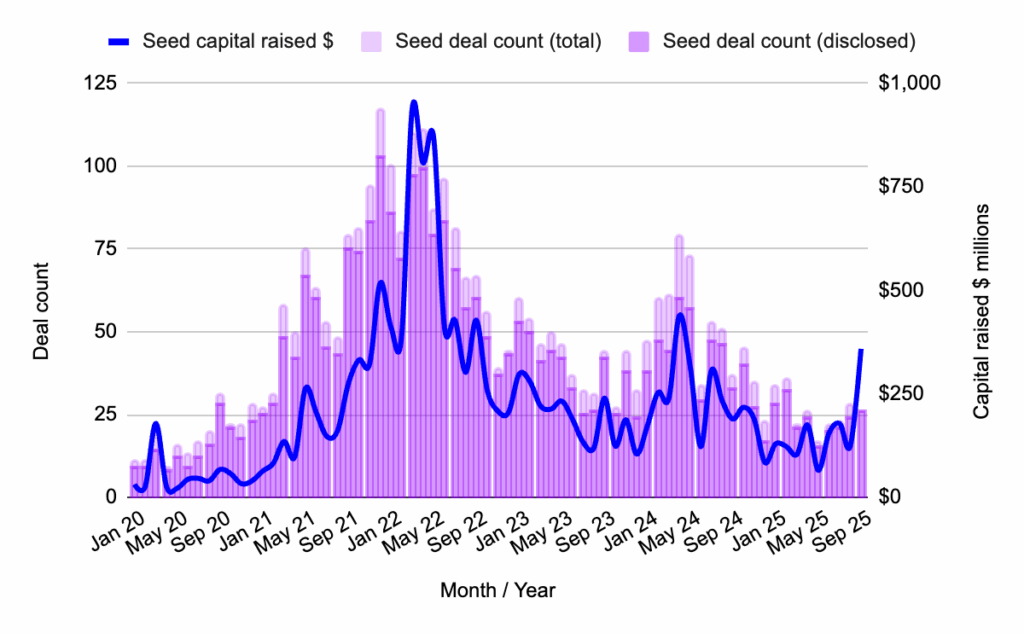
Seed-stage metrics experienced a dramatic mathematical distortion in September 2025, driven almost entirely by one of the most unusual and largest early-stage transactions in crypto history: Flying Tulip. The decentralized finance (DeFi) platform successfully secured $200 million at a remarkable $1 billion unicorn valuation during its seed round.
Flying Tulip’s architectural design breaks away from traditional early-stage fundraising templates. The protocol aims to unify spot trading, perpetual swaps, lending markets, and structured yield generation into a single on-chain exchange. Utilizing a hybrid automated market maker (AMM) and order book model, the platform integrates cross-chain deposits alongside volatility-adjusted lending mechanisms.
Crucially, the structural mechanics of the Flying Tulip raise introduced a novel twist on capital efficiency. Investors retained on-chain redemption rights, granting them capital security and continuous yield exposure without necessitating the complete liquidation of raised funds into operational overhead. Instead of burning capital on immediate user acquisition or aggressive marketing, the protocol leverages DeFi yield generation to organically fund its growth, token buybacks, and ecosystem incentives. While investors retain the contractual right to withdraw their capital at any time, this deployment represents a massive vote of confidence from Web3 venture capitalists who might otherwise have deployed illiquid capital through standard Simple Agreements for Future Equity (SAFEs) or Simple Agreements for Future Tokens (SAFTs). Analysts note that while Flying Tulip stands out as an exceptional outlier rather than a repeatable industry norm, its success points toward an emerging preference for liquid, yield-bearing venture exposure.
Pre-Seed Slump and the Rise of Niche Social Predictions
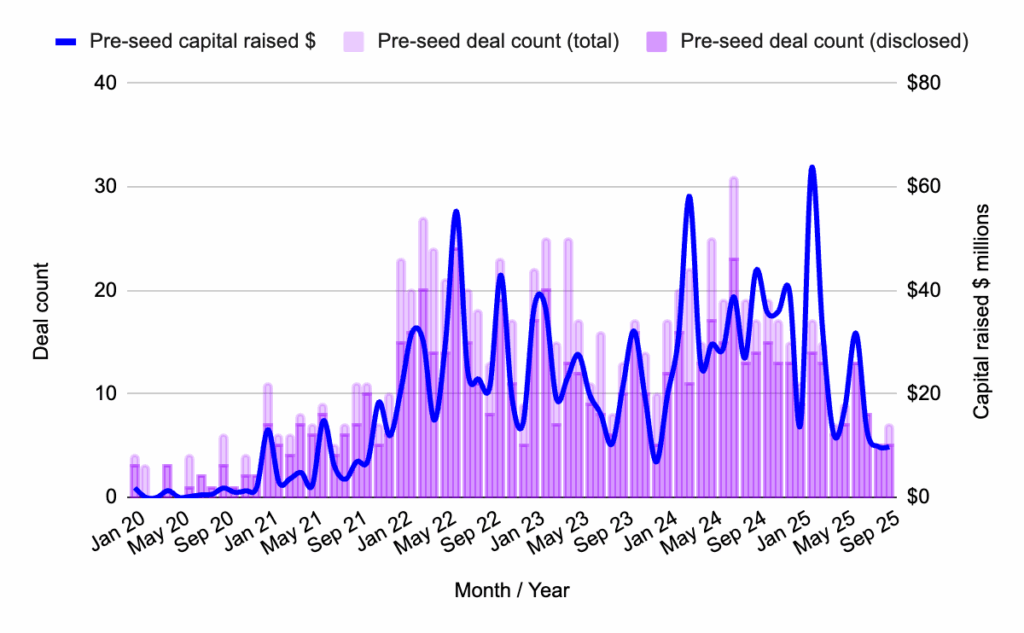
In sharp contrast to the liquidity-driven euphoria of the seed and late-stage sectors, pre-seed funding continued a protracted nine-month contraction. Both aggregate capital deployed and total deal counts at the pre-seed level registered declines, reflecting a cautious stance among angel investors and early-stage funds. Founders attempting to secure initial backing faced rigorous scrutiny, requiring exceptionally tight narratives, clear product-market fit arguments, and undeniable technical conviction.
Among the few pre-seed success stories to break through the friction was Melee Markets, a Solana-based protocol that closed a $3.5 million funding round with backing from prominent funds such as Variant and DBA. Melee Markets operates at the intersection of prediction markets and social trading, enabling users to speculate directly on influencers, cultural events, and trending real-world topics. The project exemplifies the type of targeted, attention-driven asset class that can still capture institutional interest during periods of early-stage capital scarcity.
Venture Fund Formation: Smaller Vehicles and Sharp Thematic Focus
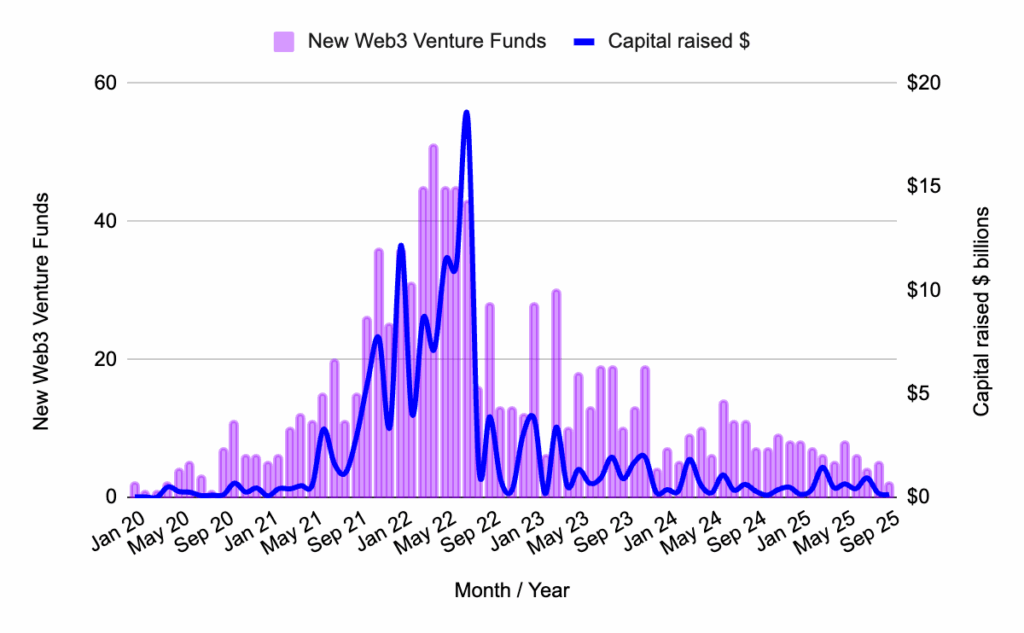
The formation of new crypto and Web3 venture capital funds experienced a notable cooling period in September 2025. Only two new investment vehicles were officially launched during the month, both characterized by relatively small capitalization targets and highly specific thematic mandates.
This slowdown in new fund aggregation does not signal a retreat from the asset class, but rather a structural refinement. Emerging fund managers are abandoning broad, generalized crypto theses in favor of highly targeted mandates focused on specific technical niches, such as modular infrastructure, real-world asset (RWA) tokenization, and artificial intelligence-driven agent economies. Limited partners are increasingly hesitant to back oversized, blind-pool general funds, preferring instead to allocate capital to specialized managers with demonstrable operational expertise.
Series A Stabilization and Asian Market Expansion
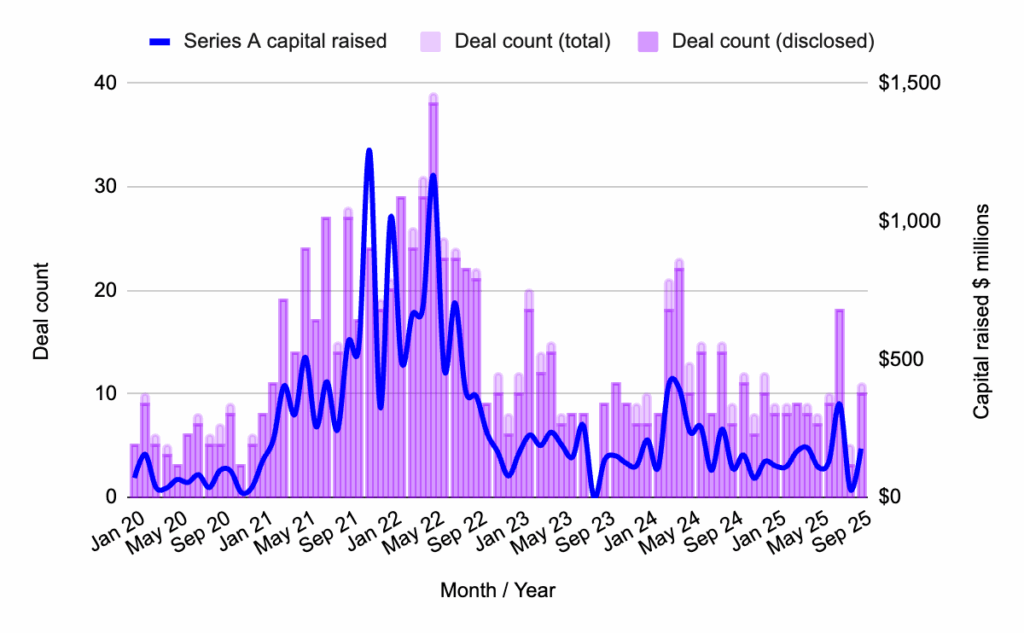
Series A funding activity demonstrated modest signs of stabilization in September following a steep contraction observed in August. Aggregate deal volume and deployed capital aligned closely with the established 2025 monthly average, confirming that investors are steadily backing proven mid-stage companies rather than chasing speculative early-stage momentum.
A prime illustration of this trend was Singapore-based Digital Entertainment Asset (DEA), which successfully secured $38 million in a Series A financing round supported by corporate heavyweights SBI Holdings and ASICS Ventures. DEA is actively developing an integrated ecosystem combining Web3 gaming, environmental, social, and governance (ESG) initiatives, and digital advertising platforms featuring real-world financial payouts. The transaction underscores the ongoing appetite within Asian markets for hybrid blockchain models that successfully bridge decentralized technology with mainstream consumer industries and traditional corporate balance sheets.
Private Token Sales and Strategic Exchange Expansion
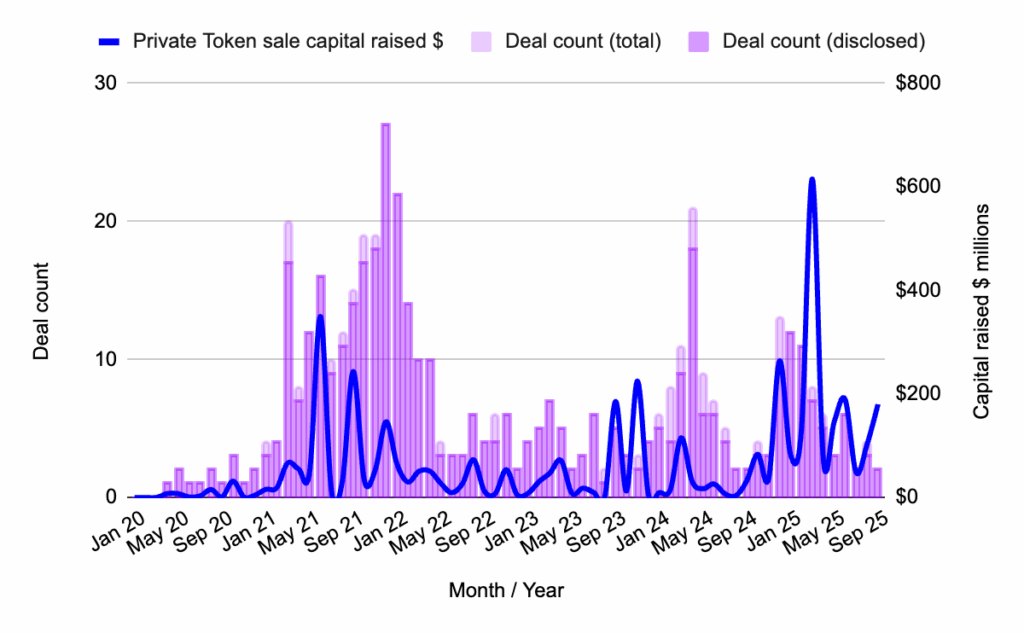
Private token sale activity in September remained heavily concentrated, with a single mega-raise absorbing the lion’s share of market liquidity. This reinforced a multi-month trend characterized by fewer overall token generation events (TGEs), larger average check sizes, and exchange-driven liquidity plays.
The standout transaction in this category was Crypto.com’s massive $178 million capital raise, executed reportedly in partnership with Trump Media. The transaction highlights the aggressive maneuvers of centralized exchanges to secure strategic capital and expand their global footprint, particularly as regulatory landscapes shift and consumer demand for mass-market crypto spending tools evolves. Industry observers have debated whether the partnership represents a long-term strategic brand pivot or a tactical marketing alignment, but the sheer scale of the capital injection cemented its status as one of the month’s defining financial events.
Public Token Sales: The Rise of BTCFi and Lombard’s Yield-Bearing Bitcoin
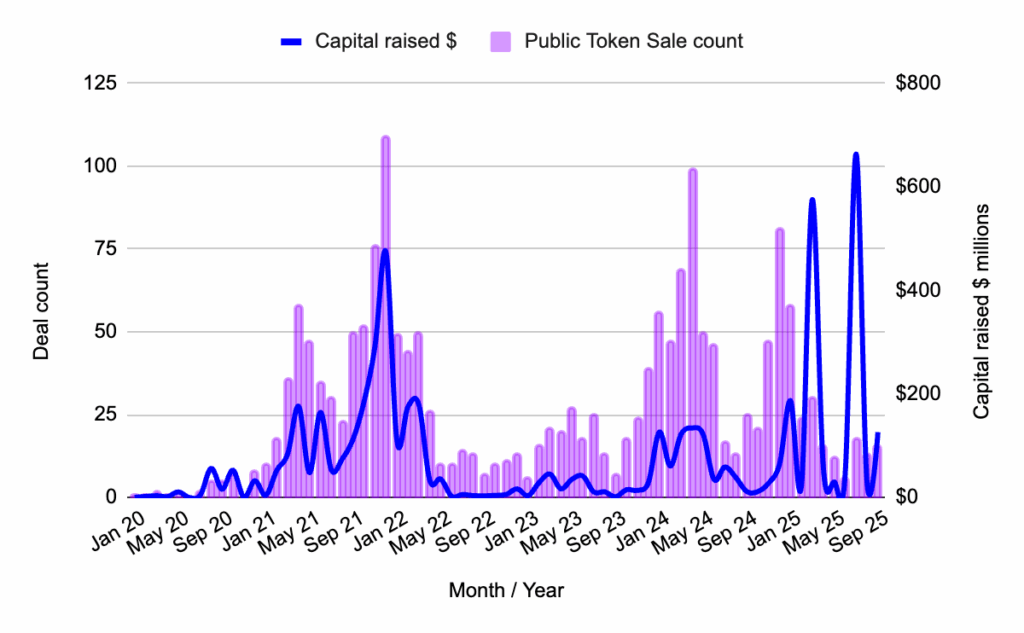
Public token markets remained active and narrative-driven, with investor enthusiasm coalescing around two primary sectors: decentralized artificial intelligence agents and Bitcoin finance, commonly known as BTCFi. As institutional adoption of spot Bitcoin exchange-traded funds (ETFs) matures, secondary market participants are increasingly demanding yield-generating mechanisms for idle BTC assets.
Demonstrating this trend, Lombard successfully completed a prominent public token launch, raising $94.7 million to expand its cross-chain infrastructure. Lombard introduces LBTC, a yield-bearing, liquid Bitcoin asset engineered to unify fragmented Bitcoin liquidity across multiple blockchain ecosystems. The protocol addresses a longstanding market inefficiency by allowing holders of the world’s largest digital asset to participate in decentralized finance yields without sacrificing structural security or liquidity. Analysts view BTCFi as a vital frontier for capital expansion, bridging the traditionally dormant capital of the Bitcoin network with the dynamic yield opportunities of smart contract platforms.
Broader Implications and Outlook for the Fourth Quarter
The fundraising landscape of September 2025 paints a picture of a maturing, highly pragmatic Web3 industry. While the headline figure of $7.2 billion suggests robust health, the underlying mechanics reveal an ecosystem undergoing structural consolidation. Late-stage enterprises, mature infrastructure providers, and exchange-backed conglomerates continue to capture the vast majority of institutional liquidity, while early-stage founders face an uphill battle against risk-averse investors.
Innovative transaction structures, such as Flying Tulip’s yield-backed redemption model and Lombard’s cross-chain Bitcoin liquidity solutions, suggest that the future of Web3 fundraising will rely heavily on capital efficiency and native financial engineering rather than traditional venture capital playbooks. As the industry transitions into the final quarter of 2025, venture capitalists are expected to maintain their disciplined, thesis-driven approach, favoring projects that offer tangible utility, clear regulatory compliance, and sustainable economic loops over speculative narrative-driven hype.