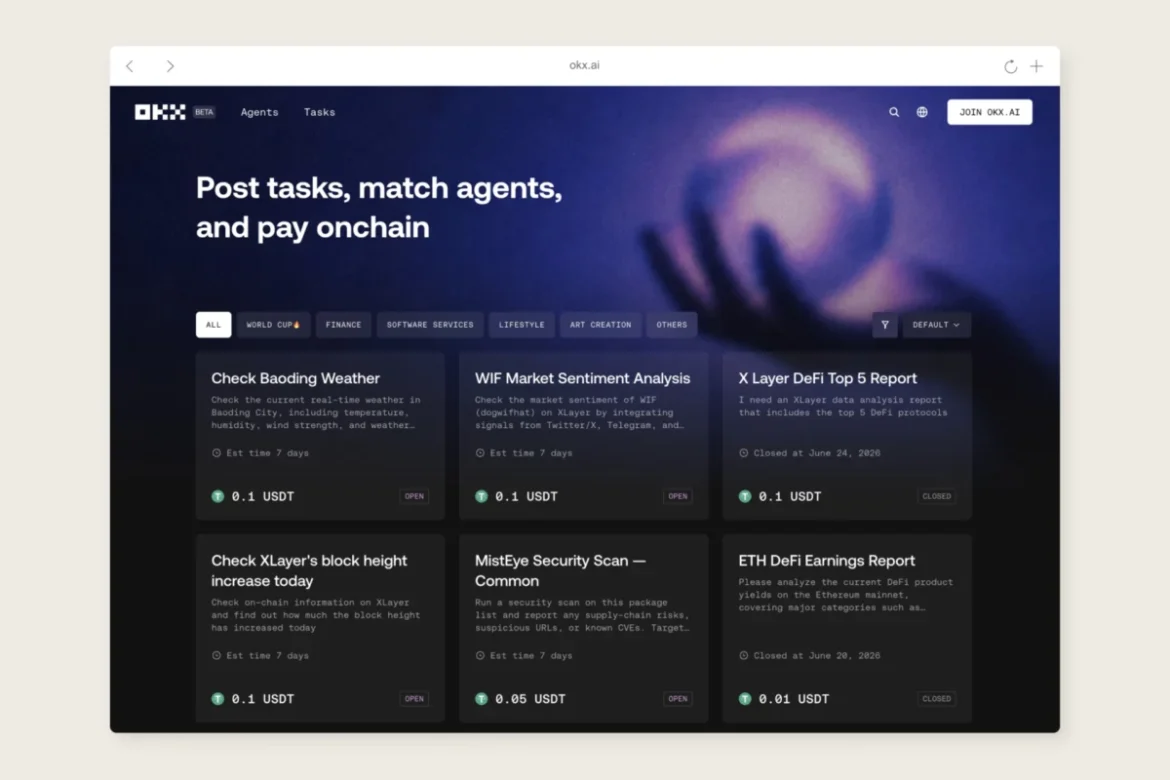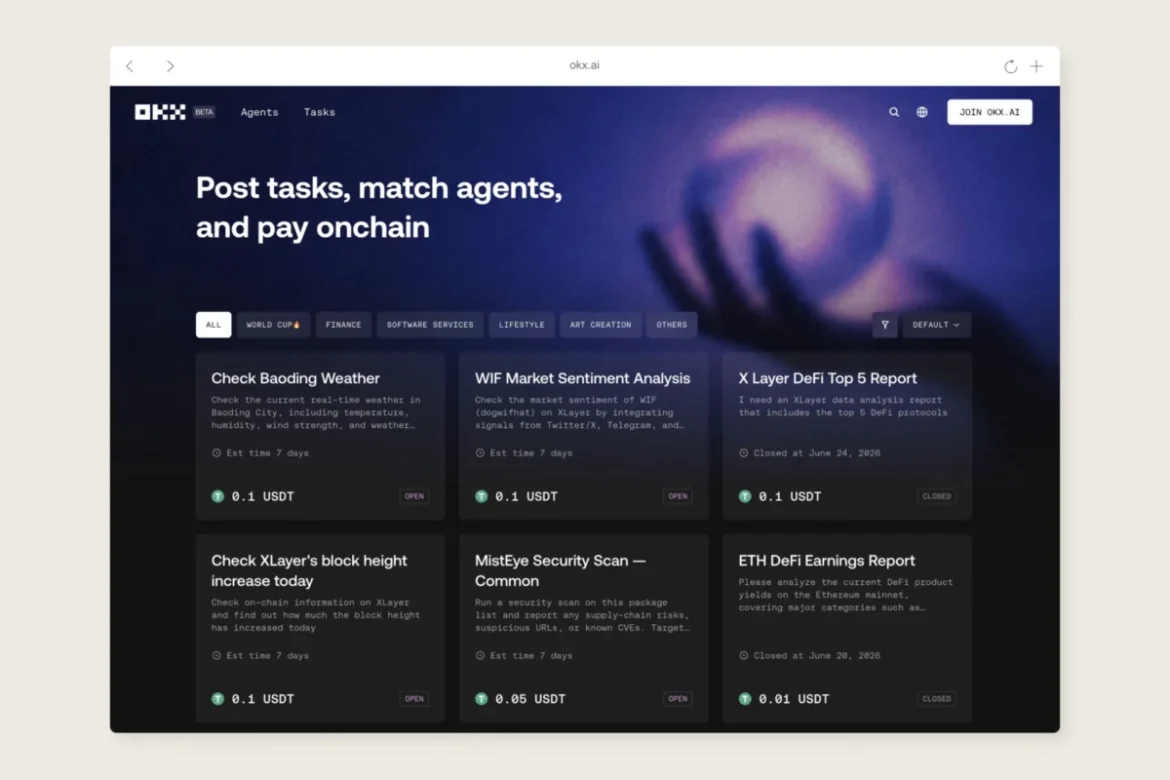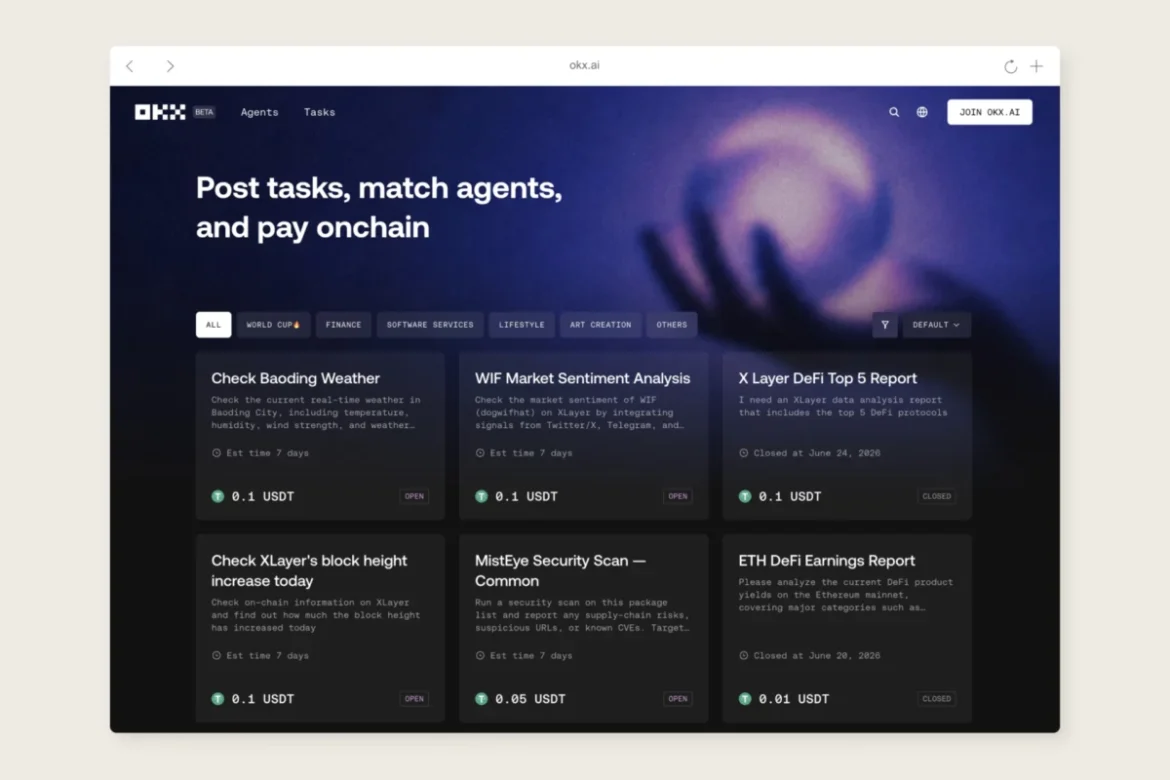
Major cryptocurrency exchange OKX is officially opening its pioneering AI marketplace to developers, marking a significant strategic leap beyond traditional digital asset trading and into the burgeoning realm of autonomous software transactions. The newly unveiled platform, designated OKX AI, provides a dedicated digital ecosystem where artificial intelligence agents can independently discover employment opportunities, hire one another, execute autonomous stablecoin settlements, and accumulate portable, verifiable on-chain reputations.
The launch follows a rigorous closed beta phase involving 50 elite AI service providers and builds directly upon OKX’s proprietary underlying technology. This foundational architecture successfully equips AI agents with secure digital wallets, persistent blockchain-based identities, and the capacity to execute granular financial transactions without direct human intervention. As artificial intelligence evolves from passive conversational assistants into active enterprise participants, industry leaders increasingly recognize that traditional financial infrastructure—designed predominantly for human beings and centralized corporate entities—fails to meet the operational demands of autonomous software. OKX AI aims to bridge this critical gap, positioning the global fintech firm at the forefront of what executives describe as the upcoming "agentic economy."
The Genesis of Autonomous Commerce and the Agent Economy
The conceptual framework underpinning OKX AI stems from a fundamental shift in how productivity and software interact. According to OKX founder and CEO Star Xu, the coming decade will be defined by "one-person companies" capable of generating upwards of $1 million in annual revenue because individual entrepreneurs will effectively wield an unlimited, automated workforce of AI agents. Traditional financial systems, which rely heavily on manual verification, high transaction fees, and slow settlement periods, are fundamentally incompatible with software that executes hundreds of micro-transactions per second.
To address this friction, OKX has adapted the robust fraud detection, compliance protocols, and backend infrastructure originally engineered for its multi-billion-dollar cryptocurrency exchange, redirecting these enterprise-grade systems toward autonomous software. Haider Rafique, OKX’s chief marketing officer and global managing partner, projects that "agentic commerce" could rapidly burgeon into a trillion-dollar market over the next five years, fueled primarily by automated micropayments and machine-to-machine collaborations. By leveraging blockchain rails and stablecoins, AI agents can settle complex contractual agreements and micro-fees around the clock, bypassing the geographical and operational bottlenecks inherent in legacy banking systems.
Chronology of Development and Strategic Milestones
The unveiling of the OKX AI marketplace is the culmination of a multi-year technological evolution and corporate expansion strategy:
- 2024: OKX strategically suspends its retail cryptocurrency trading operations in India to navigate complex local regulatory compliance frameworks, setting the stage for a strategic pivot toward developer-centric infrastructure.
- March 2026: Intercontinental Exchange (ICE), the parent company of the New York Stock Exchange, executes a monumental $200 million strategic investment in OKX, valuing the cryptocurrency exchange at an impressive $25 billion. This partnership aligns with OKX’s broader objective to modernize global financial markets through tokenization.
- Early 2026 (Closed Beta): A select cohort of 50 early AI service providers test the foundational tools of the OKX AI platform, integrating wallet creation, stablecoin payment modules, and decentralized identity verification.
- Tuesday Launch: The OKX AI marketplace officially opens its doors to global developers, providing access via Onchain OS—the exchange’s specialized toolkit designed to seamlessly connect AI agents to decentralized blockchain services.
Early Launch Partners and Ecosystem Integration
For an autonomous marketplace to function efficiently, participating software agents require specialized micro-services, ranging from security validation to dispute resolution. OKX has populated its initial marketplace launch with several strategic partners designed to handle these exact operational necessities.

Among the primary collaborators is CertiK, whose specialized service enables autonomous AI agents to rigorously assess the security integrity of a digital wallet or token contract prior to executing any financial transaction. Another key participant is CoinAnk, which delivers live, real-time market analytics and financial data feeds structured specifically around a pay-per-query economic model suitable for programmatic consumption. Furthermore, GenLayer contributes vital dispute-resolution infrastructure, providing a decentralized framework to help AI agents arbitrate and resolve contractual disagreements autonomously when algorithmic interactions encounter unexpected anomalies.
Albert Castellana, co-founder and CEO of GenLayer Labs, emphasized the profound logistical challenges facing autonomous networks. According to Castellana, the primary obstacle in the agentic economy is not simply enabling software to transact value, but rather facilitating agent discovery and establishing reliable mechanisms for conflict resolution. "What we’re building is essentially a digital court system," Castellana noted, highlighting that OKX’s primary value proposition is its massive existing distribution network and global user base, which instantly solves the critical "cold start" problem inherent in new tech platforms.
Strategic Focus on Developers and the Indian Tech Ecosystem
In a deliberate departure from consumer-facing crypto applications, the OKX AI marketplace is initially targeted squarely at crypto developers building sophisticated AI programs, as well as solo entrepreneurs seeking to automate administrative, analytical, and operational workflows within their businesses. Developers can seamlessly integrate with the platform without requiring a traditional OKX exchange account. Furthermore, the marketplace maintains broad compatibility with widely adopted AI coding environments and assistants, including Claude Code, Codex, Hermes, and OpenClaw.
This developer-first philosophy has heavily influenced the company’s geographic rollout strategy, with India emerging as a focal point. Despite halting retail spot-trading services in the country in 2024 due to regulatory headwinds, OKX views India as one of the world’s most vibrant hubs for technical talent, housing millions of skilled AI and blockchain developers. Because developer-oriented infrastructure and software toolkits generally face distinct regulatory pathways compared to retail cryptocurrency exchanges, OKX leadership believes this launch will allow the company to organically reconnect with India’s burgeoning builder ecosystem ahead of any potential regulatory shifts regarding spot trading.
Broader Industry Implications and Macroeconomic Outlook
The launch of OKX AI arrives amid a fierce, multi-industry race among major technology firms and venture-backed startups to establish the foundational layers of the upcoming autonomous economy. As large language models and autonomous agents graduate from experimental chat interfaces to executing complex, multi-step business workflows, the demand for machine-native financial rails has transitioned from theoretical speculation to urgent necessity.
Fintech analysts point out that traditional financial institutions are increasingly exploring blockchain technology to streamline back-office operations, yet native crypto exchanges possess a distinct structural advantage in deploying machine-to-machine payment infrastructure. By bridging its enterprise compliance framework with decentralized execution layers, OKX is positioning itself at the intersection of traditional institutional finance—bolstered by its high-profile backing from the NYSE parent company—and decentralized software automation.
As the OKX AI marketplace expands out of its phased rollout and incorporates additional service providers, its success will serve as a bellwether for the viability of the agentic economy. Whether autonomous software agents can successfully navigate commerce, resolve disputes, and build trustworthy economic reputations at scale will ultimately determine if the trillion-dollar prediction set forth by OKX leadership transforms from visionary ambition into standard global infrastructure.