OpenAI has officially announced the global release of GPT-6.1 Terra, a cutting-edge artificial intelligence model engineered explicitly for advanced computer use, visual reasoning, complex coding, and routine workplace automation. Positioned as a faster, more economical alternative to the company’s flagship heavy-duty models, Terra is designed to shoulder the repetitive burden of digital white-collar labor. The release marks a strategic pivot by the artificial intelligence pioneer toward economic efficiency and practical execution, drastically lowering the financial barrier for enterprises looking to integrate sophisticated AI agents into their daily operations.
According to technical specifications released by the company, GPT-6.1 Terra combines enhanced visual processing capabilities with precise computer interaction and a refined, natural writing style. The model is purposefully built to tackle the granular, mechanical tasks that consume a significant portion of the modern workday. These include filling out sprawling administrative forms, editing digital video files, interpreting complex technical blueprints, and executing automated workflows across standard desktop environments. By streamlining these repetitive processes, OpenAI aims to transition generative AI from a conversational novelty into an indispensable utility for enterprise productivity.
The Evolution and Chronology of the Terra Line
The debut of GPT-6.1 Terra represents a major developmental leap from its predecessor, GPT-5.6 Terra. Over the past several product cycles, OpenAI has systematically worked to bridge the gap between raw computational capability and real-world utility. While earlier iterations focused heavily on expansive language generation and broad conversational intelligence, the Terra lineage has carved out a distinct niche focused on operational agency—the ability of an AI to not just write about a task, but to actively execute it across software interfaces.
Industry observers note that the rapid iteration cycle between GPT-5.6 and the newly minted 6.1 version highlights the intense competitive pressure within the generative AI sector. Enterprises are no longer satisfied with models that merely generate text; they demand agents capable of interacting with legacy software, interpreting non-textual data like architectural drawings, and operating with minimal supervision. GPT-6.1 Terra is the direct manifestation of this industry-wide demand, arriving at a time when businesses are actively seeking concrete return on investment from their artificial intelligence expenditures.
Unprecedented Pricing and Cost Efficiency
Perhaps the most disruptive aspect of the GPT-6.1 Terra launch is its aggressive pricing structure. OpenAI has announced that the API pricing for Terra will be set at 50 percent lower than both the preceding GPT-5.6 Terra and the concurrent GPT-6.1 Sol models. Specifically, developers and enterprise clients can access the model at a rate of $1 per million input tokens and $5 per million output tokens.
This aggressive cost reduction does not, however, translate to a compromise in performance. Internal benchmarks demonstrate that Terra punches remarkably high above its weight class. On the rigorous "Agents’ Last Exam" benchmark—a standardized evaluation designed to test an AI’s ability to navigate multi-step digital tasks—Terra scored 15 percentage points higher than GPT-5.6 Terra when operating under medium reasoning effort. Remarkably, it achieved this performance while consuming approximately one-third of the computational resources of its predecessor.
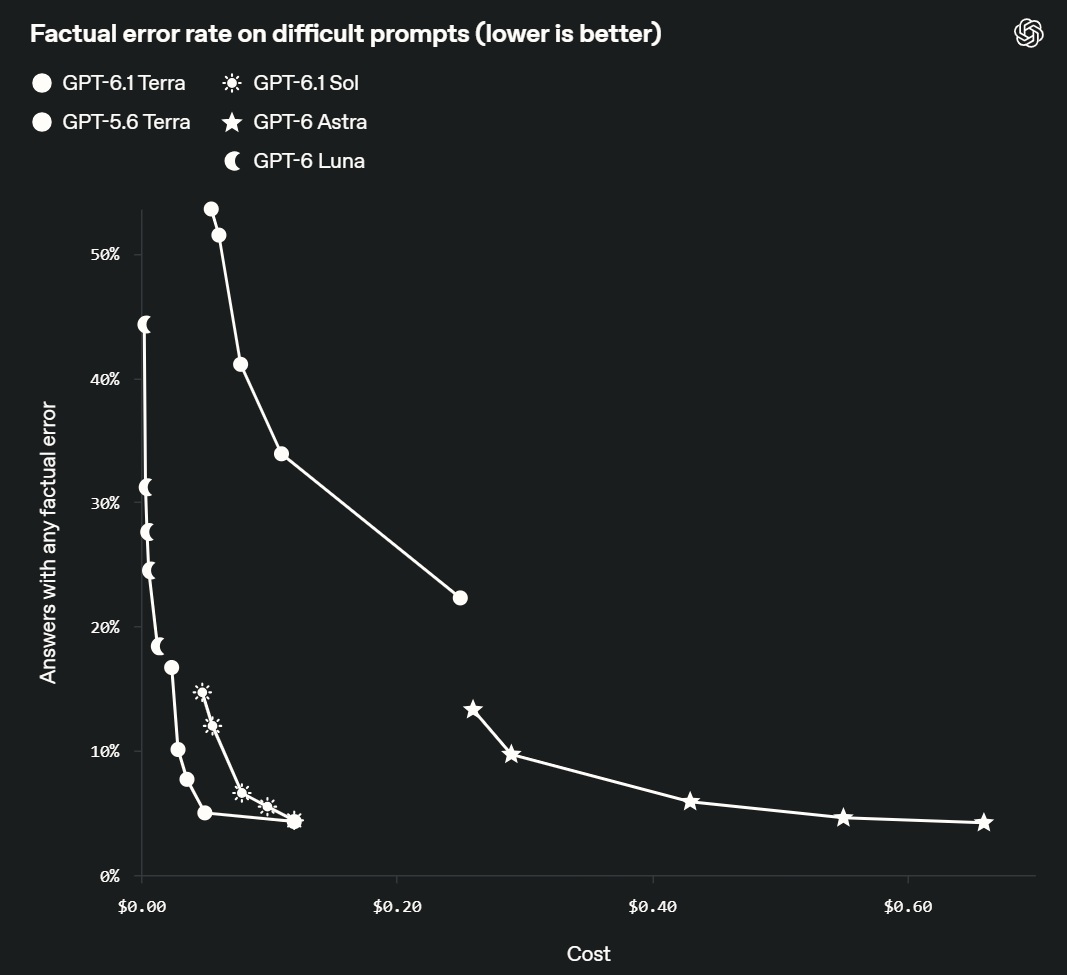
Furthermore, OpenAI’s internal data reveals that Terra performs on par with the much larger and more expensive GPT-6 Astra, yet costs a mere one-tenth of Astra’s price per token. In terms of processing speed, Terra outpaces both GPT-6 Astra and GPT-6.1 Sol, completing assigned workloads more than three times faster. For high-volume enterprise users, this combination of velocity and cost-efficiency is expected to dramatically lower the total cost of ownership for AI-driven automation pipelines.
Mitigating Hallucinations and Improving Reliability
A persistent challenge in the deployment of enterprise artificial intelligence has been the phenomenon of hallucinations—instances where a model confidently generates incorrect or fabricated information. For tasks involving technical drawings, financial forms, and software code, even a minor hallucination can result in catastrophic errors.
With GPT-6.1 Terra, OpenAI has achieved substantial improvements in reliability. On the company’s internal benchmarks, the model’s error rate at low reasoning effort dropped precipitously from 53.6 percent in GPT-5.6 Terra down to just 16.7 percent in GPT-6.1 Terra. When pushed to maximum reasoning effort, the error rate plummeted by an additional 18 percentage points to rest at a highly reliable 4.3 percent. This places Terra’s accuracy profile roughly on par with OpenAI’s elite heavy-duty models, the GPT-6 Astra and GPT-6.1 Sol.
Software Development and Coding Capabilities
In addition to administrative and visual tasks, GPT-6.1 Terra demonstrates marked improvements in software engineering workflows. When evaluated on Terminal-Bench 4.0—a benchmark that measures an AI’s proficiency in executing command-line tasks and debugging software environments—Terra achieved a score of 50.3 percent at maximum reasoning effort. This represents more than a 100 percent performance increase over GPT-5.6 Terra, which managed a score of just 21.5 percent on the same test.
Despite these impressive gains in routine programming and debugging, OpenAI maintains a measured stance regarding software development. The company continues to recommend its heavier models, specifically GPT-6.1 Sol and GPT-6 Astra, for exceptionally complex, multi-layered architectural coding tasks. Nevertheless, for day-to-day scripting, error logging, and standard code maintenance, Terra provides more than adequate capability at a fraction of the operational cost.
Availability and Ecosystem Integration
GPT-6.1 Terra is rolling out immediately across OpenAI’s primary commercial ecosystems. The model is now accessible to subscribers of ChatGPT Plus, Pro, Enterprise, and Edu tiers via ChatGPT Work and the Codex development environment. Simultaneously, software developers can integrate the model directly into their proprietary applications through the OpenAI API by referencing the endpoint identifier gpt-6.1-terra.
This broad, day-one availability underscores OpenAI’s strategy of rapid deployment. By making the model simultaneously available to everyday consumers, enterprise organizations, and third-party developers, the company is positioning Terra as a foundational building block for the next wave of desktop automation tools.
Broader Industry Implications and Future Outlook
The introduction of GPT-6.1 Terra carries significant implications for the broader technology sector, particularly in the realm of Robotic Process Automation (RPA) and enterprise software. For years, businesses have relied on rigid, rule-based automation scripts that break down whenever user interfaces change or unexpected data formats appear. AI models like Terra, which combine robust visual reasoning with low-latency execution and rock-bottom API costs, threaten to render traditional RPA tools obsolete.
By empowering AI agents to "see" a computer screen, interpret user interfaces, and execute complex workflows much like a human employee would, OpenAI is opening the door to truly autonomous enterprise operations. However, this shift will also invite renewed scrutiny regarding workplace automation, labor displacement, and the economic restructuring of administrative professions.
As businesses race to integrate models like GPT-6.1 Terra into their daily operations, the focus will increasingly shift from what artificial intelligence can theoretically accomplish to how reliably, safely, and affordably it can be scaled across the global economy. With Terra, OpenAI has made a decisive bet that affordability and speed will be the ultimate arbiters of AI adoption in the enterprise market.