
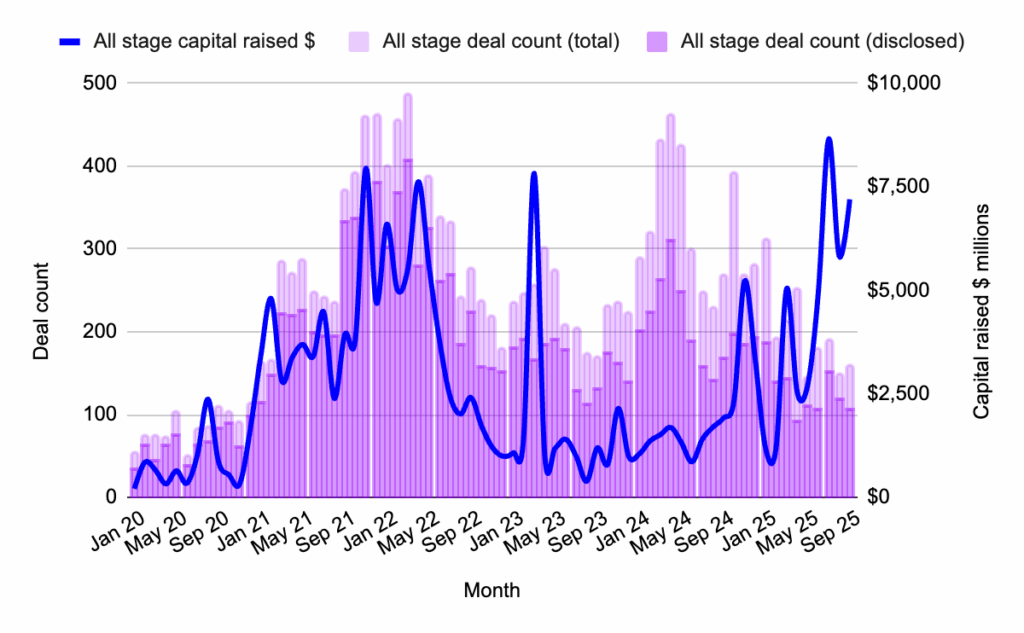
September 2025 marked a significant uptick in Web3 fundraising, with a total of $7.2 billion deployed across 160 deals, representing the highest capital infusion since the spring surge. However, a closer examination of the data reveals a market heavily skewed towards late-stage investments, a trend that has persisted for the past three months. The notable exception to this late-stage dominance was the seed-stage funding round for Flying Tulip, which garnered significant attention for its innovative structure and substantial valuation. This bifurcated market activity, characterized by robust late-stage investment contrasting with a more subdued early-stage landscape, offers a compelling snapshot of the evolving venture capital appetite within the Web3 ecosystem.
Market Overview: A Strong, Yet Top-Heavy Landscape
At first glance, the figures for September 2025 suggest a strong resurgence of risk appetite within the Web3 sector. The total capital raised, exceeding $7 billion, signals renewed confidence from investors. However, this headline figure masks a more nuanced reality. With the singular exception of Flying Tulip’s seed round, the vast majority of capital deployment was concentrated in companies that have already achieved significant developmental milestones and are seeking to scale their operations. This pattern is not new; it represents a continuation of a trend observed in the preceding quarters and aligns with insights gathered from major industry events like Token2049 Singapore. The data indicates that while early-stage dealmaking remains active, the primary focus for substantial capital allocation is now on mature projects with clear pathways to liquidity.
The chart from Messari and Outlier Ventures, illustrating Web3 capital deployed and deal count across all stages from January 2020 to September 2025, underscores this "top-heavy" distribution. While the overall deal volume in September showed an increase, the distribution within the chart would likely reveal a disproportionate allocation of funds to Series B, C, and beyond, overshadowing the contributions from pre-seed and seed rounds. This suggests that investors are increasingly prioritizing established business models and proven traction over the speculative potential of nascent ventures.
Market Highlight: Flying Tulip’s Unicorn Seed Round
The most prominent development in September was Flying Tulip’s remarkable $200 million seed-stage funding round, achieving a staggering $1 billion valuation. This achievement is particularly noteworthy as it positions the company as a unicorn at its earliest stage of funding. Flying Tulip aims to revolutionize decentralized finance (DeFi) by creating a unified on-chain exchange that integrates spot trading, perpetual futures, lending, and structured yield products. Its proposed hybrid model, combining automated market makers (AMMs) with order books, alongside cross-chain deposit capabilities and volatility-adjusted lending, addresses several critical pain points in the current DeFi landscape.
The significance of this round extends beyond its size and valuation. Flying Tulip’s innovative approach to capital deployment, discussed further in the Seed Rounds section, offers a potential blueprint for future Web3 fundraising. By leveraging DeFi yield to fund its growth, incentives, and buyback programs, the company demonstrates a novel strategy for capital efficiency that could influence how early-stage protocols secure and utilize funding.
New Crypto/Web3 Venture Funds: A Shift Towards Targeted Theses
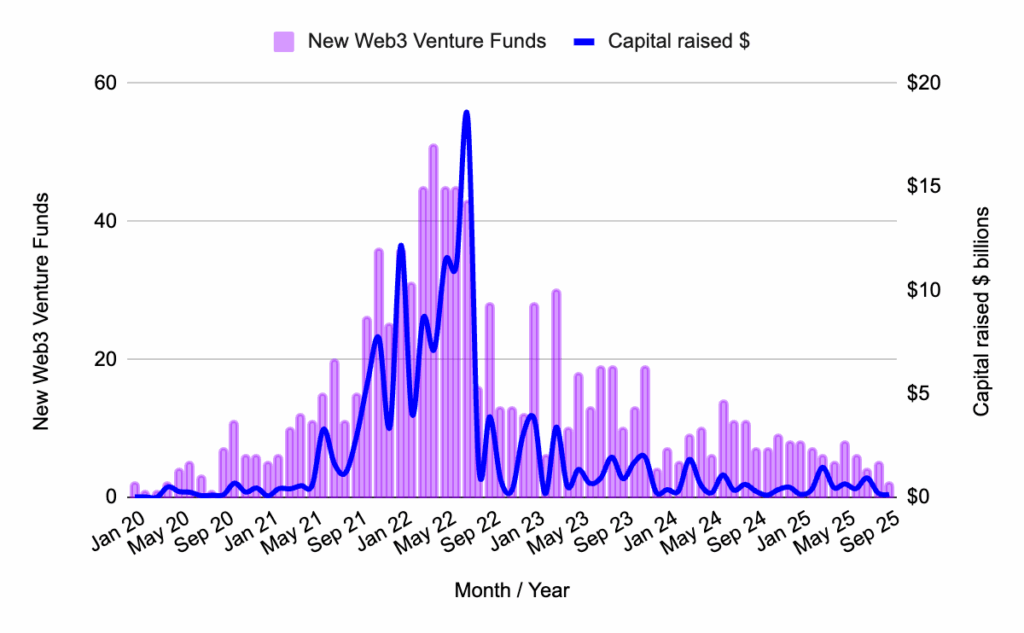
September 2025 saw a notable cooling in the formation of new cryptocurrency and Web3 venture capital funds. Only two new vehicles were launched during the month, both characterized by their relatively smaller size and highly thematic investment mandates. This trend suggests a move towards greater selectivity rather than an overall slowdown in fundraising for venture capital firms. While VCs continue to raise capital, their focus appears to be narrowing, concentrating on sharper, more targeted investment theses that align with specific sub-sectors or technological advancements within the Web3 space.
The graph depicting the number of Web3 venture capital funds launched and capital raised from January 2020 to September 2025, as provided by Messari and Outlier Ventures, would likely illustrate a plateauing or slight decrease in new fund launches compared to earlier periods. This indicates a maturation of the venture capital landscape, where established funds may be focusing on deploying existing capital rather than launching new ones, and emerging funds are likely to be more niche-oriented to carve out their competitive advantage.
Pre-Seed Rounds: A Nine-Month Downward Trend Continues
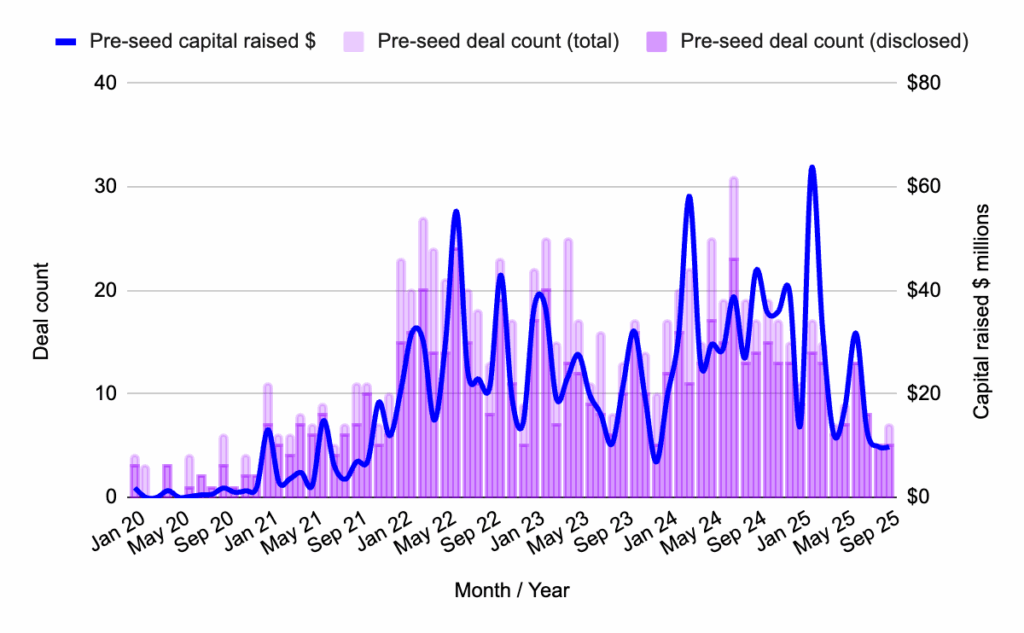
Pre-seed funding continued its slump in September 2025, with both the number of deals and the total capital raised experiencing a decline. This stage of funding remains sluggish, with a limited number of prominent investors actively participating. For founders operating at the pre-seed level, capital has become scarcer. Those who manage to secure funding often do so by presenting exceptionally tight narratives and demonstrating strong technical conviction in their projects.
Pre-Seed Highlight: Melee Markets ($3.5 million)
Despite the overall downturn, Melee Markets emerged as a notable player in the pre-seed space, raising $3.5 million. Built on the Solana blockchain, Melee Markets offers a unique platform that allows users to speculate on influencers, events, and trending topics. It functions as a hybrid between prediction markets and social trading, aiming to capture attention flow as a valuable asset class. The backing from prominent investors like Variant and DBA underscores the potential for innovative social-economy models within Web3, even amidst broader funding challenges at this early stage. This highlights that while general sentiment might be cautious, projects with compelling use cases and strong community potential can still attract investment.
Seed Rounds: "Tulipmania" and a New Funding Paradigm
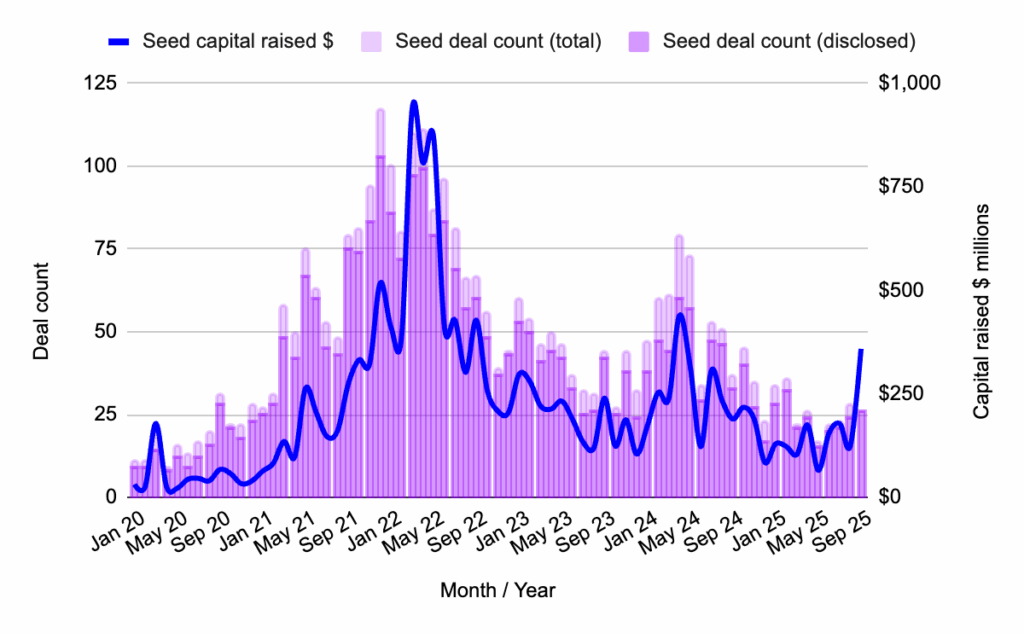
Seed-stage funding experienced a significant, albeit artificial, boost in September, largely attributable to Flying Tulip’s substantial $200 million round. Without this outlier, the seed stage would have remained relatively consistent with previous months. However, the structure of Flying Tulip’s raise is far more significant than its monetary value.
A key innovation lies in its on-chain redemption rights, which provide investors with a degree of capital security and yield exposure without sacrificing potential upside. This contrasts sharply with traditional seed-stage investments, which often involve illiquid instruments like SAFEs (Simple Agreement for Future Equity) and SAFTs (Simple Agreement for Future Tokens). Flying Tulip’s model is not merely about raising capital; it’s about how that capital is deployed. The project intends to generate returns from DeFi yields to fund its operations, growth initiatives, and token buybacks, representing a novel approach to capital efficiency within the Web3 ecosystem.
The implication here is a potential shift in how early-stage companies can be funded. Investors, increasingly seeking more liquid asset exposure, may find Flying Tulip’s model attractive. The ability for investors to redeem funds at any point, while still allowing the company to deploy capital strategically, offers a compelling hybrid between traditional venture capital and more liquid DeFi investments. This could set a new precedent, influencing how future Web3 protocols approach their initial funding rounds and potentially leading to a re-evaluation of standard fundraising instruments.
Series A: Stabilizing Amidst Selective Investment
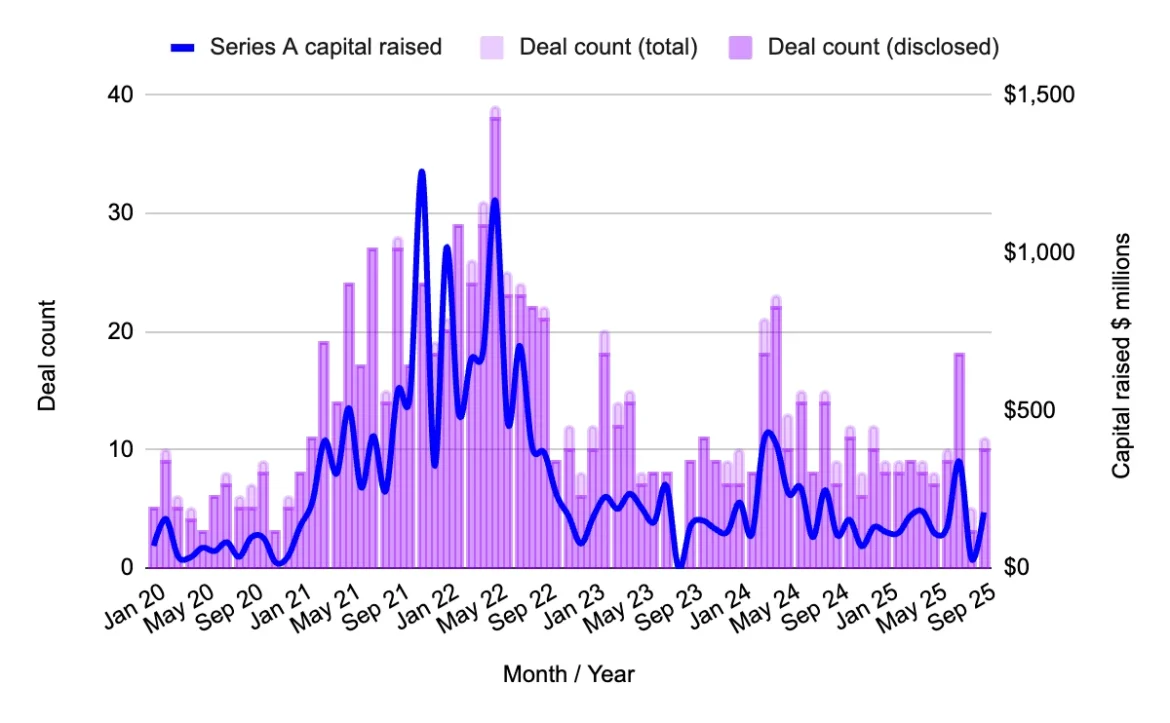
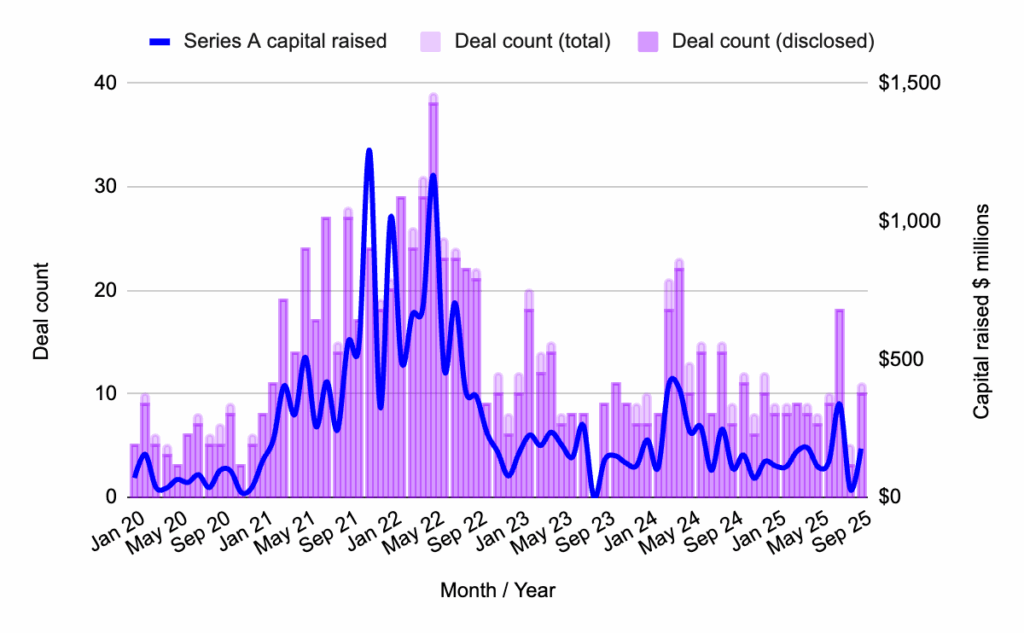
Following a sharp decline in August, Series A activity saw a modest recovery in September. While not a breakout month, deal volume and capital deployed settled around the average for 2025. This stabilization suggests that investors are maintaining a selective approach at this stage, continuing to prioritize companies with demonstrated traction and a clear path to market over those relying solely on early-stage momentum. The data implies that Series A investors are still performing rigorous due diligence, seeking robust business fundamentals and evidence of product-market fit before committing capital.
Series A Highlight: Digital Entertainment Asset ($38 million)
A notable Series A investment was made in Singapore-based Digital Entertainment Asset (DEA), which raised $38 million. DEA is focused on building Web3 gaming, ESG (Environmental, Social, and Governance), and advertising platforms that offer real-world payouts. The round, backed by prominent firms such as SBI Holdings and ASICS Ventures, underscores Asia’s continued strong interest in integrating blockchain technology with mainstream consumer industries. This investment highlights the ongoing exploration of new monetization models and user engagement strategies within the gaming and digital advertising sectors, driven by blockchain’s potential to enhance transparency and reward participation.
Private Token Sales: Concentration of Capital and Major Players
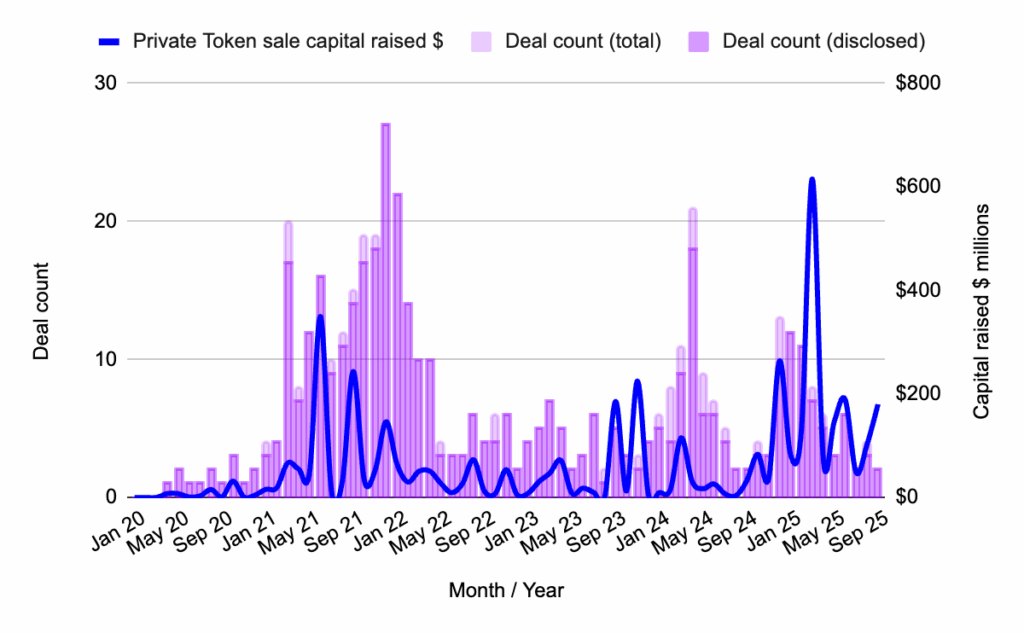
Activity in private token sales remained concentrated in September 2025, with a single mega-raise accounting for a significant portion of the total capital deployed. This trend, observed in recent months, points to a market characterized by fewer token rounds, larger individual checks, and exchange-driven initiatives capturing substantial liquidity. The consolidation of investment into fewer, larger deals suggests that investors are either making larger bets on perceived winners or are being more cautious about spreading their capital across a wider range of projects.
Highlight: Crypto.com ($178 million)
The standout private token sale was by Crypto.com, which reportedly raised a substantial $178 million, with speculation of a partnership involving Trump Media. This significant capital infusion indicates Crypto.com’s continued commitment to expanding its global reach and developing tools for mass-market cryptocurrency adoption. While the specifics of the partnership remain a subject of discussion, the raise itself signals a strategic move by the exchange to bolster its position in the competitive crypto landscape and potentially explore new avenues for user acquisition and engagement. The partnership, whether a deliberate brand pivot or a strategic marketing maneuver, certainly garnered significant attention.
Public Token Sales: The Rise of Bitcoin Yield and AI Agents
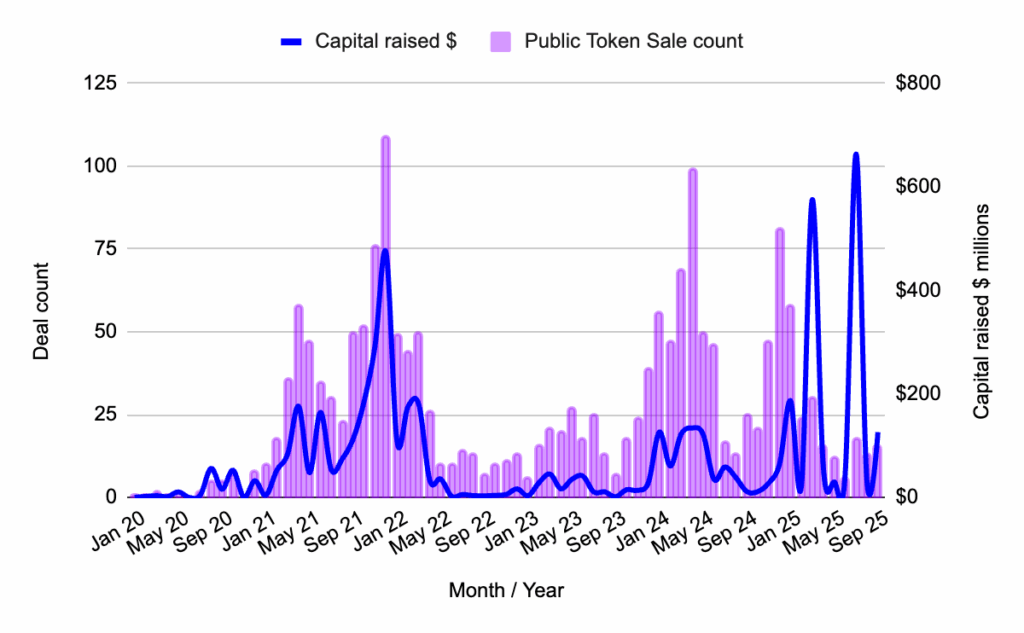
Public token sales demonstrated continued vibrancy in September 2025, largely fueled by two dominant narratives: Bitcoin yield (often referred to as BTCFi) and Artificial Intelligence (AI) agents. This sustained activity in public markets serves as a reminder that the broader investor base often gravitates towards compelling narratives and emerging trends.
The growth of BTCFi signifies a crucial development where Bitcoin, historically viewed primarily as a store of value, is increasingly being integrated into decentralized finance protocols to generate yield. This unlocks new possibilities for Bitcoin holders and further enhances the utility of the original cryptocurrency. Simultaneously, the surge in interest around AI agents reflects the ongoing excitement and investment flowing into AI-powered applications and infrastructure within the Web3 space.
Highlight: Lombard ($94.7 million)
Lombard secured $94.7 million, positioning itself as a key player in the burgeoning BTCFi narrative. The company is focused on bringing Bitcoin into the DeFi ecosystem through LBTC, a yield-bearing, cross-chain, liquid Bitcoin asset. LBTC is designed to unify Bitcoin liquidity across various blockchain networks, making it more accessible and functional within DeFi applications. This initiative is a prime example of how Bitcoin is evolving from a passive asset to an active participant in the decentralized financial landscape, learning to earn yield and interact with a broader range of financial services.
Broader Implications and Future Outlook
The fundraising landscape in September 2025 paints a picture of a Web3 sector that, while attracting significant capital, is doing so with increasing discernment. The dominance of late-stage investments suggests a market that is maturing, with investors seeking more predictable returns and established business models. The continued struggles of pre-seed funding indicate that early-stage founders face a challenging environment, requiring exceptional execution and a clear value proposition to attract capital.
The innovation demonstrated by Flying Tulip at the seed stage offers a glimpse into potential future fundraising mechanisms, where DeFi-native strategies for capital deployment and investor returns could become more prevalent. This could lead to more capital-efficient growth for Web3 projects and offer investors a more attractive risk-reward profile compared to traditional equity.
The strong performance of public token sales driven by BTCFi and AI narratives highlights the enduring power of compelling themes to capture public market attention and capital. As the Web3 ecosystem continues to evolve, investors and founders alike will need to navigate these shifting trends, focusing on sustainable growth, innovative funding models, and technologies that address real-world problems and opportunities. The future of Web3 fundraising will likely be shaped by a combination of maturing market dynamics, technological advancements, and the ongoing search for novel approaches to capital allocation and value creation.
