
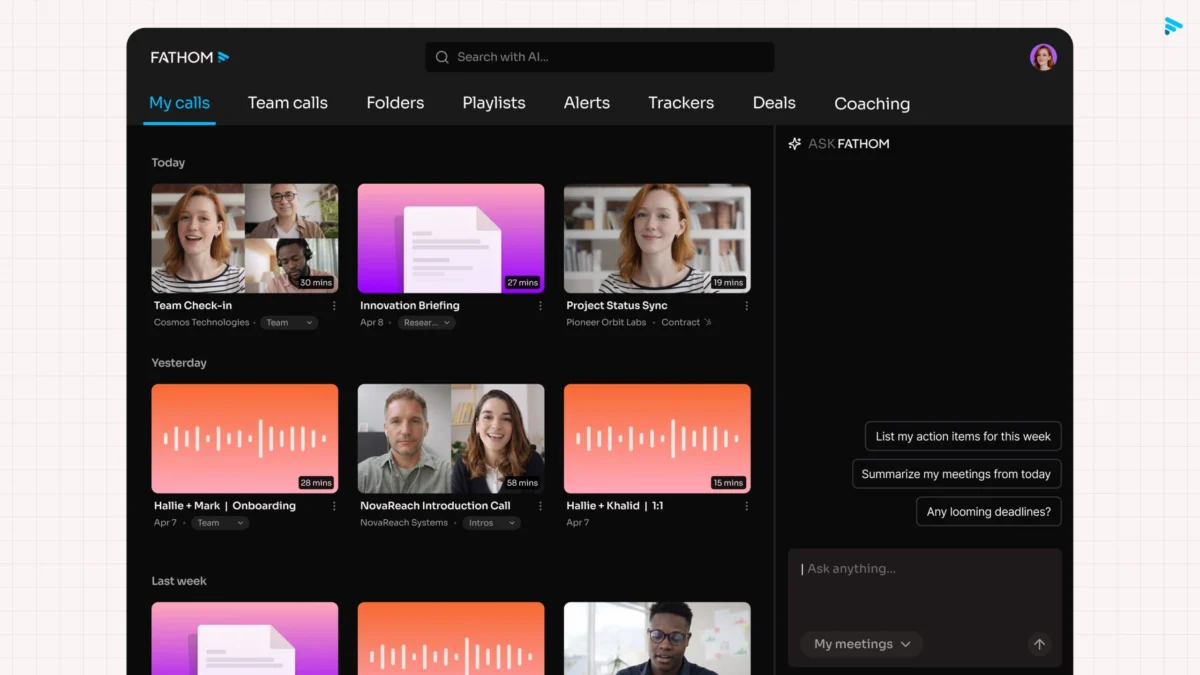
In an era where digital calendars are increasingly dominated by back-to-back video conferences, the presence of artificial intelligence has become both a blessing and a logistical nuisance. Fathom, a prominent player in the competitive AI note-taking sector, has officially announced a significant platform update designed to resolve the growing issue of "meeting room overcrowding." By introducing a bot-less transcription feature, the startup aims to provide the same high-quality summaries and transcripts users have come to expect, but without the requirement of a visible digital assistant joining the call as a separate participant.
This move marks a strategic pivot for Fathom as it seeks to distance itself from the "recording bot" era of 2023 and 2024. For years, the standard operating procedure for AI transcription services involved a virtual "bot" entering Zoom, Microsoft Teams, or Google Meet sessions. While effective, this method often resulted in awkward social dynamics, where a three-person meeting might appear to have six participants due to each attendee bringing their own preferred AI assistant. Fathom’s new update allows the software to capture, transcribe, and summarize audio and video directly through a desktop client, effectively making the AI invisible to other participants while maintaining comprehensive record-keeping capabilities.
The Evolution of the AI Meeting Assistant
The transition to bot-less technology is not merely an aesthetic choice; it represents a significant leap in how desktop applications interact with system-level audio and video streams. Early iterations of meeting assistants relied on joining calls via a URL because it was the most reliable way to access a clean audio feed across different operating systems. However, as the market matured, users began to report "bot fatigue."
Fathom’s CEO, Richard White, noted that the industry has reached a tipping point where the abundance of note-taking assistants has become counterproductive. When multiple bots join a single call, they often compete for the same audio data, cluttering the participant list and, in some cases, triggering security protocols or recording permissions that can disrupt the flow of conversation. By moving to a client-side recording model, Fathom joins a new wave of "stealth" productivity tools that prioritize user experience and professional etiquette.
The timing of this release is particularly relevant as corporate policies regarding AI usage become more stringent. Many enterprises have begun to ban third-party bots from sensitive internal meetings due to concerns over data privacy and the optics of "uninvited" digital listeners. Fathom’s bot-less approach provides a workaround that satisfies the need for documentation without violating the visual privacy of the meeting environment.
Technical Innovations in Speaker Diarization and Video Capture
While Fathom is not the first company to explore bot-less transcription—competitors such as Granola, Talat, and even OpenAI’s ChatGPT have introduced various desktop recording features—the startup claims its implementation is superior in two key areas: video retention and speaker diarization.
Speaker diarization is the process of partitioning an audio stream into homogeneous segments according to the speaker’s identity. In simpler terms, it is the technology that allows the AI to know exactly who said what. "A lot of these bot-less tools don’t indicate who said what in their captured transcript," White explained. He highlighted that misattribution is a common pain point for professionals who use AI to query past meetings. If a user asks their AI assistant, "What did the client say about the budget three months ago?" and the transcript has mislabeled the speakers, the resulting answer could be dangerously inaccurate.
Fathom has invested heavily in refining these algorithms over the last six months, leveraging advancements in large language models (LLMs) to ensure that even in a bot-less environment, the software can accurately distinguish between multiple voices. Furthermore, unlike some competitors that only capture text or audio, Fathom’s new client retains the ability to record video. This allows users to revisit the visual context of a meeting—such as a screen share or a participant’s facial expression—which is often vital for sales teams and project managers.

A Chronology of the Transcription Wars
To understand the significance of Fathom’s update, one must look at the rapid evolution of the AI transcription market over the last five years:
- 2021-2022: The Rise of the Bot. Companies like Otter.ai and Fireflies.ai popularized the "join-by-link" bot. This was the era of basic transcription where accuracy was moderate, and the primary goal was simply to have a text record of the meeting.
- 2023: The Generative AI Explosion. With the release of GPT-4, transcription tools evolved into "intelligence" tools. They began offering summaries, action items, and sentiment analysis.
- 2024: The Rise of Specialized Competitors. New players like Granola entered the fray, focusing on "human-in-the-loop" note-taking, where the AI assists the user in writing notes rather than just providing a raw transcript.
- 2025: Integration and Platform Wars. Giants like Microsoft (Copilot) and Google (Gemini) integrated transcription directly into their meeting suites, forcing independent startups to innovate or face obsolescence.
- 2026: The Bot-Less Frontier. Fathom and its peers are now moving toward "invisible" AI that lives on the device, offering better privacy, lower latency, and a more professional interface.
Fathom’s move into bot-less territory is a direct response to this timeline, ensuring that it remains a viable alternative to native solutions offered by Big Tech.
Data Portability and the Model Context Protocol (MCP)
One of the most technically ambitious aspects of Fathom’s update is the release of a Model Context Protocol (MCP) server. This move addresses a growing demand among power users for data portability. In the past, meeting transcripts were often trapped within the "walled garden" of the app that recorded them. If a user wanted to use that data in a different AI tool or a custom enterprise workflow, they often had to resort to manual copy-pasting or complex API integrations.
By implementing the MCP, Fathom allows users to pull their meeting data and plug it directly into other AI tools. This is particularly significant following recent controversies in the industry. For instance, the startup Granola recently faced backlash from its user base after changes to its on-device database structure broke third-party AI workflows that relied on that data. Fathom is positioning itself as the "open" alternative, providing a standardized way for businesses to utilize their own meeting history as a broader context for their internal AI models.
This "queryable" database turns a collection of old meetings into a living corporate memory. A manager could, for example, ask an AI agent to "summarize all feedback regarding the new product roadmap from every client meeting in Q1," and the Fathom-powered system could synthesize that information instantly across dozens of hours of recorded content.
Market Implications and Future Outlook
The broader implications of Fathom’s update suggest a shift in the "AI Notetaker" category from a standalone utility to an integrated layer of the enterprise tech stack. As Fathom prepares to launch an iOS app capable of recording in-person meetings, the company is signaling its intent to capture the "offline" world as well.
Industry analysts suggest that the "bot-less" trend will likely become the industry standard by the end of 2026. The benefits to system resources, privacy, and social etiquette are too significant to ignore. However, this shift also raises new questions regarding consent. When a bot joins a call, its presence serves as a visual notification that recording is taking place. With bot-less recording, the responsibility shifts entirely to the user to inform other participants that they are being recorded, potentially leading to new legal and ethical challenges in jurisdictions with strict "all-party consent" recording laws.
Fathom’s strategy appears to be a bet on the "prosumer" and the enterprise user who values both high-end features (like video and diarization) and the flexibility of open data standards. As the company continues to refine its models, the goal is clear: to make the AI assistant so seamless that users forget it is there, while making the data it gathers so accessible that it becomes the most valuable asset in a professional’s digital toolkit.
In the competitive landscape of 2026, where every software company is an "AI company," Fathom is attempting to win by being the most unobtrusive and the most useful. By removing the bot, they are not just cleaning up the meeting room; they are attempting to clear the path for a more integrated and intelligent way of working.

