

The Ethereum (ETH) derivatives market, particularly on leading exchange Binance, is currently exhibiting a peculiar dynamic that suggests a significant number of traders are betting against the cryptocurrency despite its recent price appreciation. This confluence of factors, detailed in an analysis shared on X by CryptoQuant contributor Darkfost, points to a market structure ripe for further short squeezes, where aggressive bearish positions could be forced to liquidate, thereby fueling additional upside momentum for ETH. Since its February low, Ethereum has staged a notable rebound, yet the conviction among a substantial segment of derivatives traders remains stubbornly bearish, setting the stage for potential volatility.
Ethereum Bears Crowd In On Binance Amidst Price Rebound
The core of Darkfost’s argument revolves around a striking incongruity between Ethereum’s positive price action and the prevailing sentiment within its derivatives market on Binance. Over the past few months, specifically since February, the open interest (OI) for Ethereum derivatives on Binance has seen a substantial increase, with approximately 350,000 ETH added to contracts. At current market valuations, this influx represents over $1 billion flowing into Binance’s ETH derivatives complex. This surge has cemented Binance’s position as a dominant player in the ETH derivatives landscape, now accounting for roughly 37% of the total market share.
Open interest, a critical metric in derivatives analysis, represents the total number of outstanding derivative contracts that have not been settled. An increase in open interest, especially when accompanied by specific funding rate dynamics, offers valuable insights into market sentiment and potential future price movements. In this case, the sheer volume of new capital entering the market signals heightened trader engagement and conviction, though the direction of that conviction is what truly stands out.
What makes this situation particularly noteworthy is the directional bias embedded within this expanding open interest. Darkfost highlighted the "paradoxical" nature of this positioning: "Despite the recent price increase (+35% since the February low), the majority of investors appear to be positioning for a correction by shorting the market." This observation suggests a widespread belief among these traders that Ethereum’s recent rally is unsustainable and that a pullback is imminent, prompting them to open short positions in anticipation.
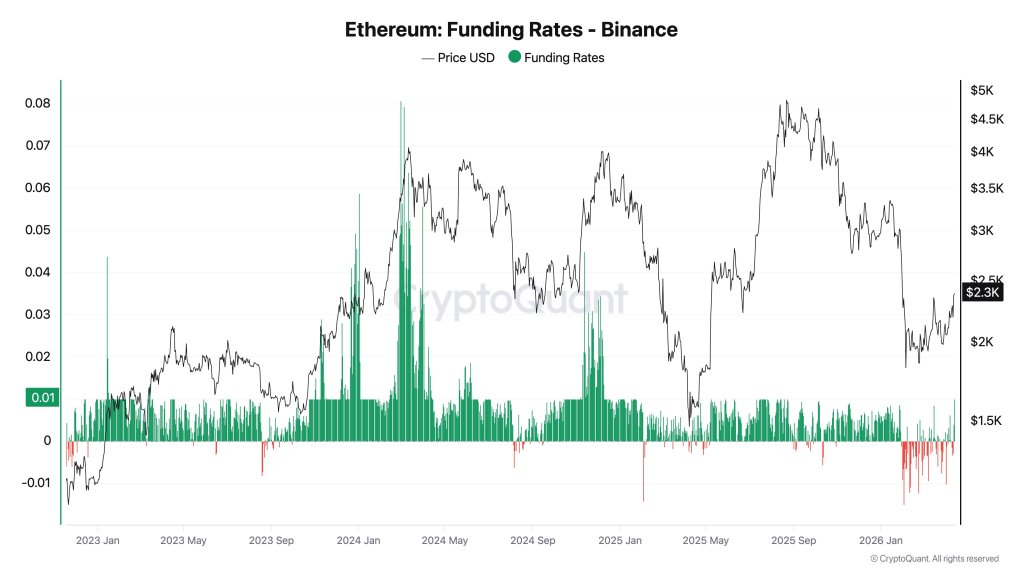
This bearish conviction is clearly observable through Ethereum’s funding rates on Binance. Funding rates are periodic payments exchanged between long and short positions in perpetual futures contracts, designed to keep the contract price pegged to the underlying asset’s spot price. When funding rates are positive, long position holders pay short position holders, indicating a predominantly bullish sentiment. Conversely, negative funding rates mean short position holders pay long position holders, signaling that bearish sentiment is dominant and shorts are willing to pay a premium to maintain their positions.
Darkfost’s analysis indicates that ETH funding rates on Binance have not only been negative but have reached levels not consistently seen since previous bear markets. This sustained negativity, persisting largely since late January, underscores a deep-seated skepticism among traders, who have continued to pay to hold short exposure rather than capitulate and chase the rebound. It signifies that the recent upward price movement has not fundamentally altered their bearish outlook.

Deep Dive into Funding Rates: A Rare Bearish Consensus
The significance of these deeply negative funding rates cannot be overstated. Darkfost specifically noted, "Observing such negative levels, with funding rates dropping below -0.01%, is relatively rare and indicates a significant buildup of short positions while investors remain in disbelief." This level of collective bearishness, where traders are actively paying to bet against the market’s current trajectory, creates a highly imbalanced market structure.
Historically, when a strong consensus forms among derivatives traders, especially when it contradicts the prevailing price trend, the market often tends to move against the majority. This phenomenon is frequently observed in "disbelief rallies," where an asset’s price continues to climb despite widespread skepticism, forcing bearish traders to cover their positions. In leveraged markets like perpetual futures, this can trigger a cascade of liquidations, leading to a "short squeeze."
A short squeeze occurs when the price of an asset suddenly increases, forcing short sellers (who bet on a price decline) to buy back the asset to cover their positions and limit losses. This forced buying further drives up the price, creating a self-reinforcing upward spiral. The more concentrated and leveraged the short positions are, the more potent a short squeeze can become.
The Mechanics of a Short Squeeze: Liquidation Cascades Begin
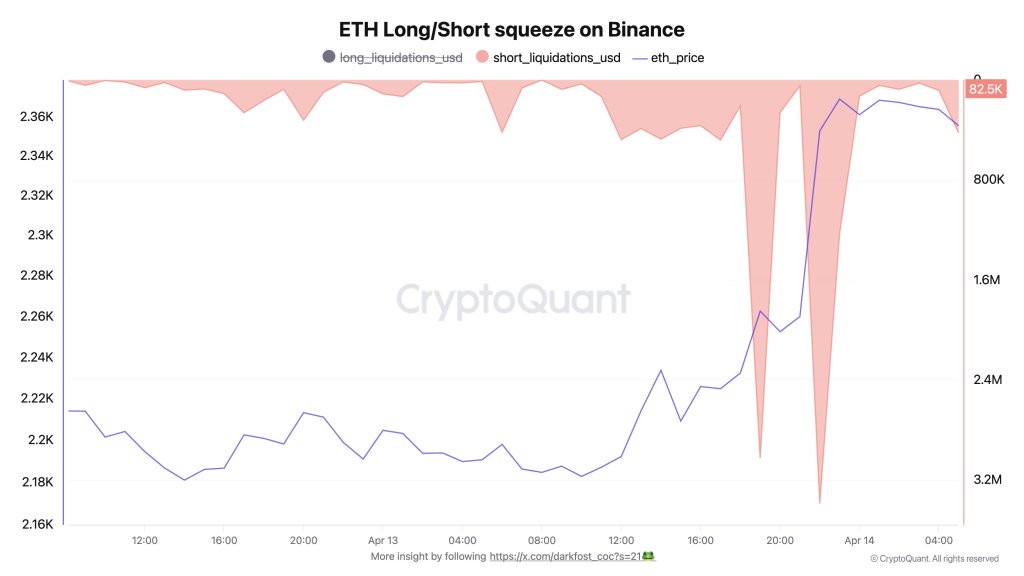
The initial signs of this squeeze dynamic have already begun to manifest in Ethereum’s liquidation data. Darkfost highlighted that "more than $3 million in short positions were liquidated twice within a single hour on Binance." This indicates that even modest upward price movements are sufficient to breach the liquidation thresholds of highly leveraged short positions, compelling these traders to exit their bets.
In a crowded short setup, these forced exits are not isolated incidents but can become a powerful self-reinforcing mechanism. As one pocket of short positions is liquidated, the resulting buy pressure pushes the price higher, which in turn triggers the liquidation of the next layer of vulnerable short positions. This cascading effect can rapidly accelerate price appreciation, far beyond what might be expected from organic buying demand alone. The "disbelief" among short sellers, while initially a source of stability for their positions, ultimately becomes their undoing as the market moves contrary to their expectations.
For context, the broader crypto market has seen significant liquidation events in recent periods. Ethereum itself has "endured a historic liquidation week," as referenced in related reports, marking one of the largest sustained liquidation phases since 2021. While the original article doesn’t directly link these broader liquidations to the current Binance-specific short squeeze, it underscores the inherent volatility and leverage risks prevalent in the derivatives market, and how rapidly sentiment can shift.
Broader Market Context and Historical Parallels
The current situation on Binance is not an isolated event but rather reflects a confluence of market forces. Ethereum, as the second-largest cryptocurrency by market capitalization, often mirrors broader trends in the crypto ecosystem while also being influenced by its unique developments. The recent upward trajectory for ETH, a 35% gain from its February lows, has occurred amidst a generally positive, albeit sometimes volatile, period for digital assets. Bitcoin, the market leader, has also seen significant gains, often pulling altcoins like Ethereum along with it.
The mention of funding rates reaching levels "not seen since the previous bear market" provides a crucial historical context. During prolonged bear markets, negative funding rates are common as traders anticipate further downside and are willing to pay to short. However, seeing such persistent and deeply negative rates during an uptrend suggests a deep-seated psychological resistance to the rally. Traders who experienced significant losses in previous downturns may be wary of sustained rallies, opting to bet against them prematurely. This "fear of missing out" (FOMO) on a correction can lead to overcrowded short positions, which historically have been prime targets for squeezes.
The "early phase of the uptrend" described by Darkfost suggests that the current price rally might still have considerable room to run, especially if fueled by continuous short covering. Months of short accumulation mean a substantial pool of potential buy orders waiting to be triggered by further price increases, providing sustained fuel for an upward trend. This dynamic is a classic feature of market cycles, where early rallies are often met with skepticism before broader market participation validates the move.
Shifting Tides: A Potential Turning Point?
Despite the entrenched bearish sentiment, there is a nascent shift underway that warrants close observation. Darkfost’s latest data points to funding rates beginning to turn positive again, citing a reading around +0.01%. While the day’s data was not yet complete at the time of the analysis, this potential reversal is a critical development.
If this change holds and funding rates become consistently positive, it would signal a fundamental shift in market structure and sentiment. A sustained positive funding rate would indicate that long positions are now paying shorts, meaning that bullish conviction is starting to dominate. This would imply that traders are beginning to align with the price rally, moving away from the "disbelief-fueled squeezes" towards a market driven by genuine long interest and conviction.
Such a shift would normalize the derivatives market, making it less prone to dramatic short squeezes but potentially more susceptible to corrections if long positions become overly leveraged. It would suggest that the market is moving past the initial phase of skepticism and is entering a more mature phase of the uptrend, where price action is increasingly supported by fundamental buying rather than forced short covering.
Implications and Outlook
The immediate implication for Ethereum is a heightened potential for volatility. As long as a significant portion of the market remains short and funding rates hover in negative territory, any upward price movement could trigger further liquidations, amplifying the rally. This makes Ethereum particularly susceptible to sharp, rapid price increases in the short term.
For traders, this scenario presents both opportunities and risks. Aggressive long positions could capitalize on the potential for a short squeeze, while short sellers face the risk of substantial losses if their positions are liquidated. The key challenge for participants is to accurately gauge the market’s tipping point and understand when the collective bearish conviction might finally break.
In the medium term, the evolution of funding rates will be a critical indicator. If funding rates continue their nascent shift into positive territory and remain there, it would signal a more sustainable and fundamentally driven uptrend for Ethereum. This would suggest that market participants are increasingly confident in ETH’s long-term prospects, perhaps driven by factors such as network upgrades, increasing utility, or broader macroeconomic tailwinds.
However, the risk remains that if the underlying market sentiment is indeed fragile, a sudden negative catalyst could trigger a rapid unwinding of long positions, leading to a sharp correction. The "early phase of the uptrend" could still be susceptible to pullbacks if the broader market environment deteriorates or if fundamental support for Ethereum wavers.
In conclusion, the message emanating from Binance’s Ethereum derivatives market is starkly clear: a substantial aggregation of short positions has created a delicate balance, making ETH highly vulnerable to a short squeeze if its upward momentum persists. While funding rates show the earliest glimmers of a potential shift toward positive territory, signaling a possible alignment of traders with the price rally, the prevailing structure suggests that the more crowded the bearish trade becomes, the more precarious it is for those betting against Ethereum’s continued ascent.
At press time, Ethereum traded at $2,318, with the coming days likely to test the conviction of both bulls and bears in this intensely watched derivatives landscape.

