
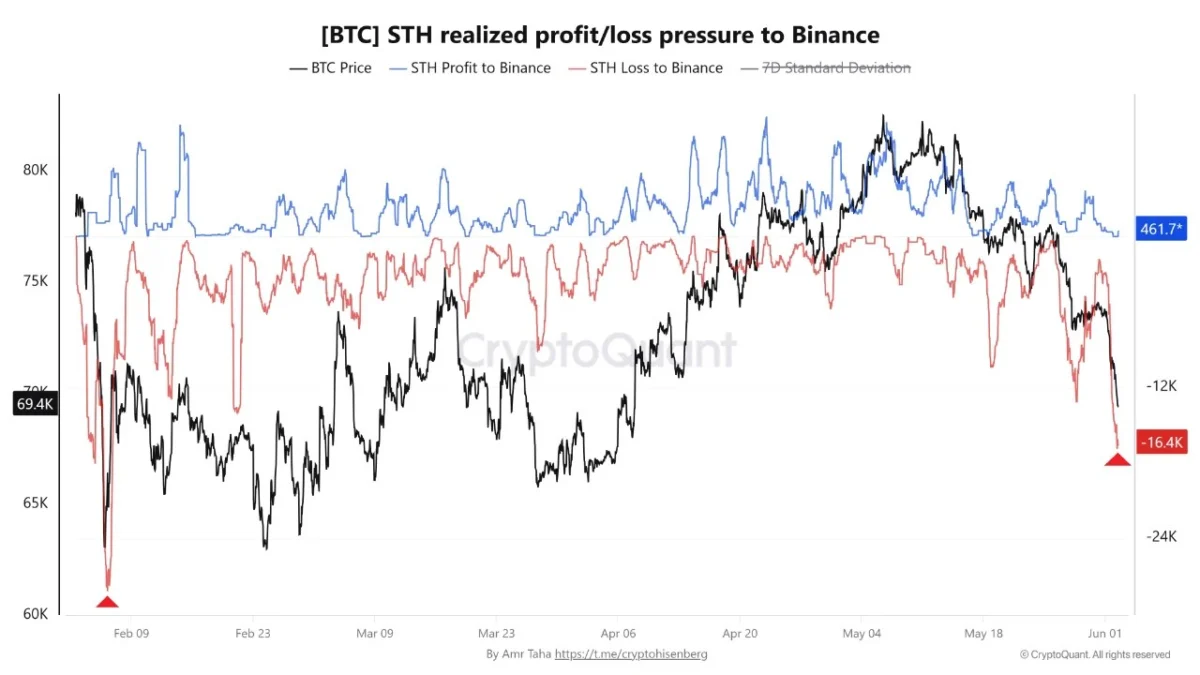
Bitcoin has relinquished the critical $66,000 price level, as a confluence of intensifying selling pressure and pervasive market uncertainty pushes the digital asset to test support thresholds not witnessed since the nascent stages of its recovery earlier this year. This accelerating breakdown is underscored by a recent CryptoQuant report, which has meticulously identified a specific on-chain data pattern, placing the current market sell-off within a historical context that seasoned traders will immediately recognize as potentially significant.
The On-Chain Evidence: A Deep Dive into Short-Term Holder Capitulation
The core of the CryptoQuant analysis points to a dramatic increase in realized losses by short-term holders (STHs). These are typically investors who have acquired Bitcoin relatively recently, often within the past 155 days, making their reactions to price volatility a key indicator of market sentiment and potential exhaustion of selling pressure. The "STH Loss to Binance" metric, a measure of Bitcoin sent to the Binance exchange by short-term holders at a loss, plummeted to -16,400 BTC on June 2. This reading represents its deepest negative value since February 6, a date etched in the memory of many market participants.
February 6, 2024, marked one of the most intense capitulation sessions of the recent market correction. During that period, forced selling from relatively new buyers created significant downward price pressure, which ultimately exhausted itself, paving the way for the subsequent recovery attempt. The current on-chain reading exhibits a strikingly similar behavioral signature: participants who acquired Bitcoin in recent months at higher price points are now actively moving their coins to Binance, presumably to liquidate their positions at a loss, rather than holding out for a recovery that the prevailing price action no longer seems to support. The sheer pace of this loss realization has reached a level that has been surpassed only once in the past four months, making the comparison to the February moment a crucial analytical reference provided by the CryptoQuant data.
Extending beyond the specific confines of Binance, the CryptoQuant report further corroborates that this loss realization pressure is not isolated to a single trading venue. Across all centralized exchanges, the "STH Loss to Exchange" metric registered a significant fall to -38,700 BTC on June 2. This followed an even more pronounced spike of -41,300 BTC on May 28. Crucially, both of these recent readings individually exceed the February 6 level that had previously signified the most intense capitulation session of the recent correction. This makes the combined impact of the May 28 and June 2 sessions one of the most aggressive short-term holder loss waves recorded in recent months, signaling a broad-based exit strategy among newer market entrants.
Adding another layer of detail to this narrative, the Binance inflow structure reveals that the current selling cannot be solely attributed to panic among smaller, retail investors. Mid-sized investors, those typically holding more substantial amounts than average retail participants but less than major institutions, sent approximately 8,400 BTC to Binance on June 2. This figure represents the highest reading for mid-sized inflows since February 6, indicating that larger participants are actively contributing to the loss realization alongside their smaller counterparts. This collective action across different investor segments suggests a more widespread erosion of conviction rather than isolated retail FUD (fear, uncertainty, doubt).

Historical Precedents and Market Dynamics
Understanding the current market dynamics requires a look back at Bitcoin’s journey throughout 2024. The year began with immense optimism, fueled by the landmark approval of spot Bitcoin Exchange-Traded Funds (ETFs) in the United States in January. This institutional validation propelled Bitcoin to new all-time highs above $73,000 in March, creating a sustained period of bullish sentiment and attracting significant capital inflows. However, since reaching those peaks, the market has experienced several corrections, with the $72,000-$74,000 range frequently acting as a strong support zone, absorbing previous selling pressure and forming the foundation for subsequent recovery attempts throughout April and May.
Capitulation events, characterized by intense, often panic-driven selling leading to significant price declines, are a recurring feature in the cyclical nature of cryptocurrency markets. Historically, these periods have a dual significance: while they reflect deep investor pain and eroded confidence, they also frequently occur near market bottoms. The forced selling by exhausted holders, particularly short-term ones, can effectively "clear out" fragile market positioning, removing weak hands and creating conditions for stabilization, provided there is sufficient underlying demand to absorb the increased supply. The CryptoQuant report acknowledges this historical framing, emphasizing that deep realized-loss events do not automatically confirm a continuation of the downtrend but rather frequently appear near panic phases and critical support tests.
Technical Breakdown and Critical Support Levels
From a technical analysis perspective, Bitcoin’s market structure has deteriorated significantly. The recent violent sell-off pushed the price decisively below the long-standing $72,000-$74,000 support zone, which had previously served as a crucial bulwark for the recovery throughout April and May. This breakdown triggered an aggressive move toward the $65,000-$66,000 region, an area that now stands as the most important immediate support level on the daily chart.
The breach of key technical indicators further solidifies the bearish shift. Bitcoin has lost both the 50-day and 100-day moving averages, widely watched indicators of short-term and medium-term trend direction, respectively. Furthermore, the cryptocurrency has fallen below a key horizontal support level that had previously acted as both resistance during upward movements and support during corrections over the past four months. The decisive rejection from the local highs around $80,000-$82,000, combined with the subsequent price action, has established a clear sequence of lower highs and lower lows, unequivocally confirming a bearish shift in momentum.
However, an encouraging sign for optimistic market participants is that the current decline has brought the price directly into a major demand zone situated between $64,500 and $66,500. This specific area proved resilient during the February capitulation event, successfully absorbing substantial selling pressure and facilitating a rebound. The market is now re-testing this critical zone. The latest daily candle, despite the overall bearish context, shows early indications of buyers stepping in near the lows, producing a modest rebound from support, notably accompanied by elevated trading volume. This increase in volume during a rebound from support often suggests a genuine attempt by buyers to defend the level.

Broader Market Sentiment and Macroeconomic Headwinds
The current downturn in Bitcoin is not occurring in isolation but within a broader macroeconomic landscape that continues to present headwinds for risk assets. Persistent concerns over inflation, particularly sticky core inflation, have led to increased uncertainty regarding the Federal Reserve’s future interest rate policy. Higher interest rates typically make speculative assets like cryptocurrencies less attractive compared to traditional, lower-risk investments, as the cost of capital increases and the allure of future returns diminishes. The strength of the U.S. dollar, often inversely correlated with Bitcoin’s performance, has also played a role, as a stronger dollar can signal tighter global financial conditions.
Beyond Bitcoin, other major cryptocurrencies have also shown signs of weakness. For instance, Ethereum’s Coinbase premium, an indicator of buying pressure on the U.S. exchange, recently hit its lowest level since February, suggesting a broader decline in demand across the altcoin market as well. Institutional investment vehicles, such as the spot Bitcoin ETFs, which had initially been a major driver of demand, have recently experienced outflows or significantly reduced inflows, signaling a cautious stance among larger capital allocators. Furthermore, futures market data, including a reduction in open interest and fluctuating funding rates, suggests a deleveraging event, where speculative positions are being unwound, adding to the selling pressure.
Analyst Perspectives and Future Outlook
Market analysts are closely scrutinizing the current loss realization events, debating whether they represent the exhaustion of selling pressure that precedes a rebound or the initial phase of a more prolonged downtrend. The historical framing of such events by CryptoQuant is crucial: they highlight that while painful, these deep realized-loss periods often precede stabilization if sufficient demand emerges to absorb the available supply.
Bitcoin’s behavior around the immediate $69,000 resistance level and the critical $65,000 support zone is now the paramount variable determining its near-term trajectory. If the price manages to hold above the $65,000-$66,000 demand zone and initiates a sustained recovery from the current levels, the intense loss spikes observed on May 28 and June 2 may, in retrospect, be identified as the capitulation event that effectively cleared out fragile market positioning and established a more solid foundation for the next phase of recovery. This scenario would imply that the market has successfully absorbed the selling pressure from short-term holders and is ready to rebuild.
Conversely, if the price fails to stabilize within this critical demand zone and breaks down further, the repeated spikes in short-term holder losses would suggest that the stress among these investors has not yet been fully exhausted. Such a failure to hold support would likely expose the market to a deeper retracement, potentially targeting the low-$60,000 region or even lower, as further loss realization pressure could remain ahead. For any meaningful recovery to gain traction, reclaiming the lost $72,000-$74,000 zone, which now acts as a formidable resistance barrier, remains absolutely essential. Until then, bears are likely to retain short-term control. The market’s direction over the next few trading sessions will be crucial in determining whether the current intense selling pressure represents a capitulation bottom or the precursor to a more significant downtrend.

