

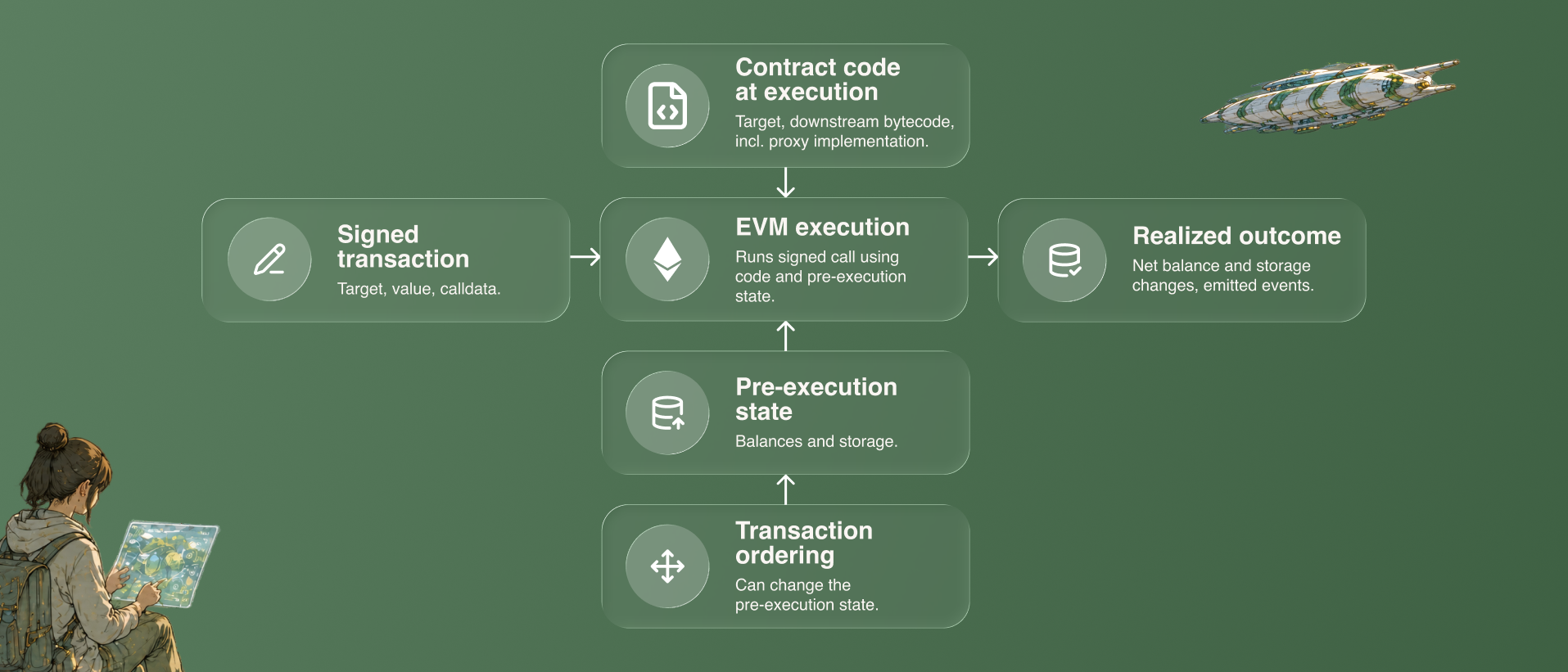
The fundamental challenge stems from the nature of the Ethereum Virtual Machine (EVM). Currently, when a user signs a transaction, they are essentially providing a cryptographic approval for a specific set of instructions. However, the EVM executes these instructions against the state of the network at the exact moment of inclusion—not the moment of signing. This temporal disconnect means that if the state of a contract, the price of an asset, or the underlying implementation of a proxy changes between the signing and the execution, the result can be vastly different from what the user expected.
The Anatomy of Transaction Failure
History is marked by high-profile incidents where the lack of outcome verification led to catastrophic losses. In the Bybit incident, attackers manipulated the frontend to deceive users into authorizing the replacement of a Safe wallet’s implementation contract. Similarly, the BadgerDAO attack saw users granting broad token permissions that were exploited by malicious actors. In both cases, the "intent" was subverted because the signer authorized a request that, while technically valid, did not align with the user’s actual goal.
A different, yet equally damaging, category of failure is the "outcome mismatch." A prime example occurred during the Aave and CoW Swap collateral swap incident, where a user attempted to trade approximately $50.4 million of aEthUSDT for aEthAAVE. Due to thin liquidity and a failure to account for slippage in a volatile market, the user received only a fraction of the expected value—approximately $36,000. While the interface provided warnings, the lack of an on-chain enforcement mechanism meant that once the transaction was signed and broadcast, the execution proceeded regardless of the extreme, detrimental price impact.
These scenarios illustrate that current security defenses are often reactive or limited in scope. Simulation tools, while helpful, are prone to "bait-and-switch" attacks where a malicious payload is substituted at the moment of signing, bypassing the simulation’s sandbox. Existing on-chain guards, such as the Safe checkAfterExecution hook, provide a layer of protection but are limited by the information they can access. They often struggle to inspect the "net" state changes of a transaction, such as full storage modifications or cross-contract effects that occur deep within the execution trace.
Understanding EIP-7906 and the Path Forward
The proposed solution, formalized in EIP-7906 (Transaction Assertions via State Diff Opcode), seeks to standardize how Ethereum handles these verification steps. Building upon the framework of EIP-8141, which introduces "frame transactions," EIP-7906 proposes a read-only POST_TX frame that executes at the very end of a transaction’s lifecycle.

This mechanism would function as a gatekeeper. By utilizing new opcodes—TXTRACE, TXDIFF, and EVENTDATACOPY—the system can inspect the cumulative changes made during the transaction. If the final state of the network deviates from the user’s predefined "assertion"—such as a minimum amount of tokens received or a restriction on contract modifications—the entire transaction reverts. This ensures that the user is not charged for an outcome they did not authorize, providing a safety net that is enforced by the protocol itself rather than by external, fallible interfaces.
The implementation of these opcodes is designed to be highly efficient. For example, TXDIFF retrieves the starting and final values of specific storage slots, meaning that if a slot is modified multiple times throughout the execution, the system only evaluates the net result. This is a crucial design choice, as it prevents the overhead of tracking every intermediate state change, keeping the gas costs of the assertion manageable.
Broader Implications and Strategic Importance
The introduction of native transaction assertions carries significant implications for the future of decentralized finance (DeFi). First, it empowers users with "policy-based" security. Instead of relying on a human-readable description of a transaction, which can be spoofed, users can attach a set of logical rules to their transactions. These rules are immutable once signed and are executed by the EVM, removing the reliance on the trustworthiness of the frontend or the wallet provider.
Second, it provides a powerful tool for delegation. In scenarios where a user employs an automated agent or a third-party solver to manage their assets, they can enforce strict constraints on what that agent is permitted to achieve. An assertion could dictate that an agent can rebalance a portfolio, but only if the total value of the assets remains above a certain threshold and no new, unauthorized token approvals are granted.
Third, the initiative represents a shift in the responsibility model of Ethereum. By moving the burden of safety from the user interface to the protocol level, the Ethereum Foundation is acknowledging that expecting average users to audit complex calldata is an unsustainable security model. "Clear Signing" provides the necessary transparency, but "Transaction Assertions" provide the necessary finality.
Addressing the Requirement for Adoption
A significant hurdle for EIP-7906 is that it is not mandatory. To be effective, the assertion must be required by the smart contracts themselves. A protocol, such as a decentralized exchange or a lending platform, could mandate that all incoming calls originate from a "frame transaction" that includes a specific, verified assertion. This effectively creates a "secure-by-default" environment for that protocol’s users.
However, this requires a transition period. Existing, immutable smart contracts cannot be retrofitted with these checks. Therefore, the ecosystem will likely see a phased adoption where new protocols incorporate these requirements into their architecture, while older, legacy systems remain dependent on external security wrappers or secondary auditing layers.
The Road to Implementation
As the Ethereum Foundation continues to refine the research surrounding these assertions, they are actively engaging with wallet developers and protocol architects. The technical community is debating the optimal balance between flexibility and security. There are concerns regarding the complexity of writing assertions that are both comprehensive enough to cover all edge cases and simple enough to remain gas-efficient.
The "Trillion Dollar Security" initiative is not merely a technical proposal; it is a strategic roadmap. It recognizes that for Ethereum to reach mainstream adoption, the user experience must be as safe as, if not safer than, traditional financial systems. By providing a protocol-level mechanism to define and enforce user intent, the Ethereum ecosystem is taking a definitive step toward maturity.
For developers and stakeholders interested in the evolution of these standards, the ongoing discourse on the Ethereum Magicians forum and the technical documentation provided at the initiative’s portal offer the most up-to-date information. As the community approaches the next network upgrades, the inclusion of EIP-7906 or similar structures will be a key indicator of Ethereum’s commitment to prioritizing user safety over raw, unchecked flexibility. The success of this initiative will ultimately depend on the collective efforts of the developer community to adopt these standards, ensuring that the "trillion-dollar" ecosystem of the future is protected by more than just trust.

