

The global Web3 and cryptocurrency venture capital landscape experienced a dramatic transformation in the third quarter of 2025, driven by an unprecedented influx of institutional capital. According to comprehensive data aggregated by industry research firms Outlier Ventures and Messari, total deployed capital across all funding stages skyrocketed by 113% quarter-on-quarter, reaching a remarkable $21.7 billion. This staggering figure eclipses the financial metrics seen during the peak periods of the 2021 and 2022 bull markets, marking a historic high for digital asset fundraising cycles.

However, this capital explosion was not matched by a proportional surge in overall market activity. The total number of disclosed deals grew by a modest 22%, moving from 309 transactions in the second quarter to 376 in the third. This statistical divergence highlights a distinct macro trend: the third quarter was defined by significantly larger, highly concentrated cheques deployed into mature, compliance-ready infrastructure rather than a broad-based resurgence of early-stage venture activity.
The Institutionalization of Crypto Financial Architecture
The underlying mechanics of third-quarter fundraising reveal a fundamental shift in how traditional finance and decentralized technologies intersect. Rather than relying on speculative retail enthusiasm, the market was propelled by operationalized institutional rails, including spot exchange-traded funds (ETFs), digital asset treasuries (DATs), tokenization protocols, and blockchain-based settlement networks.
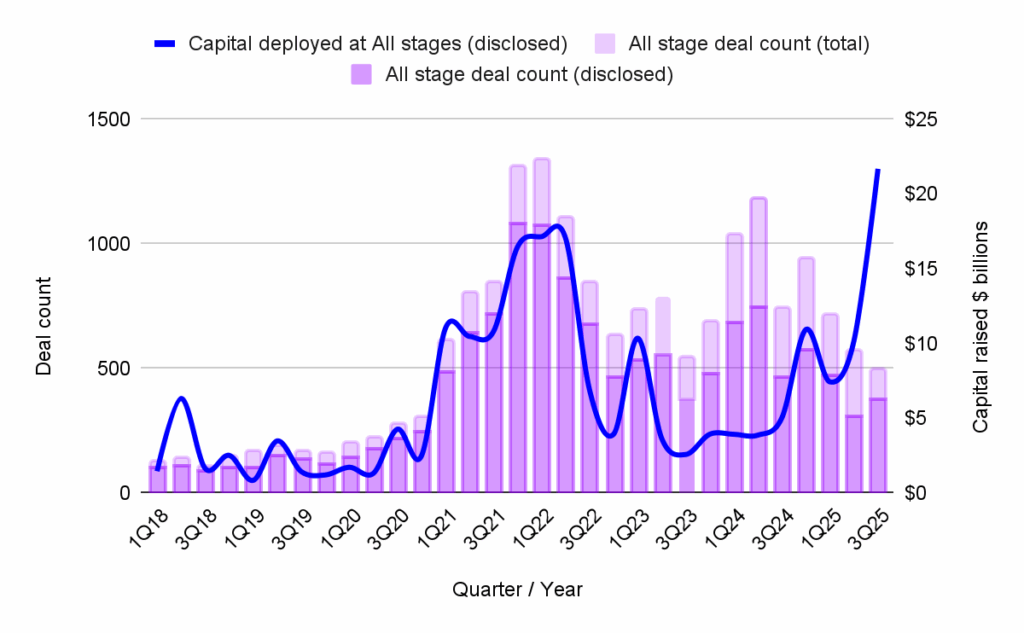
Market data underscores this institutional pivot. Ethereum-focused ETFs experienced a stellar period, capturing approximately $8.7 billion in inflows during the third quarter alone and surpassing Bitcoin-focused products for the first time in a single quarter. Total assets under management (AUM) for Ethereum ETFs surged by roughly 170% quarter-on-quarter, closing the period at $27.4 billion. Concurrently, Digital Asset Treasuries amassed roughly 3.8% of the total circulating Ethereum supply, signaling a structural evolution in corporate treasury management.
Traditional financial institutions also transitioned their blockchain initiatives from theoretical pilot programs to live, production-grade environments. JPMorgan officially launched its Kinexys network for tokenized repurchase agreement settlements, while SWIFT advanced its cross-border tokenization trials in collaboration with major global custodians such as BNY Mellon, Citi, Clearstream, Euroclear, and Northern Trust. Furthermore, Visa Direct expanded its operational scope by processing cross-border transactions using USD Coin (USDC).
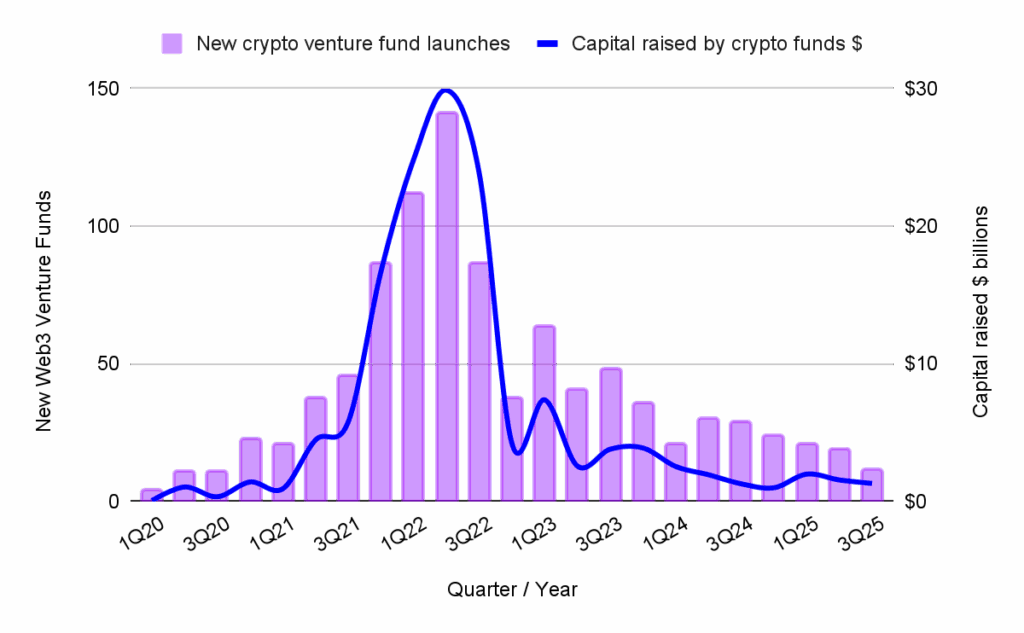
Industry analysts note that these tangible deployments created a durable foundation for large-scale capital allocation, directly influencing why later-stage ventures and enterprise infrastructure providers commanded outsized funding rounds.
Capital Concentration and Stage-by-Stage Breakdown
The concentration of capital was starkly visible across different funding stages, illustrating a venture ecosystem that heavily rewards proven utility and regulatory alignment over early-stage promises.
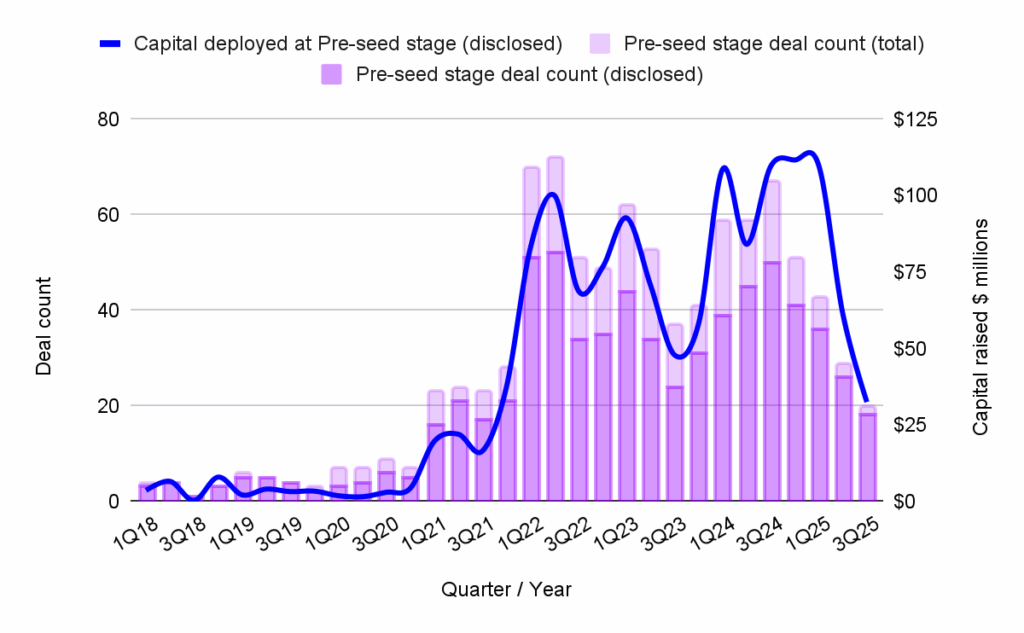
At the pre-seed level, fundraising dropped to multi-year lows. The sector recorded just 18 disclosed rounds totaling a meager $32.5 million, with the 12-month running median slipping below $2.5 million. A notable contraction in accelerator activity contributed to this narrow funding funnel, forcing early-stage founders to meet exceptionally high criteria for admission.
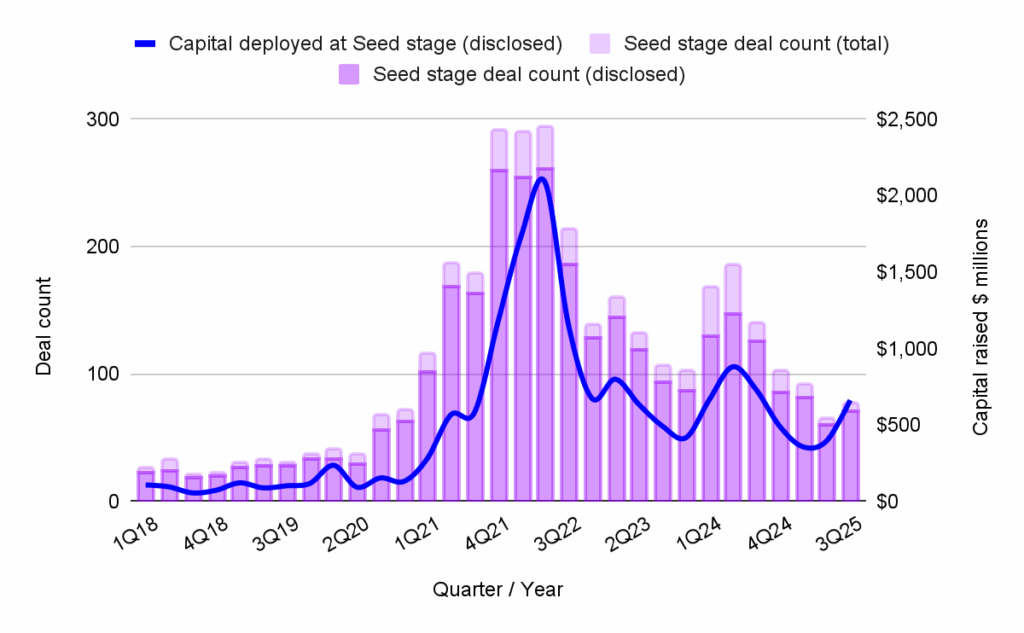
Conversely, the seed stage demonstrated headline growth, logging 71 disclosed rounds worth nearly $663 million. However, this metric was significantly skewed by outlier transactions, most notably Flying Tulip’s unconventional $200 million raise. Structurally distinct from traditional Simple Agreements for Future Equity (SAFEs), Flying Tulip’s financing utilized on-chain redemption rights, granting investors capital and yield exposure without sacrificing upside potential. This transaction underscored a broader investor preference for liquid, capital-efficient financial instruments.
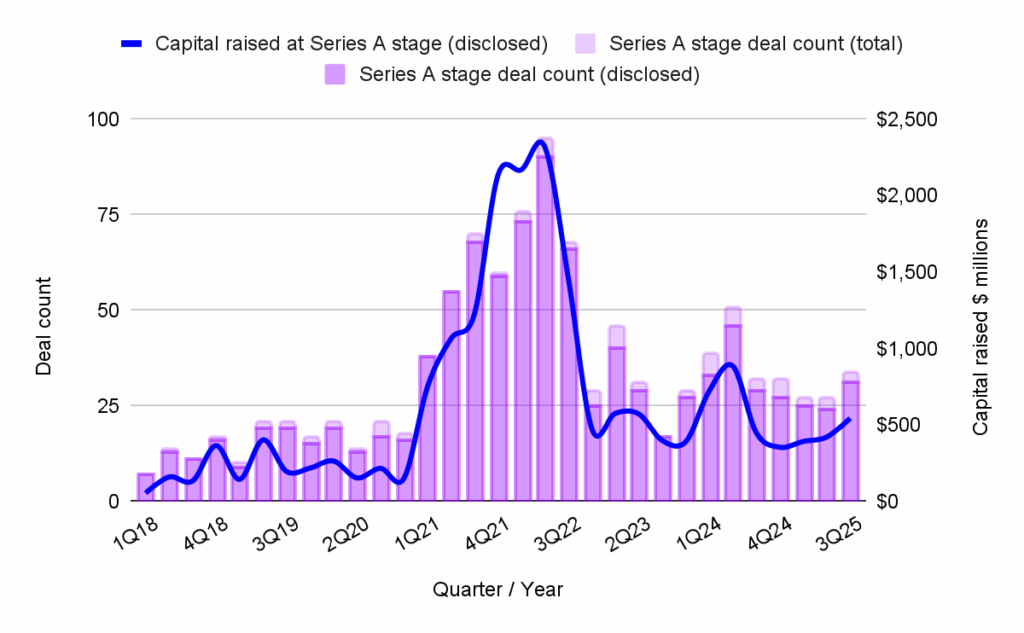
Series A fundraising remained relatively stable, recording 31 disclosed rounds totaling approximately $545 million, with a 12-month running median holding steady at $16 million. Mid-stage funding showed clear preference for projects aligned with institutional rails, such as payments, tokenized assets, data analytics, and foundational infrastructure.
Sector Distribution and the Shift Toward Infrastructure
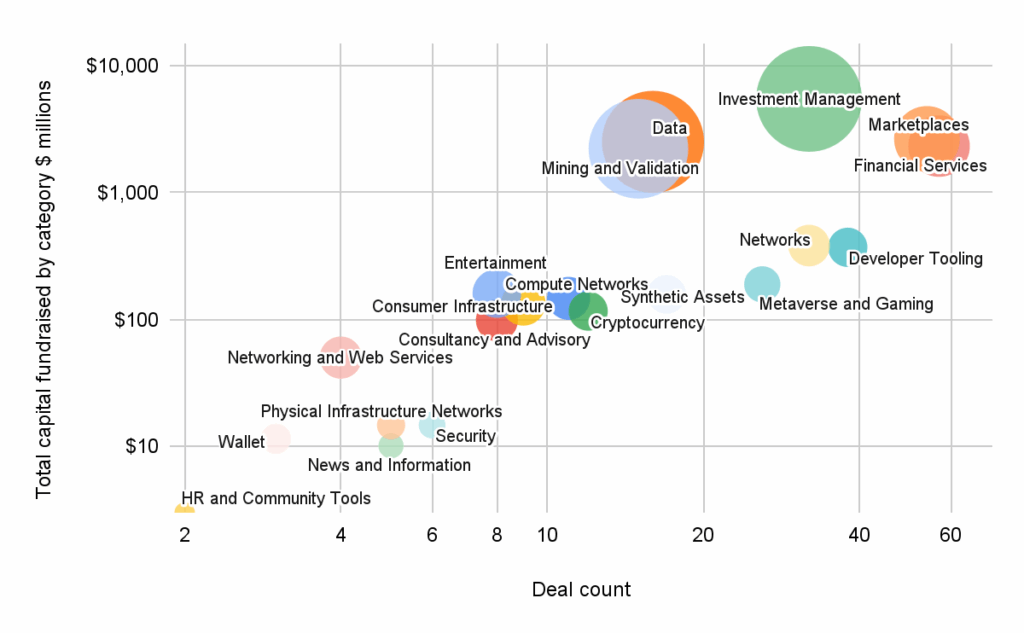
Categorical analysis of the third-quarter deployment reveals that approximately 70% of all venture capital was absorbed by five core sectors: Investment Management, Marketplaces, Data Infrastructure, Financial Services, and Mining and Validation.
These verticals directly support issuance, custody, settlement, and blockspace supply—areas heavily amplified by institutional ETF inflows and enterprise tokenization frameworks. Data infrastructure projects secured substantial investments, buoyed by the formal recognition of artificial intelligence and blockchain convergence as a distinct, investable market segment. Meanwhile, consumer-oriented applications, including metaverse gaming platforms and retail wallet security, remained largely peripheral as investors favored revenue-generating, compliance-legible enterprise rails.
Public Token Markets Outpace Private Sales
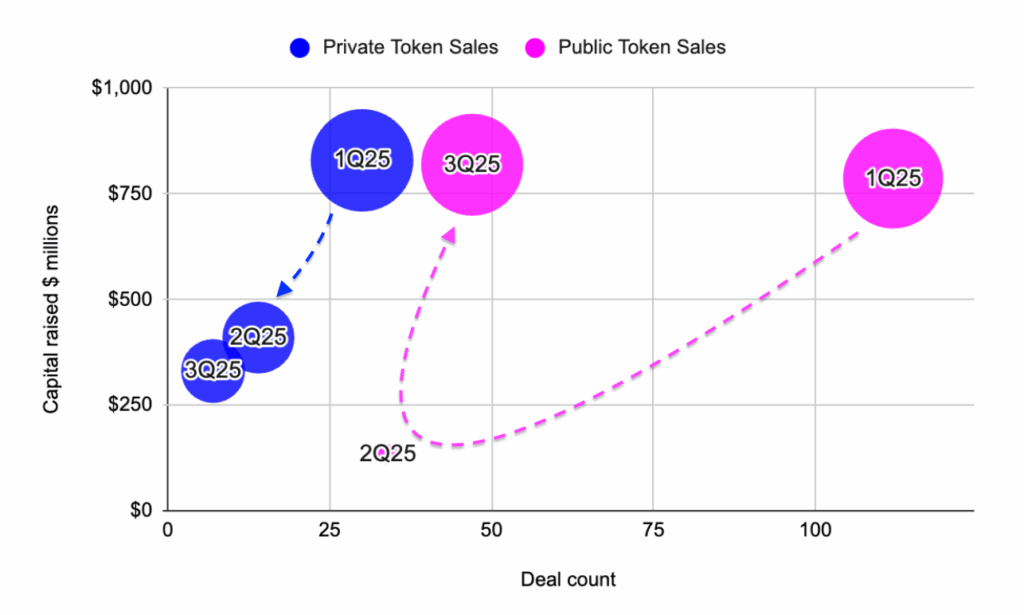
A significant development within the third-quarter financing cycle was the rotation of token fundraising back toward public distribution models. Public token sales surged to 47 distinct events raising a combined $819 million, while private token sales retreated to just 7 events totaling $331 million.
Improved market depth, rising trading volumes, and receding regulatory uncertainty in key jurisdictions emboldened project teams to utilize public token sales for effective price discovery and community alignment. Additionally, the re-emergence of initial public offerings (IPOs) within the broader tech and crypto sectors served as a vital sentiment marker. Analysts emphasize that while few Web3 firms possess the scale to execute public listings, the reopening of the IPO window functions as a regulatory compliance certification mark, signaling to institutional allocators that public markets are increasingly receptive to digital asset exposure.
Outlook and Future Implications for Founders and Investors
As the Web3 ecosystem navigates the final stretch of 2025, the overarching narrative remains defined by institutional integration and rigorous capital selectivity. The convergence of traditional finance and blockchain technology has transitioned from a speculative hypothesis to the primary framework guiding capital allocation.
For early-stage founders, the path forward requires designing product architectures, compliance frameworks, and governance models that are institutionally digestible from inception. For venture capitalists, the primary challenge heading into 2026 lies in bridging the thin pre-seed pipeline and developing hybrid financial structures that harmonize liquidity preferences with long-term ecosystem alignment. Ultimately, the degree to which current liquidity permeates the broader venture market will depend on sustained regulatory clarity and the ability of early-stage projects to demonstrate tangible economic utility.

