

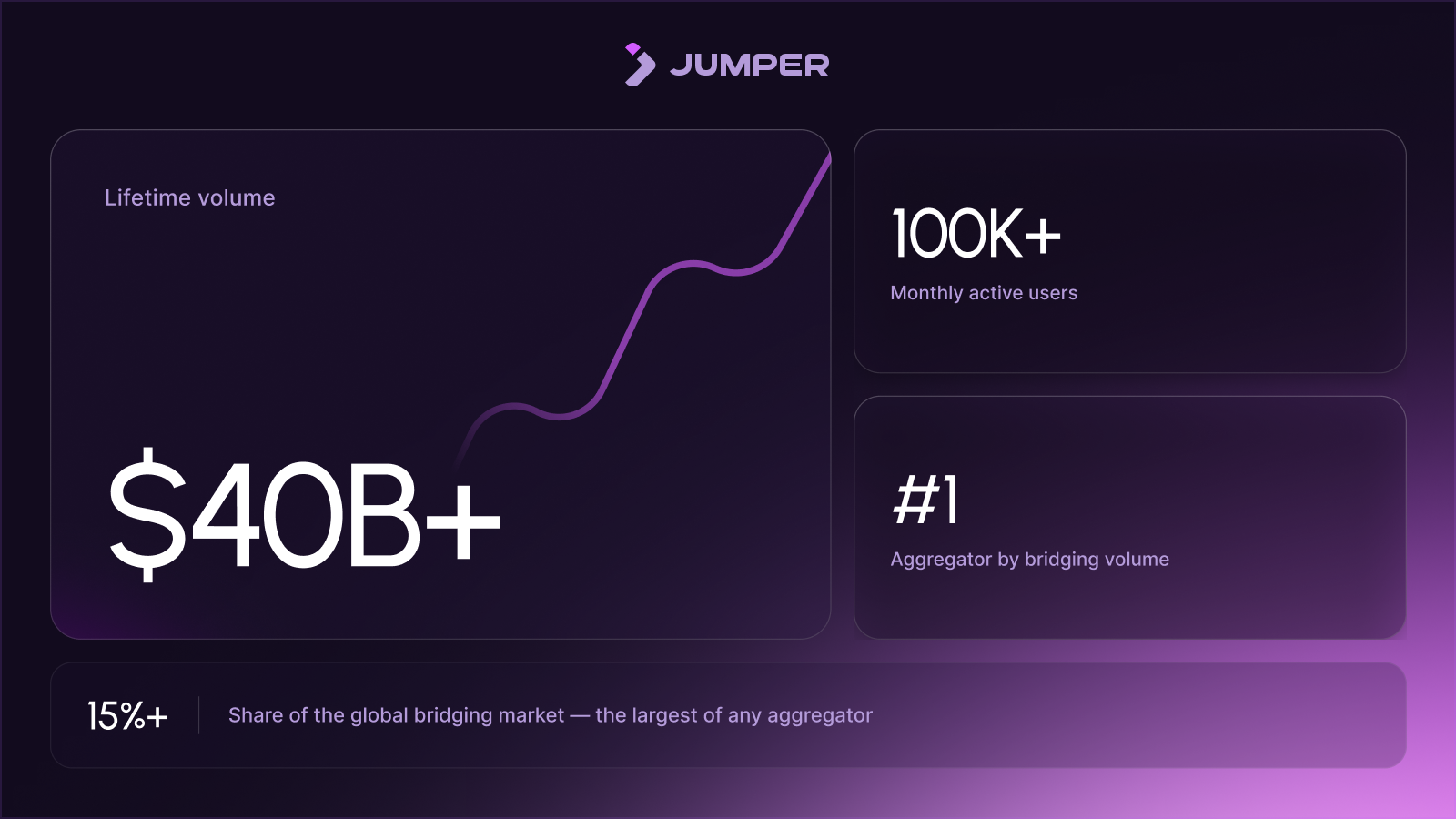
BRITISH VIRGIN ISLANDS — In a significant structural evolution for the decentralized finance (DeFi) sector, Jumper, a leading consumer application for moving and trading assets across blockchain networks, has officially announced its transition into an independent entity. Previously incubated within LI.FI, the platform is carving out a distinct operational identity backed by robust usage metrics, including more than $40 billion in lifetime trading volume and a loyal base exceeding 100,000 monthly active users. Concurrently, Jumper has revealed plans for its inaugural JUMP token sale through the Legion platform, marking a pivotal milestone in the protocol’s lifecycle as it sets its sights on broader market dominance.
The strategic spin-out signifies a major maturity phase not only for Jumper but also for its parent incubator, LI.FI. Moving forward, the two organizations will operate as distinct entities positioned at complementary layers of the Web3 technology stack. While LI.FI continues to focus on orchestration infrastructure and cross-chain routing architecture, Jumper will concentrate its efforts on being the premier consumer-facing application. This structural division allows each team to optimize its operational roadmap, dedicating specialized capital, distinct leadership, and focused engineering resources to their respective core competencies.
Evolution from Bridging Leader to Comprehensive Onchain Super-App
Since its inception, Jumper has established itself as a cornerstone of cross-chain liquidity management. By simplifying the often fragmented process of transferring value between disparate blockchain networks, the platform captured a dominant market share, establishing itself as the premier aggregator by bridging volume with over 15% of the total market. However, leadership’s vision has consistently extended beyond simple asset transfer. The platform is actively expanding its suite of financial products to transform into a unified "super-app" for onchain finance—a single portal where users can seamlessly execute swaps, bridge tokens, access high-yield opportunities, trade perpetual futures, and interact with tokenized real-world assets (RWAs) such as traditional equities.
The core philosophy driving this expansion is user-centric consolidation. In the current fragmented blockchain ecosystem, retail and institutional traders frequently find themselves navigating dozens of separate interfaces, liquidity pools, and network-specific bridges to execute basic multi-step investment strategies. Jumper aims to abstract away this underlying technical complexity. By unifying diverse protocols, liquidity venues, and blockchain networks behind a singular, intuitive interface, the application bridges the gap between traditional financial expectations and decentralized execution.
According to Marko Jurina, CEO of Jumper, the platform’s foundational success in bridging was merely the entry point to a much larger market opportunity. As an increasing volume of traditional financial instruments, commodities, and corporate securities migrate onto public ledgers, the demand for unified access points will scale exponentially. Jurina notes that the company’s strategic objective is to position Jumper as the default application that users open whenever they need to deploy, trade, or move value across the decentralized economy.
Chronology and Strategic Milestones
The journey toward full independence and tokenization has been characterized by deliberate architectural and product milestones. Understanding the trajectory of Jumper requires examining the sequence of developments that have shaped its current market standing:
- Incubation and Foundation (LI.FI Era): Jumper was originally conceived and developed under the umbrella of LI.FI, leveraging the latter’s advanced cross-chain bridging infrastructure to build an intuitive, user-friendly frontend.
- Volume and User Milestones: Through continuous feature rollouts and strategic liquidity integrations, the application crossed the $40 billion threshold in cumulative lifetime volume while sustaining a monthly active user base exceeding 100,000 participants.
- Diversification into RWAs and Advanced Trading: The platform expanded its offering beyond native cryptocurrencies and meme assets, integrating yield-generating mechanisms and paving the way for advanced trading verticals.
- Independence and Spin-Out Announcement: Leadership formally initiated the corporate and structural carve-out, establishing Jumper as a standalone entity with dedicated capital, management structures, and a localized roadmap.
- Upcoming Launch of Jumper Perps: Slated for release in the coming weeks, the integration of perpetual futures aggregators represents the next major product milestone, designed to capture high-value derivatives trading volume.
- Debut JUMP Token Sale via Legion: Scheduled as the platform’s first-ever capital-raising event, the Legion token sale will fuel the next phase of expansion, ecosystem development, and user acquisition.
Expanding Product Ecosystem: The Arrival of Jumper Perps
A critical driver behind Jumper’s growth strategy is the continuous introduction of high-margin, high-demand trading verticals. The platform’s upcoming product release, Jumper Perps, is designed to aggregate leading perpetual futures venues into a single, cohesive trading environment. Derivatives trading represents a massive share of total crypto market volume, yet executing perpetual trades often requires specialized platforms that lack integration with broader spot and bridging infrastructure.
By embedding perpetual futures directly into the Jumper ecosystem, the platform creates a powerful synergy. Users can manage their spot portfolios, bridge assets across networks, and open leveraged positions within the same interface. Each newly introduced product vertical functions as an organic catalyst for protocol revenue and volume growth, providing existing users with compelling incentives to centralize their entire onchain financial activity within a single application environment. Furthermore, this multi-product approach shields the protocol from cyclical downturns in any single market sector, balancing spot trading fees with derivatives revenue and yield-aggregation streams.
A Token-First Ownership Model and the Legion Capital Raise
Perhaps the most disruptive aspect of Jumper’s current transition is its approach to capital formation and governance alignment. Unlike traditional web3 and fintech ventures that frequently conduct separate private equity financing rounds alongside public token generation events, Jumper has made a definitive structural choice: it is bypassing traditional equity fundraising in favor of a unified, token-first model.
The upcoming token sale, hosted on the Legion platform, represents the first time Jumper has raised external capital. Crucially, the proceeds generated from the JUMP token sale will be deployed directly to accelerate product development, drive user acquisition, and expand distribution networks. Because there is no parallel equity tier, the JUMP token serves as the exclusive instrument for value capture, governance participation, and economic exposure.
In this framework, everyday users, early contributors, and strategic investors all hold the exact same asset class. This deliberate alignment aims to eliminate the historical friction often observed in crypto projects, where early venture capital equity holders and retail tokenholders possess divergent financial incentives and exit timelines.

Addressing the Industry Paradigm Shift
In commentary surrounding the spin-out and token launch, CEO Marko Jurina emphasized that the decision to implement a token-first ownership structure reflects a broader philosophical critique of prevailing industry norms. For years, many blockchain-based projects have treated utility tokens as marketing add-ons or secondary mechanisms detached from the core underlying business operations. Jurina argues that this legacy model is fundamentally flawed and undermines the original promise of decentralization.
According to leadership, if the blockchain industry is genuinely committed to pioneering new economic models of ownership, the individuals who actively utilize, support, and build these platforms must have direct participation in the financial value they generate. By establishing JUMP as the sole vehicle for enterprise exposure, Jumper seeks to set a new benchmark for corporate governance and stakeholder alignment in the decentralized technology sector. The company hopes to catalyze a broader industry-wide standard where application ownership is democratized from day one.
Broader Market Implications and Future Outlook
The spin-out of Jumper and its upcoming JUMP token generation event occur against a backdrop of rapid maturation within the decentralized finance sector. As modular blockchain architectures proliferate and Layer-2 scaling networks multiply, user fragmentation has emerged as one of the primary hurdles to mass adoption. Consumers are increasingly fatigued by the cognitive load required to track gas tokens, manual bridging routes, and siloed application interfaces.
Super-apps like Jumper represent a structural solution to this fragmentation. By abstracting the backend mechanics of multi-chain routing and bundling diverse financial services—from spot trading and yield generation to perpetual contracts and real-world asset exposure—into a unified consumer touchpoint, the platform addresses the core usability barriers facing the industry.
The success of the Legion token sale and the subsequent rollout of Jumper Perps will serve as a crucial test case for token-first business models in Web3. If Jumper can successfully demonstrate that a standalone application powered exclusively by a unified token economy can scale efficiently and compete with traditional equity-backed fintech giants, it may well chart a new blueprint for entrepreneurial growth in the decentralized era. With $40 billion in proven volume already secured, Jumper enters this next chapter not as an untested concept, but as an established market leader ready to redefine the boundaries of onchain finance.

