

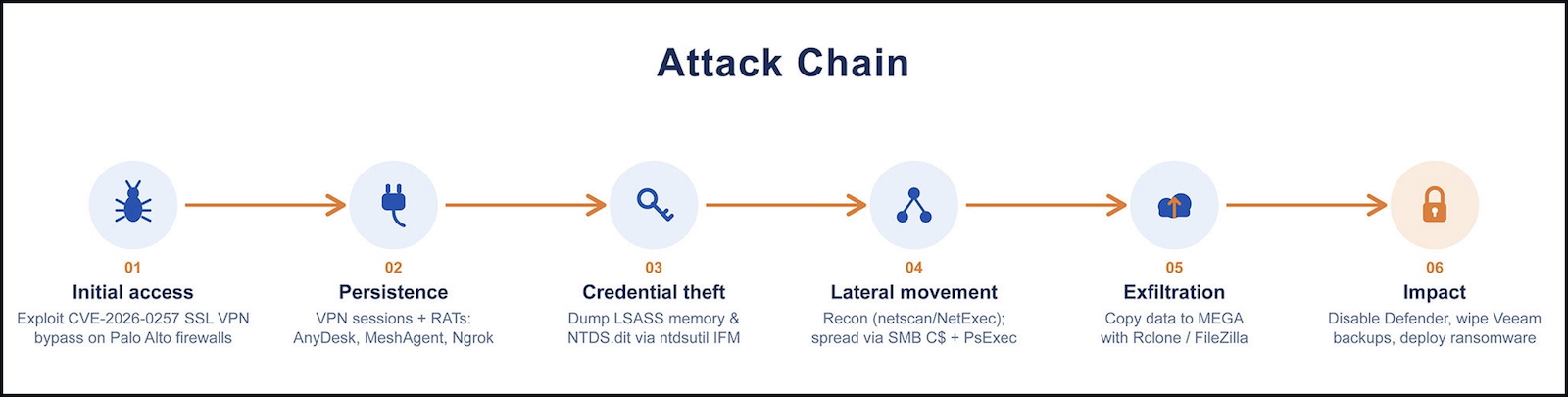
The notorious Qilin ransomware gang has been observed actively exploiting a critical authentication bypass vulnerability in Palo Alto Networks’ PAN-OS GlobalProtect software, identified as CVE-2026-0257, to gain unauthorized access to victim networks. This alarming development, brought to light by cybersecurity firm Arctic Wolf Labs, underscores the escalating threat posed by sophisticated cybercriminal operations targeting widely used network infrastructure. The flaw allows attackers to bypass security restrictions and establish unauthorized VPN connections, effectively creating a backdoor into corporate environments.
A Critical Vulnerability Uncovered and Rapidly Exploited
The vulnerability, CVE-2026-0257, pertains specifically to the GlobalProtect portal and gateway components of Palo Alto Networks’ PAN-OS software. This critical flaw was officially addressed by Palo Alto Networks on May 13, 2026, when the company released patches and issued a warning about limited exploit attempts on unpatched devices. However, the window of opportunity for attackers was short-lived. Just four days later, on May 17, 2026, security firm Rapid7 reported observing active exploitation of the vulnerability against numerous customers, indicating a swift transition from discovery to weaponization by threat actors.
Palo Alto Networks had initially cautioned that "GlobalProtect portal and gateway of Palo Alto Networks PAN-OS® software allows the attacker to bypass security restrictions and establish an unauthorized VPN connection." The company’s proactive measure to release patches was a crucial step, yet the speed at which the vulnerability was integrated into attack campaigns highlights the persistent challenge of timely patching across diverse organizational landscapes. The potential impact of such a bypass is profound, as GlobalProtect VPNs serve as a primary gateway for remote access to internal networks, making them a high-value target for adversaries seeking to establish a foothold.

Chronology of a Widening Threat
The timeline of CVE-2026-0257’s exploitation reveals a rapid escalation from initial discovery to widespread abuse by financially motivated threat groups:
- May 13, 2026: Palo Alto Networks issues an advisory for CVE-2026-0257, a critical authentication bypass flaw in PAN-OS GlobalProtect. Patches are released, and initial warnings about limited exploitation in the wild are made public. Organizations are urged to apply updates immediately.
- May 17, 2026: Cybersecurity firm Rapid7 publicly reports observing active exploitation of CVE-2026-0257 against several of its customers. This marks a significant shift, confirming that the vulnerability is no longer theoretical but actively being leveraged by malicious actors.
- May 29, 2026: The U.S. Cybersecurity and Infrastructure Security Agency (CISA) adds CVE-2026-0257 to its authoritative Known Exploited Vulnerabilities (KEV) catalog. This action carries significant weight, as CISA mandates that all federal agencies secure their GlobalProtect VPN instances within a strict three-day deadline, underscoring the severity and immediate threat posed by the flaw.
- June 2026 (Ongoing): Arctic Wolf Labs releases its findings, detailing multiple distinct intrusions observed throughout June 2026. These investigations conclusively link successful exploitation of CVE-2026-0257 against Palo Alto Networks firewall appliances directly to the deployment of Qilin ransomware, leading to domain-wide encryption events. Arctic Wolf assesses with moderate confidence that such intrusions are likely ongoing, driven by extensive scanning activity and the operational model of ransomware-as-a-service (RaaS).
This swift progression from vulnerability disclosure to confirmed ransomware deployment within weeks paints a stark picture of the agility and determination of modern cybercriminal enterprises.
Qilin Ransomware: A Persistent and Evolving Threat
The Qilin ransomware group, a prominent player in the cybercrime landscape, operates under a Ransomware-as-a-Service (RaaS) model. This framework allows various affiliates to utilize the Qilin ransomware strain and infrastructure in exchange for a cut of the ransoms paid by victims. The group first emerged in August 2022, initially operating under the moniker "Agenda." Since its inception, Qilin has steadily grown its victim count, claiming responsibility for over 2,000 victims on its dark web leak site, which serves as a platform to pressure non-paying victims by publishing their stolen data.

Arctic Wolf Labs’ investigation into the recent breaches revealed that post-exploitation tradecraft varied considerably across different incidents. This variation, ranging from rapid encryption-only operations to more comprehensive double-extortion tactics (where data is exfiltrated before encryption to increase leverage), strongly suggests the involvement of multiple Qilin affiliates. Each affiliate, operating independently under the Qilin RaaS umbrella, likely employs its own preferred methods for lateral movement, data exfiltration, and ransomware deployment after initial network access is achieved. This distributed model makes attribution and defense more complex, as attack patterns can differ significantly even when originating from the same initial vulnerability.
Qilin has a track record of targeting high-profile organizations across various sectors, demonstrating its broad reach and impact. Notable past victims include:
- Nissan: The automotive giant confirmed a data breach claimed by Qilin ransomware, impacting its design studio.
- Yanfeng: Another major automotive industry player, Yanfeng, was also hit by Qilin.
- Asahi: The Japanese beer giant suffered an attack where Qilin ransomware claimed responsibility and subsequently leaked data.
- Synnovis: A pathology services provider, linked to attacks on London hospitals, fell victim to Qilin.
- Lee Enterprises: The publishing giant experienced an attack that led to the leakage of stolen data.
- Australia’s Court Services Victoria: Court recordings and other sensitive information were reportedly exposed in a ransomware attack attributed to Qilin.
The group’s consistent ability to breach and extort significant entities highlights its sophistication and the ongoing threat it poses to global businesses and critical infrastructure. The integration of CVE-2026-0257 into their toolkit significantly expands their attack surface, enabling them to target a vast number of organizations relying on Palo Alto Networks GlobalProtect for secure remote access.
The Pervasive Reach of the Vulnerability
The scale of potential exposure to CVE-2026-0257 is staggering. Internet threat watchdog Shadowserver actively monitors over 167,000 GlobalProtect VPN instances that are directly exposed online. Similarly, the popular search engine Shodan, which indexes internet-connected devices, has identified over 172,000 IP addresses exhibiting a GlobalProtect fingerprint. These figures underscore the immense number of organizations globally that could potentially be at risk if their systems remain unpatched.
However, it is crucial to note that these numbers represent the total count of exposed instances and do not differentiate between systems that have already been patched against CVE-2026-0257 and those that remain vulnerable. Furthermore, some of these identified instances might be honeypots or intentionally exposed systems used for research or deception purposes. Nevertheless, the sheer volume of publicly accessible GlobalProtect interfaces presents a formidable challenge for network defenders and a lucrative target for opportunistic attackers.
Palo Alto Networks holds a significant market share in the cybersecurity industry, with its products and services utilized by over 70,000 customers worldwide. This customer base includes a substantial portion of the largest U.S. banks and an impressive 90% of Fortune 10 companies. The widespread adoption of Palo Alto Networks’ solutions means that a vulnerability in a core product like GlobalProtect has far-reaching implications, potentially impacting critical sectors and vital economic infrastructure globally.
Broader Impact and Implications for Cybersecurity
The exploitation of CVE-2026-0257 by the Qilin ransomware group serves as a stark reminder of several critical cybersecurity challenges:
- The Criticality of Perimeter Security: VPNs and other perimeter devices are often the first line of defense, making them prime targets for initial access. A flaw allowing authentication bypass in such a device effectively nullifies this defense, granting attackers direct entry into an organization’s internal network. This incident reinforces the need for rigorous security assessments, continuous monitoring, and rapid patching strategies for all internet-facing infrastructure.
- The Agility of Ransomware-as-a-Service (RaaS): The speed at which Qilin affiliates integrated CVE-2026-0257 into their operations demonstrates the efficiency and scalability of the RaaS model. This framework enables a broader range of cybercriminals to leverage newly discovered exploits quickly, accelerating the pace of attacks and putting immense pressure on defenders to patch vulnerabilities almost immediately.
- The Imperative of Timely Patch Management: Despite warnings and available patches, many organizations struggle with applying updates promptly due to complex IT environments, resource constraints, or lack of awareness. The CISA directive to federal agencies, demanding patching within three days, highlights the critical importance of having robust patch management processes that can respond to zero-day or N-day exploits with extreme urgency.
- The Economic and Operational Toll of Ransomware: Ransomware attacks, particularly those involving double-extortion, can cripple businesses, leading to significant financial losses from ransom payments, operational downtime, recovery costs, and reputational damage. The pervasive nature of Qilin’s operations and its ability to target diverse sectors underscore the ongoing economic threat posed by such groups.
- The Role of Threat Intelligence and Collaboration: The contributions of cybersecurity firms like Arctic Wolf Labs and Rapid7 in identifying and reporting active exploitation are invaluable. Their intelligence allows organizations to prioritize patching efforts and enhance their defensive postures. Collaborative efforts between vendors, government agencies, and private security researchers are essential in the ongoing fight against sophisticated cyber threats.
- Supply Chain Vulnerabilities: Given Palo Alto Networks’ extensive customer base, a vulnerability in their products creates a supply chain risk. Organizations that rely on these systems inherit the risks associated with any unpatched flaws, emphasizing the need for robust vendor risk management and continuous security assessments of third-party software and hardware.
In conclusion, the exploitation of CVE-2026-0257 by the Qilin ransomware group represents a severe and ongoing threat to organizations worldwide. The rapid weaponization of this critical vulnerability, combined with Qilin’s established track record and the vast number of exposed GlobalProtect instances, necessitates immediate and decisive action. Organizations utilizing Palo Alto Networks GlobalProtect are strongly advised to verify that all necessary patches have been applied and to implement enhanced monitoring for any signs of compromise, as the window for effective defense continues to narrow against an ever-evolving threat landscape.

