
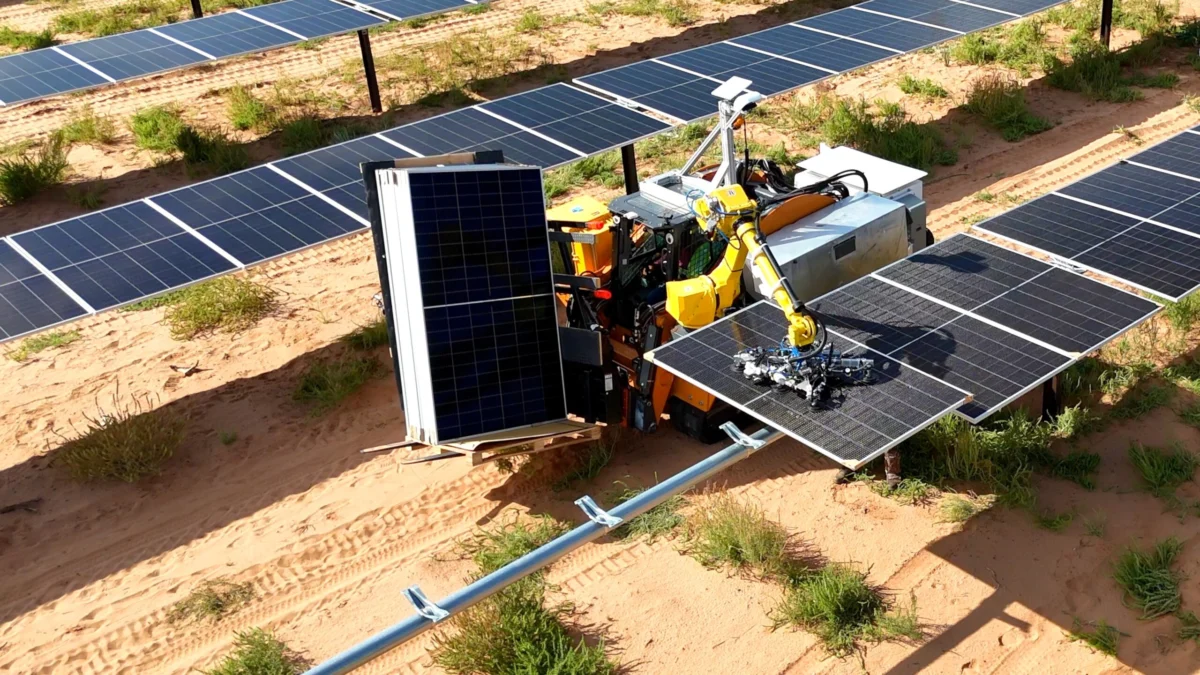
Gritt, a robotics and artificial intelligence startup founded by Carnegie Mellon-trained engineers, officially exited stealth mode on Tuesday morning, announcing a $26 million Series A funding round. This investment, led by Obvious Ventures with participation from Union Square Ventures and Active Impact Investment, brings the company’s total capital raised to $34 million. The funding follows an earlier seed round supported by First Round Capital, Climactic, Congruent Ventures, and VSC Ventures. Headquartered in the robotics hub of Pittsburgh, Gritt aims to revolutionize the construction industry by deploying "physical AI" to handle the labor-intensive, repetitive, and often dangerous tasks associated with large-scale solar energy projects.
The emergence of Gritt comes at a critical juncture for the global energy transition. As nations race to meet decarbonization targets, the deployment of solar energy has transitioned from a niche environmental goal to a massive industrial imperative. However, the industry is currently grappling with a severe labor shortage that threatens to derail the pace of construction. By integrating advanced AI models with off-the-shelf industrial hardware, Gritt believes it has found a scalable solution to automate the most arduous aspects of infrastructure development, beginning with the installation of utility-scale solar arrays.
The Intersection of Renewable Energy Demand and Labor Shortages
The global solar energy market is experiencing unprecedented growth, driven by falling costs and significant legislative support, such as the Inflation Reduction Act (IRA) in the United States. According to the Solar Energy Industries Association (SEIA), the U.S. solar market installed a record 32.4 gigawatts (GW) of capacity in 2023, a 51% increase over 2022. To maintain this momentum and reach the Biden administration’s goal of a 100% clean electricity grid by 2035, the industry must significantly increase its workforce.
However, the reality on the ground is stark. Construction firms report persistent difficulties in recruiting and retaining workers for utility-scale projects, which are often located in remote, arid regions with harsh working conditions. These jobs involve the "dirty, dull, and dangerous" tasks of manual labor, such as lifting 100-pound glass panels repeatedly in the sun. The Solar Training Network has estimated that the industry will need hundreds of thousands of additional workers by 2030 to meet installation targets.
Gritt’s founders, CEO Puneet Puri and CTO Vishal Dugar, identified this bottleneck as an opportunity for robotics. While industrial robots have long dominated controlled environments like automotive assembly lines, they have historically struggled in the "unstructured" environments of construction sites, where terrain is uneven, lighting is unpredictable, and tasks are non-linear. The recent leap in AI and machine vision, however, has provided the necessary intelligence to bridge this gap.
A "Software-First" Approach to Physical Intelligence
Unlike many of its competitors who are building bespoke hardware from the ground up, Gritt has adopted a strategy centered on software and off-the-shelf machinery. The company’s primary focus is the development of a "physical AI" layer that can be integrated into existing industrial equipment. Currently, Gritt utilizes rented skidders—versatile construction vehicles—and robotic arms manufactured by established providers like Kawasaki.
This approach offers several strategic advantages. First, it allows Gritt to remain "asset-light," avoiding the massive capital expenditures and long lead times associated with manufacturing proprietary heavy machinery. Second, it ensures that the hardware used is already familiar to construction crews and is serviceable through existing global supply chains.
The core of Gritt’s innovation lies in its AI models. These systems enable the robot to perceive its environment with high fidelity, allowing it to unload large solar panels from delivery crates, transport them to the installation site, and position them on metal racking systems with sub-millimeter accuracy. This level of precision is essential for ensuring the structural integrity of the solar farm and for allowing human workers to quickly fasten the panels without needing to manually adjust their weight.
Puri explains that the goal was never just to build a robot for a single task, but to create a generalizable intelligence. "Our thesis is that if we truly want to speed up construction, you need an intelligence which can work in the outdoor, chaotic environments of these construction sites," Puri said. The company’s software pipeline is designed to be adaptable; for instance, the founders noted that while it took weeks to train the system to stack cinder blocks, it took only a single day to adapt that knowledge for the task of tying rebar.
Operational Efficiency and Safety Gains
The impact of Gritt’s technology on site productivity is substantial. In current field deployments, Gritt has demonstrated that its systems can exponentially increase the output of a standard installation crew. Typically, an eight-person manual crew can install approximately 800 solar panels in a single day. When augmented with Gritt’s robotic systems, that same crew can install between 3,000 and 4,000 panels daily.
This four-to-five-fold increase in efficiency changes the economic calculus of large-scale solar projects. Faster installation reduces the "time-to-power" for utility companies, allowing them to begin generating revenue and clean energy months earlier than planned. Furthermore, the technology addresses significant safety concerns. The manual handling of solar panels, which can weigh up to 100 pounds and have large surface areas susceptible to wind, is a leading cause of musculoskeletal injuries and site accidents.
One Gritt customer, a senior executive at a major U.S. power construction firm who spoke on the condition of anonymity, highlighted the safety benefits as a primary driver for adoption. "In remote sites, it is incredibly difficult to attract labor. When you do find workers, you are constantly worried about the physical toll the job takes on them," the executive stated. "Using a system that handles the heavy lifting not only speeds up the project but significantly reduces our liability and improves worker retention."
Chronology of Development and Market Traction
Gritt’s journey from a research concept at Carnegie Mellon to a venture-backed startup with a multi-gigawatt pipeline has been rapid.
- Founding Phase: Puri and Dugar, drawing on their backgrounds in robotics and AI, began developing the core algorithms for unstructured environmental navigation several years ago.
- Seed Funding: The company raised $8 million in seed funding to develop its first prototypes, focusing on the most labor-intensive part of the solar value chain: panel placement.
- Pilot Programs: Over the past year, Gritt has quietly deployed two systems in active field environments. These units have been used to collect vast amounts of data, which are fed back into the AI models to improve performance in various weather and terrain conditions.
- Series A and Commercialization: The $26 million Series A announced this week marks the transition from pilot testing to commercial scale.
The company is currently contracted to assist in the installation of 2.8 gigawatts of solar capacity over the next 18 months. To put this in perspective, 2.8 GW is enough to power roughly 2.1 million homes. Gritt’s client list includes three of the top ten power construction companies in the United States, and the startup plans to have 48 systems operational in the field within the next six months.
Strategic Positioning and Competitive Landscape
The market for construction robotics is becoming increasingly crowded as the industry recognizes the necessity of automation. Gritt faces competition from several other players, including Luminous Robotics, Cosmic, and China-based Trinabot. However, a key differentiator remains the hardware strategy.
Competitors like Trinabot often develop specialized, proprietary robots designed solely for solar installation. While these can be highly efficient, they often lack the versatility of Gritt’s software-first approach. By using standard industrial arms and vehicles, Gritt can theoretically pivot its "intelligence layer" to other construction tasks without redesigning the physical machine.
Andrew Beebe, a partner at Obvious Ventures who led the Series A round, emphasized the importance of the founders’ background in navigating this space. Beebe categorized entrepreneurs into those who build "space-grade" hardware with infinite budgets and those who understand the "dirty, dull, and dangerous" reality of industrial scaling. "These guys are in the second camp," Beebe said. "They have the technical chops to make the AI work, but they also understand the rugged realities of a construction site."
Broader Implications for the Construction Industry
While solar installation is the immediate focus, Gritt’s long-term vision extends to the broader $12 trillion global construction industry. The company is already experimenting with tasks such as drilling posts, building the metal racks that hold solar panels, and tying rebar—a ubiquitous and backbreaking task in concrete construction.
The "physical AI" Gritt is building could also serve as a management layer for construction sites. The founders envision a future where the sensors and cameras mounted on their robotic units provide real-time data to site managers. For example, the AI could detect if a trench has been left open during an approaching storm and alert the crew, or it could automatically track inventory levels of panels and fasteners, preventing costly delays due to missing materials.
This level of site-wide intelligence represents a shift from "automation of a task" to "automation of a process." By providing a digital twin of the construction site’s progress, Gritt enables more informed decision-making and reduces the "chaos" that Puri identifies as the primary hurdle to infrastructure speed.
Conclusion: Accelerating the Path to Net Zero
The success of companies like Gritt may determine whether global climate goals remain achievable. The transition to renewable energy is no longer just a matter of policy or finance; it is a matter of physical execution. If the world cannot build the necessary infrastructure due to a lack of human hands, the energy transition will stall.
Gritt’s approach—combining the latest breakthroughs in AI with the reliability of existing industrial hardware—offers a pragmatic and scalable path forward. By increasing the productivity of existing crews and removing the most hazardous elements of the job, the startup is not replacing workers but empowering them to build the future of energy at a pace previously thought impossible. As the company scales its fleet over the coming year, its impact on the 2.8 GW of contracted projects will serve as a high-stakes proof of concept for the role of AI in the physical world.

