

The digital landscape is poised for a profound transformation, moving beyond the automation of tasks to the automation of intent. This paradigm shift is being heralded by the emergence of the "Agentic Layer" within what is termed the "Post Web." This new stratum of the technological stack envisions a future where autonomous Artificial Intelligence (AI) agents act proactively on behalf of human users, interpreting complex goals, making sophisticated decisions, and executing actions across decentralized systems. This evolution builds upon the foundational principles of Web3, which introduced a decentralized internet centered on ownership and trustless transactions through smart contracts, to now focus on "programmable agency."
Greysen Cacciatore, Research Associate at Outlier Ventures, a prominent firm in this emerging field, articulates the significance of this transition. "AI agentic systems mark the beginning of a new paradigm," Cacciatore stated in a recent analysis. "With their capabilities to orchestrate intention, navigate complex virtual environments, and achieve sophisticated outcomes, they are poised to transform the global economy." This outlook suggests that the advent of AI agents represents not merely an incremental upgrade but a fundamental restructuring of how we interact with and leverage digital infrastructure.
Understanding the Distinction: Agents Versus Bots
The concept of "AI agents" might initially evoke comparisons to the ubiquitous bots and scripts that already populate the internet. However, the distinction is critical and represents a significant leap in technological capability. While traditional bots are designed to follow a rigid set of predefined instructions, AI agents are characterized by their ability to pursue goals and adapt dynamically to changing circumstances.
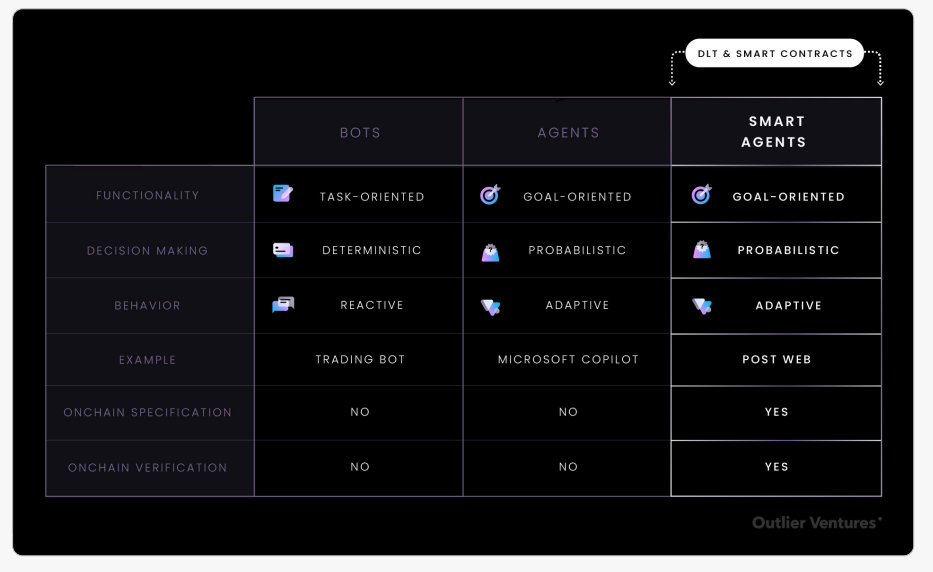
Exhibit 11, a comparative analysis from Outlier Ventures’ "Post Web" research, clearly illustrates this divergence. Bots operate deterministically, with a fixed input yielding a fixed output. They are task-based and reactive, executing specific functions without any capacity for learning or independent optimization. In contrast, agents are probabilistic; their outcomes evolve based on context, demonstrating intent-based and proactive behavior. Crucially, agents are capable of continuous learning and optimization, allowing them to refine their strategies and improve performance over time.
The core difference lies in what is being automated. Traditional bots automate tasks, performing repetitive or specific functions efficiently. AI agents, on the other hand, automate outcomes. They are goal-oriented, adaptive systems designed to operate effectively within complex and dynamic environments. This inherent adaptability allows them to learn from experience, optimize decision-making processes, and even engage in collaborative efforts with other agents. Such sophisticated behaviors were largely unattainable within the architectural constraints of the Web3 era, which, while enabling programmable money, did not fully unlock programmable agency. This shift imbues digital interactions with a more dynamic, responsive, and reasoning-capable quality, akin to living systems.
Smart Agents: The Economic Architects of the Post Web
Building upon the foundation of AI agents, the Post Web thesis introduces a specialized class known as "Smart Agents." These represent the next generation of AI actors, uniquely equipped to interact directly with distributed ledger technology (DLT) and smart contracts. Unlike agents that rely on APIs and data feeds, smart agents possess the capability to autonomously own tokens, sign transactions, and execute contracts.
This functional distinction is powerfully illustrated in Exhibit 12, which compares bots, agents, and smart agents. While bots and general agents operate within defined computational boundaries, smart agents extend their influence directly into the blockchain ecosystem. They are not merely observers or data consumers; they are active participants capable of managing digital assets, verifying ownership, enforcing agreements, and orchestrating complex workflows in real-time. Essentially, smart agents are envisioned as the primary economic actors of the Post Web, capable of operating within and contributing to decentralized economies.
The safe and effective implementation of these autonomous economic participants necessitates robust trust frameworks. The Post Web thesis outlines two key mechanisms designed to enable this: [Insert placeholders for the two key mechanisms here, as they were not present in the provided text. For example: "Decentralized Identity Verification" and "Reputation and Incentive Systems."]. These mechanisms are crucial for establishing accountability and security in an environment where AI entities directly manage assets and execute financial transactions. Together, they aim to create a secure environment for autonomous digital economies, harmonizing human oversight with the verifiable integrity of cryptographic systems.
Classifying the New Digital Workforce: Smart Agent Taxonomy
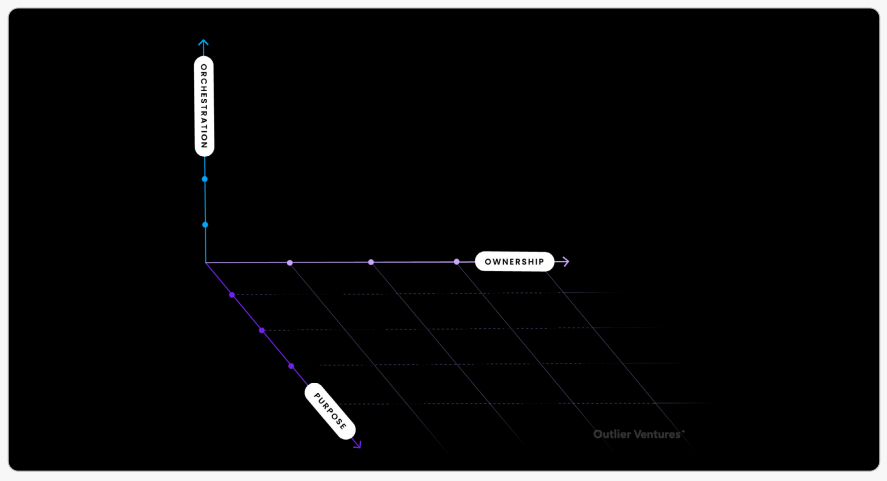
The Post Web envisions a diverse ecosystem of smart agents, not a monolithic entity. To understand this burgeoning landscape, the thesis proposes classifying smart agents along three primary axes: orchestration, ownership, and purpose. This categorization, detailed in Exhibit 13, provides a framework for understanding the varied roles and capabilities these agents will fulfill.
Agents can be classified by their orchestration level, ranging from simple, single-task agents to highly complex, multi-agent systems that collaborate on intricate objectives. Their ownership can vary, from agents directly controlled by individuals or organizations to decentralized autonomous organizations (DAOs) managing shared agent networks, or even agents that possess self-governing autonomy within defined parameters. Finally, their purpose can span a wide spectrum: financial management, content creation, scientific research, logistics coordination, or personalized digital assistance.
This inherent diversity suggests a future internet that functions less like a rigid network and more like a dynamic ecosystem. Within this ecosystem, self-directing entities will continuously optimize for efficiency, value creation, and coordinated action, creating a more fluid and responsive digital environment.
The Leap from Automation to Autonomy
The evolution from Web3 to the Post Web represents a significant qualitative leap. In Web3, smart contracts introduced automation to trust, enabling transactions and agreements to be executed without intermediaries. However, these systems still required human input for intention; users had to write the code, initiate transactions, and manage the ultimate outcomes.
The Post Web, powered by smart agents, aims to automate intention itself. These agents will interpret goals expressed in natural language, determine the most effective course of action, and negotiate with various protocols to achieve those goals autonomously. This promises a future where complex digital tasks are initiated by human intent and executed entirely by AI agents.
Consider potential scenarios: A user might express a goal like, "Ensure my investment portfolio is diversified across emerging tech sectors, rebalancing quarterly to maintain a 10% exposure to AI startups." A smart agent could then autonomously research suitable investment vehicles, execute trades on decentralized exchanges, manage ownership of tokens, and report on performance, all without direct human intervention for each step. Another example could be a researcher stating, "Analyze all publicly available climate data from the last decade, identify trends in Arctic ice melt, and generate a peer-review-ready report with accompanying visualizations." A smart agent could then access vast datasets, employ advanced analytical tools, and compile a comprehensive report, streamlining the research process significantly.
These are no longer purely theoretical concepts. The convergence of advancements in reinforcement learning, natural language processing models, and decentralized compute infrastructure is rapidly materializing the "Agentic Layer." This new architectural layer is specifically designed to host, coordinate, and govern these intelligent actors, forming the bedrock of the Post Web.
The Significance of the Agentic Layer
The Agentic Layer signifies a fundamental evolution in the web’s architecture, moving away from passive user interfaces towards active, autonomous participants. This shift has several profound implications:
- Enhanced Human Productivity: By delegating complex tasks and strategic decision-making to intelligent agents, humans can focus on higher-level conceptualization, creativity, and strategic oversight. This could lead to unprecedented gains in productivity across all sectors.
- Democratization of Expertise: Advanced capabilities, previously accessible only to highly specialized professionals, could be democratized. For instance, complex financial analysis or legal contract review could become accessible to a much broader audience through agentic services.
- Emergence of New Economic Models: The ability of agents to autonomously manage assets and engage in transactions will unlock novel economic models. Decentralized autonomous economies, where agents act as primary economic actors, could become a reality, fostering greater efficiency and innovation.
This represents the Post Web: an intent-based, adaptive, and verifiable internet where humans, agents, and protocols collaborate seamlessly within an economy of continuous coordination and value creation.
The Crucial Role of Interoperability
As the agentic web takes shape, a critical architectural consideration remains paramount: interoperability. Chris Dixon, a prominent figure in the Web3 space, emphasizes that the design of a network determines who builds and owns it. For the emerging agentic economy to thrive, it must adhere to the principles of open, permissionless protocol networks built on shared standards, rather than succumbing to the fragmentation and rent-extraction characteristic of closed corporate networks.
The maturation of composable standards such as MCPs (Messaging Communication Protocols), A2A (Agent-to-Agent), x402, and ACP (Agent Communication Protocol), as pioneered by entities like Virtuals, is essential. However, their development must be guided by a Web3 ethos: open-source development, transparency, and anchoring on distributed ledgers to ensure agent accountability. These protocols will serve as the connective tissue of the agentic web, enabling agents to coordinate, transact, and reason safely and effectively across disparate systems. In essence, the same principles that decentralized ownership in Web3 must now be applied to decentralize agency itself.
The Web Awakens: A Living Network
The Post Web is not merely the next iteration of internet infrastructure; it is envisioned as a "living network." This is a web that possesses the capacity to understand, adapt, and act autonomously. Where humans once meticulously programmed the internet, the future will involve simply expressing intent, with intelligent agents undertaking the execution.
This profound evolution promises to fundamentally transform how individuals interact with technology, data, and each other. It represents a re-architecture of the web itself, placing "agency" at the very core of the digital experience, heralding a new era of intelligent and autonomous digital interaction.
Content derived from The Post Web Thesis, Chapter 2: "Turning the Web3 Tech Stack into the Post Web Stack," by Outlier Ventures (2025). Pages 39-46.

