

In the nascent stages of Web3, the digital wallet served a singular, albeit crucial, purpose: acting as a secure vault for private keys, facilitating transaction signing, and holding digital assets like tokens. This paradigm, however, is rapidly becoming obsolete with the emergence of what is being termed the "Post Web." In this evolving digital landscape, the wallet is no longer a peripheral tool but has fundamentally transformed into the central nexus of the user experience. It has evolved into a dynamic, "living interface" capable of managing not just assets, but also an individual’s digital identity, granular permissions, access to resources, and even the oversight of autonomous artificial intelligence (AI) agents.
This significant evolution is detailed in Chapter 2 of "The Post Web Thesis," which posits that the wallet is poised to become the primary control center of the "Agentic Web." This future iteration of the internet is envisioned as a space where human interaction and intelligent systems converge, with the wallet acting as the principal coordination hub. This shift signifies a profound redefinition of digital ownership, identity, and interaction, moving far beyond the initial cryptocurrency-centric utility of early Web3 wallets.
From Cryptographic Keys to Digital Personhood
The foundational principle of early Web3 wallets, exemplified by platforms like MetaMask and Ledger, revolved around cryptographic custody. The mantra was simple: "own your keys, own your crypto." This focus on secure private key management was paramount for safeguarding digital assets. However, the demands of the Post Web necessitate a broader functionality. Identity and composability have ascended to prominence, transforming wallets into robust self-sovereign identity frameworks.
This transformation allows wallets to perform a range of sophisticated functions previously unimagined. They can now act as verifiable credentials, enabling users to prove their identity and qualifications without relying on centralized authorities. Furthermore, wallets are becoming the conduits for reputation management, accumulating and displaying a verifiable history of interactions and contributions within digital ecosystems. Crucially, they are evolving to manage digital agency, granting permission for actions and interactions on behalf of the user, thereby extending their reach and utility. In essence, the wallet is no longer merely a digital vault; it is becoming a digital representation of the individual – an anchor for personhood, ownership, and verifiable trust.
The Wallet as a Comprehensive Resource Management Hub
The Post Web architecture positions the wallet as a central orchestrator of a far broader spectrum of "resources," extending beyond the management of mere digital assets. This expanded scope means the wallet will govern access to a diverse array of digital and even physical resources, mediated through various protocols and decentralized infrastructures.
This evolving role transforms the wallet into what can be described as an "operating system for autonomy." It will function as a crucial intermediary, mediating interactions across complex networks, diverse protocols, and the burgeoning field of Decentralized Physical Infrastructure Networks (DePIN). By managing access and permissions for these resources, the wallet empowers users to engage with a more interconnected and automated digital world, while retaining granular control over their digital footprint and access rights.
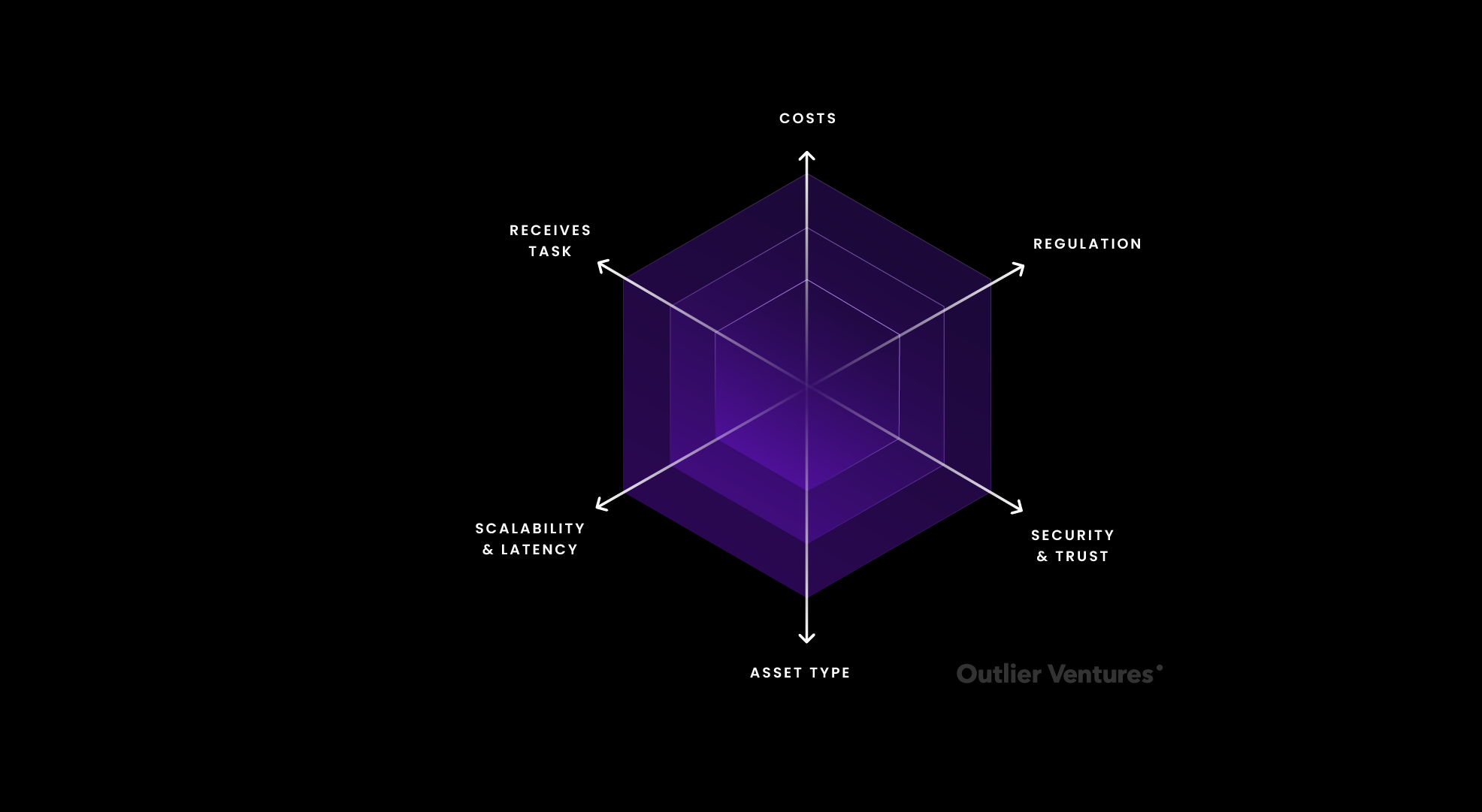
Exhibit 18: Navigating AI Agent Transactions and Decentralized Ledger Technology (DLT)
A critical consideration in this new era is how autonomous AI agents will interact with decentralized systems. As depicted in Exhibit 18, titled "Vector Considerations Deciding if an AI Agent Transaction Needs to Interact DLT," the decision-making process for AI agent transactions is becoming increasingly sophisticated. This exhibit, found on page 64 of "The Post Web Thesis," likely outlines a framework for determining when an AI agent’s proposed action requires the immutability and transparency of a DLT, versus when it can be executed through more conventional, centralized means. This nuanced approach is vital for optimizing efficiency, managing costs, and ensuring appropriate levels of trust and verification for different types of agent-driven activities.
Exhibit 19: The Wallet as the Central Interface of the Post Web
Illustrating this paradigm shift, Exhibit 19, on page 70 of "The Post Web Thesis," presents a conceptual model of "The Wallet as the Post Web Interface." This visual representation underscores the wallet’s central role in connecting users to the multifaceted digital ecosystem. It highlights the wallet’s capacity to manage not only digital assets but also permissions, identity verification, and interactions with AI agents, effectively making it the primary gateway to the Post Web’s functionalities.
A Command Center for Autonomous Agents
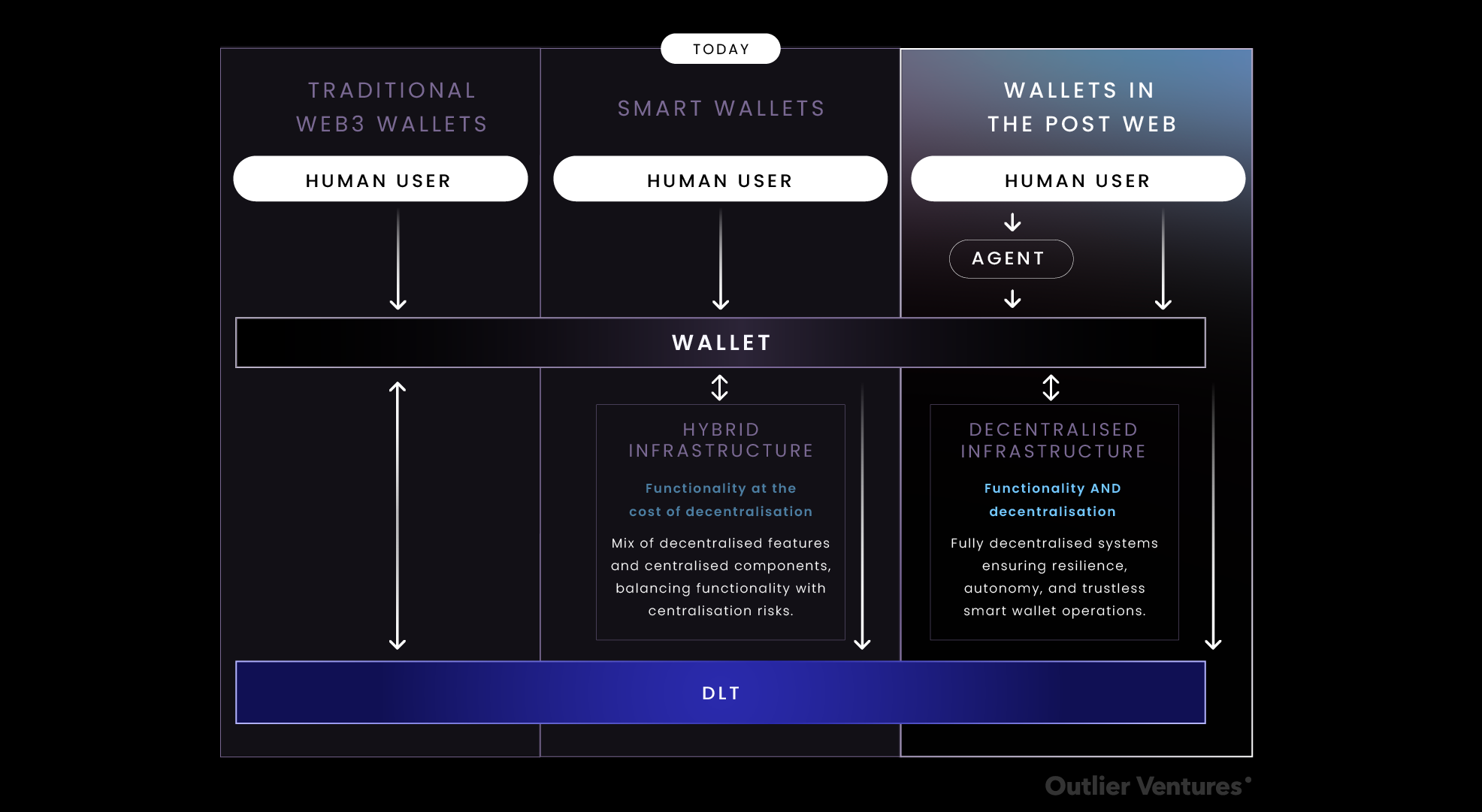
As "smart agents" – sophisticated AI entities designed to perform tasks autonomously – become increasingly integral to the Post Web experience, wallets are evolving into their command consoles. Each agent will connect through a user’s wallet, which will serve several critical functions. It will authenticate and authorize agents, ensuring only trusted entities can act on the user’s behalf. The wallet will also manage permissions, defining the scope of actions an agent can take, thereby preventing unauthorized or unintended operations. Furthermore, it will provide a mechanism for reviewing and approving agent-initiated transactions, offering a final layer of human oversight.
This architectural design ensures that while agents can act autonomously and efficiently, they always operate within the defined boundaries set by the user and their wallet. The wallet, therefore, transcends its role as a simple transaction facilitator to become a governance layer for digital autonomy itself, enabling a more seamless and controlled integration of AI into daily digital life.
Exhibit 20: The Interplay Between Wallets and AI Agents
Exhibit 20, located on page 71 of "The Post Web Thesis," visually details "The Relationship Between Wallets and Agents." This exhibit likely illustrates a user’s wallet as the central hub, with various AI agents connecting through it. The diagram would emphasize the crucial permission and verification loops that govern these interactions. This visual representation reinforces the concept of the wallet as a secure and controlled environment for managing the complex relationships between users and their AI counterparts, ensuring that agency is delegated responsibly and transparently.
Fortifying Privacy and Security in an Agentic World
The expansion of wallet functionality to encompass behavioral data, credentials, and agent connections brings with it a heightened imperative for robust privacy and security measures. As outlined on pages 74-76 of "The Post Web Thesis," under the section "Privacy-Preserving Wallet Architectures," new cryptographic frameworks are being deployed to maintain user trust in this increasingly complex environment.
Techniques such as zero-knowledge proofs are enabling the verification of information without revealing the underlying data, thereby protecting sensitive user details. Secure multi-party computation allows for computations to be performed on encrypted data, further enhancing privacy. Homomorphic encryption enables computations on encrypted data without decryption, offering a powerful tool for private data analysis. These advancements collectively foster a "privacy by design" approach, ensuring that users remain in control of their data while still enabling verifiable and autonomous operations.
Smart Wallets: Addressing Current User Experience Challenges
For much of its history, the cryptocurrency space has grappled with significant user experience hurdles, with wallets often being a primary bottleneck. Cumbersome onboarding processes, the catastrophic potential of losing access due to misplaced seed phrases, and the complexity of managing assets across numerous blockchain networks have hindered mainstream adoption.
The advent of "smart wallets" is actively addressing these challenges. Platforms like Safe exemplify this evolution, significantly improving user experience and enabling users to automate their digital intentions. Smart wallets like Safe offer extensive customization through features such as automated recurring transactions, enhanced security protocols like spending limits and whitelisting, and seamless integration with decentralized finance (DeFi) protocols. This move from manual execution to intention-based interaction positions smart wallets as the critical interface between human users and autonomous on-chain actions.
Interoperability and Intent: Redefining the Wallet’s Interface
As the proliferation of AI agents continues, the wallet is set to become the definitive interface for expressing "intent." Instead of requiring users to manually sign and approve each individual transaction, they will be able to articulate high-level goals. Examples include directives such as "Find the best yield strategy under 5% risk" or "Vote on governance proposals aligned with sustainability." The wallet will then interpret these intents, route them across the appropriate protocols and networks, and ensure their verifiable execution.
This fundamental shift from discrete task execution to sophisticated "intent negotiation" marks the final metamorphosis of the wallet. It evolves from a simple digital vault into an intelligent mediator, bridging the gap between human purpose and machine execution, and fundamentally reshaping how we interact with the digital world.
Closing Thoughts: The Wallet as an Extension of Self
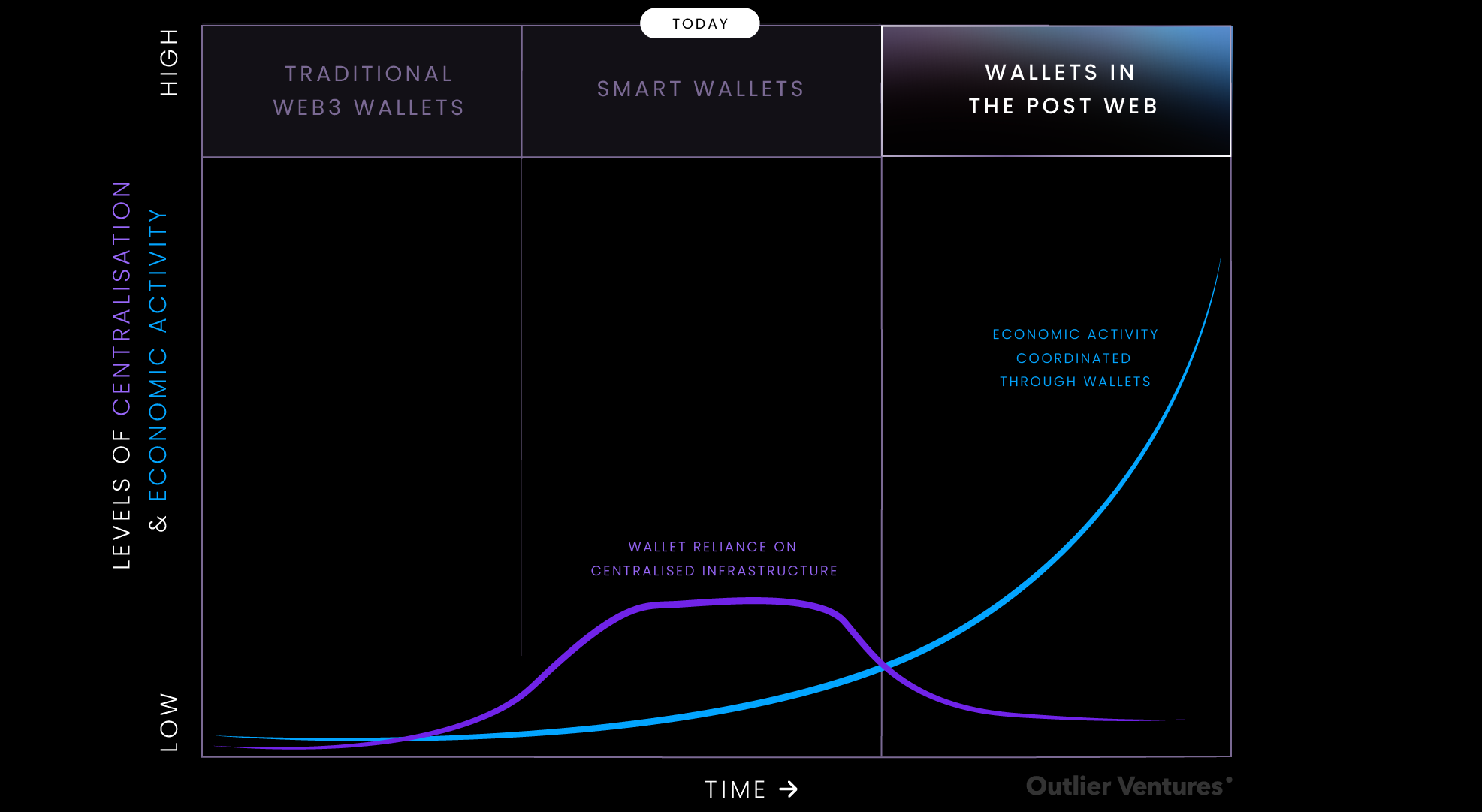
The Post Web fundamentally redefines the concept of a digital wallet. It is no longer merely a tool for cold storage or asset management. Instead, it is emerging as a living, adaptive interface that serves as the gateway to identity, assets, and autonomy. In this new paradigm, a user’s wallet will go far beyond simply signing transactions. It will proactively manage digital identity, curate access to resources, orchestrate autonomous agents, and facilitate intent-based interactions.
In essence, the wallet is becoming the true manifestation of digital selfhood, serving as the nexus of ownership, identity, and agency within the burgeoning agentic economy. It represents a profound evolution, moving from a passive repository of value to an active, intelligent extension of the user in the digital realm.
Credits and Source
This analysis is derived from "The Post Web Thesis; Chapter 2: Turning the Web3 Tech Stack into the Post Web Stack," published by Outlier Ventures in 2025, with specific references to pages 67-76. The insights on smart wallets have been further enriched by contributions from Andres Acevedo, Investment Manager at Outlier Ventures. Readers interested in a deeper exploration of this vision are encouraged to seek early access to Chapter 3 of "The Post Web Thesis," titled "Zero to Many," which is slated for future release.

