

The digital landscape is on the cusp of a profound transformation, shifting its focus from merely automating tasks to orchestrating human intention. This paradigm shift, articulated in the foundational "Post Web Thesis" by Outlier Ventures, heralds the emergence of the "Agentic Layer." This new stratum of the technological stack is designed to host autonomous Artificial Intelligence (AI) agents that will act on behalf of individuals, interpreting complex goals, making sophisticated decisions, and executing actions across decentralized systems. This evolution builds upon the ownership revolution of Web3, promising an internet not just of ownership, but of programmable agency.
Greysen Cacciatore, a Research Associate at Outlier Ventures, underscores this pivotal moment in a statement within the thesis: "AI agentic systems mark the beginning of a new paradigm. With their capabilities to orchestrate intention, navigate complex virtual environments, and achieve sophisticated outcomes, they are poised to transform the global economy." This sentiment reflects a growing consensus within the tech industry that the current iteration of the internet, while powerful, has limitations in its ability to truly empower users with proactive and intelligent digital assistants.
Distinguishing Agents from Their Predecessors: The Evolution from Bots
The concept of "AI agents" might initially evoke images of the bots and scripts already ubiquitous online. However, the distinction is far more fundamental than a mere semantic difference. While traditional bots operate on predefined instructions and execute specific, often repetitive tasks, AI agents are designed for a higher level of autonomy and adaptability.
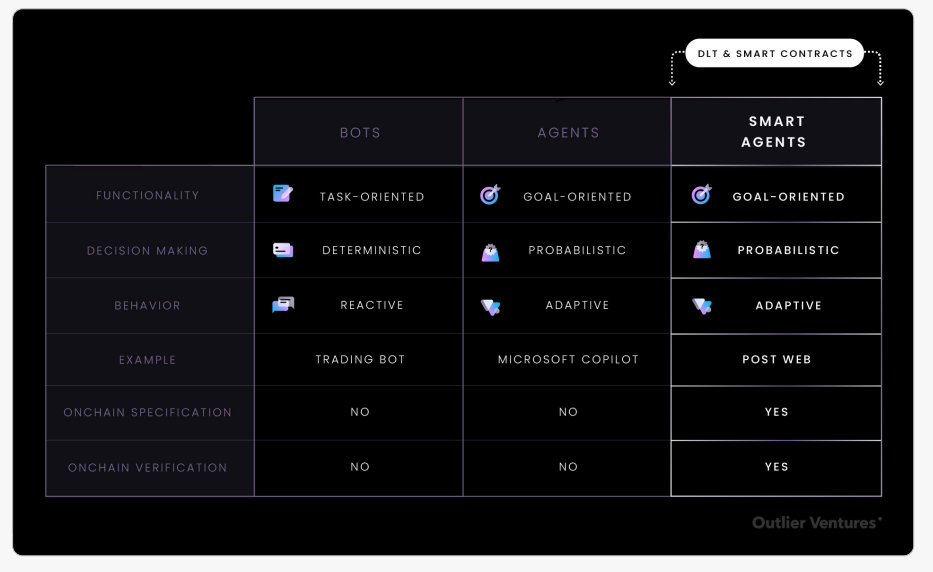
Exhibit 11 from the Post Web Thesis, "Comparison of Bots & Agents," clearly delineates this evolution. Bots are characterized by their deterministic nature, following fixed input/output pathways and executing task-based, reactive functions. They lack the capacity for learning or dynamic adaptation. In contrast, agents are probabilistic, meaning their outcomes can evolve based on context. They are intent-based and proactive, capable of learning from experience, optimizing their decision-making processes, and even collaborating with other agents to achieve overarching goals. This continuous learning and optimization is a critical differentiator, transforming digital interactions from static sequences into dynamic, responsive processes. The core difference, therefore, lies in their operational scope: bots automate tasks, while agents automate outcomes.
Smart Agents: The Economic Engines of the Post Web
The Post Web thesis introduces a further refinement: "Smart Agents." These represent a next-generation class of AI agents specifically engineered to interact directly with distributed ledger technology (DLT) and smart contracts. Unlike earlier iterations that relied on APIs or data feeds for information, smart agents possess the capability to autonomously own tokens, sign transactions, and execute contracts.
As illustrated in Exhibit 12, "Comparison of Bots, Agents & Smart Agents," this capability elevates them to the status of true economic participants within the digital realm. They are not merely tools; they are autonomous entities capable of managing digital assets, verifying ownership, enforcing agreements, and executing complex workflows in real-time. This functionality is crucial for enabling a decentralized economy that can operate with unprecedented efficiency and autonomy.
To facilitate this secure operation, the Post Web framework introduces two key mechanisms:
- Verifiable Credentials and Decentralized Identifiers (DIDs): These provide agents with secure, self-sovereign digital identities, enabling them to prove their authenticity and authorization without relying on centralized authorities.
- Decentralized AI Compute and Oracles: This ensures that agents can access the computational power and real-world data necessary to make informed decisions and execute actions securely and transparently, independent of single points of failure.
Together, these innovations are designed to establish a robust trust framework for autonomous digital economies, harmonizing human oversight with cryptographic verifiability.
Classifying the Intelligent Actors: A Spectrum of Agent Capabilities
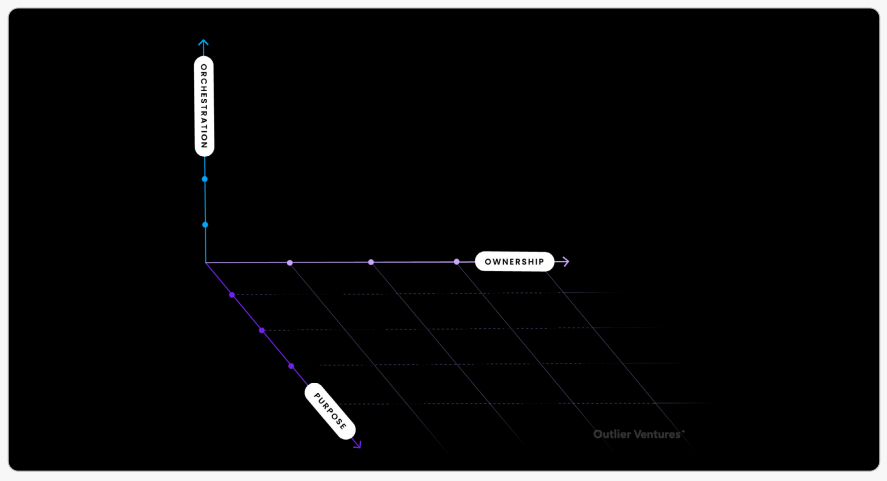
The Post Web envisions a diverse ecosystem of smart agents, not a monolithic entity. Exhibit 13, "Classification of Smart Agents by Orchestration, Ownership & Purpose," outlines a framework for understanding this spectrum. Agents are categorized along three primary axes:
- Orchestration: This axis defines how agents are coordinated, ranging from single-agent operations to complex, multi-agent systems working in concert.
- Ownership: This refers to how agents are owned and controlled, encompassing entities owned by individuals, corporations, decentralized autonomous organizations (DAOs), or even other agents.
- Purpose: This describes the specific functions agents are designed to fulfill, from simple data aggregation and analysis to complex strategic decision-making and execution in financial markets or decentralized applications.
This multifaceted classification suggests a future internet that functions more like a dynamic ecosystem than a static network. These self-directing entities will continuously optimize for efficiency, value creation, and intricate coordination, leading to a more fluid and responsive digital environment.
The Leap from Automation to Autonomy: A Fundamental Shift
The evolution from Web3 to the Post Web represents a significant leap from automation to autonomy. In Web3, smart contracts automated trust, enabling transactions and agreements without intermediaries. However, they still required human input for intention – users had to write the code, initiate transactions, and manage outcomes.
The Post Web, with its introduction of smart agents, automates intention itself. These agents are designed to interpret human goals expressed in natural language, determine the most effective course of action, and autonomously negotiate with protocols to achieve those goals. This opens up a realm of possibilities previously confined to theoretical discussions:
- Autonomous Financial Management: Imagine an agent tasked with optimizing your investment portfolio, automatically rebalancing assets based on market fluctuations and your stated risk tolerance.
- Decentralized Autonomous Organizations (DAOs) with Enhanced Capabilities: Agents could manage DAO treasuries, propose and vote on proposals, and execute complex governance decisions without constant human oversight.
- Personalized Digital Assistants: Beyond current virtual assistants, these agents could proactively manage your schedule, book appointments, handle travel arrangements, and even negotiate contracts on your behalf, all while adhering to your preferences and ethical guidelines.
These scenarios are becoming increasingly tangible as advancements in reinforcement learning, natural language processing (NLP), and decentralized compute converge. This convergence is giving rise to the "Agentic Layer" – a new architectural foundation for the web, purpose-built to host and coordinate these intelligent actors.
The Significance of the Agentic Layer: A Reimagined Web Architecture
The Agentic Layer signifies a fundamental evolution in the web’s architecture, moving beyond passive user interfaces to active, autonomous participants. Its implications are far-reaching:
- Enhanced Efficiency and Productivity: By automating complex tasks and decision-making processes, the Agentic Layer promises to unlock unprecedented levels of efficiency and productivity for individuals and organizations.
- Democratization of Agency: It empowers individuals with sophisticated digital capabilities previously accessible only to large corporations or highly technical users, democratizing access to powerful tools for managing their digital lives and assets.
- Creation of Autonomous Digital Economies: The Agentic Layer provides the infrastructure for truly autonomous digital economies, where agents can participate in markets, manage resources, and drive innovation without constant human intervention.
This constitutes the Post Web: an intent-based, adaptive, and verifiable internet where humans, agents, and protocols collaborate in an economy of continuous coordination.
The Crucial Role of Interoperability in the Agentic Web
As the agentic web takes shape, the principles of interoperability become paramount. Chris Dixon’s observation that "the design of the network determines who builds and who owns it" is particularly relevant here. Protocol networks, characterized by openness, permissionlessness, and shared standards, must take precedence over closed, rent-seeking corporate networks.
For the burgeoning agentic economy, this is not merely an ideological preference but a practical necessity. Without standardized, interoperable protocols, the risk of replicating the fragmentation and walled gardens of today’s internet is substantial. The maturation of composable standards, such as Multi-Party Computation (MCPs), Agent-to-Agent (A2A) communication protocols, x402, and Agent Communication Protocols (ACPs) – as championed by entities like Virtuals – is therefore critical. The evolution of these standards must adhere to a Web3 ethos: open-source development, transparency, and an anchor on distributed ledgers to ensure agent accountability.
These protocols will serve as the connective tissue of the agentic web, enabling agents to coordinate, transact, and reason safely across disparate systems. In essence, the same principles that underpinned the decentralization of ownership in Web3 must now extend to the decentralization of agency itself.
The Web Awakens: A Living Network
The Post Web thesis posits that the internet’s next iteration is not merely an upgrade in infrastructure but the birth of a "living network." This is a web that understands, adapts, and acts. Where in the past, humans were the primary programmers of the internet, soon the act of expressing intent will suffice, with intelligent agents handling the execution.
This profound evolution will "transform how we interact with technology, data, and one another," fundamentally re-architecting the web to place agency at the very core of the digital experience. The transition from a user-executing model to an agent-executing model marks a significant milestone in the ongoing development of the internet, promising a future where digital interactions are more intelligent, autonomous, and aligned with human intentions.
Credits & Source
Content derived from The Post Web Thesis, Chapter 2: "Turning the Web3 Tech Stack into the Post Web Stack", Outlier Ventures (2025). Cited pages 39-46.
Readers interested in delving deeper into this vision for the reimagined internet are invited to sign up for early access to The Post Web Thesis, Chapter 3: "Zero to Many," which is forthcoming.

