
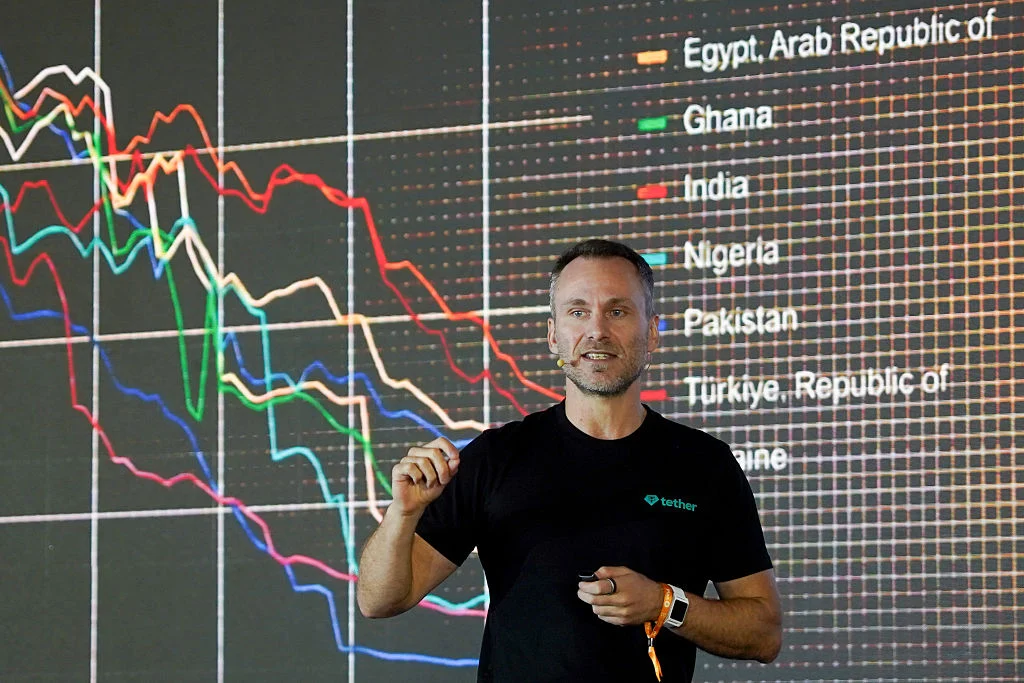
A noticeable shift has occurred in the narrative surrounding Tether, the issuer of the world’s largest stablecoin, USDT. After years of operating largely from the periphery, marked by regulatory scrutiny and a reputation for opacity, CEO Paolo Ardoino has embarked on an extensive media blitz. High-profile features in publications like Fortune and Bloomberg, alongside interviews with Reuters and TechCrunch, signal a deliberate and dramatic change in strategy. This concerted effort coincides with the launch of USAT, Tether’s first U.S.-regulated, dollar-backed stablecoin, issued through Anchorage Digital Bank, directly challenging established competitors like Circle’s USDC and new entrants from financial giants such as Fidelity Investments, JPMorgan Chase, and PayPal.
A New Chapter: Embracing Regulation and Competition
For years, Tether and its flagship product, USDT, existed in a regulatory gray zone, largely avoiding direct engagement with U.S. authorities. This approach fostered an environment where the company was frequently portrayed as an enigma, subject to investigations and accusations ranging from insufficient reserve backing to facilitating illicit financial activities, famously labeled a "money launderer’s dream" by The Economist in 2025. However, recent developments suggest a complete reversal of this stance. Ardoino now openly discusses meetings with White House officials and collaborations with federal agencies like the FBI and Secret Service, signaling a proactive engagement with the U.S. regulatory framework.
The launch of USAT is the most tangible evidence of this strategic pivot. Unlike USDT, which currently boasts a staggering $187 billion in circulation globally but does not meet evolving U.S. regulatory requirements, USAT is specifically designed for federal compliance. This move positions Tether to directly compete for market share in the U.S., a crucial step given the increasing institutional interest and regulatory clarity emerging for stablecoins. The timing is particularly noteworthy, as the stablecoin market is experiencing a surge of new, well-capitalized entrants. Fidelity’s launch of its Fidd token, joining JPMorgan Chase with JPM Coin and PayPal with PYUSD, underscores the growing competition and the perceived legitimacy of regulated stablecoin offerings. This crowded field intensifies the race for market dominance, making Tether’s shift from an offshore operator to a U.S.-compliant entity a critical, calculated gamble.
From Shadow to Spotlight: Tether’s Journey and Dominance
Tether, founded in 2014, pioneered the concept of a stablecoin, a cryptocurrency designed to maintain a stable value relative to a fiat currency, typically the U.S. dollar. USDT quickly gained traction, especially in emerging markets and within the broader cryptocurrency ecosystem, providing a stable medium of exchange and a hedge against volatile local currencies. Its market capitalization dwarfs that of all its stablecoin competitors combined, a testament to its first-mover advantage and extensive adoption. Ardoino highlights this immense reach, noting 536 million users globally, with an astonishing growth rate of 30 million users per quarter, a pace he likens more to Facebook than to traditional fintech applications.
This market dominance, however, has historically been intertwined with controversy. Critics pointed to a lack of transparent, verifiable audits of its reserves, fueling doubts about whether every USDT token was indeed backed 1:1 by U.S. dollars or equivalent assets. Regulatory bodies, including the New York Attorney General’s office, initiated investigations, culminating in a settlement in 2021 that required Tether to pay fines and provide regular attestations of its reserves. Despite these challenges, USDT continued its meteoric rise, demonstrating remarkable resilience and fulfilling a critical need for stability in the often-turbulent crypto landscape.
Ardoino frames Tether’s success not merely as a financial triumph but as a profound social impact story. He emphasizes its role in financial inclusion, particularly for populations in countries grappling with hyperinflation and limited access to traditional banking services. Citing examples like the Argentine peso, which depreciated by 94.5% against the U.S. dollar in five years, and Haiti, where the average daily salary is a meager $1.34, Ardoino asserts that Tether has provided stability and a means of preserving value for hundreds of millions who were previously excluded from the global financial system. He declares, "What Tether created is the biggest financial inclusion success story in the history of humanity."
Addressing Allegations: Illicit Activity and Regulatory Cooperation
The narrative of Tether’s past is often overshadowed by allegations of its use in illicit activities. The Economist‘s report detailing how Russian money launderer Ekaterina Zhdanova allegedly utilized Tether to connect criminal networks, sanctioned oligarchs, and intelligence operatives remains a potent point of criticism. When confronted with such reports, Ardoino downplays the significance of the highlighted amounts, calling them "truly a drop in the ocean." He firmly maintains that the "infinite, vast majority of the usage of USDT is by good people," drawing an analogy to everyday tools like iPhones or Toyotas, which can also be misused.
Crucially, Ardoino stresses Tether’s intensified efforts in combating illicit finance, a direct counter to its historical reputation. He states that the company now collaborates with nearly 300 law enforcement agencies across more than 60 countries. Far from being a haven for criminals, he argues that Tether’s blockchain technology offers superior traceability compared to physical cash. "If there are cash pallets of hundreds of billions of dollars roaming around the world, U.S. law enforcement can hardly do anything about it," Ardoino explains. "But with USDT, we demonstrated that working with the DOJ, FBI, Secret Service, and hundreds of other law enforcement agencies, we could quickly freeze the funds."
To underscore this commitment, Tether has frozen a total of $3.5 billion in tokens, with the majority belonging to victims of scams and hacks. A notable example cited by Ardoino is the proactive identification and freezing of $225 million in a "pig-butchering scam" in 2023. These sophisticated scams involve perpetrators building long-term relationships with victims before luring them into fraudulent investments. Ardoino asserts that Tether acted "in the blink of an eye" where traditional financial systems had failed, highlighting the speed and efficiency of blockchain-based asset recovery. He reiterates Tether’s adherence to international sanctions, stating, "We have onboarded the FBI and the Secret Service. We follow OFAC [the Office of Foreign Assets Control that enforces U.S. sanctions]."
Financial Fortitude and Competitive Edge
Despite persistent criticism, Tether has weathered numerous storms, demonstrating remarkable financial resilience. In November 2025, S&P Global Ratings controversially downgraded USDT’s stability assessment to "weak." Ardoino, however, dismisses this critique with characteristic defiance. "If that is the same S&P that completely missed the subprimes, I’m proud they’re considering us weak," he retorts, referencing the rating agency’s role in the 2008 financial crisis.
Tether’s ability to withstand extreme market pressures provides a compelling counter-argument to its detractors. The most significant test came in spring 2022, following the abrupt collapse of TerraLuna, another major stablecoin, which wiped out $40 billion in value overnight. The ensuing panic triggered a "bank run" on the entire stablecoin market, with hedge funds betting on Tether’s imminent failure. Despite the immense pressure, Tether successfully redeemed an astounding $7 billion in 48 hours, representing 10% of its reserves, and a total of $20 billion (25% of its reserves) within 20 days. Ardoino proudly states, "There is no bank in the world that can survive that level of redemptions. We did it with flying colors."
He also draws a veiled comparison to a competitor that faced similar challenges. While refraining from naming it directly, the implication points to Circle, issuer of USDC. During the 2023 Silicon Valley Bank collapse, Circle’s USDC briefly lost its peg after revealing a $3 billion exposure to the faltering institution. Ardoino’s subtle jab, "Sometimes you are painted in a different light if you don’t bend the knee to Wall Street," hints at a rivalry often framed as the "cleaner", more Wall Street-friendly USDC against the more maverick Tether.
To further bolster confidence, Ardoino emphasizes Tether’s robust reserve strategy. The company now boasts $30 billion in excess reserves, far exceeding the amount required to back all outstanding USDT tokens. These substantial reserves are managed by Cantor Fitzgerald, a prominent Wall Street firm led for decades by Howard Lutnick. Lutnick has publicly vouched for Tether’s legitimacy, and his firm benefits from managing Tether’s massive Treasury holdings. This relationship, particularly in light of Lutnick’s recent appointment as U.S. Commerce Secretary, presents a fascinating dynamic where financial interests intersect with high-level government policy.
Ardoino argues that Tether’s reserve model fundamentally surpasses that of traditional banks. He explains the concept of fractional reserve banking, where banks typically lend out 90% of deposits, keeping only a small fraction on hand. "So if you deposit $1 million in a bank account, $100,000 is there, and $900,000 is lent out," he illustrates. In contrast, Tether’s strategy ensures that "even if Bitcoin would go to zero, Tether would have more money than all the USDT tokens issued," implying a level of solvency far exceeding conventional financial institutions.
Profits, Purpose, and the Future of Yield
The sheer scale of Tether’s operations and its conservative reserve management generate enormous profits. Fortune reported that Tether recorded over $15 billion in profit for 2025, largely derived from the yield on its reserves. Unlike traditional savings or checking accounts, Tether does not typically share this interest with USDT holders. When questioned about this, Ardoino explains that while interest payments might be expected by American users, they are not a priority for Tether’s primary user base.
He reiterates the core value proposition for these users: preserving value in the face of rampant inflation. "The Turkish Lira lost 81% of its value against the U.S. dollar in the last five years. The Argentina peso lost 94.5%," he emphasizes. For individuals whose local currency is depreciating by several percent daily, a hypothetical 4% annual interest rate on a stablecoin would be negligible compared to the imperative of simply maintaining purchasing power. He articulates the difference in perception: "While for the rest of the world, U.S. dollar stablecoins are the savings account, you cannot think about stablecoins for U.S. people as the savings account, but more like a checking account."
Moreover, pending legislation could solidify Tether’s current model. The CLARITY Act, currently advancing through Congress, proposes to prohibit stablecoin issuers from paying interest to holders. This move, supported by traditional banking groups aiming to prevent deposit outflows, would simply codify Tether’s existing business practice. For competitors like Circle, which has explored reward programs, such legislation could eliminate a key competitive tool, inadvertently favoring Tether’s established approach.
Beyond Stablecoins: A Vision for a Stable Ecosystem
Ardoino’s ambitions extend far beyond the realm of dollar-pegged stablecoins. Tether’s diversification strategy reveals a grander vision, positioning the company as a multifaceted technology and financial powerhouse.
One significant initiative is Tether Gold (XAUT), a token launched in 2020 and backed by physical gold. With $2.6 billion in circulation, representing physical gold holdings, it offers another avenue for stable value preservation. However, Tether’s overall gold strategy is far more ambitious. According to Ardoino’s Bloomberg interview, the company holds approximately 140 tons of gold, valued at roughly $24 billion, positioning Tether as one of the largest private gold holders globally. Ardoino views this as a re-democratization of gold, leveraging blockchain technology to transform it from merely a store of value into an exchangeable currency. He proudly states that Tether is becoming "one of the biggest gold central banks in the world," despite initially being "almost called crazy" for the idea. The company’s consistent acquisition of one to two tons of gold per week underscores this commitment.
Perhaps the most intriguing and forward-looking venture is Qvac, Tether’s decentralized AI platform, launched about nine months prior. The name, inspired by Isaac Asimov’s short story "The Last Question," reflects Ardoino’s expansive philosophical outlook. His pitch for Qvac mirrors his rationale for USDT: serving the underserved. Just as USDT targeted those left behind by traditional finance, Qvac aims to democratize access to powerful AI. Ardoino argues that centralized AI platforms, with their subscription models, will exclude billions who cannot afford the costs. "If they don’t have enough money for paying $150 per year for a bank account, they don’t have enough money to be onboarded on powerful AI platforms," he asserts. Qvac’s vision is to run locally on smartphones, leveraging the anticipated ubiquity of powerful devices in regions like Africa and South America within three to five years, thereby enabling up to 80% of AI use cases. In this ecosystem, USDT is envisioned as the financial backbone, empowering "the biggest decentralized AI platform in the world."
This expansive vision is further evidenced by Tether’s substantial strategic investments, which Fortune likened to those of a sovereign wealth fund. These include over $1 billion committed to German AI robotics firm Neura, $775 million to social media platform Rumble, and hundreds of millions more allocated to satellites, data centers, and agriculture. Even a stake in the Juventus Football Club finds its place within this strategy. Ardoino insists these seemingly disparate investments are interconnected, united by Tether’s motto: "to be the stable company." He explains that investments in land, cattle, agriculture, modern tech, and gold share a "common denominator" – ensuring Tether remains a "cornerstone of the world that is our user." He describes an interlocking system where agriculture is digitalized, gold markets are revolutionized, and telecommunications become peer-to-peer. "Our story is about building a company that can [stand] the test of time," he concludes, portraying Tether as a "social impact company that is changing the lives of hundreds of millions of people and providing them something they never had before – stability."
Navigating Political Headwinds and Education
Ardoino is acutely aware of the political risks inherent in Tether’s global operations, particularly in the U.S. He anticipates potential challenges from future administrations that might view Tether as a threat, much as the previous administration did. His response is pragmatic and politically astute: he hopes that "financial inclusion and bringing 536 million people on board onto the dollar is something that both Republicans and Democrats care about." He believes that overcoming political hurdles will ultimately be "a matter of education," suggesting that a deeper understanding of Tether’s mission and impact will ultimately win over policymakers.
Tether’s strategic pivot, marked by its media blitz, the launch of USAT, and its ambitious diversification into AI and gold, signifies a profound transformation. From its origins as a controversial offshore stablecoin issuer, Tether is aggressively repositioning itself as a compliant, transparent, and foundational player in the global financial and technological landscape. The coming years will reveal whether this bold strategy will solidify its dominance, legitimize its operations, and truly realize Ardoino’s vision of a stable, inclusive, and technologically advanced future.

