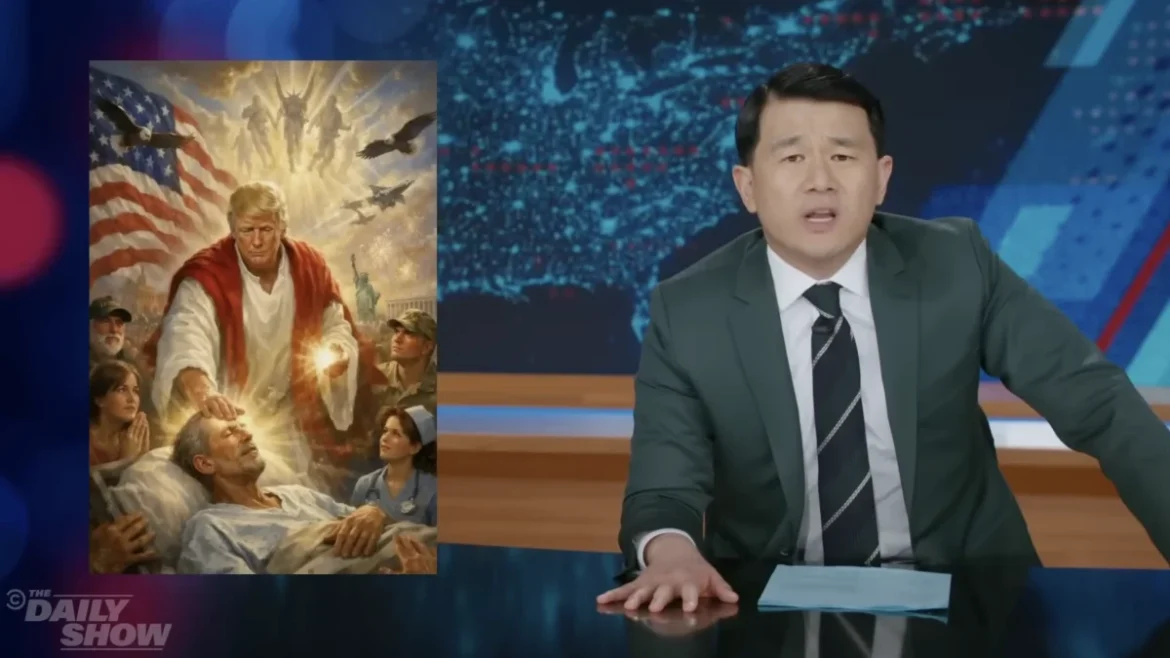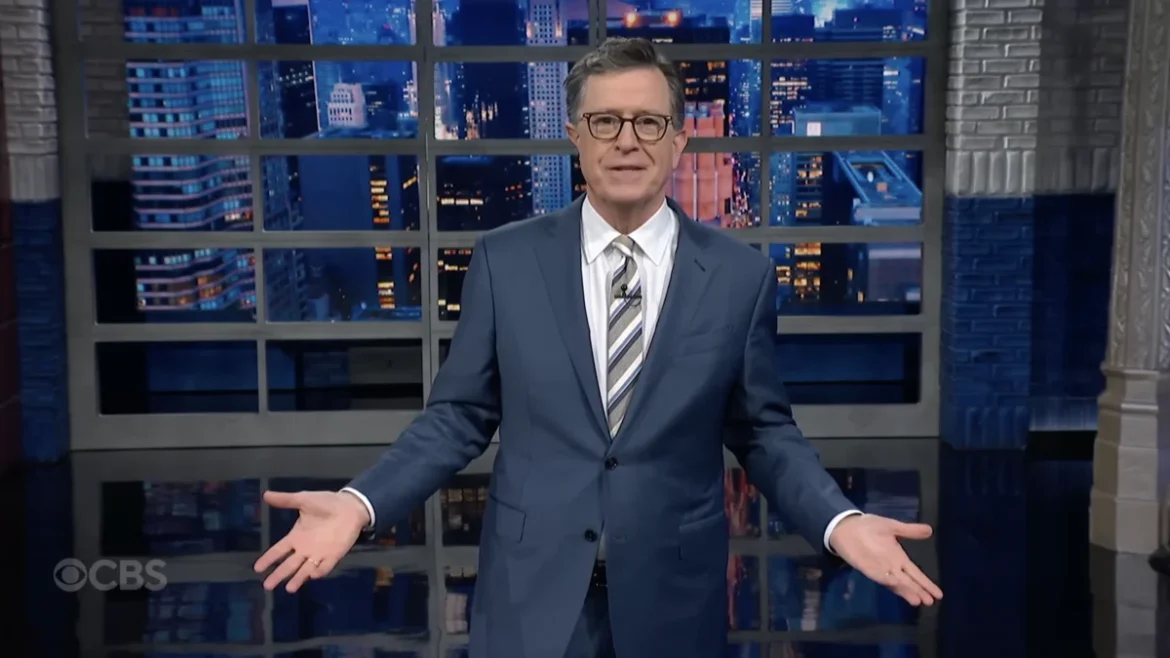
The intersection of artificial intelligence, religious iconography, and high-level geopolitics reached a surreal climax this week as President Donald Trump faced a wave of criticism following a series of controversial social media posts and public statements. The situation, which began with the sharing of an AI-generated image on Truth Social, has escalated into a multifaceted controversy involving the Vatican, an ancient order of knighthood, and shifting public approval ratings. Late-night host Stephen Colbert addressed the events during his Tuesday broadcast, characterizing the sequence of events as perhaps the most unconventional period in modern American political history.
The controversy originated when President Trump shared an image depicting himself in a likeness traditionally associated with Jesus Christ. While the post was quickly removed following an immediate backlash from various religious organizations, the digital footprint of the image sparked a broader conversation regarding the use of generative AI in political messaging and the boundaries of religious reverence in the public square.
The AI Image Controversy and the White House Response
On April 14, 2026, President Trump addressed reporters outside the Oval Office, attempting to clarify the intent behind the now-deleted Truth Social post. When questioned about the image, which critics labeled as "recreational blasphemy," the President offered an unconventional explanation. He suggested that he had not initially recognized the religious nature of the AI-generated figure, claiming instead that he believed the image portrayed him as a medical professional.
"I thought it was me as a doctor," the President stated to the press corps, a claim that was met with skepticism by media analysts and religious scholars alike. The image, which featured long hair, robes, and a glowing aura, was widely interpreted as a Messianic representation. The President’s "U-turn" on the imagery did little to quell the mounting criticism, as the post had already been archived and disseminated across various global platforms.
Stephen Colbert, during his monologue on The Late Show, highlighted the absurdity of the explanation. "If you just woke up from a coma and that report was the first thing you saw, you’d ask the doctor to put you back in," Colbert remarked. He further noted that the removal of the post served only to amplify its reach, a phenomenon often referred to as the Streisand Effect.
The Intervention of the Knights Templar
In perhaps the most unexpected development of the week, the Sovereign Military Order of the Temple of Jerusalem, more commonly known as the Knights Templar, issued a formal statement condemning the President’s social media activity. The organization, which traces its spiritual lineage back to the medieval crusading order, demanded a public apology for what they described as a disrespectful appropriation of sacred imagery.
"The Knights Templar said they condemn it wholeheartedly," Colbert noted during his program. "We’re officially trapped in a Dan Brown movie. Quick! Somebody find Tom Hanks and give him a terrible haircut."
The involvement of the Knights Templar adds a layer of historical and symbolic gravity to the situation. While the modern iteration of the order primarily focuses on charitable works and the preservation of Christian history in the Holy Land, their public rebuke of a sitting U.S. President is a rare occurrence. Historians suggest that the move reflects a growing concern among traditionalist organizations regarding the secularization and "gamification" of religious symbols for political gain.
Feud with the Holy See: Trump vs. Pope Leo XIV
The tension between the White House and religious authorities extended beyond the Knights Templar. In the days leading up to the AI image controversy, President Trump engaged in a series of online attacks directed at Pope Leo XIV. The friction reportedly stems from the Pope’s recent encyclical on global peace and social welfare, which some in the administration viewed as a critique of current U.S. foreign policy.
The President’s criticisms of the Pontiff were particularly notable given the Pope’s current standing in American public opinion. According to a recent NBC News favorability poll, Pope Leo XIV holds the highest approval rating of any public figure in the United States. The data suggests that the Pope’s message of reconciliation and his focus on humanitarian aid have resonated across traditional partisan lines.

Colbert pointed out the irony of the President’s antagonism toward a figure who shares some superficial similarities in terms of lifestyle. "It’s got to piss Trump off to learn that the most popular guy on the planet lives in a palace dripping with gold and wears an insane hat and it’s not him," Colbert joked.
Statistical Analysis: The NBC Approval Poll
The NBC poll referenced by Colbert provides a unique snapshot of the American zeitgeist in early 2026. The survey, which sampled 1,200 registered voters, revealed a significant gap between religious/cultural figures and traditional political leaders.
- Pope Leo XIV: 68% Favorability
- Stephen Colbert: 54% Favorability
- Donald Trump: 41% Favorability
The fact that a late-night comedian and a religious leader outrank the sitting President in favorability suggests a period of profound political fatigue among the electorate. For Colbert, the poll results provided a moment of levity. "Colbert trailed only Pope Leo in favorability," he said, quoting the report. "Forgive me, I lied. I actually found that quite pleasurable."
Analysts suggest that the high favorability of non-political figures is a reaction to the highly polarized nature of the current administration’s tenure, which has been marked by ongoing conflicts and unconventional diplomatic strategies.
Chronology of a Tumultuous 24 Hours
To understand the scale of the current controversy, it is necessary to examine the sequence of events that unfolded over the 24-hour period described by Colbert as "the weirdest weird that ever weirded."
- 08:00 AM: Reports emerge that the President utilized a commercial delivery service to order McDonald’s to the White House, an act that drew attention to his continued reliance on fast-food chains despite official dietary recommendations from the White House physician.
- 10:30 AM: The President receives a high-level briefing on the escalating tensions between the United States, Israel, and Iran. The geopolitical situation remains volatile following a series of cyber-attacks and regional skirmishes.
- 01:00 PM: The President posts the AI-generated "Jesus" image to Truth Social. Within minutes, the post goes viral, drawing condemnation from theologians and praise from his core digital base.
- 03:00 PM: The Knights Templar issue their official statement via social media and press release, demanding a retraction and an apology.
- 05:00 PM: The President deletes the post and issues a series of tweets attacking Pope Leo XIV, questioning the Pontiff’s influence and the Vatican’s wealth.
- 06:30 PM: During an impromptu press gaggle, the President offers the "doctor" defense for the deleted image.
- 11:35 PM: Stephen Colbert’s monologue airs, synthesizing the day’s events for a national audience.
Broader Implications and the Role of AI in Politics
The "AI Jesus" incident highlights a growing challenge for the 2026 political landscape: the regulation and ethical use of generative artificial intelligence. As AI tools become more sophisticated, the ability to create hyper-realistic or intentionally provocative imagery has outpaced the development of social norms and legal frameworks.
Political strategists argue that such imagery is designed to provoke an emotional response and maintain "engagement" in an increasingly crowded digital attention economy. However, the backlash from organizations like the Knights Templar and the Catholic Church indicates that there are still significant cultural "third rails" that can trigger widespread condemnation.
Furthermore, the juxtaposition of serious national security issues—such as the U.S.-Iran conflict—with seemingly trivial social media controversies has led to concerns regarding the "distraction factor" in modern governance. Critics argue that the focus on AI imagery and celebrity feuds diminishes the gravity of the military and diplomatic challenges facing the nation.
Conclusion: The New Normal of Political Discourse
As the dust settles on this latest episode, the broader impact on the Trump administration’s relationship with religious voters remains to be seen. While the President has historically enjoyed strong support from certain evangelical blocks, the direct conflict with the Vatican and the condemnation from traditional orders like the Knights Templar may signal a fracture in his broader coalition.
The role of late-night satire, as exemplified by Stephen Colbert, continues to serve as a primary lens through which a significant portion of the public processes these events. By framing the administration’s actions within the context of pop culture—referencing Dan Brown and Tom Hanks—satirists highlight the increasingly cinematic and surreal nature of 21st-century American politics.
For now, the White House appears focused on moving past the incident, but with the digital ghost of the AI image still circulating and the Knights Templar standing firm in their demand for an apology, the "weirdest weird" may have lasting consequences for the President’s public standing and the future of political communication.