Bitcoin is currently exhibiting strong signals that suggest a potential move towards a more substantial upside, contingent on the persistence of prevailing technical and on-chain trends, according to Charles Edwards, founder of Capriole. In a recent market analysis, Edwards highlighted a confluence of macro, sentiment, and blockchain indicators that have decisively shifted into a more constructive posture, even amidst a highly volatile and unpredictable global geopolitical landscape. This analysis comes at a pivotal moment for the cryptocurrency, as it navigates complex market dynamics and evolving investor sentiment.
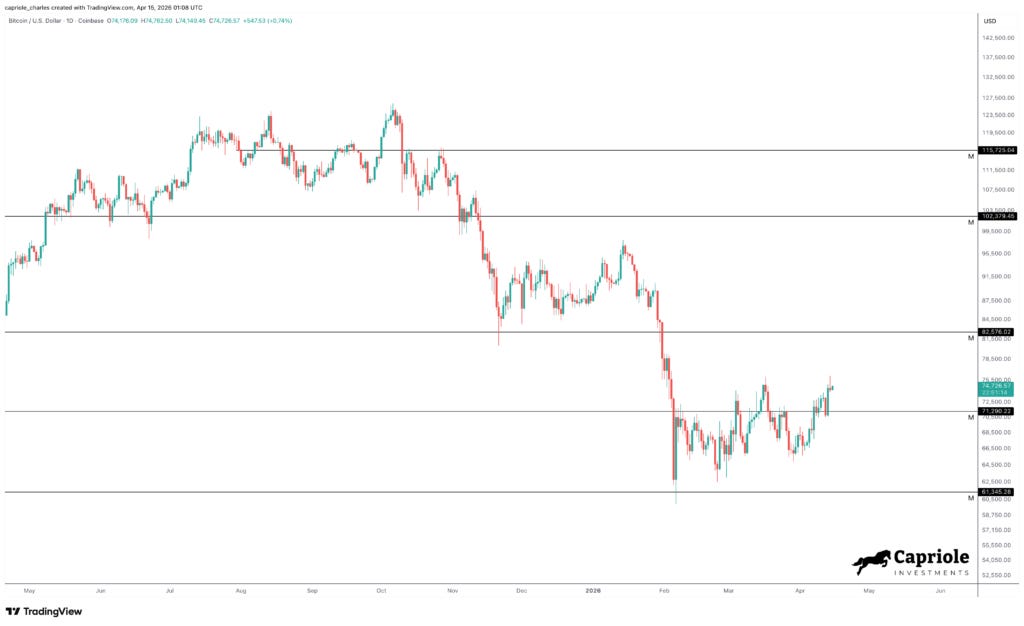
The present market environment, as framed by Edwards, is uniquely challenging, characterized by rapid shifts influenced by escalating war fears, volatile oil prices, and the burgeoning, yet uncertain, landscape of artificial intelligence threats. Despite these multifarious headwinds, Edwards asserts that the underlying data from Bitcoin itself, coupled with broader macroeconomic indicators, presents an increasingly compelling bullish signal. A crucial determinant for this bullish outlook is Bitcoin’s ability to sustain a monthly and weekly close above the $71,500 mark, a price point he identifies as a critical psychological and technical threshold. This level is not merely arbitrary; it represents a significant resistance-turned-support zone that, if held, could validate a new phase of price discovery.
Bitcoin’s Technical Landscape: A Resilient Ascent
From a purely technical standpoint, the significance of a sustained close above $71,500 cannot be overstated. Edwards notes that such a move would represent Bitcoin’s most robust technical monthly finish in the past year, underscoring a powerful resurgence in buying momentum. Examining the daily chart, the recent price action appears even more encouraging. Edwards specifically points to an "engulfing advance," a bullish candlestick pattern where a large white candlestick completely engulfs the previous day’s black candlestick, signaling strong buying pressure overpowering selling pressure. This pattern, particularly after a period of consolidation or decline, often presages further upward movement.
Moreover, Bitcoin has demonstrated notable relative strength against other traditional markets since the onset of the Iran conflict. Historically, Bitcoin has often traded in correlation with risk-on assets like tech stocks, frequently experiencing sell-offs during periods of global uncertainty. However, its recent outperformance, especially in the face of geopolitical tensions, suggests a potential decoupling or a re-evaluation of its role in diversified portfolios. For an asset that spent a significant portion of the preceding nine months mirroring the broader downtrend of risk assets, this shift in character is profoundly meaningful. The ability of Bitcoin to not only hold its ground but to appreciate while other markets grapple with instability lends credence to the narrative of its growing maturity and potential as a hedge against conventional market volatility, or at least its unique resilience.
The $71,500 level itself carries significant weight. It has historically acted as a pivotal point, representing either strong resistance preventing further gains or robust support preventing deeper corrections. Breaking and holding above such a level often clears the path for subsequent price targets, as previous sellers at that price point become potential buyers, and new capital is attracted by the demonstrated strength. Analysts often look to Fibonacci retracement and extension levels around such thresholds to project potential future price movements, with a sustained break suggesting targets well into the higher echelons of its all-time highs and beyond.
On-Chain Metrics Paint a Bullish Picture
Complementing the strong technical outlook, a series of on-chain signals further bolster Edwards’s bullish thesis, resembling patterns observed during previous accumulation phases that preceded significant price rallies. These metrics provide a unique, transparent view into the behavior of market participants directly on the blockchain, offering insights often unavailable in traditional markets.

One key indicator is Normalized Dormancy, which is currently low. Normalized dormancy measures the average age of spent transaction outputs (UTXOs), essentially indicating how long coins that are being moved have been dormant. A low dormancy suggests that older, long-term holders are not actively distributing their Bitcoin into weakness, implying conviction in future price appreciation rather than panic selling. This behavior is typical of accumulation phases, where patient investors are either holding or adding to their positions.
Furthermore, Edwards highlights a renewed "restacking" by longer-dated holders, particularly within the 2-year-plus cohort. This refers to Bitcoin that has been held for two years or longer moving back into accumulation. When these long-term holders, often referred to as "HODLers," increase their holdings or reduce their selling activity, it signals strong confidence in Bitcoin’s long-term value proposition. Their sustained holding removes supply from the active market, which can exert upward pressure on price when demand remains constant or increases.
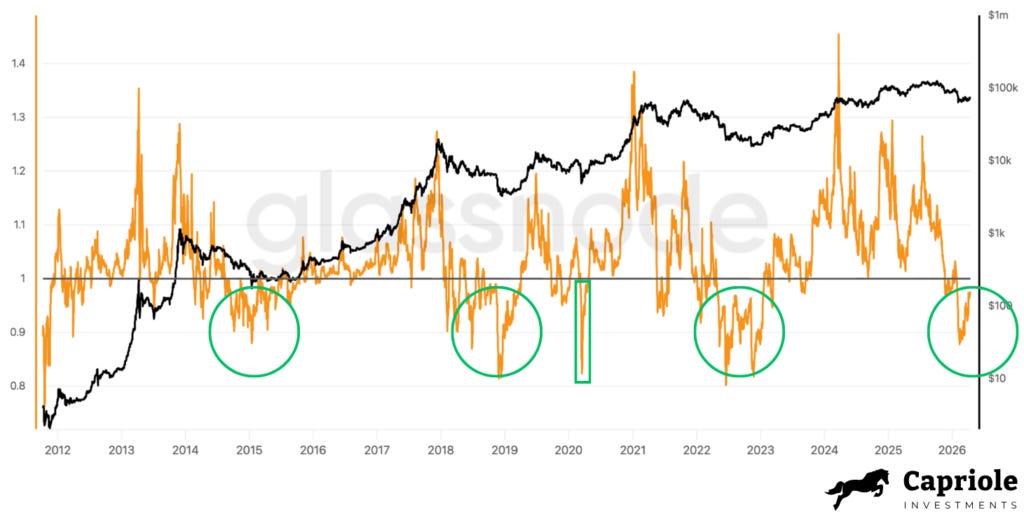
The analysis also points to deeply depressed SOPR (Spent Output Profit Ratio) readings. SOPR is an on-chain indicator that provides insight into whether Bitcoin holders are selling at a profit or a loss. A SOPR value above 1 indicates that, on average, coins are being sold at a profit, while a value below 1 indicates coins are being sold at a loss. Deeply depressed SOPR readings, meaning values significantly below 1, historically coincide with periods of capitulation, where sellers are exiting at a loss, often marking a market bottom or a strong accumulation zone for savvy investors. For instance, in previous market cycles, periods of sustained low SOPR have frequently preceded major bull runs, as the market purges weak hands and prepares for a new cycle of growth.
Even Bitcoin miners, who are critical participants in the network and often face unique financial pressures, are sending a similar message. Edwards argues that the market remains in a deep miner capitulation phase, referencing Hash Ribbons. Hash Ribbons are an indicator that signals miner capitulation when the 30-day moving average of hash rate crosses below the 60-day moving average, implying that less efficient miners are shutting down due to unprofitability. Historically, the recovery from such capitulation phases, often marked by a crossover back, has been a strong buy signal for Bitcoin. Despite this capitulation, miner sell pressure is unusually subdued, suggesting that even those miners who remain active are holding onto their newly minted Bitcoin rather than immediately selling it to cover operational costs. This behavior further constrains available supply in the market.
Finally, one of the most compelling on-chain insights from Edwards’s analysis is that institutions are once again emerging as net buyers. He notes that this backdrop – where institutional demand consistently outstrips the newly mined supply of Bitcoin – has been a hallmark of every major Bitcoin appreciation phase over the past five years. The entry and sustained buying pressure from institutional players, particularly amplified by the recent approval of spot Bitcoin Exchange Traded Funds (ETFs) in major markets, provides a significant and continuous demand sink for Bitcoin. These institutional flows represent substantial capital allocations that can dramatically influence market dynamics, absorbing available supply and driving price upwards.
Taken collectively, these diverse on-chain metrics present a clear and coherent message: the fundamental underpinnings of the Bitcoin market are shifting towards a bullish posture, especially if the $71,500 threshold is decisively overcome. "Amongst this swathe of data (and more) it’s hard not to be bullish on Bitcoin above $71.5K," Edwards concludes.
Fading Macro Fear, Yet Lingering Risks
Edwards’s analysis also meticulously ties Bitcoin’s improving outlook to a broader recalibration of traditional market gauges, indicating a waning of macro-level fear. He highlights several key traditional finance indicators that have turned positive:
The VIX (Volatility Index), often referred to as the market’s "fear gauge," has flashed a macro buy signal. This occurred as volatility dropped significantly from above 30, a level indicative of extreme fear and uncertainty, towards the more stable 20 area. A decline in VIX typically suggests that investors are becoming less apprehensive about future market swings, leading to increased risk appetite and a willingness to invest in growth assets.
The CNN Fear & Greed Index has also moved back into "buy territory." This composite index measures various market factors (stock price momentum, stock price strength, put/call options, junk bond demand, market volatility, safe haven demand, and breadth) to gauge overall market sentiment. A shift to "greed" or "buy" zones often precedes or accompanies market rallies, as investor confidence grows.
Crucially, Edwards points to the biggest weekly jump in US liquidity since May 2025. Increased liquidity, often driven by central bank policies or market participants returning capital to circulation, typically translates to more available funds for investment. A surge in liquidity can fuel asset price appreciation across the board, particularly for assets like Bitcoin that are sensitive to capital flows. This suggests that the intense phase of geopolitical panic, which often causes capital to flee to safer, less volatile assets, is beginning to recede.
This shift in macro sentiment is further corroborated by how traditional markets are increasingly interpreting the Iran conflict. Initially, geopolitical tensions, particularly those involving major oil-producing regions, tend to trigger significant market volatility and a flight to safety. However, Edwards observes that markets now appear to be treating the Iran conflict as a "contained risk" rather than a lasting, systemic macro shock. Evidence supporting this includes crude oil prices moving back below the $100 mark, an indicator that supply fears are easing, and reports of a US-Iran ceasefire being established. In this context, Bitcoin’s outperformance, showing an 11% gain against equities since the war’s commencement, is particularly telling. For an asset that was previously correlated with risk-off sentiment during crises, this performance marks a significant change in its market character, potentially signaling its evolving role as a mature asset capable of independent price action.
Edwards posits that markets may be entering a phase of "volatility fatigue." This psychological state occurs when investors become desensitized to daily headline reversals and persistent uncertainty. Instead of reacting impulsively to every new geopolitical tremor or economic data point, they begin to re-focus on fundamental drivers such as liquidity, economic growth prospects, and intrinsic value. This shift in investor psychology can create a more stable environment for assets to appreciate based on their underlying merits.
The Shadow of AI: A New Threat to DeFi Infrastructure
While the overall outlook for Bitcoin appears robust, Edwards’s note is not without its caveats. He dedicates a substantial portion of his analysis to what he perceives as a rapidly escalating, AI-driven security threat to the broader crypto infrastructure, particularly decentralized finance (DeFi) protocols and complex smart contract systems.
Edwards warns that the exponential advancements in artificial intelligence models will dramatically compress the timeline required to discover and exploit vulnerabilities within these systems. What once took months of meticulous human effort to uncover potential exploits could soon be identified and leveraged by sophisticated AI in mere minutes. This acceleration poses an existential threat to the security models underpinning many DeFi applications, which often involve intricate interlocking smart contracts and significant sums of locked capital.
Past DeFi hacks, such as the Poly Network exploit or various flash loan attacks, have demonstrated the fragility of these systems when vulnerabilities are discovered. With AI, the speed and scale of potential attacks could increase exponentially, making it exceedingly difficult for developers to patch vulnerabilities before they are exploited. AI could quickly analyze vast amounts of code, identify obscure logical flaws, and even generate exploit payloads autonomously.
Edwards’s advice to investors and users is unequivocally blunt: "If you don’t have a really good reason to use complex DeFi protocols and smart contracts, you probably shouldn’t be as we enter this new AI realm. Think about it. Is it really worth the complexity of juicing out that extra few basis points to lend/borrow/bridge/stake/restake?" He cautions against the pursuit of marginal gains in highly complex and potentially insecure DeFi ecosystems, suggesting that the heightened risk due to AI-driven exploitation may outweigh the incremental returns. This implies a need for extreme prudence and a re-evaluation of risk-reward ratios for DeFi participation.
This cautionary perspective, however, does not contradict the bullish case for Bitcoin itself. Instead, it sits alongside it as a critical risk management consideration. Edwards’s broader argument is that the market is beginning to reward opportunity over fear, but only for investors who maintain rigorous discipline in managing their risks. Bitcoin, as the most decentralized and battle-tested cryptocurrency, with a relatively simpler smart contract footprint compared to many DeFi protocols, may be comparatively more resilient to these emerging AI-driven threats.
Strategic Positioning and Future Implications
Edwards’s holistic view underscores the importance of a balanced approach: recognizing emerging opportunities while diligently preparing for potential pitfalls. "Let’s not overweight the problems in our head, but be prepared accordingly," he wrote. He emphasizes that historically, long-term performance in dynamic markets has favored those who strategically position themselves for optimistic outcomes, provided they concurrently manage risks, meticulously monitor data, and act with strong conviction.
This systematic approach is central to his firm’s philosophy: "In short, if the current move breaks down next week, and risk metrics start flashing, our systematic portfolio will pivot accordingly. Until then, things look great for Bitcoin and equities today." This statement highlights the dynamic nature of market analysis and the necessity for adaptable investment strategies, particularly in volatile asset classes like cryptocurrency.
The implications of Bitcoin sustaining above the $71,500 threshold are significant. It could cement its status as a robust asset class attracting mainstream institutional capital, further validating its long-term investment thesis. A continued upward trajectory would likely draw more retail investors back into the market, creating a positive feedback loop. Furthermore, Bitcoin’s resilience in the face of geopolitical instability could reinforce its narrative as "digital gold," a reliable store of value independent of traditional financial systems. However, the omnipresent threat of AI-driven vulnerabilities in the broader crypto ecosystem means that while Bitcoin itself may thrive, investors must exercise extreme caution in their interactions with more complex, less secure decentralized applications.
At press time, Bitcoin was trading at $74,117, signaling that it had indeed surpassed and was holding above the critical $71,500 level, at least momentarily. The coming weeks will be crucial in determining whether this newfound strength can be sustained, transforming a promising outlook into a confirmed consequential upside move for the world’s leading cryptocurrency. Investors will be closely watching technical closes, on-chain flows, and the broader macro environment for confirmation of this pivotal shift.