
Ethereum can provide you the money for to lose finality most regularly without striking the network at excessive possibility, in accordance with co-founder Vitalik Buterin, even after a fresh client bug came discontinuance to disrupting the blockchain’s confirmation mechanism.
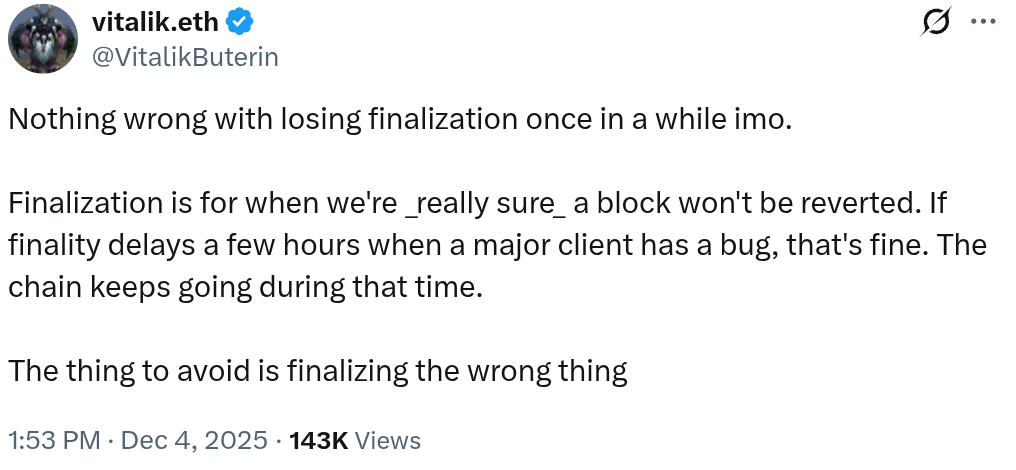
Following a fresh bug in the Prysm Ethereum client, Buterin acknowledged in an X put up that there may maybe be “nothing unsuitable with shedding finalization every so regularly.” He added that finalization signifies the network is “in actuality sure” a block may maybe well well additionally no longer be reverted.
Buterin argued that if finality is frequently delayed for hours attributable to a critical bug, “that’s comely,” and the blockchain keeps working while that occurs. The true screech may maybe well well be something else, he acknowledged: “The component to lead clear of is finalizing the unsuitable component.”
Connected: Ethereum’s first ZK-rollup, ZKsync Lite, to be retired in 2026
Experts weigh in on finalization loss
Fabrizio Romano Genovese, PhD in pc science at the University of Oxford, England, associate at the blockchain compare firm 20squares, and Ethereum protocol skilled, agreed with Buterin.
He acknowledged that as soon as finality is lost, Ethereum becomes more care for Bitcoin (BTC), and pointed out that Bitcoin has had “no finality since 2009 and no one complains.”
A proof-of-work blockchain, equivalent to Bitcoin’s, can department into a couple of chains, with the person that receives the most work (generally the longest) regarded as skilled. Serene, if a secondary department grows sufficient to overhaul the predominant department, it invalidates the predominant department and the transactions it contained — this known as a reorganization.
This is how Bitcoin operates: its finality is probabilistic, no longer deterministic, on epic of — while it is kind of no longer doable after sufficient blocks are added to the predominant department — a reorganization can restful theoretically occur. Genovese explained how Ethereum is a range of, with tips setting blocks as “closing.”
Ethereum has a finalization mechanism: when a block receives more than 66% of the validator votes, it becomes ‘justified.’ At this level, if more than two epochs (64 blocks) scamper, the block is finalized.
This is rarely any longer apt theoretical; it took place in Might maybe maybe seemingly also 2023 attributable to an incident very equivalent to the fresh one with the Prysm client. Genovese acknowledged that these incidents enact no longer invent the chain terrorized; as a alternative, “it apt way that our guarantees spherical reorg contain temporarily reverted to be probabilistic and no longer deterministic.”
Connected: Vitalik Buterin floats gas futures on Ethereum to hedge charge spikes
Penalties for L2s and bridges
Serene, Genovese renowned that a scarcity of finality would have an effect on infrastructure that relies on it, including some inter-blockchain or layer-2 (L2) bridges. A representative from the Ethereum sidechain Polygon suggested Cointelegraph that Polygon would proceed with typical operations, but transfers from Ethereum to the sidechain “will seemingly be delayed while attempting ahead to finality.”
Moreover, the Polygon spokesperson acknowledged that the crosschain settlement layer AggLayer would delay transactions from Ethereum to L2 unless finality is reached again. Serene, they acknowledged that “there may maybe be rarely any screech all over which users expertise a rollback or message invalidation” attributable to a scarcity of finality:
“The excellent influence of a delayed finality event is exclusively that deposits may maybe well well additionally rob longer to appear. Customers are no longer uncovered to reorg-driven reversions beyond this delay.”
Genovese shifted the blame for such delays to developers who require finality. “If a bridge builder decides no longer to implement any fallback mechanism in case of lack of finality, that’s their decision,” he concluded.
Magazine: When privateness and AML felony pointers warfare: Crypto initiatives’ no longer doable decision