
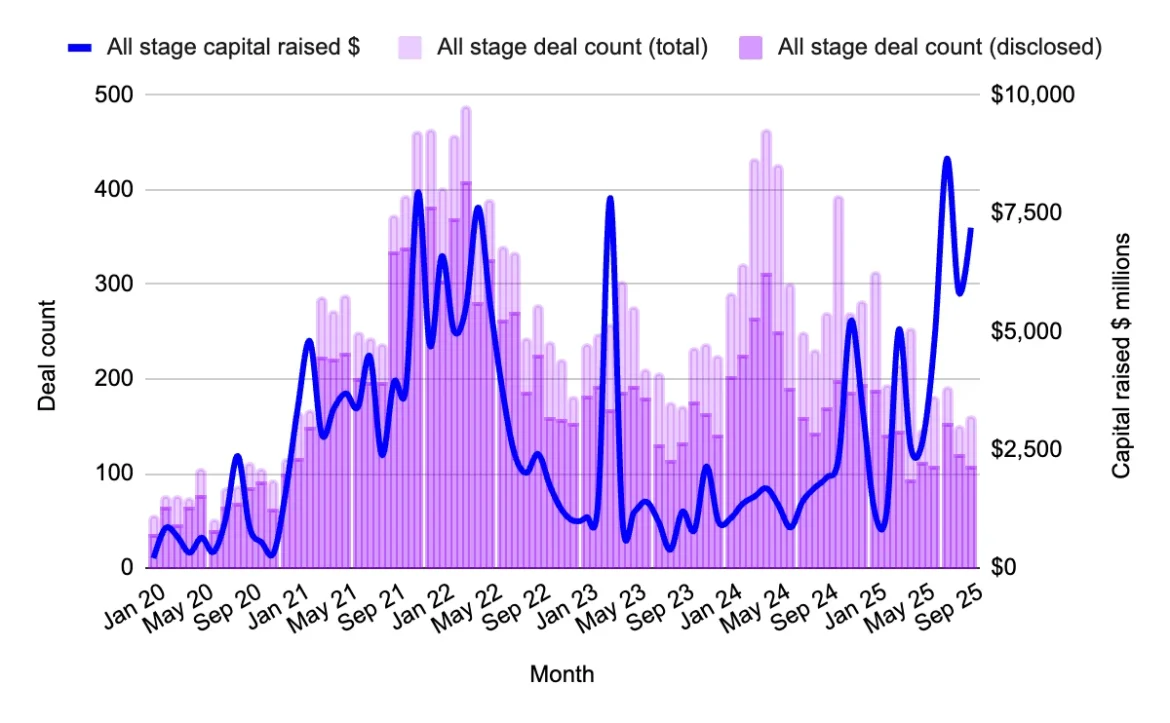
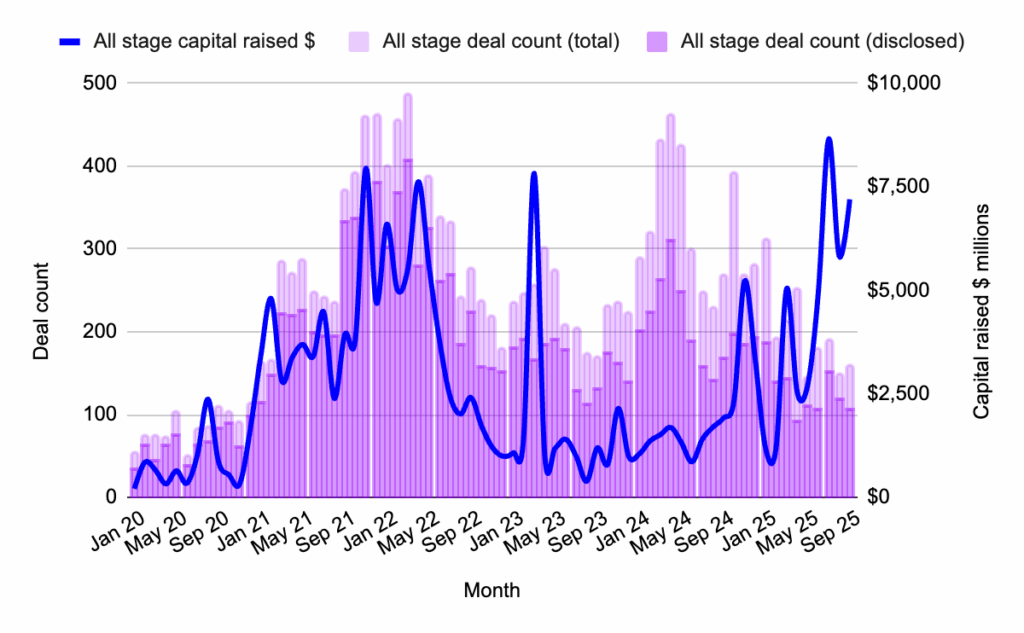
The global Web3 venture capital landscape experienced a robust revival in September 2025, recording $7.2 billion raised across 160 distinct deals. This performance marks the highest monthly capital deployment total since the spring surge earlier in the year. However, a deeper examination of the data reveals a market that remains heavily top-heavy. While the headline figures suggest an enthusiastic return of investor risk appetite, the underlying momentum is overwhelmingly concentrated in later-stage enterprises, private token sales, and mature protocol scaling initiatives, leaving early-stage pre-seed and seed founders navigating a prolonged capital scarcity.
Market Overview: A Shift Toward Maturity and Liquidity
According to data compiled by Messari and Outlier Ventures, September 2025 continued a broader structural trend observed throughout the third quarter. Rather than scattering smaller checks across speculative, unproven concepts, venture capitalists and institutional allocators concentrated their deployment capacity into enterprises demonstrating clear pathways to market maturity and immediate liquidity.
This strategic pivot aligns closely with insights gathered from industry participants at Token2049 in Singapore, where investors emphasized risk mitigation, capital efficiency, and sustainable revenue models over pure growth-at-all-costs metrics. Consequently, while overall capital deployment reached $7.2 billion, the distribution was unevenly skewed, heavily propped up by a handful of mega-rounds and high-profile token sales.
The Chronology of 2025 Funding Trends
To understand the current state of Web3 fundraising, it is necessary to examine the trajectory of the market over the past several quarters. The opening months of 2025 saw a tentative recovery from the prolonged crypto winter of preceding years, characterized by a spring surge in venture activity. By mid-year, however, institutional investors began tightening their criteria, shifting away from speculative infrastructure plays toward applications with demonstrable user traction.
By August 2025, the market experienced a noticeable cooling off, particularly in Series A and pre-seed deal volumes. September broke this temporary stagnation in terms of gross capital raised, but it did so without curing the underlying bifurcation of the market. Late-stage companies and established token ecosystems absorbed the vast majority of dry powder, while early-stage founders faced continued friction in securing commitments from tier-one funds.
Pre-Seed Struggles and the Rise of Niche Narratives
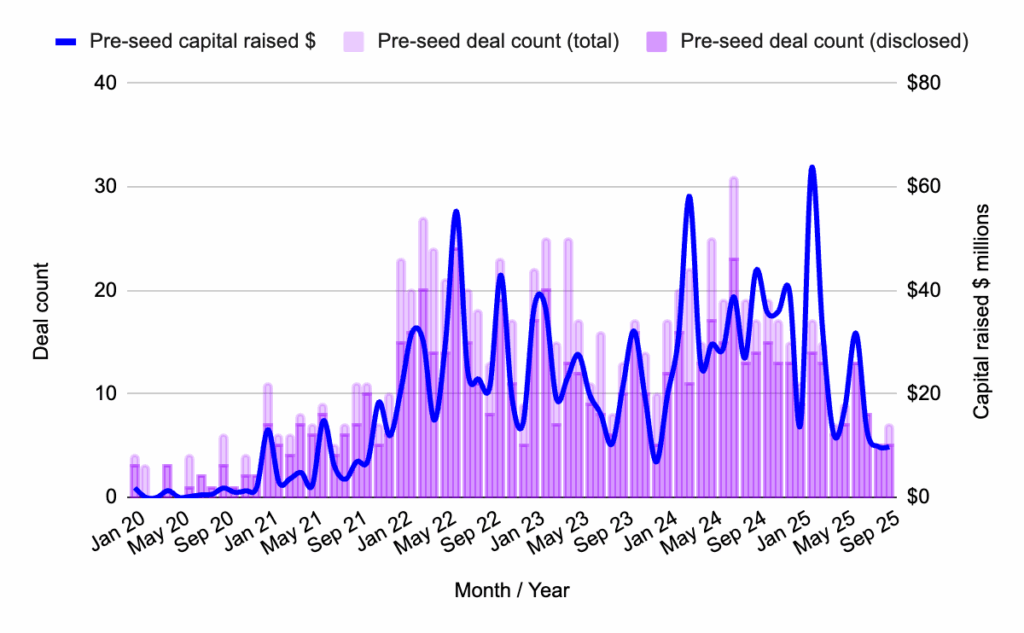
At the foundational level of the market, pre-seed rounds extended a nine-month downward trend in both aggregate capital deployed and total deal counts. Early-stage entrepreneurs faced a highly selective environment where generalist funds were largely absent, leaving only specialized thesis-driven micro-VCs active in the segment.
Despite the broader contraction, founders with tight, highly technical narratives successfully captured attention. A prime example from September was Melee Markets, a Solana-based platform securing $3.5 million in pre-seed funding with backing from Variant and DBA. Melee Markets operates at the intersection of prediction markets and social trading, allowing users to speculate on influencers, cultural events, and trending topics. The successful raise highlights how early-stage capital continues to flow toward consumer-facing attention economies, provided the underlying thesis addresses immediate market engagement vectors.
The Seed Stage Anomaly: Flying Tulip and Novel Capital Structures
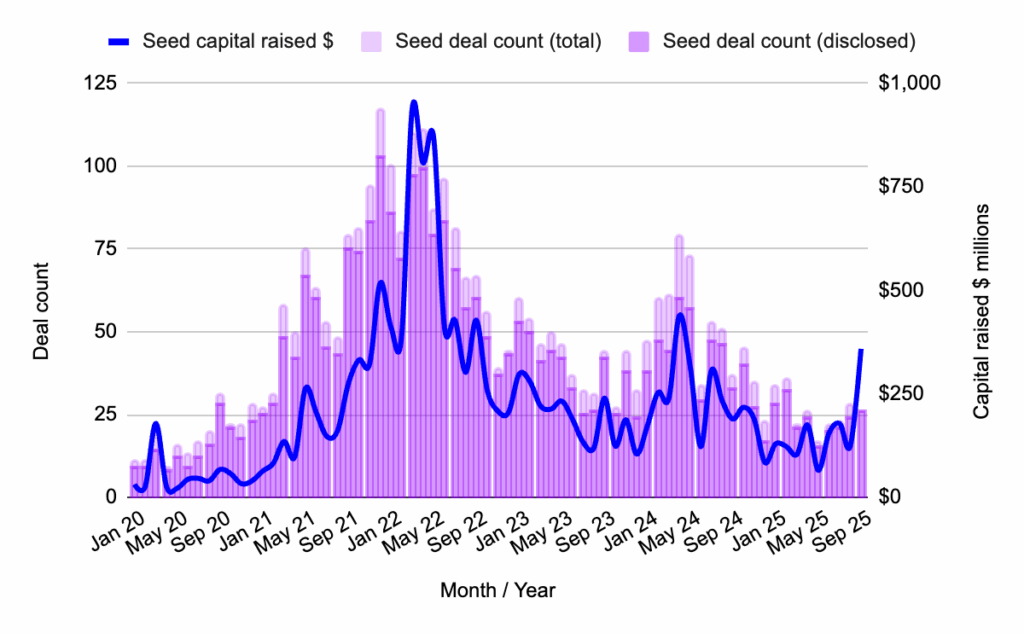
Seed-stage metrics for September appeared exceptionally strong on paper, but this statistical anomaly was almost entirely attributable to a single transaction: the $200 million seed-stage raise by Flying Tulip at a unicorn valuation of $1 billion.
Flying Tulip aims to unify spot trading, perpetual swaps, lending, and structured yield into a single on-chain exchange. The platform utilizes a hybrid Automated Market Maker (AMM) and order book model, complete with cross-chain deposits and volatility-adjusted lending. Beyond its sheer size, the transaction attracted intense industry scrutiny due to its unique structural design.
Rather than deploying capital via traditional illiquid instruments such as Simple Agreements for Future Tokens (SAFEs) or standard token warrants, Flying Tulip incorporated on-chain redemption rights for its investors. This mechanism provides institutional participants with continuous capital security and yield exposure without sacrificing token upside. Crucially, the project does not immediately spend its raised capital; instead, it deploys the treasury into decentralized finance (DeFi) yield-generating strategies to organically fund its operational growth, user incentives, and token buybacks.
Industry analysts view this as a potential watershed moment for protocol fundraising—a DeFi-native approach to capital efficiency that could redefine how future decentralized applications finance their bootstrapping phases. However, market observers caution that Flying Tulip remains a structural outlier rather than an immediate blueprint for the broader seed market.
Series A Stabilization and Regional Divergence
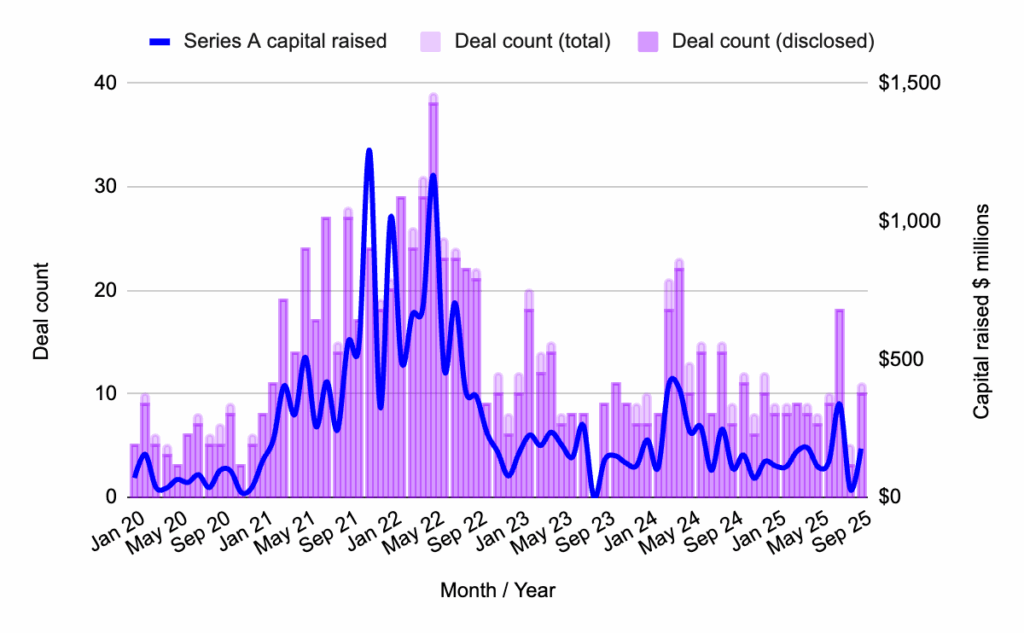
Following a sharp contraction in August, Series A financing staged a modest recovery in September, aligning closely with the 2025 monthly average for both deal volume and capital deployed. Investors at this stage demonstrated strict discipline, refusing to chase early momentum and instead demanding rigorous proof of product-market fit.
A notable transaction in this tier was Singapore-based Digital Entertainment Asset (DEA), which secured $38 million in Series A funding. Backed by strategic heavyweights such as SBI Holdings and ASICS Ventures, DEA is developing Web3 gaming, environmental, social, and governance (ESG) platforms, and advertising infrastructure featuring real-world payouts. The round underscores the ongoing bifurcation of geographic markets, with Asian institutional investors continuing to aggressively fund the intersection of blockchain architecture and mainstream consumer industries.
Private and Public Token Sales: Big Checks and Narrative-Driven Yield
Private token sales in September mirrored the trends seen in equity rounds, characterized by fewer total deals, substantially larger check sizes, and a heavy reliance on established exchange networks. The marquee transaction of the month was Crypto.com’s massive $178 million private raise, completed in a reported strategic partnership aimed at expanding global accessibility and mainstream crypto payment tools.
Meanwhile, public token sales remained highly active, propelled by two dominant market narratives: Bitcoin yield generation (BTCFi) and decentralized artificial intelligence agents. The standout performer in this category was Lombard, which successfully closed a $94.7 million public token deployment. Lombard introduces LBTC, a yield-bearing, cross-chain liquid Bitcoin asset engineered to unify liquidity across disparate blockchain ecosystems. The protocol capitalizes on the burgeoning BTCFi trend, satisfying a long-standing market demand to unlock productive yield opportunities for dormant Bitcoin capital.
New Venture Fund Formations: Smaller, Sharper Vehicles
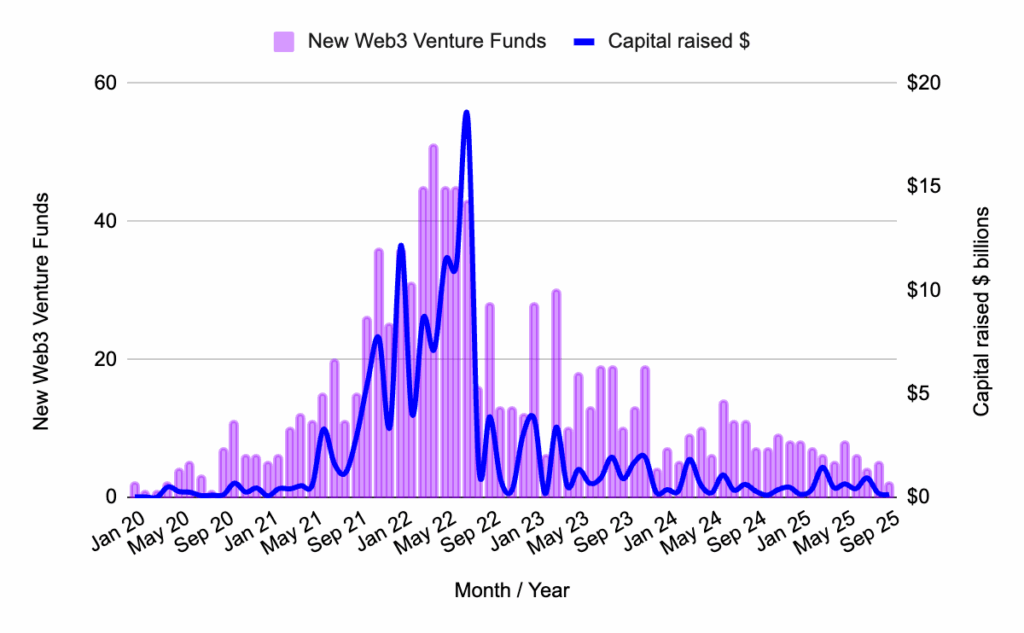
Parallel to the primary fundraising data, the formation of new crypto-focused venture funds experienced a notable cooling period in September 2025. Only two new vehicles were officially launched during the month. Both funds were relatively small in scale and highly thematic in their investment mandates.
This contraction in fund formation does not signal an exit of capital from the asset class, but rather a maturation of the allocator base. Generalist crypto funds are increasingly giving way to specialized, thesis-driven syndicates and ecosystem-specific funds. VCs are raising smaller, more agile vehicles designed to target highly specific verticals, such as zero-knowledge infrastructure, modular execution layers, and application-specific chains.
Broader Industry Implications and Outlook
The fundraising data from September 2025 paints a picture of a Web3 venture market entering a phase of pragmatic consolidation. The era of loose capital allocation across speculative, pre-product concepts has been permanently replaced by a rigorous demand for utility, regulatory clarity, and structural innovation.
While late-stage enterprises and liquidity-focused token sales captured the lion’s share of the $7.2 billion deployed, innovative structures like Flying Tulip’s yield-generating treasury model demonstrate that capital formation is evolving in tandem with decentralized technology. For early-stage founders, the message from the September data is clear: securing venture backing requires tighter narratives, rigorous technical execution, and strategic alignment with established blockchain ecosystems such as Injective and Solana. As the market looks toward the final quarter of 2025, liquidity and maturity will remain the primary currencies of the Web3 economy.
