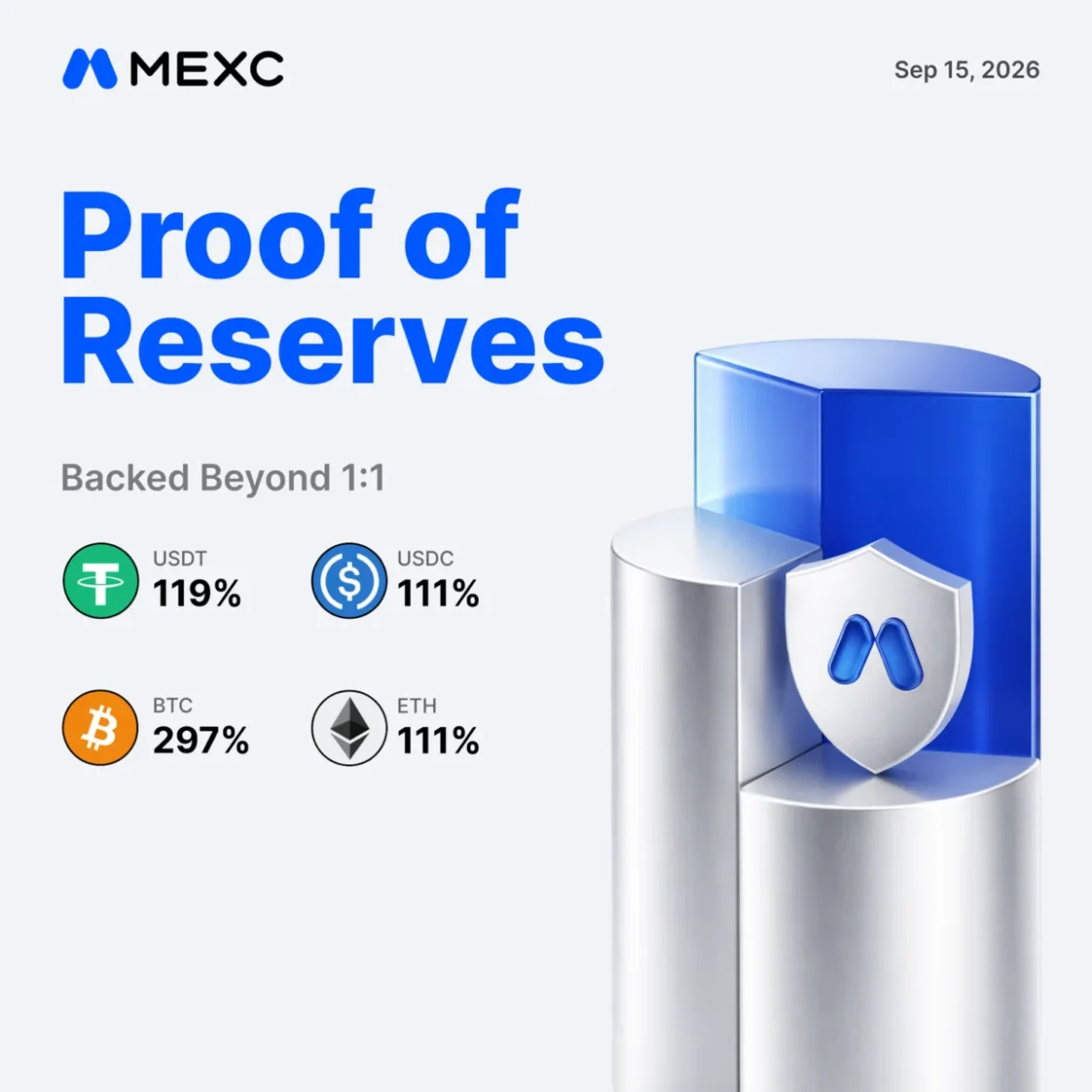
Mutsamudu, Comoros — MEXC, a prominent global digital asset trading platform known for its zero-fee spot trading model, has officially published its Proof of Reserves (PoR) report for September 2026. Audited by the prominent blockchain security firm Hacken, the report reveals that user assets across major cryptocurrencies remain fully backed at ratios significantly exceeding the standard 1:1 requirement. According to the data finalized from a September 10 snapshot, the exchange’s Bitcoin (BTC) reserve ratio notably climbed to 297%, marking a substantial increase from the 288% reported in August.
The monthly publication of verified reserve data forms a cornerstone of MEXC’s ongoing strategy to bolster transparency, reassure retail and institutional traders, and establish higher accountability benchmarks across the cryptocurrency exchange sector. By utilizing advanced cryptographic verification mechanisms such as Merkle Trees, the platform allows individual users to independently verify that their specific account balances are accurately accounted for within the aggregate reserve totals, all while safeguarding user privacy.
Detailed Breakdown of the September 2026 Reserve Ratios
The comprehensive audit conducted by Hacken evaluated multiple core operational layers, encompassing Proof of Liabilities, Proof of Ownership, rigorous reserves calculation methodologies, and an overall PoR assessment. The findings confirm that MEXC maintains substantial over-collateralization across its primary liquid asset classes.
As outlined in the September 2026 audit report, the asset-by-asset backing breakdown is as follows:
- Bitcoin (BTC): The reserve ratio stands at an impressive 297%. Total reserves of 12,202.13 BTC comfortably cover the aggregate user holdings of 4,106.57 BTC.
- Tether (USDT): The reserve ratio is recorded at 119%. Total holdings of 1,818,202,910.24 USDT back the total user liability of 1,526,526,878.38 USDT.
- USD Coin (USDC): The stablecoin maintains a reserve ratio of 111%, with total reserves amounting to 299,925,929.77 USDC against user liabilities of 269,894,125.25 USDC.
- Ethereum (ETH): The Ethereum reserve ratio also sits at 111%, backed by 58,917.60 ETH in reserves covering 53,243.98 ETH in user assets.
Hacken’s verification process confirms that the exchange holds more than sufficient capital to fulfill 100% of withdrawal requests simultaneously under standard operating conditions, offering a strong financial cushion against unexpected market movements.
Leadership Perspective on Accountability and Trust
In the wake of historical industry-wide liquidity crises and exchange failures, digital asset platforms have faced mounting pressure from regulators and retail participants alike to prove their solvency beyond mere verbal assurances. MEXC’s executive leadership has consistently framed monthly transparency reports as a mandatory operational duty rather than a voluntary marketing exercise.
Vugar Usi, Chief Executive Officer of MEXC, emphasized the critical importance of verifiable solvency in modern digital finance: "Protecting user assets and earning their trust are fundamental responsibilities, not optional commitments. In an industry where confidence has been tested time and again, transparency must be demonstrated through actions that users can independently verify. That is why we publish verifiable Proof of Reserves every month, giving users the ability to validate their asset data at any time rather than simply relying on our assurances. Our commitment is to continue raising the standard for transparency, accountability, and asset protection, and to build the kind of trust that is earned consistently over time."
Risk Mitigation and Specialized Insurance Funds
Beyond standard reserve audits, MEXC maintains multiple specialized financial safety nets designed to absorb systemic shocks, protect against extreme market volatility, and compensate users in the unlikely event of platform-related operational discrepancies.
The exchange operates a dedicated Futures Insurance Fund designed to absorb shortfalls and negative balances resulting from rapid liquidations during high-volatility events across derivatives markets. As of the September report, this fund maintained a robust balance of approximately 798 million USDT.
Additionally, MEXC manages The Guardian Fund, a dual-reserve structure denominated in a combination of USDT and BTC. Established to provide comprehensive compensation coverage for platform-related issues, The Guardian Fund held $101 million at the time of the September snapshot. Exchange roadmap disclosures indicate active plans to scale this specialized fund to $500 million over the next two years, further insulating the ecosystem against unforeseen black swan events.
Background and Evolution of Proof of Reserves Standards
The practice of publishing cryptographic Proof of Reserves gained widespread momentum across the centralized cryptocurrency exchange ecosystem following the systemic collapses of late 2022. Prior to this regulatory and cultural shift, crypto traders largely relied on traditional third-party audits or trusted-entity assertions, which often lacked real-time verifiability.
The adoption of Merkle Tree cryptography transformed this landscape by allowing cryptographic proofs to link individual user balances to a master root hash published on a public ledger or audit report. This cryptographic architecture ensures that an exchange cannot manipulate liabilities without detection, as any omission or inflation of user balances would invalidate the mathematical tree structure. MEXC’s consistent monthly reporting cycle places it among a select group of major global trading venues that subject their ledger balances to regular third-party cryptographic scrutiny.
Broader Market Implications and Regulatory Context
As global regulatory frameworks for digital assets continue to mature—exemplified by the implementation of comprehensive guidelines in jurisdictions such as the European Union under the Markets in Crypto-Assets (MiCA) regulation—the standard for centralized exchange transparency is shifting from a self-regulatory luxury to a mandatory compliance requirement.

By maintaining high over-collateralization ratios (such as nearly 300% backing for Bitcoin liabilities) and partnering with respected cybersecurity and auditing entities like Hacken, exchanges aim to preemptively satisfy upcoming international compliance benchmarks. For retail investors navigating an increasingly complex macroeconomic environment, regular PoR disclosures serve as a primary quantitative metric for evaluating counterparty risk before depositing capital onto trading venues.
About MEXC
Founded in 2018, MEXC has developed into a prominent global multi-asset trading platform catering to millions of registered participants across more than 170 international markets. Positioned as a zero-fee gateway to a diverse array of financial instruments, the platform provides simplified, high-performance access to spot cryptocurrency trading, digital asset derivatives, tokenized assets, and emerging traditional finance (TradFi) linked opportunities through a unified account infrastructure.
With an emphasis on deep liquidity, broad asset coverage, and zero trading fees, MEXC continues to focus on lowering barriers to entry for retail and professional traders alike. The platform’s ongoing publication of monthly audited reserve reports aligns with its stated corporate mission to foster a transparent, accountable, and secure global trading environment.
Users, analysts, and market participants wishing to review the full September 2026 Hacken audit report and examine individual Merkle Tree verification parameters can access the data directly through the official MEXC Proof of Reserves portal.
Disclaimer: This article is presented for informational and educational purposes only and does not constitute financial, investment, or legal advice. Digital asset markets and derivatives trading involve substantial risk of loss. Investors should conduct thorough independent research and consult with qualified financial professionals before engaging in any cryptocurrency or traditional financial trading activities.