Yahoo Finance has officially concluded its data-sharing partnership with decentralized prediction market platform Polymarket, ending an integration that once brought real-time probabilistic forecasting directly to mainstream financial audiences. The decision, which first manifested in the quiet removal of the dedicated Yahoo Finance prediction market hub back in April 2026, marks a notable pivot in how traditional financial media portals handle crowd-sourced forecasting data. Despite the winding down of the specialized data-display agreement, the commercial relationship between the two entities has not entirely severed; Polymarket maintains an active presence as an advertising partner across broader Yahoo properties, leaving the door open for potential future collaborations.
The dissolution of the arrangement highlights the nuanced, rapidly shifting dynamics governing the integration of prediction markets into mainstream financial journalism. While the partnership has officially ended, both companies are recalibrating their broader strategic footprints in an environment where prediction markets are transitioning from niche digital novelties into dominant forces across global media, finance, and sports entertainment.
Origins and Demise of the Yahoo Finance and Polymarket Collaboration
The partnership between Yahoo Finance and Polymarket initially launched with considerable fanfare in late 2025. In November of that year, Polymarket took to the social media platform X to formally announce that it had secured an exclusive partnership designation with Yahoo Finance. The core objective of the arrangement was to establish a dedicated prediction markets hub on the Yahoo Finance portal.
This hub was designed to aggregate and display probability data generated by Polymarket users regarding crucial economic indicators, government decisions, and broader financial market outcomes. To provide contextual depth, these crowd-sourced probabilities were paired directly with professional reporting, market quotes, and analytical commentary generated by Yahoo Finance editors and financial partners.
However, the lifespan of this specialized integration proved relatively brief. According to subsequent media reporting in September 2026, the dedicated prediction market hub was quietly taken down by Yahoo executives in April, signaling an internal reassessment of how prediction data should be served to everyday retail investors and financial consumers.
A Yahoo spokesperson addressed the termination of the specialized agreement by emphasizing that while the dedicated market-display partnership had run its course, the underlying business relationship retained value. “We had a previous partnership with Polymarket to display relevant prediction market data across Yahoo Finance,” the spokesperson noted. “That specific agreement ended, but Polymarket continues to be an advertising partner across Yahoo, and we’re open to similar types of partnership.” Polymarket did not issue an immediate public statement regarding the conclusion of the Yahoo partnership at the time of the reports.
A Chronology of Polymarket’s Media and Sports Expansions
While the Yahoo Finance integration has come to a close, Polymarket’s broader aggressive push into mainstream media, sports entertainment, and financial data syndication has continued unabated throughout 2026. The platform has methodically secured high-profile partnerships across diverse industries, positioning itself as the premier global infrastructure for crowd-sourced predictive data.
In January 2026, Polymarket announced a landmark exclusive partnership with Dow Jones, a premier division of News Corp. This strategic alliance was structured to embed real-time prediction market data directly into some of the most respected consumer financial platforms in the world, including The Wall Street Journal, Barron’s, MarketWatch, and Investor’s Business Daily. This integration allowed millions of traditional investors and market watchers to view real-time probabilities alongside traditional journalistic reporting.
The expansion accelerated into the spring when Polymarket set its sights on the professional sports landscape. In March 2026, the platform signed a comprehensive agreement with Major League Baseball (MLB), officially designating Polymarket as the league’s chosen prediction markets exchange. This pact granted Polymarket and its associated brokers official authorization to utilize MLB trademarks and logos within specialized prediction products. Furthermore, the agreement integrated official data feeds from Sportradar, MLB’s designated global distributor of sports data, ensuring that prediction markets tied to baseball outcomes were backed by official, verified statistics.
By August 2026, Polymarket deepened its ties with Sportradar in an expansive multi-league agreement. This partnership extended Sportradar’s comprehensive sports data, live streaming infrastructure, and integrity monitoring services to Polymarket across more than 20 distinct sports leagues and competitions. Taken together, these data streams encompass an estimated 300,000 professional matches and sporting events annually, cementing Polymarket’s capacity to host deep, liquid prediction markets on global sports.
Explosive Growth and Institutional Projections for the Prediction Market Sector
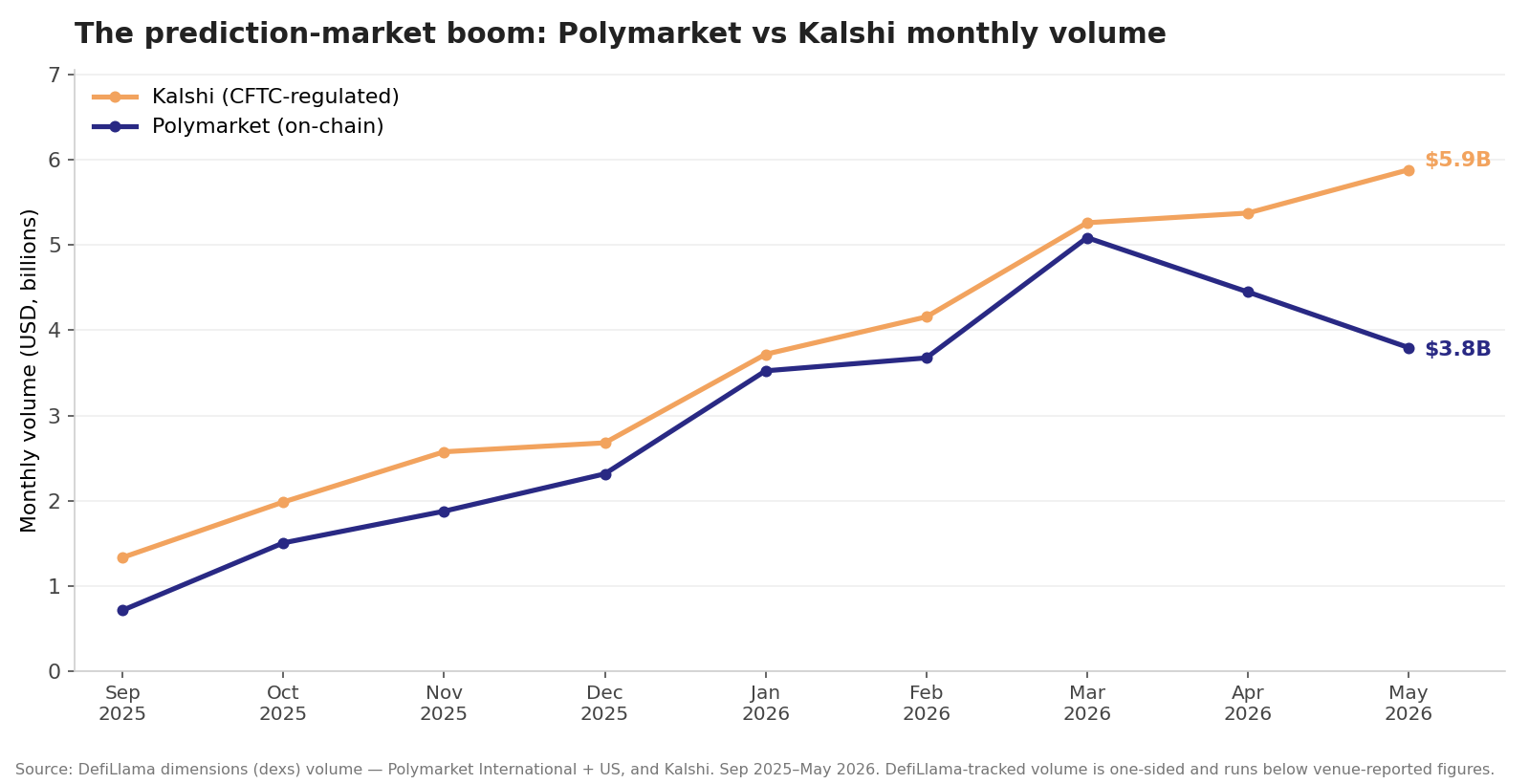
The scaling back of the Yahoo Finance partnership occurs against a backdrop of unprecedented financial growth for the broader prediction market industry. Long dismissed by critics as speculative side projects, prediction markets have experienced a meteoric surge in trading volume, driven by high-profile global events, political elections, and an increasing appetite among retail traders for alternative asset classes.
Industry estimates underscore this exponential trajectory. Last year, total prediction market volumes reached approximately $51 billion globally. Current projections indicate that the sector is on track to shatter previous records, with total trading volume anticipated to approach $240 billion by the end of 2026.
This remarkable expansion has captured the attention of major Wall Street institutions. In an exhaustive research report published in April 2026, prominent financial services firm Bernstein projected that cumulative prediction market volumes could skyrocket to an astonishing $1 trillion by 2030. According to Bernstein’s analytical findings, this anticipated milestone will be driven by a fundamental structural shift: the industry is actively evolving from a collection of isolated, niche wagers into a mature, comprehensive "information market" spanning global sports, cryptocurrency, macroeconomic developments, and complex geopolitical outcomes.
Broader Implications for Financial Portals and Information Markets
The parting of ways between Yahoo Finance and Polymarket offers valuable insight into the evolving relationship between mainstream financial media and alternative data providers. For financial portals like Yahoo Finance, integrating third-party prediction metrics requires a delicate balance between driving user engagement and maintaining journalistic rigor. While probability data offers compelling insights into crowd sentiment, integrating live market bets directly into a financial information portal introduces complex regulatory, editorial, and user-experience considerations.
As prediction markets transition into trillion-dollar asset classes, traditional media outlets must carefully evaluate how they present these probabilistic insights to the public. The conclusion of the Yahoo Finance hub does not signal a rejection of prediction data altogether—evidenced by Polymarket’s continued presence as an advertiser on the platform and its successful integrations with Dow Jones and global sports leagues. Rather, it underscores a maturation phase in the market, where media companies are refining their strategies on whether to host native prediction hubs or simply report on prediction market movements as objective news stories.
Looking forward, as regulatory frameworks solidify and institutional capital flows deeper into the sector, the boundary between traditional financial analysis and crowd-sourced prediction markets will continue to blur. Whether platforms like Yahoo Finance revisit native data integrations in the future will largely depend on how consumer demand evolves as prediction markets scale toward their projected 2030 milestones.