
Five and a half years after the infamous "buy button" incident that sparked widespread outrage and congressional scrutiny, Robinhood, the popular retail brokerage, has unveiled its own public blockchain, Robinhood Chain, boldly branding it as "permissionless." Launched on July 2, 2026, the new Layer 2 network, built on Arbitrum’s Orbit stack and settling to Ethereum, represents a significant strategic pivot for the company. However, the move is met with a mix of technical admiration for its robust architecture and profound skepticism regarding its operator’s history and the inherently restricted nature of its flagship asset: tokenized stocks. This dichotomy forms the central tension surrounding Robinhood Chain, raising critical questions about what "permissionless" truly signifies when tied to an entity with a track record of unilateral control.
The Genesis of the "Buy Button" Controversy: A Scarred Legacy
To understand the current skepticism surrounding Robinhood’s venture into decentralized finance, one must recall the tumultuous events of January 28, 2021. At the apex of the GameStop (GME) short squeeze, a retail investor-led phenomenon that saw the stock’s price skyrocket, Robinhood unilaterally disabled the "buy" button for GME, AMC, and several other "meme stocks." While users retained the ability to sell, opening new positions was prohibited. The company cited unprecedented clearinghouse collateral requirements—a legitimate, albeit sudden, financial constraint—as the reason for its actions.
However, the public perception was swift and damning: a brokerage seemingly protecting its institutional counterparties, primarily hedge funds that were heavily short GME, at the expense of its own retail users who were driving the price surge. The move ignited a firestorm of criticism across social media, leading to protests, multiple class-action lawsuits, and a highly publicized congressional hearing where Robinhood CEO Vlad Tenev testified. The phrase "buy button" became an enduring shorthand for a platform’s capacity to arbitrarily dictate trading parameters, directly challenging the principles of free and open markets that Robinhood had initially championed for its user base. This indelible image of centralized control and intervention continues to shadow Robinhood’s attempts to position itself as a champion of "permissionless" technology.
Robinhood’s Strategic Pivot into Web3: A Calculated Move
Despite its contentious past, Robinhood has been steadily integrating crypto offerings into its platform, recognizing the burgeoning interest among its user base. The launch of Robinhood Chain is not an isolated event but rather the culmination of a broader strategy to embrace Web3 technologies and potentially redefine its market position. The company’s vision, as articulated in its launch materials, is to "democratize finance" by leveraging blockchain’s transparency and efficiency, offering 24/7 trading and composability for assets. This move positions Robinhood to own its on-chain infrastructure, rather than merely rent it, granting greater control over its product ecosystem and potentially enabling new revenue streams.
The decision to build on Arbitrum’s Orbit stack, a leading Layer 2 solution, reflects a conservative yet sensible technological choice. Orbit allows for the creation of custom, application-specific chains that benefit from Ethereum’s security while offering enhanced scalability and reduced transaction costs. By opting for a battle-tested L2 framework and standard Solidity/Vyper contract compatibility, Robinhood has minimized the technical risk often associated with novel blockchain development. Gas fees are paid in ETH, and notably, there is no native chain token announced, a decision that could mitigate immediate speculative pressure and regulatory scrutiny often associated with new project tokens.
Unpacking Robinhood Chain’s Architecture and Ecosystem
Robinhood Chain’s technical blueprint is undeniably robust. As a Layer 2 built on Arbitrum Orbit, it leverages the Nitro-based technology, benefiting from Ethereum’s robust security model and utilizing Ethereum blobs for data availability. The mainnet chain ID is 4663, with a testnet ID of 46630. The chain supports ERC-4337 account abstraction, enabling features like gas sponsorship and batched transactions, enhancing user experience. Transaction sequencing is currently first-come, first-served, managed by a single sequencer operated by or on behalf of Robinhood.
The day-one integration list is remarkably comprehensive, showcasing a concerted effort to establish a functional and diverse ecosystem from launch:
- Infrastructure: Key partners include Alchemy (primary RPC provider), Arbitrum itself, Chainlink for critical oracle data, BitGo and Fireblocks for institutional-grade custody solutions, LayerZero for cross-chain interoperability, and QuickNode.
- Trading/DEX: The ecosystem supports various trading venues. Uniswap operates a dedicated Automated Market Maker (AMM) for public liquidity, complemented by Pleiades, a proprietary AMM catering to prop trading. Further routing is facilitated through 1inch, Rialto, and Arcus, serving as venues for stock tokens.
- Lending: Morpho powers Robinhood Earn, the on-chain lending product, with additional ecosystem partners like Steakhouse, Ethena, Spark, and Maple contributing to the lending landscape. Robinhood Earn, offering competitive yields (e.g., ~7% APY on USDG via Morpho, with insurance from Lloyd’s of London and RELM against cyber/smart-contract exploits), represents a key DeFi offering for eligible users.
This extensive roster suggests a serious architectural undertaking, and indeed, much of the crypto-native community acknowledges the technical competence. The prevailing skepticism, however, quickly shifts from the "tech" to the "operator," highlighting the enduring trust deficit Robinhood faces.
The Flagship Asset: Tokenized Stocks Under Scrutiny
The primary driver for Robinhood Chain’s creation is its tokenized stock offering, designed to provide 24/7 exposure to major equities like Nvidia, Apple, and Alphabet, enabling their use as collateral and tradability on-chain. This is the headline feature, but it comes with critical fine print.
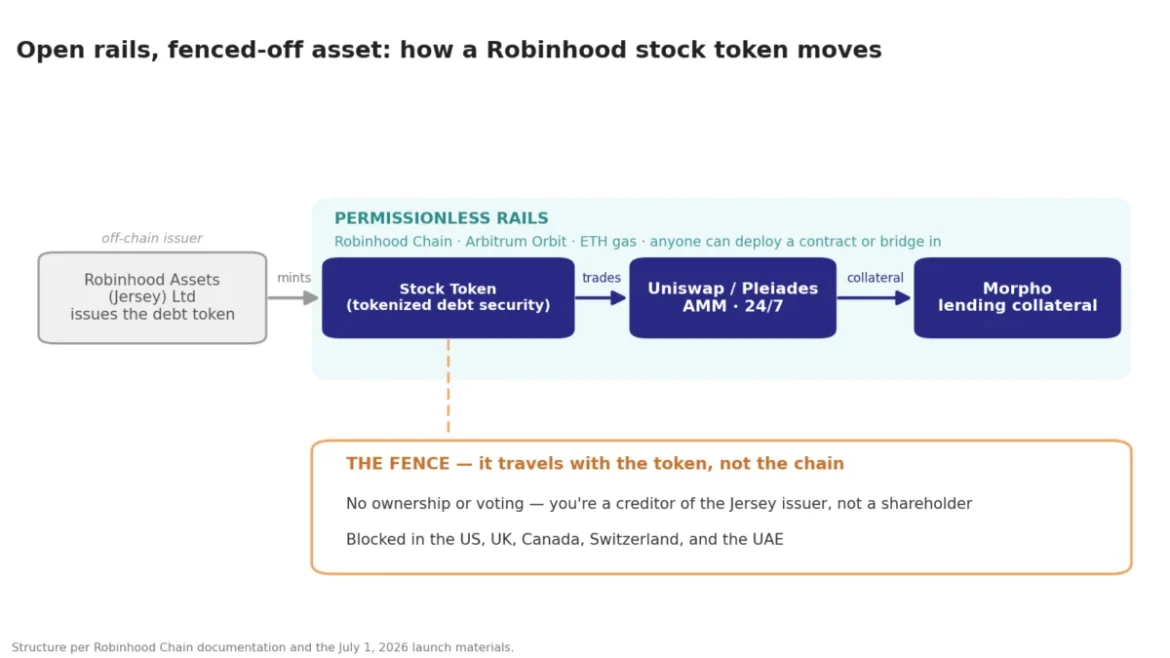
The "Stock Tokens" are not actual shares of the underlying companies. Instead, they are tokenized debt securities issued by Robinhood Assets (Jersey) Limited, a subsidiary established in the Channel Islands. Holding one of these tokens grants price exposure to the underlying stock but confers no actual ownership, voting rights, or direct claim on the issuing company. In the event of the Jersey entity’s failure, token holders would be creditors, not shareholders. Redemption is currently for cash via authorized participants, with the redemption for actual underlying securities described as a "future plan." This structural model mirrors previous tokenized equity efforts that have faced public pushback, including instances where companies, like OpenAI in 2025, distanced themselves from tokens purporting to represent their equity.
A comparative breakdown highlights the fundamental differences:
| Feature | Robinhood Stock Token | The Actual Share |
|---|---|---|
| What it is | Tokenized debt security | Equity ownership |
| Counterparty | Robinhood Assets (Jersey) Limited | The company itself |
| Ownership / Voting | None | Yes |
| Claim if issuer fails | Creditor of the Jersey entity | Shareholder of the company |
| Redemption | Cash via authorized participants | Sell on the exchange |
| Who can hold | 120+ countries (not US, UK, CA, CH, UAE) | Anyone with a broker |
| Trading | 24/7 on an AMM | Exchange hours, on an order book |
This is not Robinhood’s inaugural venture into tokenized equities. In June 2025, it launched over 200 tokenized US stocks and ETFs for EU and EEA users, branded as "Classic Stock Tokens" within the Robinhood Europe app. The new Robinhood Chain tokens represent a second generation, primarily distinguished by their composability within the broader DeFi ecosystem, allowing movement beyond a single application.
Crucially, the geographical restrictions are significant. While available in over 120 countries, these tokenized stocks are explicitly unavailable in the United States, the United Kingdom, Canada, Switzerland, the UAE, and sanctioned jurisdictions. While the US exclusion is largely attributed to the complex regulatory landscape for retail-traded tokenized debt securities wrapping equities, the impact remains the same: Robinhood’s core American retail audience, the very demographic that made the company a household name, cannot access its flagship on-chain product. While US users can engage with Robinhood Earn’s lending product, they are excluded from the tokenized equity component that underpins the entire chain.
This creates the central paradox: the underlying blockchain rails are permissionless, allowing anyone to deploy contracts or bridge ETH. Yet, the core product that justifies the chain’s existence is highly permissioned—a geographically gated, ownership-free debt instrument issued by a single offshore entity. The chain is open; the product it was built for is fenced. This dichotomy raises fundamental questions about the true "permissionless" nature of the overall offering.
Market Structure and the Liquidity Question
Even assuming the tokenized stocks function as advertised, a significant market-structure challenge looms, forming the basis of many bearish arguments. The primary spot venues for these tokens are Automated Market Makers (AMMs) like Uniswap and Pleiades. While AMMs excel in providing liquidity for long-tail crypto assets, their suitability for highly liquid, widely traded equities, traditionally priced on central limit order books (CLOBs) for over a century, is debatable. Equities benefit from continuous price discovery and deep order books.
An AMM holding tokenized NVDA or AAPL must be constantly arbitraged against its real-world exchange price, which updates continuously during market hours. Arbitrageurs extract value from liquidity providers (LPs) who supply the capital to the AMM pools. In environments with thin liquidity and a fast-moving external reference price, LPs are highly susceptible to "being picked off," leading to losses that, in turn, can further thin liquidity.
Robinhood appears to acknowledge this challenge, as its perpetual futures venue, Lighter, integrated into the wallet, operates as an order-book DEX (CLOB) rather than an AMM. This creates an inconsistency: a CLOB for perps, but an AMM for the underlying tokenized stocks where the argument for order-book efficiency is arguably stronger. Whether tokenized equities can achieve robust, deep, and efficient trading at scale on an AMM model remains an open and untested question. Early liquidity for these stock tokens will be a crucial metric to monitor in the coming weeks.
The Trust Deficit and Centralization Concerns
The "buy button" incident casts a long shadow over Robinhood’s claims of "permissionless" finance. At launch, Robinhood Chain employs a single sequencer, controlled by Robinhood. While this is a common starting point for many young Arbitrum Orbit chains, with decentralization planned for later stages, it means the entity that once restricted trading now dictates transaction ordering on a chain whose core asset is issued by its own subsidiary. While the canonical bridge to Ethereum is trustless (subject to a seven-day challenge period for withdrawals), the operational reality is that the sequencer, the asset issuer, and the primary application are currently all under the same corporate umbrella.
Further fueling skepticism are recent corporate developments. In mid-June 2026, just weeks before the chain’s launch, Robinhood announced layoffs affecting approximately 10% of its workforce, incurring roughly $28 million in restructuring charges. While management framed these cuts as coming "from a position of business strength," the timing appears incongruous with the intensive execution demands of launching a new blockchain, an issuer entity, a wallet integration, and a lending product simultaneously.
Additionally, the bootstrap incentives—a confirmed 90 days of covered gas fees for eligible wallet users and zero fees on Lighter perps during the initial window—while common for new platform launches, can inflate early usage numbers that may not be sustainable post-expiration. While none of these points are individually disqualifying, collectively they contribute to a cautious outlook and a discounting of initial adoption metrics.
Early Adoption Metrics and Market Reception
As of July 2, 2026, with mainnet mere hours old, confirmed on-chain data remains scarce. What exists is a mix of testnet benchmarks, company launch claims, and unverified figures:
- Testnet Activity: Approximately 4 million transactions were reported in the first week of testnet activity (February 2026), indicating technical functionality.
- Latent Distribution: Robinhood frequently cites its ~28 million user base as a significant on-ramp potential, though this represents company scale, not direct chain adoption.
- Gas Subsidy: A confirmed 90-day period of covered gas fees for wallet users incentivizes early engagement.
- Lighter Incentives: An estimated $11 million in LIT tokens has been allocated for perps liquidity, according to ecosystem project claims.
- Robinhood Earn Yield: Confirmed ~7% APY for lending USDG via Morpho, backed by insurance.
- $HOOD Reaction: Robinhood’s stock ($HOOD) saw a modest ~2% increase pre-market on the announcement, reflecting a limited market reaction.
- Mainnet TVL/Volume: Crucially, no meaningful mainnet Total Value Locked (TVL), transaction count, or active address figures have been widely published, underscoring the nascent stage of the ecosystem.
The 28-million-user figure, while impressive for Robinhood as a platform, does not translate directly to chain adoption, especially given that most of these users, particularly in the US, cannot access the flagship tokenized stock product. The absence of a confirmed airdrop or governance token has not prevented the usual wave of "point-farming" guides and memecoin launches, reflecting speculative interest typical of new chain deployments. While headline integrations are technically "live," "live" does not equate to "liquid," and many deployed AMMs may initially suffer from thin depth.
Competitive Landscape and Strategic Positioning
Robinhood Chain’s launch naturally invites comparisons, most notably with Coinbase’s Base. Both are large, regulated, US-listed consumer platforms launching Layer 2 solutions to onboard their user bases into Web3. However, their approaches differ:
| Feature | Robinhood Chain | Coinbase’s Base |
|---|---|---|
| Stack | Arbitrum Orbit | OP Stack |
| Mainnet Launch | July 2026 | August 2023 |
| Design Focus | Purpose-built for tokenized equities | General-purpose |
| Operator | Robinhood (single sequencer, for now) | Coinbase (single sequencer) |
| US Access | Flagship stock tokens blocked | Fully available |
Coinbase Base, launched in 2023, adopted a general-purpose OP-stack chain, allowing the ecosystem to organically determine its primary use cases. Robinhood, conversely, has opted for an Arbitrum-stack chain with a very specific, flagship use case—tokenized equities—integrated from day one. This represents a significant bet on whether a purpose-built chain can outperform a general-purpose one in attracting both developers and users.
Furthermore, Robinhood is not the first to venture into on-chain equities. The debt-security-wrapper model it employs has been attempted by other issuers, often with mixed success and recurring questions from underlying companies about tokens they never explicitly authorized. This highlights a broader challenge in the tokenized RWA (Real World Asset) space: navigating legal ownership, regulatory compliance, and the often-reluctant participation of traditional financial entities.
Regulatory Horizons and Future Implications
The launch of Robinhood Chain, particularly its tokenized stock offering, operates within an evolving and fragmented global regulatory landscape. The explicit exclusion of US users from the tokenized stock product underscores the prevailing uncertainty and stringency of US securities law concerning tokenized debt securities wrapping equities for retail distribution. Jurisdictions like the UK, Canada, Switzerland, and the UAE also maintain strict frameworks, leading to similar restrictions.
The implications of Robinhood’s move are multi-layered. For Robinhood, it’s an attempt to regain trust and pivot towards a future where it controls more of its infrastructure, potentially tapping into new markets and revenue streams. For DeFi, it represents a significant institutional player entering the space, bringing with it a large user base and established brand, albeit with a centralized operational model. For the broader financial market, it accelerates the conversation around tokenized assets, their liquidity, and the challenges of integrating traditional securities into decentralized frameworks. The "Distributed vs. Represented" RWA framework is a useful lens here: while Robinhood’s tokens are mobile and composable (Distributed), their lack of direct ownership and reliance on a single issuer places them firmly on the "Represented" end of the spectrum in terms of underlying asset claim.
Conclusion and Outlook
Robinhood Chain stands as a fascinating case study at the intersection of traditional finance and Web3. The bull case highlights a technically sound, battle-tested Layer 2, deep day-one integrations, the promise of 24/7 tokenized equity access for non-US users, and the immense retail distribution potential of Robinhood. The bear case, however, focuses on the fundamental limitations of the flagship asset—a synthetic debt security with counterparty and regulatory risk, blocked in Robinhood’s primary market, and reliant on an unproven AMM model for equities. Compounding this is the enduring trust deficit in an operator whose "permissionless" chain is, for now, centrally controlled by the very entity famously associated with restricting trades.
For DeFi builders and users, the chain’s open architecture and standard tooling mean it’s immediately accessible for deployment and bridging. However, the unique selling proposition of Robinhood Chain—its tokenized stock product—is precisely where the most significant caveats and risks reside. The next few weeks will be crucial in observing real-world metrics like mainnet TVL, transaction volume, and the actual liquidity depth of its tokenized stock AMMs. These figures, rather than initial promises or speculative fervor, will ultimately determine whether Robinhood Chain can truly reconcile its past with its permissionless aspirations, or if the "buy button" legacy continues to define its future.
