
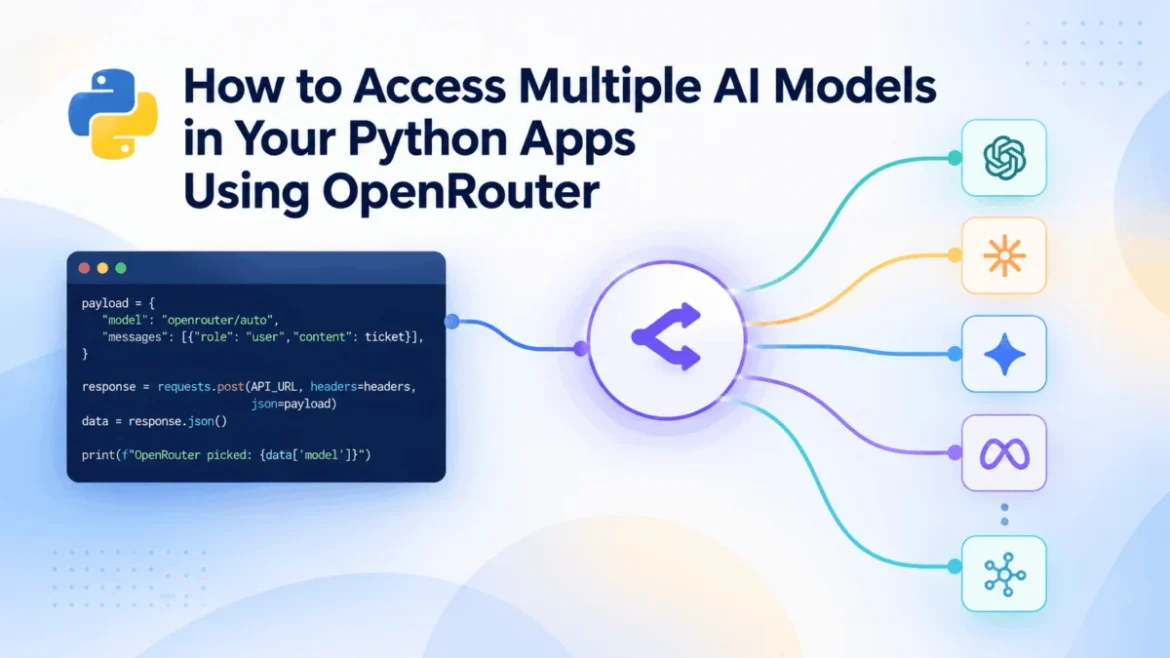
The rapid proliferation of Large Language Models (LLMs) has created a significant fragmentation challenge for software developers. With major players like OpenAI, Anthropic, Google, and Meta releasing frequent iterations of their models, developers are increasingly tasked with evaluating performance, cost, and latency across disparate platforms. Traditionally, integrating these models into a single application required managing multiple SDKs, navigating distinct authentication protocols, and maintaining separate codebases for each provider. The emergence of OpenRouter—a unified API aggregator—marks a structural shift in how AI applications are architected, moving the industry toward a provider-agnostic infrastructure.
The Fragmentation of the AI Development Landscape
Since the public debut of ChatGPT in late 2022, the artificial intelligence sector has experienced an unprecedented explosion in proprietary and open-source model availability. Organizations today are no longer tethered to a single model provider. Instead, developers are adopting a "best-of-breed" approach, selecting models based on specific task requirements—such as code generation, semantic analysis, or creative writing.
However, this flexibility comes at a cost. Maintaining integrations with multiple proprietary APIs introduces technical debt. A standard Python application might require three separate client libraries—one for OpenAI’s GPT-4, one for Anthropic’s Claude, and another for Meta’s Llama ecosystem. Each library imposes its own limitations on rate-limiting, error handling, and output formatting. This environment has necessitated the rise of "middleware" services like OpenRouter, which acts as a routing layer between developers and the underlying AI compute providers.
The Mechanics of Unified Model Integration
At its core, OpenRouter serves as an abstraction layer. By exposing a single, normalized API, it allows developers to swap between models—such as switching from a high-performance GPT-4 variant to a cost-efficient Llama 3 model—by simply changing a string value in their JSON payload.
The architecture relies on the industry-standard OpenAI API format, which has become the de facto schema for chat completions. By normalizing requests, OpenRouter ensures that headers, authentication tokens, and payload structures remain consistent. For a Python-based developer, this means moving away from vendor-specific SDKs in favor of standard HTTP libraries like requests or httpx.
Technical Implementation Workflow:
- Authentication: Developers generate a centralized API key via the OpenRouter console. This key is stored as an environment variable to prevent credential leakage.
- Payload Normalization: Requests are sent as POST commands to a single endpoint. The specific model is identified by a slug (e.g.,
meta-llama/llama-3.2-3b-instruct:free). - Response Handling: Because the output is normalized into a standard JSON structure, the application logic for parsing the assistant’s reply remains identical regardless of the underlying model.
Strategic Advantages: Cost Optimization and Reliability
The primary value proposition for developers using this aggregation model is the ability to implement sophisticated routing strategies without reinventing the underlying infrastructure.
The "Free-to-Try" Ecosystem
One of the critical hurdles for developers is the prohibitive cost of experimentation. Many models on the OpenRouter platform are labeled with a :free suffix, indicating that they are provided at no cost for developers to test and prototype. This significantly lowers the barrier to entry for small-scale projects or R&D departments testing the viability of a specific LLM for a production use case. Furthermore, the platform allows for a "catch-all" routing strategy via the openrouter/free model identifier, which automatically selects an available free model, ensuring that the development workflow remains functional without incurring unexpected billing charges.
Robustness and Failover Strategies
In production environments, model availability is not guaranteed. Provider outages, rate-limiting, and unexpected API changes can cause significant downtime. By utilizing OpenRouter’s native support for model lists, developers can implement automatic failover. By passing a list of models instead of a single string, the system attempts to process the request through the first available model. If that provider fails, the system cascades to the next one in the list. This "model chaining" provides a layer of redundancy that is difficult to replicate with traditional, single-provider integrations.
Broader Industry Implications
The trend toward API aggregation signals a maturation in the AI development ecosystem. Much like the transition from bespoke server-side infrastructure to cloud-agnostic container orchestration (e.g., Kubernetes), AI development is moving toward a layer of abstraction that separates the application logic from the compute provider.
Industry analysts observe that this shift provides three key advantages for businesses:
- Vendor Neutrality: Companies are less likely to experience "lock-in," allowing them to migrate to more performant or cost-effective models as they emerge without undergoing major code refactoring.
- Operational Efficiency: Engineering teams can focus on prompt engineering and business logic rather than maintaining multiple API wrappers and authentication handlers.
- Optimized Latency: Through features like provider sorting, developers can programmatically select models based on real-time latency or cost metrics, ensuring that the application meets performance SLAs.
Timeline of Development and Adoption
- Early 2023: The rapid release of various LLMs by startups and open-source communities leads to an "API fatigue" among developers, who struggle to keep up with shifting integration requirements.
- Late 2023: Introduction of unified routing services begins to gain traction in the developer community, primarily among hobbyists and early-stage AI startups looking for an easier way to test multiple models.
- 2024: Major performance gains in smaller, open-source models (such as Llama 3 and Mistral) make them viable alternatives to larger, proprietary models. The use of aggregators becomes a standard practice for developers prioritizing cost-efficiency and model-agnostic systems.
- Present: Integration services evolve to include advanced features like usage-based routing, sophisticated failover, and enhanced security, moving from simple prototypes to production-grade infrastructure.
Ethical and Technical Considerations
While the convenience of a unified API is evident, developers must remain cognizant of data privacy and latency overhead. Every request routed through a third-party aggregator adds a potential point of failure and a middleman to the data chain. Enterprise developers must ensure that the aggregator complies with internal security standards and that sensitive user data is handled in accordance with GDPR, CCPA, or other relevant regulations.
Furthermore, relying on a unified API requires a degree of trust in the aggregator’s service uptime. If the routing layer itself goes down, all connected services may face disruption. As such, while the aggregation model is ideal for rapid prototyping and multi-model testing, critical production systems often pair this approach with robust internal monitoring and circuit-breaker patterns.
Future Outlook
As the AI field continues to evolve, the distinction between models will likely become less about the provider and more about the specific capability, size, and cost of the model. The infrastructure that enables this flexibility—standardized API formats and intelligent routing—will continue to be the backbone of modern AI application development. For the developer, the ability to switch between a high-parameter model for complex reasoning and a smaller, faster model for simple classification tasks with a single line of code is no longer a luxury; it is a necessity for building scalable, resilient, and cost-effective AI systems.
By leveraging tools like OpenRouter, developers can effectively mitigate the risks associated with the rapidly changing AI landscape, ensuring that their applications remain agile and capable of utilizing the best technology available at any given moment.
