
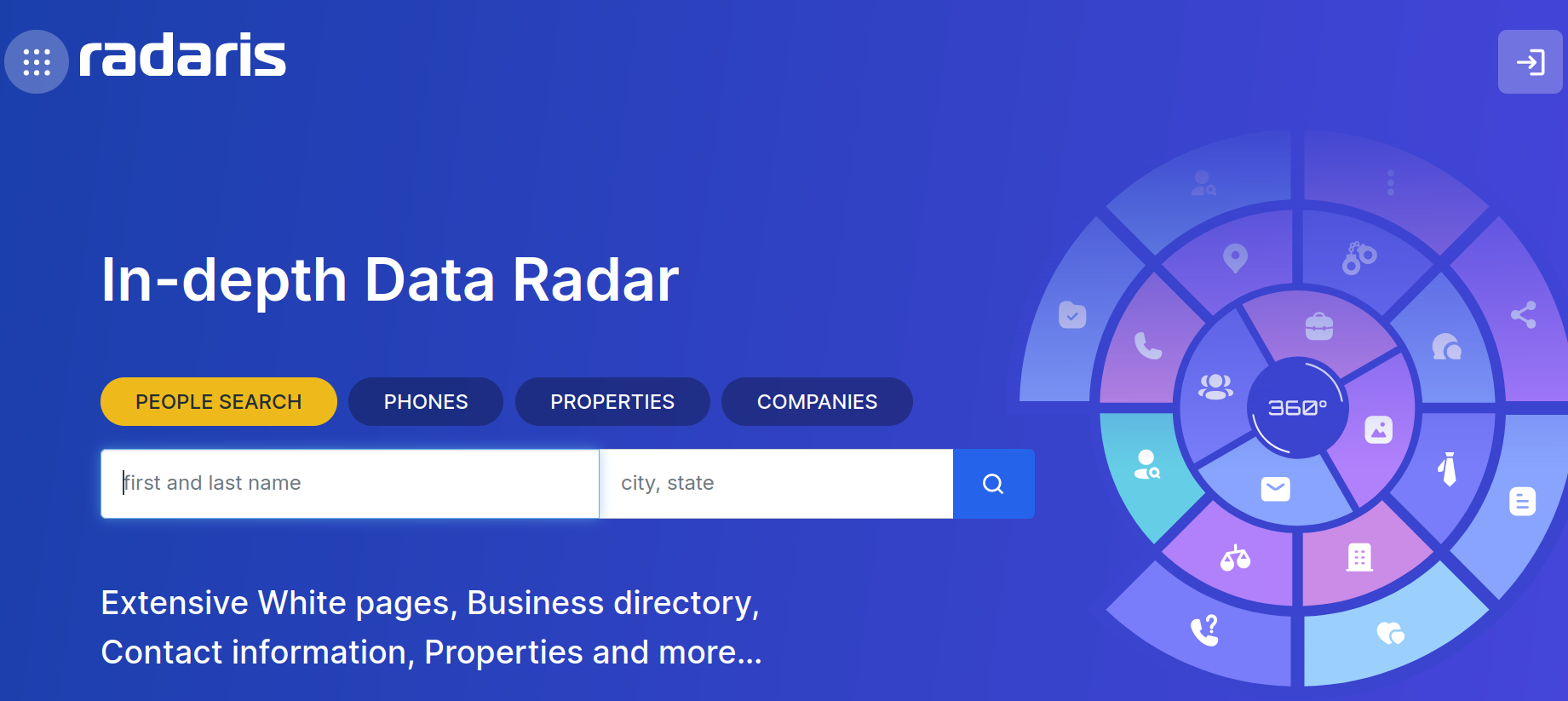
The landscape of online consumer privacy and the murky world of commercial data brokers underwent a dramatic shift when a New Jersey court ordered the seizure and transfer of the high-traffic people-search domain, Radaris.com. For over a decade, Radaris operated as a pervasive fixture in the digital ecosystem, systematically scraping, compiling, and monetizing the personal dossiers of millions of Americans while routinely ignoring deletion requests and consumer complaints. That era of impunity slammed into a judicial roadblock following a relentless legal campaign spearheaded by Atlas Data Privacy Corp under New Jersey’s stringent Daniel’s Law.
The punitive domain transfer—which swept up Radaris.com alongside more than a dozen sister domains—was not merely a routine civil penalty. It represented the culmination of years of calculated obfuscation, international shell games, and aggressive legal posturing by the platform’s operators. As privacy advocates hail the ruling as a monumental victory for public safety officials, legal experts warn that the battle over commercial data harvesting is rapidly escalating into a constitutional showdown with far-reaching implications for the entire information broker industry.
Anatomy of a Lawsuit: The Battle Over Daniel’s Law
Passed in response to a horrific tragedy involving the family of a federal judge, New Jersey’s Daniel’s Law is designed to shield law enforcement personnel, judicial officers, prosecutors, and their immediate family members from targeted harassment and violence. The statute grants these public servants the absolute right to have their personal information completely expunged from commercial people-search engines and data broker databases. Crucially, the law carries teeth, imposing statutory fines of $1,000 per violation against companies that willfully ignore valid removal requests.
In February 2024, Atlas Data Privacy Corp—a private entity dedicated to enforcing privacy mandates—initiated legal action against Radaris, alleging systematic and flagrant violations of Daniel’s Law. Rather than engaging constructively with the judicial process, Radaris and its legal representation allegedly engaged in a familiar pattern of delay, stonewalling, and jurisdictional maneuvering.
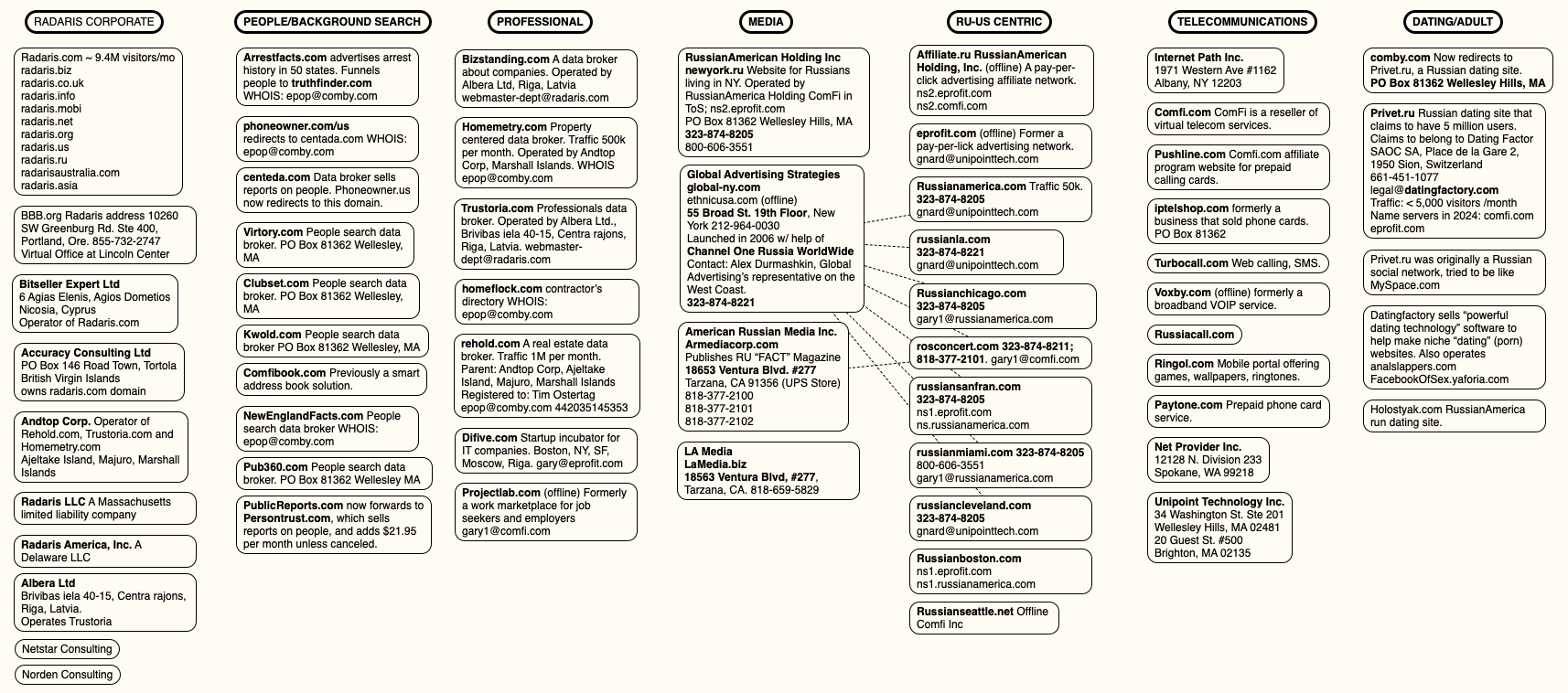
As the litigation progressed, investigative reporting by cybersecurity journalist Brian Krebs unmasked the true masterminds behind the sprawling enterprise: Igor and Dmitry (also known as Dan) Lubarsky, Russian-born brothers residing in Massachusetts. The investigation revealed that the brothers operated an intricate web of dozens of people-search subsidiaries, Russian-language dating portals, and affiliate marketing networks. Furthermore, court filings and investigative disclosures exposed that Radaris had historically utilized a fictitious chief executive officer named "Gary Norden" to front operations and court investors, an admission later confirmed by Boston-based attorney Val Gurvits during legal proceedings.
The Corporate Shell Game and International Evasion
The legal confrontation with Radaris exposed the sophisticated mechanics employed by modern data brokers to evade accountability. According to Matt Adkisson, president and CEO of Atlas, the defendants frequently engaged in what he characterized as an "island-hopping phase" designed to frustrate plaintiffs and exhaust judicial resources.
As legal pressure mounted across various jurisdictions, the corporate entities ostensibly owning and managing Radaris shifted continuously across offshore tax havens, including the Marshall Islands, the British Virgin Islands, Cyprus, and the Seychelles. Terms of service agreements were allegedly altered on the fly to reflect newly minted shell companies. In one notable instance, when Radaris updated its corporate documentation to claim management by a newly incorporated Marshall Islands entity, an Atlas-commissioned local investigator discovered that the alleged management firm did not even physically exist at the time of the claim.
This strategy of tactical attrition had served Radaris well for nearly ten years. Plaintiffs’ attorneys, worn down by complex jurisdictional challenges, opaque corporate structures, and the immense cost of pursuing foreign-shielded operators, typically abandoned their suits. However, recognizing the acute physical threat that exposed home addresses and personal records posed to New Jersey law enforcement officers, Atlas committed the requisite financial resources and investigative stamina to pierce the corporate veil.
Financial Interconnections and Industry Partnerships
Discovery materials obtained through the litigation—encompassing upwards of 10,000 internal emails, financial documents, and operational records—provided empirical proof of how the Radaris ecosystem functioned behind closed doors. The records reportedly validated that nominal legal entities such as Radaris America Inc., Bitseller Expert Limited, Digital Orbit Corp, Core Solutions Group, Lucky Solutions, and Veripages were centrally administered by a tight-knit cluster of individuals operating out of the Boston area.
These diverse corporate storefronts shared centralized banking channels, payment card processors, virtual office addresses, and core technical infrastructure routed through shared mail domains. The documentary evidence demonstrated that individual nodes within the network, such as Radaris.com and Veripages.com, generated substantial monthly revenues ranging between $42,000 and $45,000.

Moreover, the financial disclosures highlighted lucrative partnerships between the Radaris network and mainstream marketing conglomerates. Revenue streams were significantly augmented through data-sharing and affiliate arrangements with entities like the Lifetime Value Company—operator of consumer search brands such as PeopleLooker, PeopleSmart, and Bumper—as well as Onerep, a prominent privacy-management firm whose founder had similarly launched multiple people-search properties. The convergence of companies claiming to clean up personal data while simultaneously feeding the commercial data broker machine underscored the incestuous and contradictory nature of the modern surveillance economy.
Constitutional Challenges and the National Landscape
While the immediate fallout of the New Jersey court’s decision has crippled Radaris’s primary domain—which now redirects visitors to an informational notice managed by Atlas—the broader legal war is far from over. Victor Worms, legal counsel representing the defendants, moved to vacate the default judgment, arguing that Radaris.com is a non-entity lacking legal capacity to be sued, and asserting that the domain seizure constitutes an unconstitutional forfeiture.
Compounding the legal complexity, the broader data broker industry has launched a coordinated counter-offensive against Daniel’s Law. More than 70 parallel lawsuits initiated by Atlas have been removed to federal court by data broker defendants challenging the constitutionality of the New Jersey statute. Industry advocates argue that sweeping restrictions on publishing legally acquired public records infringe upon commercial free speech protections under the First Amendment of the U.S. Constitution.
The outcome of these challenges—which are widely anticipated to climb the judicial ladder to the Supreme Court of the United States—carries profound implications. While at least 14 other U.S. states have enacted legislation modeled after Daniel’s Law, parallel statutes face severe judicial scrutiny. Notably, a federal district court ruled West Virginia’s version of Daniel’s Law facially unconstitutional under the First Amendment, illustrating the friction between state-level privacy mandates and constitutional jurisprudence.
The Structural Deficit in American Data Privacy
Privacy experts point out that the protracted legal battles over Daniel’s Law highlight a glaring structural deficit in American governance: the enduring absence of a comprehensive federal consumer privacy framework.
According to privacy researcher and author Justin Sherman, state-level statutes—while well-intentioned—offer fragmented and incomplete protection because they almost universally exempt records categorized as "public" or "government" documents. Vital information including voting registries, property deeds, marriage licenses, motor vehicle registrations, criminal histories, and court documents remain legally accessible for commercial exploitation. Consequently, unless federal lawmakers enact robust baseline regulations governing data scraping and commercial surveillance, people-search enterprises will simply adapt their business models to harvest and repackage legally accessible public registries.
The systemic risks associated with unchecked data collection extend far beyond people-search directories. The ease with which sensitive personal information can be aggregated, monetized, and exposed was starkly demonstrated by high-profile breaches, such as the security failure at IDScan.net, which briefly exposed the driver’s license data of over 153 million Americans on the dark web. Despite repeated legislative wake-up calls and catastrophic corporate data leaks, comprehensive federal oversight remains paralyzed by intensive lobbying from big tech, social media platforms, cryptocurrency advocates, and artificial intelligence developers.
Conclusion: A Precedent With Limitations
The forced transfer of Radaris.com and its sister properties stands as a landmark tactical victory for privacy enforcement agencies and public safety officials. By systematically dismantling the corporate infrastructure of a notorious data broker through relentless litigation and exhaustive forensic accounting, Atlas Data Privacy Corp has demonstrated that even the most deeply entrenched commercial surveillance operations can be held accountable.
Yet, as the legal battleground shifts to federal appellate courts and the constitutional merits of Daniel’s Law are weighed, the case serves as a stark reminder of the limitations of piecemeal state regulation. Until the United States enacts comprehensive, 21st-century federal privacy legislation that restricts the commercial aggregation of public records, the multi-billion-dollar data broker industry will likely continue its high-stakes game of regulatory evasion.