Cardano’s native cryptocurrency, ADA, is currently navigating a period of significant volatility, characterized by a marked shift in investor sentiment and deteriorating on-chain metrics. Following a 6% decline during Thursday’s trading session, the asset managed a modest 2% recovery during Asian market hours on Friday; however, analysts remain cautious as the broader market environment continues to exert downward pressure. This recent price action follows a sustained three-week slump that has erased roughly 20% of the asset’s value from its local high of $0.2704, bringing the current price to $0.2163 and placing the total market capitalization of the ecosystem at approximately $7.95 billion.
The decline is not merely a reflection of broader market trends but appears to be driven by structural shifts within the Cardano ecosystem. Key indicators, including a reduction in whale holdings and a collapse in Open Interest (OI), suggest that the asset is undergoing a period of institutional and retail deleveraging. As the price breaks below established support levels, market participants are increasingly focused on whether this correction will stabilize or if further downside is imminent.
Chronology of the Recent Market Downturn
The recent bearish trajectory for ADA began in earnest over the last twenty-one days, during which the asset experienced a steady erosion of gains. Historically, Cardano has maintained a recovery channel since June 2026, characterized by ascending trendlines that provided reliable support for the asset during periodic corrections. However, the events of this past week have challenged this technical structure.

On Thursday, the selling pressure intensified, forcing a decisive breakdown below the lower boundary of the long-standing ascending channel. This breach is widely considered a bearish signal, indicating that the previous momentum—which had supported the asset’s steady climb—has been invalidated. The subsequent price recovery to $0.2163 is being viewed by technical analysts as a "retest" of the newly formed resistance level. In traditional market parlance, a failed retest of a broken support line often serves as a precursor to further decline, suggesting that the current recovery may be ephemeral.
On-Chain Analysis: The Role of Whale Activity
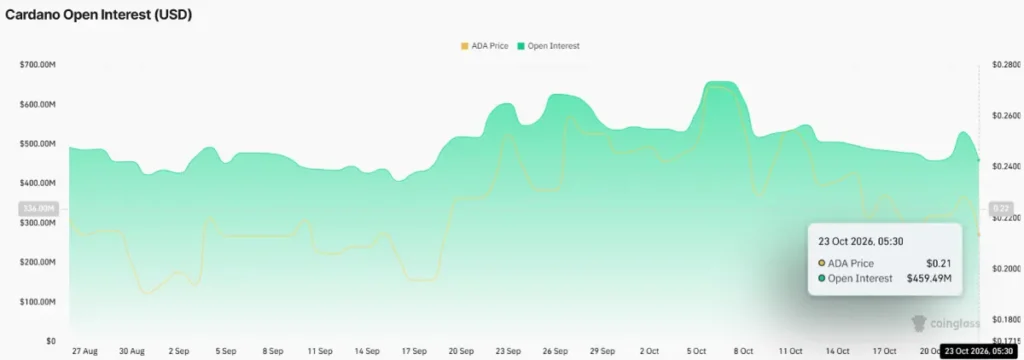
The behavior of "whales"—large-scale investors holding significant quantities of ADA—has become a primary point of concern for market observers. Data provided by market intelligence platform Santiment reveals a distinct cooling in conviction among these major stakeholders. Specifically, mid-tier whales, defined as those holding between 10 million and 100 million ADA, reduced their aggregate dominance from 38.27% on October 10 to 37.93% as of Friday.
While addresses holding more than 100 million ADA showed a marginal increase from 15.92% to 16.04%, the overall shift suggests a strategic redistribution of assets. When large holders begin to trim positions during a period of price weakness, it often signals an anticipation of further downside or a rebalancing of portfolios toward more stable or liquid assets. Furthermore, the contraction in market profitability has been stark. The proportion of circulating ADA supply currently held in profit has plummeted from 30.78% to 17.8%, reflecting a widespread exit strategy among investors who are seeking to secure remaining gains or minimize further losses in a tightening liquidity environment.
Derivatives Market: A Decline in Open Interest
The derivatives market for Cardano has mirrored the on-chain bearishness. Open Interest (OI), which serves as a proxy for the amount of capital locked in active futures and options contracts, has seen a dramatic reduction. Over the last few weeks, OI collapsed from $658 million to $459.5 million, representing a decline of approximately 30.17%.
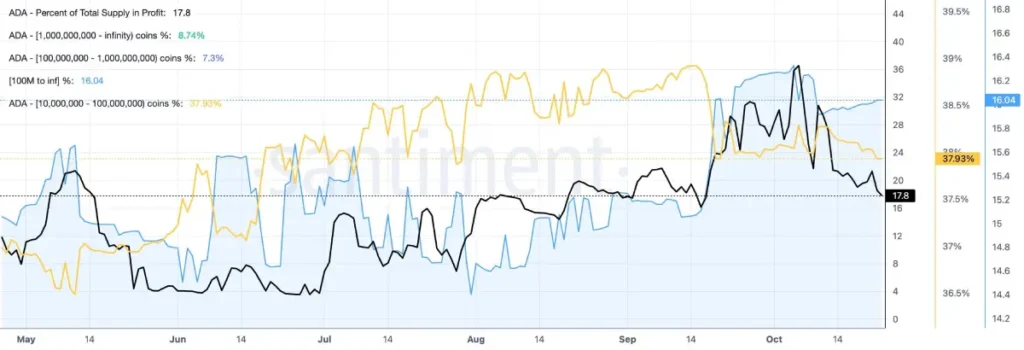
This reduction in Open Interest is particularly telling. In a healthy bull market, rising OI often accompanies rising prices, indicating new capital entering the ecosystem. Conversely, a sharp drop in both price and OI suggests a "long squeeze" or an aggressive unwinding of leveraged positions. The fact that the decline is driven by the closure of long positions rather than a surge in new short selling indicates that market participants are losing confidence in a near-term relief rally. Investors are choosing to close out their trades and pull capital from the ecosystem, preferring to remain on the sidelines until the trend reverses or a clearer bottom is established.
Further evidence of this pessimism is found in the OI-Weighted Funding Rate, which has dipped into negative territory at -0.0095%. In the context of perpetual futures contracts, a negative funding rate means that those holding short positions are paying a fee to those holding long positions. This is a classic indicator that the market is heavily skewed toward betting on further price declines. As short sellers maintain their dominance, the cost of holding long positions increases, further discouraging potential buyers from entering the market at current levels.
Broader Implications and Technical Outlook
The current technical setup for Cardano is precarious. With the asset trading below its 100-day exponential moving average (EMA) and having failed to maintain its multi-month recovery channel, the path of least resistance appears to be toward the downside. Market analysts are currently monitoring the $0.22 level as the primary near-term resistance. Should the price continue to trade below this threshold, the next major support level is identified near $0.19.
However, it is important to note that technical patterns are not absolute. The cryptocurrency market is notoriously reactive to macro-economic news, regulatory developments, and project-specific updates. Cardano, which has been focused on ongoing infrastructure improvements—such as the recent testnet developments—remains a project with significant long-term development activity. If the asset were to regain the $0.22 resistance and demonstrate a strong, volume-backed move back into the ascending channel, the current bearish thesis would be invalidated. Such a move would require a significant influx of new capital and a renewed willingness from retail investors to take on risk.
Contextualizing the Market Sentiment
The current situation with Cardano is symptomatic of a broader trend observed across the altcoin sector during this quarter. Many assets that saw strong recovery phases during the summer months are now experiencing a cooling-off period. This phase is often defined by the "washout" of speculative capital, where over-leveraged traders are forced out of the market, leaving behind a more stable, albeit smaller, base of holders.
For the average ADA investor, the current volatility highlights the importance of risk management. The $1.8 million in long liquidations recorded during Thursday’s selloff serves as a stark reminder of the risks associated with high-leverage trading in the crypto space. While the immediate outlook is dominated by bearish technical signals and the cautious behavior of large-wallet holders, historical market cycles suggest that these periods of consolidation are often necessary for price discovery.
Summary of Future Scenarios
Looking ahead, the next several days will be critical for determining the medium-term direction of Cardano. The interaction between retail sentiment and whale behavior will likely dictate whether the $0.19 support holds or if the asset enters a deeper corrective phase.
- Bearish Scenario: If selling pressure persists and the price remains rejected by the 100-day EMA, a retest of the $0.19 support is highly probable. Further downside could potentially test liquidity levels below this, though this would likely require an exacerbation of the current negative funding rate and a continued exodus of capital from the futures market.
- Bullish Scenario: A reversal would necessitate a "bullish thrust"—a rapid increase in buying volume that pushes the price back above the 100-day EMA and re-establishes the integrity of the ascending channel. Such a move would likely require positive catalysts from the Cardano development team or a shift in general market sentiment toward risk-on assets.
Ultimately, while the current data paints a picture of a market in decline, the Cardano ecosystem remains functional and active. The current price action is a reflection of the immediate financial landscape rather than a fundamental condemnation of the project’s underlying utility. Traders and investors are advised to monitor the $0.22 resistance and the $0.19 support closely, as these levels will likely define the parameters of price action for the remainder of the month. As with all cryptocurrency investments, market participants should remain cognizant of the high volatility inherent in the asset class and the potential for rapid shifts in sentiment that can occur without warning.