
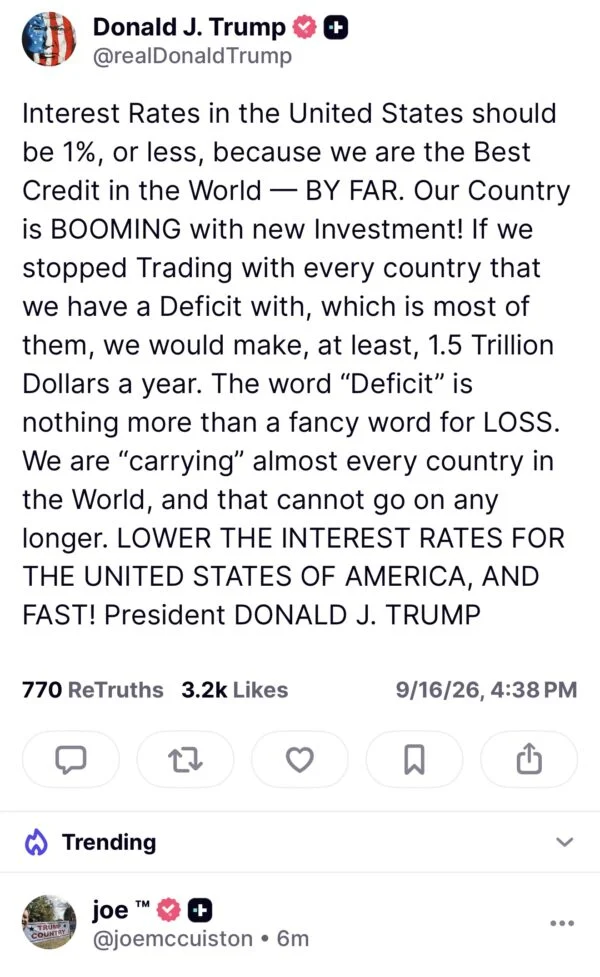
Washington — In a swift and vehement response to monetary policy tightening, President Donald Trump took to his Truth Social platform just hours after the Federal Reserve announced a 25-basis-point increase in benchmark interest rates. The president’s latest online outburst reignites a long-standing public feud between the executive branch and the nation’s central bank, underscoring deep-seated philosophical divisions over the direction of the American economy.
The Federal Reserve’s decision to hike rates—which immediately triggered upward movements in Treasury yields and a downward correction in major equity markets—was framed by central bank officials as a necessary step to manage macroeconomic stability. However, President Trump rejected this assessment outright, arguing that borrowing costs should be plummeting rather than climbing. His remarks not only targeted the current trajectory of monetary policy but also touched upon broader economic nationalist themes, including sweeping criticisms of international trade deficits and foreign policy burdens.
The clash places Federal Reserve Chair Kevin Warsh in a politically precarious position. While Warsh has historically enjoyed a warmer relationship with Trump than his predecessor, Jerome Powell, the central bank’s recent policy action directly defies the administration’s explicit preferences. Financial markets and political analysts alike are now watching closely to see whether this policy divergence will strain relations between the White House and the independent monetary authority.
Presidential Demands and the Logic of Economic Nationalism
In his widely circulated social media post, President Trump laid out a radical vision for U.S. monetary and trade policy, insisting that the exceptional strength of the American economy warrants ultra-low interest rates.
"Interest Rates in the United States should be 1%, or less, because we are the Best Credit in the World — BY FAR," Trump wrote on Truth Social. "Our Country is BOOMING with new Investment! If we stopped trading with every country that we have a Deficit with, which is most of them, we would make at least 1.5 Trillion Dollars a year. The word ‘Deficit’ is nothing more than a fancy word for LOSS."
The president went on to frame the United States as an unfairly burdened superpower, asserting that American taxpayers and consumers are subsidizing the global economy. "We are ‘carrying’ almost every country in the World, and that cannot go on any longer. LOWER THE INTEREST RATES FOR THE UNITED STATES OF AMERICA, AND FAST!"
Economists and trade experts, however, quickly pushed back against the administration’s characterization of trade deficits. Standard economic theory dictates that a trade deficit is not inherently a "loss," but rather a reflection of robust domestic consumption, foreign capital inflows, and the status of the U.S. dollar as the world’s primary reserve currency. Severing trade ties with deficit partners, as suggested in the post, would likely cause severe supply chain disruptions, ignite inflationary pressures, and trigger a contraction in global economic output.
A Historical Precedent: The Executive Branch vs. The Federal Reserve
The tension between President Trump and the Federal Reserve is far from new. Throughout his political career, Trump has consistently challenged the traditional convention of central bank independence, which is designed to insulate monetary policy from short-term political pressures.
During his first term in office, Trump frequently locked horns with then-Fed Chair Jerome Powell. Dissatisfied with Powell’s interest rate hikes, Trump publicly lambasted the Fed chief on numerous occasions, questioning his competence and famously referring to him as an "enemy" of the economy. The friction reached unprecedented levels when the administration reportedly explored legal avenues to demote Powell or force his exit, utilizing investigations into a multi-million-dollar renovation of the Federal Reserve’s Washington headquarters as leverage.
The appointment of Kevin Warsh to lead the central bank was initially viewed by financial markets as a bridge between conventional monetary stewardship and the White House’s growth-oriented agenda. Warsh, a former Fed governor with deep ties to both Wall Street and policymaking circles, was widely perceived as more sympathetic to deregulation and market-friendly policies than his predecessors. Yet, this recent 25-basis-point hike demonstrates that the central bank’s statutory mandate—focusing on maximum employment and stable prices—will routinely supersede political lobbying, even when led by a Fed chair favored by the sitting president.
Anatomy of a Rate Hike: Market Reactions and Central Bank Credibility
The Federal Reserve’s decision to raise rates by a quarter of a percentage point came after months of deliberation over sticky inflation metrics, resilient labor market data, and robust consumer spending. While central bank leadership maintains that monetary policy remains data-dependent, the latest hike was widely interpreted by institutional investors as a signal that the Fed remains steadfast in its commitment to anchoring inflation expectations near its 2% target.
Immediately following the announcement, financial markets experienced noticeable turbulence. Benchmark Treasury yields ticked upward as fixed-income investors repriced debt securities to reflect higher near-term borrowing costs. Concurrently, major stock indices surrendered early-session gains, closing lower as traders factored in the dampening effect of tighter credit conditions on corporate profit margins and consumer borrowing.
Despite the immediate market volatility, many macroeconomists and institutional observers praised the Fed’s fortitude. By moving forward with the rate hike in the face of intense political scrutiny, the central bank sought to reinforce its institutional credibility and demonstrate that monetary decisions are insulated from political interference.
"The Federal Reserve’s primary responsibility is to safeguard the long-term purchasing power of the U.S. dollar and maintain financial stability," noted a prominent Washington-based economic analyst who spoke on condition of anonymity. "Yielding to presidential pressure on interest rates would permanently damage the Fed’s credibility, remove a vital anchor against inflation, and ultimately destabilize the very markets the administration wants to see thrive."
The Dilemma Facing Federal Reserve Chair Kevin Warsh
For Kevin Warsh, navigating the current political landscape requires a delicate balancing act. As a central banker who has previously voiced skepticism regarding excessive regulatory overreach and bureaucratic inertia within the Fed, Warsh shares some common ground with the White House’s economic philosophy. However, as the head of an independent institution, he is legally and professionally bound to follow empirical economic indicators rather than executive directives.
Insiders suggest that while Warsh likely anticipated political blowback from tightening monetary policy, the public nature and intensity of President Trump’s Truth Social tirade presents a formidable communications challenge. Maintaining the appearance of absolute independence is paramount for a central bank chief; responding directly to presidential critiques risks dragging the institution further into the partisan fray, whereas remaining completely silent can be misconstrued as weakness or acquiescence.
So far, leadership at the Federal Reserve has maintained a policy of stoic silence regarding the president’s social media posts, adhering to the traditional protocol of ignoring political commentary to let policy actions speak for themselves.
Broader Implications for the U.S. Economy and the 2026 Policy Outlook
As the dust settles from the latest Federal Reserve announcement and the subsequent political fallout, economists are assessing the broader implications for the U.S. economy moving forward. The divergence between the White House’s push for hyper-growth and cheap capital versus the central bank’s cautious management of inflationary risks sets the stage for a tense policy environment through the remainder of 2026.
Key areas of focus for financial markets and policymakers include:
-
Consumer Borrowing Costs: Higher benchmark rates will continue to flow through to commercial lending products, including mortgages, auto loans, and credit card interest rates. This is expected to cool sectors of the economy that are highly sensitive to borrowing costs, particularly residential real estate and durable goods retail.
-
Foreign Exchange and Trade Dynamics: The persistence of higher yields in the United States relative to other developed nations is likely to sustain strength in the U.S. dollar. A strong dollar makes American exports more expensive overseas while cheapening imports, directly conflicting with the administration’s stated goals of reducing trade deficits through protectionist measures.
-
Institutional Independence: The ongoing public friction serves as a stress test for the American institutional framework. Observers globally will be monitoring whether political pressure ultimately influences future FOMC (Federal Open Market Committee) voting patterns or structural proposals aimed at reforming the Federal Reserve’s mandate.
Ultimately, the clash between President Trump and the Federal Reserve highlights the enduring tension between political imperatives for short-term economic stimulation and technocratic mandates for long-term monetary prudence. As Chair Warsh and his colleagues on the FOMC weigh incoming data for their upcoming meetings, they do so under an unremitting spotlight, knowing that every basis point change will be scrutinized not just by Wall Street, but from the highest office in the land.
