
The Discovery of LAP1-B and the Role of Gravitational Lensing
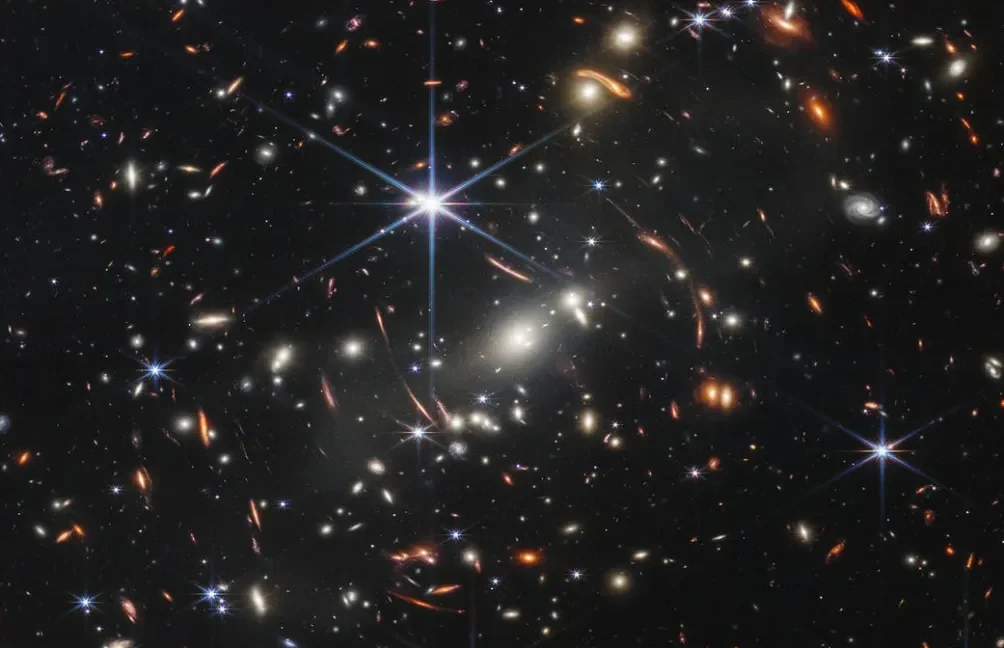
The observation of LAP1-B, led by Kimihiko Nakajima of Kanazawa University in Japan, represents a milestone in observational cosmology. Located approximately 13 billion light-years away, the galaxy is seen as it existed a mere 800 million years after the Big Bang. At this distance, even the most advanced human technology is typically insufficient to resolve such a small, dim object. The James Webb Space Telescope, with its 6.5-meter gold-coated beryllium mirror, is the most sensitive infrared observatory ever built, yet LAP1-B’s intrinsic brightness is so low that it would have remained invisible without an assist from Einstein’s General Relativity.
The researchers utilized a phenomenon known as gravitational lensing. A massive foreground cluster of galaxies, designated MACS J046, sits directly between Earth and LAP1-B. The immense mass of this cluster warps the fabric of spacetime, creating a natural magnifying glass. As light from LAP1-B traveled toward Earth, it was bent and focused by the gravity of MACS J046, amplifying the signal by approximately 100-fold. This "gravitational boost" allowed the JWST to capture light that would otherwise have been lost to the vacuum of space.
Despite this amplification, LAP1-B remains remarkably faint. The team reported that they could not detect the "stellar continuum"—the combined, steady light from the galaxy’s stars. By analyzing the detection limits of the telescope, Nakajima’s team calculated that the stellar mass of LAP1-B is no more than 3,300 times the mass of our Sun. For comparison, the Milky Way contains roughly 100 billion solar masses. This makes LAP1-B one of the smallest and most primitive galaxies ever identified in the early universe.
Chemical Forensics: Searching for Population III Signatures
The primary objective of the study, published in the journal Nature, was to determine the chemical composition of the gas within LAP1-B. In astronomy, "metals" refer to any element heavier than hydrogen and helium. The very first stars, known as Population III stars, were born into a universe devoid of metals. These stars were the "cosmic alchemists" that produced the first oxygen, carbon, and iron through nuclear fusion.
Using the JWST’s Near-Infrared Spectrograph (NIRSpec), the researchers analyzed the light emitted by glowing gas clouds within the galaxy. This gas is illuminated by the intense ultraviolet radiation of young, massive stars. The spectral analysis revealed a startlingly low abundance of heavy elements. The oxygen-to-hydrogen ratio in LAP1-B is only 0.4 percent of the solar value, indicating that the galaxy is in an extremely early stage of chemical evolution.
However, the most significant finding was the detection of triply ionized carbon. To strip three electrons away from a carbon atom requires extreme-ultraviolet photons with energies exceeding 47.9 electronvolts. Standard stars, even the massive O-type stars found in the modern universe, are generally not hot enough to produce radiation of this intensity in such quantities. Nakajima’s team argues that this radiation must have come from Population III stars or their immediate, extremely metal-poor descendants (Population II). These stars, formed from primordial gas, could reach surface temperatures far higher than modern stars because they lacked the heavy elements that typically help stellar interiors cool during formation.
Chronology of the Early Universe and LAP1-B’s Place in It
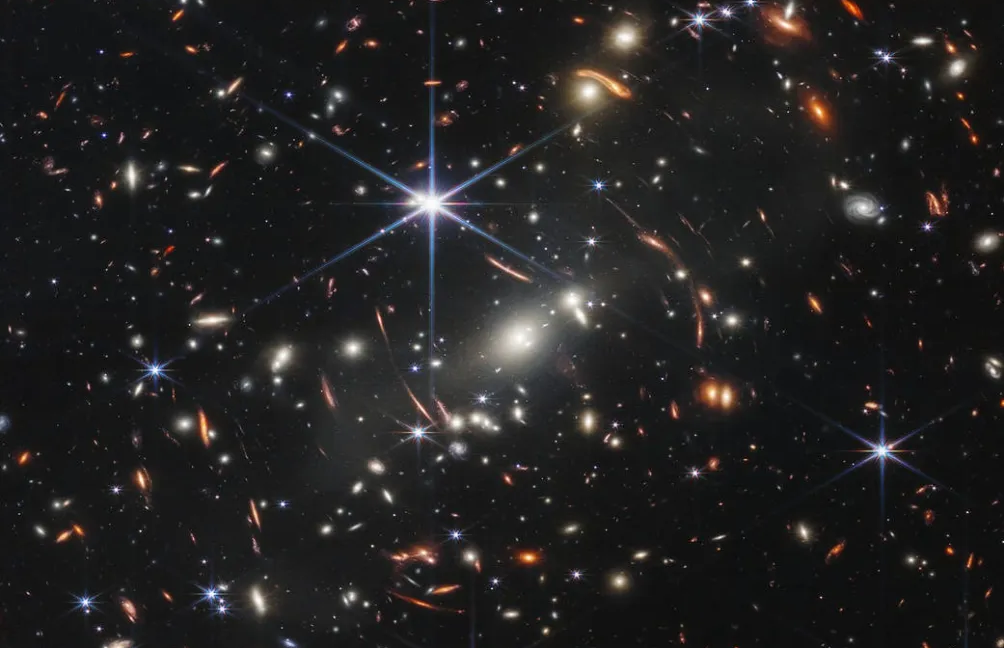
To understand the importance of LAP1-B, it is necessary to view it within the timeline of the early universe:
- The Big Bang (0 years): The universe begins as a hot, dense singularity.
- Primordial Nucleosynthesis (3–20 minutes): Protons and neutrons combine to form the nuclei of hydrogen, helium, and trace amounts of lithium. No heavier elements exist.
- The Cosmic Dark Ages (380,000 to ~150 million years): The universe is filled with neutral hydrogen gas. No stars have yet formed.
- The Cosmic Dawn (~150 million to 500 million years): The first Population III stars ignite, ending the Dark Ages and beginning the Epoch of Reionization.
- Observation of LAP1-B (800 million years): The universe is in the midst of reionization. Galaxies are small, metal-poor, and dominated by the first generations of stars.
- End of Reionization (~1 billion years): The intergalactic medium is fully ionized by stellar radiation, making the universe transparent to ultraviolet light.
LAP1-B exists at a critical juncture. It represents the "missing link" between the theoretical first stars and the established dwarf galaxies we see in the local universe today.
The Mystery of the Faint Supernova
The chemical makeup of LAP1-B presents a paradox: while it is extremely poor in oxygen, it is relatively rich in carbon. The carbon-to-oxygen ratio is significantly higher than that of our Sun. This specific chemical "fingerprint" points toward a unique type of stellar death known as a "faint supernova with fallback."
According to theoretical models of Population III stars, these giants were so massive—often hundreds of times the mass of the Sun—that their gravitational binding energy was immense. When such a star exhausts its fuel, its core collapses into a black hole. In many cases, the resulting supernova explosion is not powerful enough to eject the entire star. The heavier elements produced in the deep interior, such as oxygen and iron, are sucked back into the forming black hole (fallback). However, the outer layers, which are rich in lighter elements like carbon, are successfully expelled into the surrounding interstellar medium.
The high carbon-to-oxygen ratio in LAP1-B suggests that the gas we are seeing today was enriched by the debris of these specific Population III explosions. This provides indirect but compelling evidence that the first generation of stars had already lived and died by the time LAP1-B was 800 million years old.
Dark Matter: The Invisible Scaffolding
Beyond its chemical composition, LAP1-B provided researchers with a rare opportunity to measure the dynamics of an ultra-faint, distant galaxy. By measuring the Doppler broadening of the emission lines—the slight stretching of light caused by the movement of gas—the team determined that the gas within the galaxy is swirling at approximately 58 kilometers per second.
Using the laws of Newtonian gravity, the researchers calculated the amount of mass required to keep gas moving at that speed from escaping into deep space. They concluded that LAP1-B must have a total mass of roughly 10 million solar masses. Given that the stars account for only 3,300 solar masses and the gas adds only a small fraction more, the overwhelming majority of the galaxy’s mass—over 99 percent—must be dark matter.
This confirms the prevailing theory that dark matter acted as the "scaffolding" for the early universe. In the early cosmos, dark matter clumped together into "halos," and its gravity pulled in primordial hydrogen and helium gas. Without these dark matter wells, the gas would have been too hot and dispersed to collapse into the first stars and galaxies. LAP1-B is a textbook example of a "dark-matter-dominated" system.
Broader Impact and Scientific Implications
The discovery has drawn significant attention from the global astrophysical community. Writing in a "News & Views" commentary for Nature, Alexander Ji, an astronomer at the University of Chicago, noted that LAP1-B offers some of the most profound insights into the first stars and galaxies yet uncovered by the JWST.

The implications for our understanding of the Epoch of Reionization are particularly noteworthy. Astronomers have long observed "fossil" galaxies orbiting the Milky Way—ultra-faint dwarf galaxies that stopped forming stars billions of years ago. It is widely believed that these galaxies were "killed" during the reionization period, when intense ultraviolet radiation from the first large galaxies heated the intergalactic gas so much that small galaxies could no longer pull in the cold gas needed for star formation.
LAP1-B appears to be one of these "fossils in the making." By observing it 800 million years after the Big Bang, astronomers are seeing a galaxy just before its growth is stunted by the changing conditions of the early universe.
The success of this study also validates the JWST’s mission design. One of the telescope’s primary goals was to "see the first light" and trace the chemical enrichment of the cosmos. The identification of LAP1-B demonstrates that even when the first stars themselves are too faint to see, their "chemical fingerprints" are visible in the gas of the galaxies they inhabited.
Conclusion and Future Research
While LAP1-B has provided a wealth of data, it also leaves several questions unanswered. Scientists cannot be 100 percent certain that the radiation ionizing the carbon came from Population III stars; it remains possible that a population of extremely massive, metal-poor Population II stars was responsible. Furthermore, the metal content in LAP1-B, while low, is still higher than what is found in the very most primitive stars discovered in our own Milky Way’s halo.
To resolve these uncertainties, Nakajima and his colleagues are already searching for more "metal-deficient" galaxies in the JWST’s deep-field surveys. The goal is to find even younger and more primitive objects, perhaps dating back to 400 or 500 million years after the Big Bang, where the influence of the very first stars should be even more pronounced.
As Dr. Nakajima noted, this work is a significant step toward understanding the primordial universe. Each new discovery of an ultra-faint galaxy brings humanity closer to answering the fundamental question of how a universe of simple hydrogen and helium evolved into the complex, element-rich cosmos that eventually gave rise to planets and life. The "fossil" of LAP1-B is just the beginning of a new chapter in the story of our cosmic origins.
