
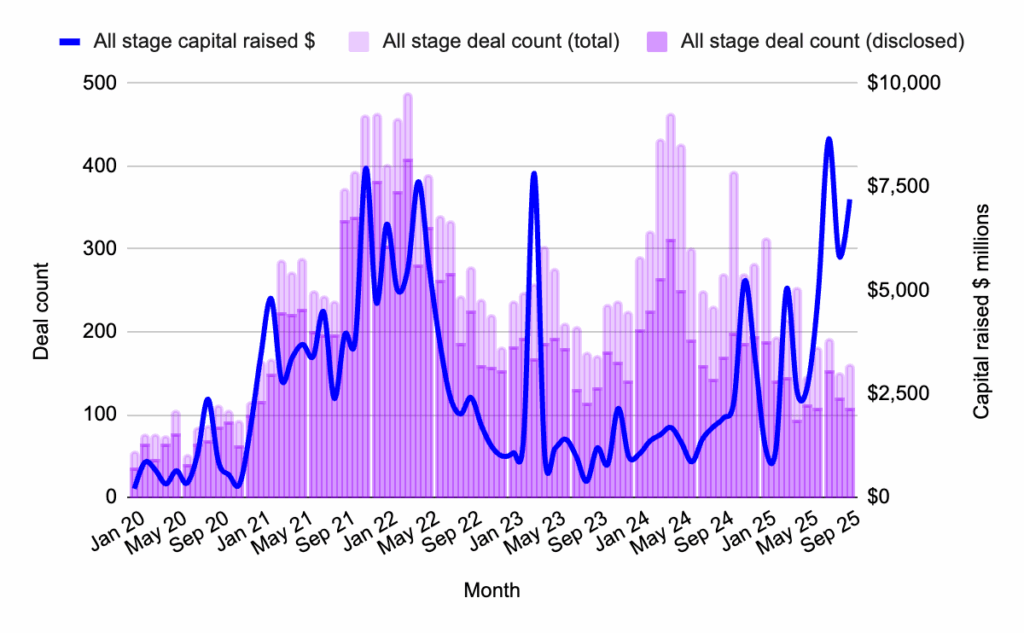
The landscape of Web3 venture capital and fundraising experienced a distinct bifurcated recovery during September 2025. While aggregate metrics pointed to a robust month with $7.2 billion raised across 160 distinct deals—marking the highest capital deployment total since the spring surge of that year—the underlying data reveals a market that was heavily top-heavy. Rather than a broad-based revitalization across the entire startup lifecycle, capital deployment continued a multi-month trend favoring late-stage maturity, institutional-grade infrastructure, and liquid asset exposure. With rare exceptions at the earliest stages of development, venture capitalists and private investors overwhelmingly favored established protocols and mature platforms capable of demonstrating immediate market traction, clear regulatory navigation, and structured yield-generation mechanisms.
This comprehensive overview of the September 2025 funding cycle draws upon aggregated data from market intelligence platforms including Messari and Outlier Ventures, reflecting strategic insights gathered from major industry summits such as Token2049 in Singapore. The data illustrates a maturing asset class where generalist speculation has given way to rigorous, thesis-driven capital allocation.
Market Overview: Strong Metrics Masking a Top-Heavy Ecosystem
At first glance, the $7.2 billion raised across 160 deals in September 2025 signals a roaring return of risk appetite within the digital asset ecosystem. However, a closer examination of the deployment distribution demonstrates that the headline figures are heavily skewed by a handful of mega-rounds. Excluding these massive late-stage investments and outliers, the broader early-stage landscape remained remarkably constrained.
This concentration of capital is not an isolated phenomenon but rather the continuation of a structural shift observed throughout the third quarter of 2025. Institutional investors, burnt by the excessive valuations and prolonged illiquidity of previous market cycles, are increasingly hesitant to lock capital into early-stage, illiquid instruments such as Simple Agreements for Future Equity (SAFEs) or Simple Agreements for Future Tokens (SAFTs) without immediate visibility toward liquidity and capital protection. Consequently, while early-stage deal counts remain superficially active, the bulk of institutional liquidity is purposefully hunting for operational maturity, proven product-market fit, and yield-bearing mechanics.
The Pre-Seed Slump and the Rise of Niche Thematic Plays
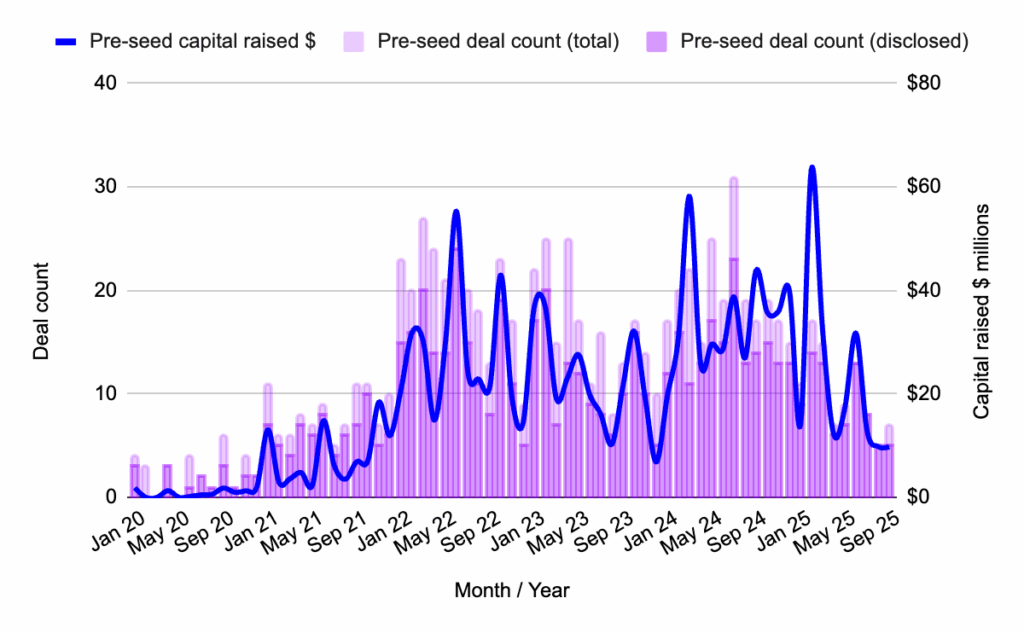
The pre-seed sector experienced a continuation of a nine-month downward trajectory throughout September 2025, registering declines in both aggregate capital deployed and total deal counts. For early-stage founders navigating this environment, capital has become exceptionally scarce, with few Tier-1 venture capital funds willing to write blank checks based purely on conceptual whitepapers.
To secure funding in this climate, pre-seed founders are increasingly required to present airtight narratives, demonstrated technical conviction, and immediate utility within established ecosystems. A prime example of this selective capital allocation is Melee Markets, which successfully secured a $3.5 million pre-seed round backed by prominent web3 funds Variant and DBA. Built on the high-throughput Solana blockchain, Melee Markets operates at the intersection of prediction markets and social trading, enabling users to speculate directly on influencers, real-world events, and trending social topics. The project exemplifies the type of targeted, high-attention asset class that successfully cuts through the current pre-seed capital freeze.
Seed-Stage Dynamics and the Anomaly of Flying Tulip
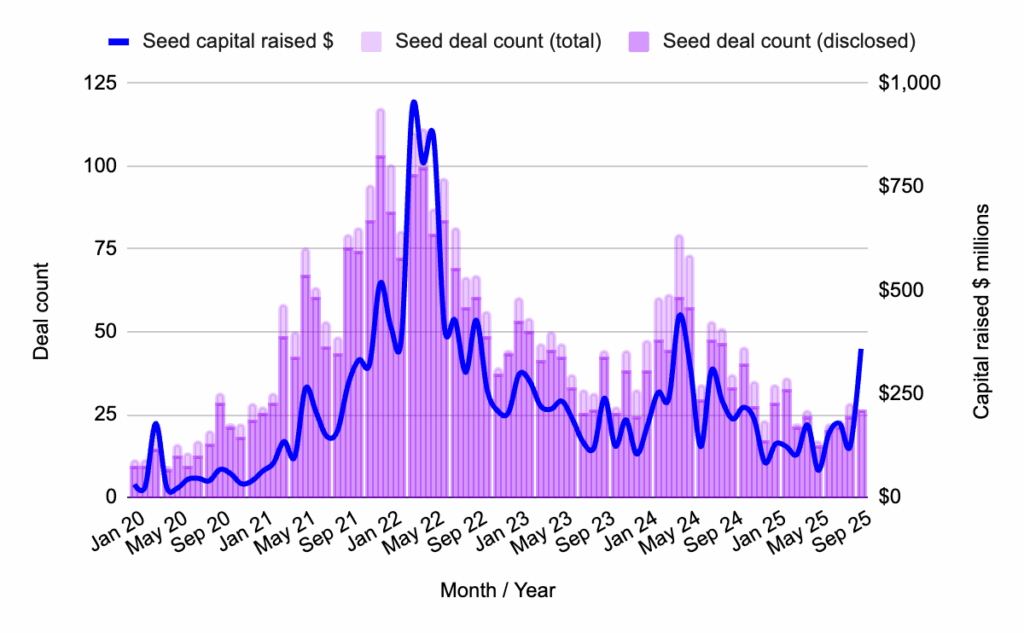
On paper, seed-stage funding displayed a dramatic statistical boost in September 2025. However, this metric is almost entirely distorted by a single, historic transaction: the $200 million seed-stage capital raise executed by Flying Tulip at a coveted $1 billion unicorn valuation. Without this unprecedented transaction, seed-stage funding volumes would have mirrored the subdued levels of the preceding summer months.
Flying Tulip’s mega-round broke conventional venture capital norms not only due to its sheer scale at the seed phase but also because of its innovative structural design. The platform, which aims to unify spot trading, perpetual contracts (perps), lending, and structured yield into a single on-chain exchange utilizing a hybrid automated market maker (AMM) and order book model, introduced a novel mechanism to institutional investing. Featuring cross-chain deposits and volatility-adjusted lending, the protocol incorporates an on-chain redemption right that provides investors with capital security and continuous yield exposure without sacrificing token upside.
Rather than burning through its raised capital on traditional marketing and overhead, Flying Tulip leverages DeFi yield generation directly from its treasury to fund ongoing protocol growth, user incentives, and token buybacks. While investors technically retain the right to withdraw their principal funds via on-chain mechanisms, the deployment represents a massive vote of confidence from Web3 venture capitalists into a DeFi-native architecture that prioritizes liquidity and capital efficiency over traditional, locked illiquid instruments. Analysts note that while Flying Tulip currently stands as a unique structural experiment rather than an immediate industry-wide standard, it provides a compelling blueprint for future protocol financing.
Series A Stabilization and Asian Market Influence
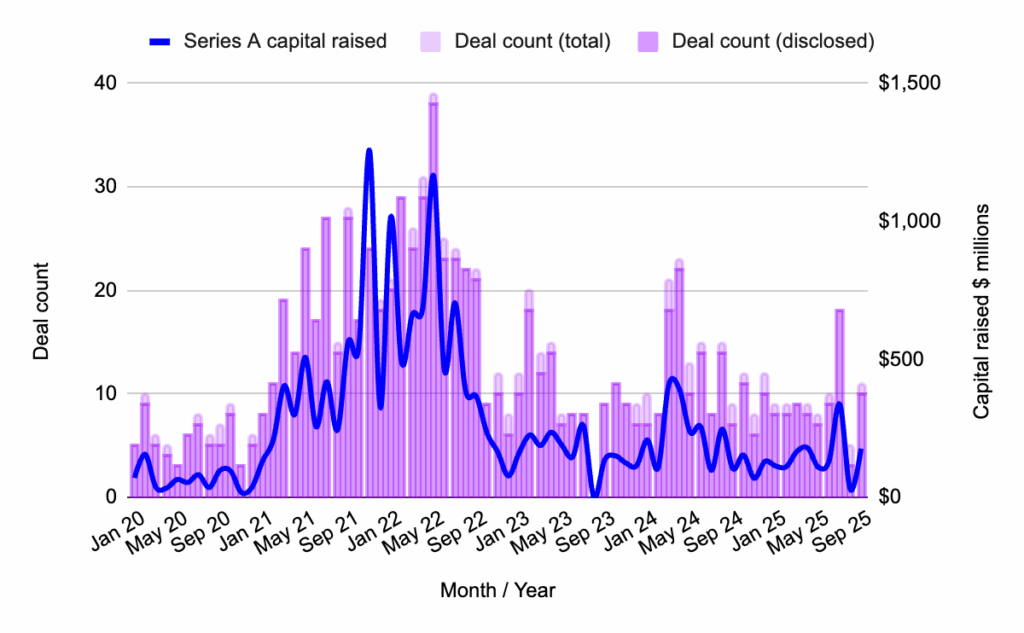
Following a sharp contraction in August 2025, Series A funding exhibited a modest stabilization in September, aligning closely with the broader 2025 monthly averages in terms of both deal volume and aggregate capital deployed. Investors at this stage continue to demonstrate pronounced selectivity, prioritizing demonstrable user metrics, sustainable revenue models, and operational resilience over early-stage momentum.
A notable highlight within the Series A category was the $38 million financing secured by Singapore-based Digital Entertainment Asset (DEA). Backed by strategic heavyweights including SBI Holdings and ASICS Ventures, DEA is developing an integrated ecosystem combining Web3 gaming, environmental, social, and governance (ESG) initiatives, and targeted advertising platforms featuring real-world fiat and token payouts. This transaction underscores the sustained appetite within Asian institutional markets for blockchain applications that successfully bridge native digital asset infrastructure with mainstream consumer industries and real-world utility.
Private Token Sales and Exchange-Driven Consolidation
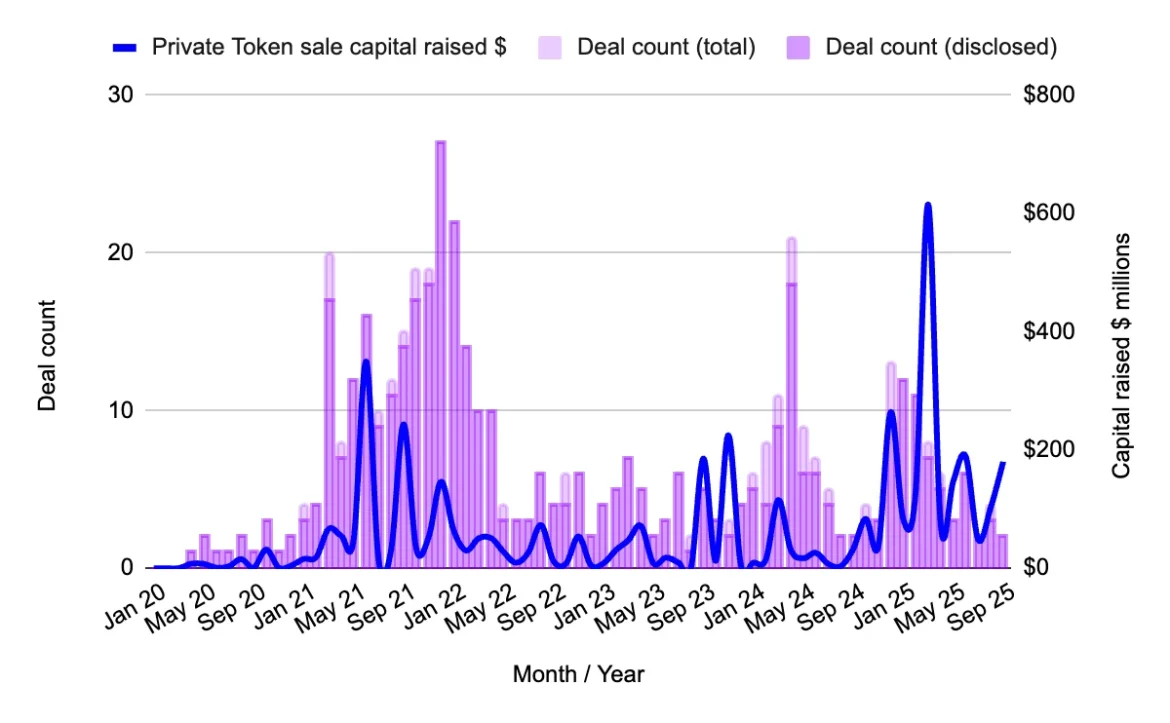
Private token sales in September 2025 remained heavily concentrated among industry giants, with mega-rounds absorbing the vast majority of available institutional liquidity. This trend reinforces a recurring pattern throughout the year: fewer individual token rounds, significantly larger check sizes, and a preference for exchange-backed or infrastructure-heavy plays.
The standout transaction in this category was Crypto.com’s massive $178 million private raise, reportedly executed in strategic partnership with Trump Media. As regulatory frameworks evolve and global competition intensifies, major centralized exchanges continue to secure substantial war chests to fund international expansion, regulatory compliance, and mass-market consumer spending tools. Industry observers remain divided on whether such high-profile corporate alignments represent a fundamental brand pivot or a tactical public relations positioning, but the sheer volume of capital involved cements its place as one of the defining financial events of the month.
Public Token Sales: The Ascent of Bitcoin Yield (BTCFi) and AI Agents
Public token markets remained surprisingly lively throughout September, heavily catalyzed by two dominant and rapidly expanding crypto narratives: Bitcoin yield generation (frequently termed BTCFi) and autonomous artificial intelligence (AI) agents. These sectors demonstrated that public retail and institutional participants alike continue to gravitate toward programmatic yield and computational infrastructure.
The most prominent public token raise of the month was executed by Lombard, which secured $94.7 million to advance its decentralized finance infrastructure. Lombard’s core product, LBTC, is a yield-bearing, cross-chain liquid Bitcoin asset engineered to unify fragmented Bitcoin liquidity across disparate blockchain ecosystems. By enabling native Bitcoin to participate in complex DeFi yield-generating strategies without sacrificing security, Lombard sits at the forefront of the burgeoning BTCFi movement, effectively answering the long-standing market demand for productive Bitcoin capital.
Venture Fund Formations: Smaller, More Thematic Vehicles
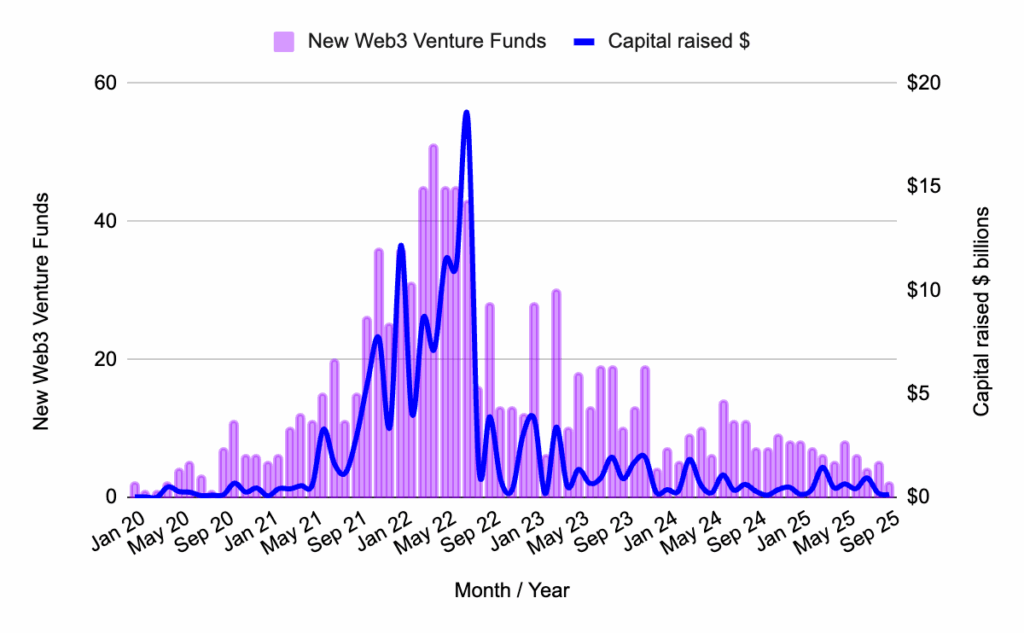
In tandem with the selective deployment of capital into startups and protocols, the formation of new crypto and Web3 venture capital funds experienced a notable cooling period in September 2025. Only two new venture vehicles were officially launched during the month, both characterized by relatively modest fund sizes and highly specialized, thematic mandates.
This contraction in fund formation points away from a general macroeconomic slowdown and toward heightened specialization. Generalist crypto funds are increasingly falling out of favor among Limited Partners (LPs). Instead, emerging fund managers are deploying targeted theses focused on specific verticals—such as modular infrastructure, real-world asset (RWA) tokenization, and cross-chain liquidity architecture—reflecting a maturation of the institutional LP base.
Broader Implications and Market Outlook
The fundraising data from September 2025 paints a clear picture of an industry in transition. The era of speculative, broad-brush venture capital deployment has been decisively replaced by an environment defined by stringent due diligence, structural innovation, and an uncompromising demand for liquidity.
While late-stage platforms, exchange-driven giants, and innovative yield-bearing protocols like Flying Tulip and Lombard continue to command immense institutional backing, early-stage founders face a grueling fundraising climate that penalizes loose narratives and rewards undeniable technical execution. As the market looks toward the final quarter of 2025, the ability to align with robust ecosystem builders—such as the ongoing cohort initiatives led by Outlier Ventures and the Injective ecosystem—will likely remain a critical differentiator for early-stage teams striving to convert foundational conviction into enduring market traction.
