
In the rugged terrains of California and the vast wilderness of Alaska, a new vanguard in the battle against wildfires is taking flight. This summer, a series of experimental deployments featuring autonomous drones capable of precision-spraying water and fire retardants has signaled a potential paradigm shift in emergency management. As climate change continues to compress the traditional "fire season" into a perennial threat across the United States, fire agencies and private innovators are looking toward unmanned aerial systems (UAS) to bridge the gap between initial smoke detection and the arrival of heavy aerial tankers.
The concept of using drones for firefighting is not entirely new, but the sophistication of the technology being tested marks a departure from simple reconnaissance. Unlike the surveillance drones used for years to map perimeters, these new platforms are designed for active suppression. They represent a tactical evolution: the "initial attack" phase, where the goal is to snuff out small ignitions before they escalate into the uncontrollable conflagrations that have devastated Western states in recent years.
The CAL FIRE Field Demonstration and Swarm Intelligence
On July 15, the California Department of Forestry and Fire Protection (CAL FIRE) conducted a pivotal field test that showcased the operational viability of autonomous swarms. Working in conjunction with the nonprofit FireWERX and Seneca, a California-based technology firm, CAL FIRE deployed five autonomous drones in a coordinated effort to suppress simulated fire lines. During the demonstration, the fleet successfully delivered between 500 and 1,000 gallons of fire-suppressing foam, demonstrating a level of synchronization previously reserved for high-end military applications.
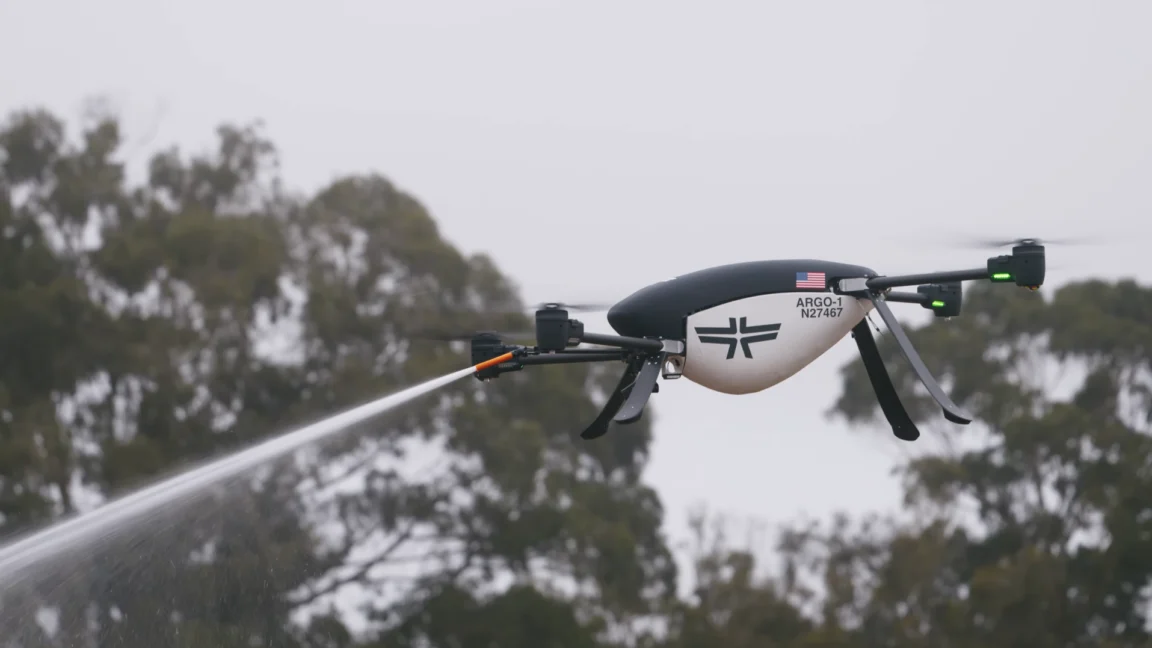
The core of this demonstration was the Argo-1 drone, developed by Seneca. These units do not operate as isolated tools but as a cohesive "swarm." Each Argo-1 is capable of carrying approximately 100 pounds of payload—whether it be water, foam, or specialized fire retardant. In the July test, the drones worked in groups of four to six, a configuration designed to maximize the saturation of a target area.
The operational flow begins with a human supervisor who identifies a fire’s coordinates and uploads a GPS waypoint to the swarm’s control interface. From that point, the drones operate with a high degree of autonomy. Utilizing a suite of onboard sensors, the drones navigate toward the waypoint and then transition to localized detection mode. They use thermal imaging and infrared sensors to pinpoint the specific heat signature of the fire, allowing them to ignore smoke and visual obstructions that might confuse a human pilot. Once the "hot spot" is identified, the drones calculate the optimal hovering altitude and wind compensation before lining up in a disciplined queue to release their payloads one after the other.
Technical Specifications and the Logistics of Portability
While the payload of a single drone is modest compared to a converted DC-10 airtanker, which can drop up to 12,000 gallons of retardant in a single pass, the Seneca Argo-1 is designed for a different mission profile. The primary constraint of the current generation of firefighting drones is their range and power density. The Argo-1 fleet is currently limited to a round trip of approximately 10 miles, flying at an average speed of 30 miles per hour.
This limited range necessitates a "pre-positioning" strategy. For these drones to be effective, they must be stationed near high-risk areas—such as the wildland-urban interface (WUI)—or transported rapidly via ground vehicles. To facilitate this, Seneca designed the Argo-1 with a focus on field logistics. An empty drone is light enough to be carried by two people, and the physical footprint is small enough that a single unit can fit into the bed of a standard pickup truck with the tailgate down.
This portability allows fire crews to bring a "portable air force" directly to the front lines. In scenarios where terrain is too steep for ground crews or where smoke makes it too dangerous for crewed helicopters to fly low, a swarm of drones can be launched from the nearest accessible road to provide immediate suppression.
The XPRIZE Wildfire Competition and Global Innovation
The momentum behind this technology is being accelerated by the XPRIZE Wildfire competition, an $11 million global incentive designed to push the boundaries of fire detection and suppression technology. The competition challenges innovators to develop systems that can detect a fire across a vast landscape and extinguish it within minutes of ignition.
The involvement of organizations like FireWERX and Seneca in these competitions underscores a growing consensus among experts: the current model of firefighting is struggling to keep pace with "mega-fires." Traditional aerial assets are often grounded during the night or in heavy smoke due to safety regulations for human pilots. Autonomous drones, however, do not share these limitations. They can fly 24/7, operating in "blackout" conditions where visibility is zero, provided their thermal sensors can lock onto the heat source.
Organizers of the XPRIZE emphasize that the goal is not to replace the heroic efforts of human firefighters but to give them a "force multiplier." By automating the suppression of small, remote fires, agencies can reserve their billion-dollar tanker fleets and ground crews for larger, more complex incidents.
Economic and Environmental Drivers of Adoption
The push for drone integration is driven by staggering economic and environmental data. According to the National Interagency Fire Center (NIFC), the United States has seen a marked increase in the frequency of fires exceeding 100,000 acres—often referred to as "megafires." In 2020 and 2021 alone, California saw millions of acres burned, resulting in billions of dollars in property damage and suppression costs.
The "initial attack" window is the most critical period in wildfire management. Data from fire scientists suggests that if a fire can be reached and suppressed within the first 15 to 30 minutes of ignition, the probability of it becoming a major disaster drops exponentially. Currently, the response time for crewed aircraft can be delayed by flight clearances, pilot availability, and the distance from regional airbases. Autonomous drones, pre-positioned in fire-prone corridors, could theoretically respond within minutes of a lightning strike or a transformer failure.
Furthermore, the cost-benefit analysis of drone swarms is compelling. While a single large airtanker costs tens of thousands of dollars per hour to operate, a swarm of electric or hybrid drones represents a fraction of that cost. There is also the human cost to consider; aerial firefighting is one of the most dangerous jobs in the world. Transitioning high-risk, low-altitude maneuvers to autonomous systems significantly reduces the potential for pilot fatalities.
Regulatory Hurdles and the Path to 2026
Despite the success of the summer trials, several hurdles remain before drone swarms become a standard feature of the American landscape. The Federal Aviation Administration (FAA) maintains strict regulations regarding the operation of multiple autonomous aircraft in the same airspace, particularly during active emergency incidents where other crewed aircraft may be present.
Seneca has indicated that its Argo-1 systems will be commercially available starting in 2026. Between now and then, the company and its partners at CAL FIRE will continue to refine the software that manages swarm coordination. One of the primary technical challenges is "deconfliction"—ensuring that drones do not collide with one another or with low-flying helicopters while maneuvering in the turbulent air created by a fire’s heat.
There is also the matter of infrastructure. To be truly effective, these drones will require a network of automated charging stations or "nests" located in remote areas. These stations would need to be ruggedized to withstand the very fires the drones are meant to fight, potentially utilizing solar power and satellite links to remain operational in the event of a grid failure.
A Strategic Shift in Wildfire Management
The successful tests in California and Alaska represent more than just a technological curiosity; they represent a strategic shift. For decades, the philosophy of firefighting was reactive—marshalling massive resources to battle a fire once it had already gained momentum. The emergence of autonomous drone swarms suggests a future that is more proactive and distributed.
By the time Seneca’s drones hit the commercial market in 2026, the landscape of the American West may look even more precarious. However, the data gathered from this summer’s trials provides a glimmer of hope. If a swarm of five drones can deliver 1,000 gallons of foam to a remote ridge in minutes, it may be enough to turn a potential catastrophe into a footnote in a daily sit-rep.
As CAL FIRE and other agencies continue to evaluate the results of the July 15 tests, the focus remains on integration. The goal is a hybrid ecosystem where satellite detection, AI-driven risk modeling, and autonomous drone swarms work in concert with human experts to manage the rising threat of wildfires in a warming world. The era of the "robot firefighter" has moved out of the realm of science fiction and onto the fire lines of the Pacific Northwest and the Sierra Nevada.
