
The Federal Reserve concluded its latest policy session on Wednesday by maintaining the federal funds rate within the target range of 3.75% to 4.00%. This decision, while broadly anticipated by market analysts and institutional investors, has failed to soothe underlying anxieties within the financial sector, particularly regarding the future of liquidity. As the Federal Open Market Committee (FOMC) navigates a complex economic landscape defined by persistent inflation, the decision to pause has highlighted a growing ideological divide within the central bank. For the cryptocurrency market, which has become increasingly sensitive to macroeconomic shifts, the announcement serves as a stark reminder that the era of aggressive monetary easing is firmly in the rearview mirror.
A Fractured Committee: The Internal Debate
The most significant revelation from the October FOMC session was not the stability of the rates themselves, but the clear lack of unanimity among policymakers. The committee reached its decision to hold rates steady via a 10-2 vote, marking a rare and notable instance of public disagreement. Fed Governor Lisa Cook and Cleveland Fed President Beth Hammack cast the dissenting votes, both advocating for an immediate 25-basis-point increase.
This friction underscores the broader struggle the Fed faces in its dual mandate. With U.S. inflation currently hovering near 3.7%—well above the Federal Reserve’s long-term target of 2%—the hawks on the committee are signaling that the fight against rising prices is far from over. Fed Chairman Kevin Warsh characterized the discussions as a "heck of a family fight," illustrating the intensity of the data-driven debate that preceded the decision. The emergence of this hawkish faction suggests that future meetings may see continued pressure to tighten monetary policy if inflationary data does not show a definitive downward trend in the coming months.
Operational Overhaul: A New Era for Monetary Policy
In a move that caught many observers by surprise, Chairman Warsh announced a comprehensive restructuring of the Federal Reserve’s administrative calendar. Starting in the fall of 2027, the central bank plans to reduce its active rate-setting meetings to seven per year, with a further reduction to six sessions annually by 2028. The remaining scheduled meetings will be strictly reserved for long-term strategic planning rather than active adjustments to the federal funds rate.
This operational shift is expected to have profound consequences for the global financial ecosystem. By limiting the frequency of policy adjustments, the Fed is moving toward a framework that emphasizes stability and long-term planning over reactive, data-dependent maneuvering. For active market participants, this shift could mean that policy moves will be constrained within broader, more predictable ranges. However, it also suggests that when the Fed does decide to act, the impact may be more pronounced, as market participants will have fewer opportunities to adjust their positions between policy sessions.
The Opportunity Cost of Capital and Bitcoin
For the digital asset market, the macroeconomic environment remains a double-edged sword. While the pause in rate hikes prevents an immediate liquidity shock, the persistent elevation of short-term Treasury yields at roughly 4% creates a significant opportunity cost for investors. When risk-free assets offer a 4% return, the hurdle for institutional capital to flow into more volatile assets like Bitcoin and Ethereum becomes substantially higher.
This dynamic has led to a noticeable cooling in risk appetite across the broader cryptocurrency sector. Liquidity has become increasingly concentrated in Bitcoin, sustaining high levels of market dominance at the expense of altcoins, which have struggled to attract sustained investment in the current high-rate environment. Bitcoin has remained tethered to the $79,500 support level, trading with a downward bias of approximately 4% over the past week as investors await clearer signals regarding future Fed actions.
Chronology of Expectations and Market Positioning
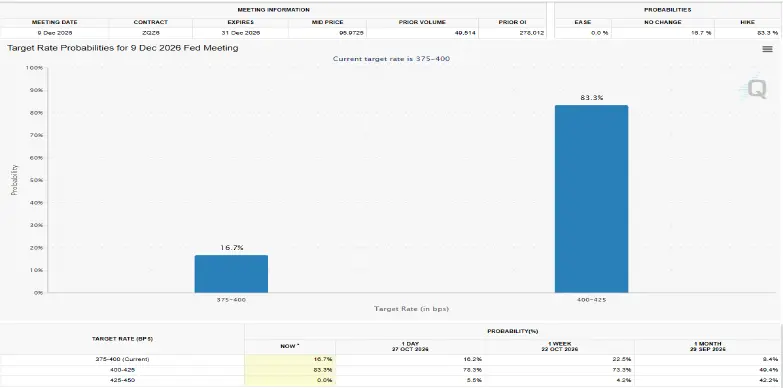
The market’s reaction to the October decision was largely muted, as the pause had been fully priced in by the CME FedWatch Tool. However, the focus of traders has shifted rapidly toward the December meeting. Current market data indicates an 82% probability of a 25-basis-point rate hike in December, suggesting that the "pause" may be temporary.
The following timeline illustrates the progression of expectations leading into the final quarter of 2026:
- Early October: Initial economic reports indicate that consumer spending remains robust, fueling concerns that inflation may remain sticky.
- Mid-October: Speculation grows regarding potential dissent within the FOMC as labor market data shows persistent tightness.
- October 28-29: The FOMC convenes; the decision to hold rates is finalized with two dissenting votes.
- Late October (Post-Meeting): Market focus shifts to December, with the CME FedWatch Tool adjusting for a high probability of a rate hike as the Fed signals its commitment to the 2% inflation target.
Technical Analysis and Market Outlook
From a technical perspective, the $79,500 level serves as a critical junction for Bitcoin. Analysts have identified this price point as the base of a classic "bull flag" consolidation pattern. In technical analysis, a bull flag typically follows a period of rapid appreciation (the pole) and represents a phase of equilibrium before the next leg of a trend.
If Bitcoin can successfully defend the $79,500 floor, it may set the stage for a rebound of approximately 8.25%, potentially challenging resistance at the $86,100 level. A successful breakout above this barrier would likely signal a resumption of bullish momentum, with a long-term target of $98,000. Conversely, a failure to hold the current support level could lead to a deeper correction, with the price potentially sliding toward a $75,000 floor.
Broader Implications for the Financial Landscape
The Federal Reserve’s current path represents a departure from the "easy money" policies that characterized the post-pandemic recovery. Investors are now operating in a "higher-for-longer" interest rate environment, which demands a more disciplined approach to risk management. The implications for the cryptocurrency market are significant: the days of speculative, debt-fueled growth are being replaced by a period where asset valuation is increasingly tied to fundamental utility and macroeconomic liquidity.
Institutional interest, which has been a primary driver of the recent growth in digital assets, remains cautious. Large-scale investors are closely monitoring the Fed’s messaging regarding the terminal rate and the potential for a "soft landing." If the Fed’s restrictive policies succeed in curbing inflation without triggering a recession, it may eventually pave the way for a more favorable environment for risk assets. However, if the current policy mix leads to an economic contraction, the resulting liquidity crunch could test the resilience of the entire crypto ecosystem.
Conclusion: Preparing for a Volatile Q4
As the year draws to a close, the market remains in a state of watchful waiting. The interplay between the Federal Reserve’s internal disagreements and the macroeconomic data—specifically employment and consumer spending reports—will be the primary drivers of volatility in the coming weeks. For crypto traders, the immediate challenge is not just the price of Bitcoin, but the broader shifts in the cost of capital.
The transition to a less frequent rate-setting schedule in the coming years will likely force traders to adopt a longer-term horizon, moving away from short-term reactions to FOMC announcements. While the current environment presents significant hurdles, it also separates speculative activity from long-term value creation. As the market digests the outcome of the October session and prepares for the potential December hike, the importance of maintaining a balanced, well-capitalized position has never been greater. Whether the current bull flag pattern results in a breakout or a consolidation depends entirely on whether the U.S. economy can prove resilient enough to withstand the Fed’s continued restrictive stance. Until then, investors should anticipate continued sensitivity to any data that suggests inflation is moving further away from the central bank’s 2% target.
