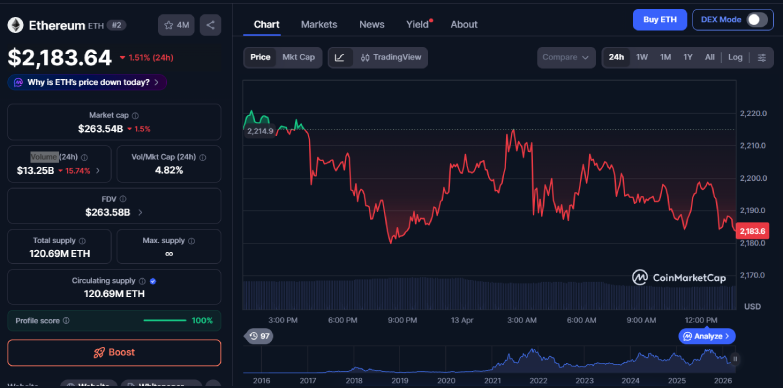
Ethereum’s price experienced a noticeable dip of nearly 1.5% on April 13, 2026, settling around the $2,180 mark. This decline placed ETH in a position of slight underperformance compared to Bitcoin, which saw a 1.26% decrease over the same period, according to data from CoinMarketCap. While initially no singular Ethereum-specific news seemed to dominate the market’s attention, subsequent reports of a significant exploit targeting the Polkadot-Ethereum bridge emerged, introducing a new layer of uncertainty that potentially weighed on ETH’s valuation. At the time of reporting, Ethereum was trading at approximately $2,183.64, reflecting a 1.51% drop in the preceding 24 hours.
Market-Wide Risk-Off Sentiment Triggers Initial Downturn
The cryptocurrency market, as a whole, exhibited a risk-off sentiment on April 13, 2026. The total market capitalization of cryptocurrencies saw a decline of 0.99% in the last 24 hours, as reported by CoinMarketCap. This broad market weakness often sees major cryptocurrencies like Bitcoin setting the trend, with altcoins like Ethereum following suit.
Analysis from social media platforms and industry commentators, including insights attributed to TedPillows, suggested that the failed US-Iran talks might have contributed to the observed market pullback. This geopolitical development, coupled with broader economic uncertainties, likely spurred a "beta-driven" reaction across the crypto space, meaning that ETH’s price movement was largely a derivative of Bitcoin’s performance rather than being influenced by isolated catalysts specific to Ethereum.
A notable observation during this period was the absence of aggressive buying pressure to counteract the selling trend. Trading volume for ETH registered a significant drop of 15.74%, a figure that signals a lack of strong conviction among bullish investors. The prevailing sentiment appeared to be one of caution, with many market participants likely waiting for Bitcoin to demonstrate sustained stability above a key psychological level, such as $71,000, before committing fresh capital. A recovery in Bitcoin’s price could potentially provide the necessary upward momentum for ETH, but as long as the leading cryptocurrency faced downward pressure, the broader market, including Ethereum, was expected to remain susceptible to declines.
Strong ETF Inflows Fail to Offset Broader Market Headwinds
Despite the overall market downturn, Ethereum spot Exchange-Traded Funds (ETFs) in the United States continued to attract significant inflows. Data from SoSoValue indicated that these ETFs collectively saw a net inflow of $187 million during the previous week. BlackRock’s ETH ETF (ETHA) was a leading contributor, accounting for $168 million in inflows and bringing its total assets under management to an impressive $11.73 billion. Following closely, another ETF, ETHB, experienced inflows of approximately $66 million.
This robust institutional demand for Ethereum through ETFs is typically viewed as a positive indicator for the asset’s long-term prospects. However, in the context of April 13, 2026, these strong inflows failed to translate into a price increase for ETH. Instead, the token’s price moved downwards, mirroring the broader cryptocurrency market’s struggle. This divergence highlights a critical market dynamic: while large institutional players were actively accumulating ETH via ETFs, a larger volume of retail or other market participants were selling, thereby overpowering the buying pressure and preventing a price rally. This suggests that macroeconomic factors and broader market sentiment can significantly influence an asset’s price, even in the face of strong, targeted investment inflows.
Polkadot-Ethereum Bridge Incident Emerges as a New Risk Factor

Adding a significant layer of concern to the already bearish market narrative, an exploit targeting the Polkadot-Ethereum bridge came to light earlier on April 13, 2026. Reports indicated that an attacker successfully exploited a vulnerability by forging fake transaction proofs. This allowed the attacker to trick the bridge mechanism into minting a staggering 1 billion $DOT tokens on the Ethereum network without any corresponding real-world backing. These illegitimate tokens were then rapidly offloaded onto decentralized finance (DeFi) platforms, leading to a sharp and immediate price crash for the native Polkadot token, $DOT.
Crucially, the integrity of the native $DOT token and the broader Polkadot ecosystem remained largely unaffected. The exploit was confined to the Ethereum side of the bridge, where the forged tokens created artificial supply. While the attacker managed to extract some ETH by selling the fake DOT, the financial impact on Ethereum itself was not substantial enough to cause a direct, significant price drop in ETH.
However, the implications of such an exploit extend beyond immediate financial losses. The incident significantly impacted market sentiment, particularly concerning the security and reliability of cross-chain bridges and DeFi protocols. Such events tend to make traders and investors more risk-averse, fostering nervousness about the safety of assets moving between different blockchain networks. This heightened sense of caution can contribute to short-term weakness in related assets, including Ethereum, as traders re-evaluate their exposure to interconnected DeFi ecosystems. The exploit served as a stark reminder of the inherent risks associated with the rapidly evolving landscape of decentralized finance and cross-chain interoperability.
Near-Term Outlook and Key Levels to Watch
As of the reporting period, Ethereum’s price was testing a critical support zone between $2,175 and $2,200. The ability of ETH to maintain its position above the $2,175 level was seen as crucial for a potential rebound. A successful hold could pave the way for a price recovery towards the $2,235 resistance mark, which aligns with the 23.6% Fibonacci retracement level.
Conversely, a break below the $2,175 support, especially on high trading volume, would signal increased selling pressure and could trigger a more significant decline. In such a scenario, the next major floor to watch would be the $2,140 level.
The security concerns stemming from the Polkadot-Ethereum bridge incident introduced an additional layer of volatility to the market. While Bitcoin’s directional movement remained the primary determinant of broader market trends, headlines related to the bridge exploit and its resolution could accelerate price movements for Ethereum and other interconnected cryptocurrencies.
The overall market sentiment appeared to be consolidating with a bearish bias. Investors were keenly awaiting definitive catalysts to shift the prevailing mood. These catalysts could include a clear stabilization of Bitcoin’s price above the $70,000 threshold or more concrete clarifications and reassurances regarding the security implications of the Polkadot-Ethereum bridge incident.
In summary, Ethereum’s recent price slide was a confluence of several factors: the pervasive Bitcoin-led market weakness, technical chart patterns indicating downward pressure, and the emerging concerns surrounding the Polkadot bridge exploit. The low trading volume accompanying the decline suggested a lack of robust buying interest to defend the price levels, underscoring the cautious sentiment prevalent among investors.
Background and Chronology of the Polkadot-Ethereum Bridge Exploit

The incident involving the Polkadot-Ethereum bridge, which surfaced on April 13, 2026, marked a significant event in the cross-chain interoperability space. Bridges are designed to facilitate the seamless transfer of assets and data between different blockchain networks, a crucial component for the growth and interconnectedness of the decentralized ecosystem. However, their complex architecture and the requirement to manage assets across multiple chains often present unique security challenges.
The exploit specifically targeted a bridge that connected the Polkadot network to Ethereum. The attacker’s methodology involved the creation of fraudulent transaction proofs. In blockchain systems, transaction proofs are cryptographic evidence that verifies the authenticity and validity of a transaction. By forging these proofs, the attacker was able to deceive the bridge’s smart contracts, which are automated agreements that execute based on predefined conditions. The bridge’s logic, tricked by the fake proofs, proceeded to mint a substantial quantity of $DOT tokens on the Ethereum network. This action effectively created "fake" $DOT tokens on Ethereum, detached from any real $DOT held on the Polkadot chain.
Upon minting these illegitimate tokens, the attacker immediately moved to liquidate them on various decentralized finance (DeFi) platforms. DeFi platforms, such as decentralized exchanges (DEXs), allow users to trade cryptocurrencies directly from their wallets without intermediaries. The rapid selling of a large, unbacked supply of $DOT on these platforms inevitably led to a severe price depreciation for the token within the DeFi ecosystem.
The timeline of events likely unfolded as follows:
- Initial Phase: The attacker identified and exploited a vulnerability within the Polkadot-Ethereum bridge’s proof verification mechanism.
- Minting Phase: The attacker successfully submitted forged transaction proofs, causing the bridge’s smart contracts to mint approximately 1 billion $DOT tokens on the Ethereum network.
- Liquidation Phase: The attacker swiftly transferred these newly minted tokens to various DeFi platforms and initiated large sell orders.
- Price Impact (DOT): The sudden influx of supply on DeFi platforms caused the price of $DOT (on Ethereum) to plummet dramatically.
- Price Impact (ETH): While the attacker used some of the proceeds to acquire ETH, the amount was reportedly not large enough to cause a significant direct impact on Ethereum’s market price.
- Market Reaction: News of the exploit spread, leading to increased scrutiny of cross-chain bridge security and contributing to a broader risk-off sentiment in the cryptocurrency market, which also affected Ethereum’s price.
It is important to note that the native Polkadot blockchain and its associated ecosystem remained secure. The exploit did not compromise the underlying Polkadot network’s integrity or the actual $DOT tokens held on its chain. The damage was confined to the synthetic representation of $DOT on Ethereum, created through the bridge’s compromised mechanism.
Analysis of Implications
The Polkadot-Ethereum bridge exploit, while not directly causing a large financial loss to Ethereum itself, carries significant implications for the broader cryptocurrency market and the development of decentralized finance:
- Trust and Security of Bridges: Cross-chain bridges are fundamental to achieving a truly interconnected blockchain ecosystem. This exploit underscores the inherent security risks associated with these complex systems. It will likely lead to increased due diligence by investors and developers, potentially slowing down the adoption of new bridge technologies until more robust security measures are proven.
- DeFi Sentiment: The incident injects a dose of caution into the DeFi space. Investors who have grown accustomed to the rapid innovation and growth in DeFi may become more wary of protocols that handle large sums of value, especially those that involve cross-chain interactions. This could lead to a temporary slowdown in DeFi growth or a shift towards more auditable and transparent DeFi solutions.
- Regulatory Scrutiny: As the cryptocurrency space matures, regulatory bodies worldwide are increasing their oversight. Major security incidents like this could attract further regulatory attention, potentially leading to calls for stricter security standards and compliance measures for DeFi protocols and bridge operators.
- Ethereum’s Role: While not directly attacked, Ethereum, as the largest smart contract platform and a key hub for DeFi, is indirectly affected by such events. A perception of instability in the interconnected DeFi ecosystem could lead to a general hesitancy towards investing in assets heavily reliant on this infrastructure, including ETH.
The incident serves as a critical reminder that while blockchain technology offers immense potential, the security of its infrastructure, particularly in complex areas like cross-chain communication, remains paramount. The industry will need to learn from these events to build more resilient and trustworthy decentralized systems.
Niharika Deshpande, a seasoned editor with over four years of experience, contributes to CryptoNewsZ. Holding a Master’s degree in Biochemistry, she possesses a unique talent for demystifying intricate blockchain concepts. Her sharp focus on industry trends enables her to deliver breaking news and insightful analyses of the cryptocurrency world. Her articles are a valuable resource for individuals navigating the crypto landscape, offering clear and well-researched perspectives. She also covers emerging crypto presales and new token launches, aiding investors in staying informed. Passionate about the evolving blockchain space, she consistently explores its transformative impact across various sectors. Beyond her journalistic endeavors, she actively participates in the crypto community, fostering discussions on decentralized innovations.
Disclaimer: This article is intended solely for informational purposes and does not represent financial, investment, legal, tax, or other professional advice. The opinions and views expressed are those of the author(s) and do not necessarily represent the position of cryptonewsz.com. Cryptocurrency investments and trading entail high risks, including possible loss of some or all of your investment, and prices may be influenced by external events like financial, regulatory, or political events. Past performance cannot be used to determine future results. Readers are strongly advised to do their own research and consult with an expert financial advisor prior to making any investment. cryptonewsz.com takes no responsibility for loss or damages sustained as a direct result of material contained in, or information, published through, this website. Explore our Terms and Conditions and Privacy Policy for more information.