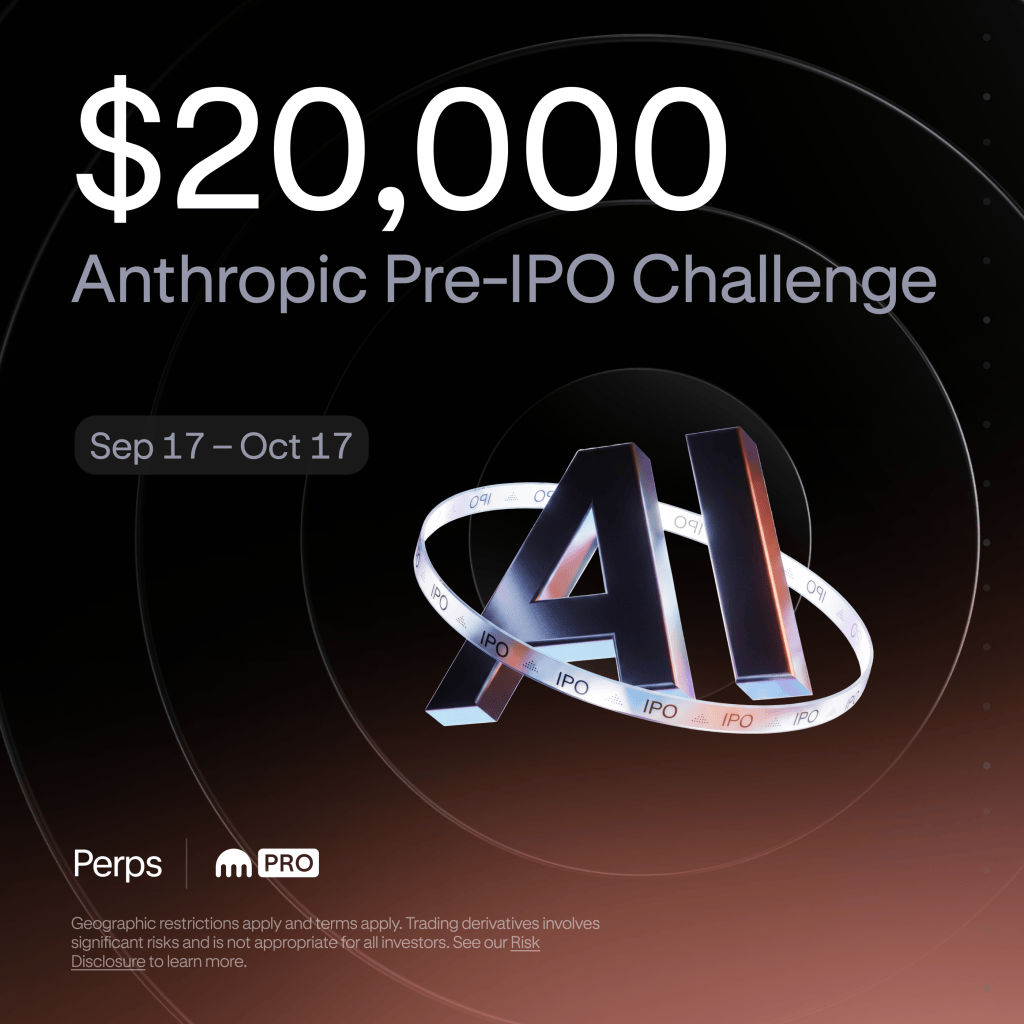
As the artificial intelligence sector continues to dominate global financial markets, major cryptocurrency and derivatives exchanges are finding novel ways to bridge traditional tech speculation with digital asset infrastructure. Cryptocurrency exchange Kraken has officially announced the launch of a new product offering designed to let traders capture price exposure ahead of what is widely considered one of the most anticipated initial public offerings (IPOs) of 2026. Beginning September 17, eligible users on Kraken Pro gain the ability to trade perpetual futures contracts tied to artificial intelligence leader Anthropic, concurrent with a community-driven trading competition boasting a prize pool of up to $20,000 in USDG.
This strategic rollout targets retail and institutional traders who have closely monitored Anthropic’s meteoric rise within the generative AI ecosystem. By introducing a derivative instrument tracking the company’s valuation before it officially lists on public equities exchanges, Kraken aims to capture speculative interest that typically remains sidelined during the pre-IPO phase.
Understanding the ANTHROPICx Perpetual Contract
The core vehicle enabling this pre-IPO speculation is the ANTHROPICx perpetual futures contract, traded under the ticker symbol PF_ANTHROPICXUSD on Kraken Pro. Market participants must understand that this financial instrument does not grant direct equity ownership, shares, or shareholder rights in Anthropic. Instead, it functions as a decentralized or exchange-hosted derivatives contract engineered to mirror and track the perceived market valuation and price sentiment surrounding the company.
Traders utilizing the Kraken Pro platform can access this contract with up to 10x leverage, amplifying both potential gains and inherent risks. The introduction of such specialized pre-IPO derivatives reflects a growing trend among crypto derivatives platforms to offer synthetic exposure to blue-chip private technology companies long before they conduct traditional public equity offerings. This allows market participants to express directional views on high-profile firms that are otherwise inaccessible to the general public through standard stock brokerages.
Structure of the Anthropic Pre-IPO Challenge
Alongside the listing of the derivative contract, Kraken has structured a volume-ranked trading competition to incentivize platform engagement. Dubbed the Anthropic Pre-IPO Challenge, the event rewards traders based on their cumulative trading volume generated within the specified competition window.
Participation is restricted to eligible Kraken Pro users who complete a mandatory enrollment step prior to executing qualifying trades. Exchange representatives have explicitly emphasized that trading volume accumulated prior to formal registration on the Kraken Pro app or web portal will not contribute toward a participant’s leaderboard score, regardless of when their underlying trading account was established.
As participants build their trading volume on the ANTHROPICx perpetual contract, their relative ranking on the public leaderboard shifts. The competition is designed to reward both high-frequency institutional-grade participants and active retail traders, with prizes distributed across multiple tier brackets ranging from the top overall individual trader down to a shared pool for participants ranked 51st and below.
Tiered Prize Pool and Community Volume Milestones
The financial incentives for the Anthropic Pre-IPO Challenge are tied directly to both individual performance and aggregate platform-wide participation. The competition features a dynamic prize pool structure initialized at $10,000 USDG. However, this figure is subject to a 100 percent expansion if community engagement hits specific pre-determined benchmarks.
Should the cumulative trading volume generated by all participating users across the platform surpass $100 million during the competition window, the total prize pool automatically doubles from $10,000 USDG to $20,000 USDG.
Under the baseline $10,000 USDG structure, the first-place winner is slated to receive $1,500 USDG, with subsequent tiers scaling downward: second place secures $800 USDG, third place receives $600 USDG, and ranks four through five earn $300 USDG each. Mid-tier participants finishing between ranks 11 and 20 are allocated $100 USDG each, while a substantial portion is reserved for the broader base of participants finishing at rank 51 and beyond, who share a collective pool of $3,975 USDG.
If the community successfully unlocks the $100 million volume milestone, all corresponding individual rewards double proportionally. Under the $20,000 USDG maximum prize pool, the first-place finisher receives $3,000 USDG, second place claims $1,600 USDG, and the distributed pool for participants ranked 51st and lower increases to $7,950 USDG.
Background and Context of the 2026 AI IPO Landscape
The timing of Kraken’s pre-IPO product launch aligns with an unprecedented era in technology financing. Throughout 2024, 2025, and into 2026, artificial intelligence enterprises have commanded historic private valuations. Anthropic, founded by former senior research executives from OpenAI, has positioned itself as a primary competitor in the generative AI space, securing massive capital injections from major enterprise technology giants, sovereign wealth funds, and venture capital syndicates.
As artificial intelligence models scale in capability, commercial adoption, and infrastructural cost, the capital requirements for training next-generation systems have necessitated massive funding rounds. Analysts have anticipated an eventual public market debut for companies of this scale to provide liquidity to early-stage investors and institutional backers. However, the lengthy regulatory and underwriting processes required for a traditional initial public offering often leave retail investors and crypto-native speculators without early market access.
Products like Kraken’s ANTHROPICx perpetual contract serve as an informal barometer of market sentiment, capturing the speculative premium or discount that the open market assigns to a company well in advance of official Form S-1 filings or pricing announcements made by Wall Street underwriters.
Regulatory Framework and Jurisdictional Compliance
Operating within the complex intersection of cryptocurrency derivatives, synthetic equity tracking, and global financial regulation requires strict adherence to compliance standards. Payward Digital Solutions Ltd., the corporate entity operating key segments of the infrastructure, is licensed to conduct digital asset business under the regulatory framework of the Bermuda Monetary Authority.
The rollout of leveraged pre-IPO products also highlights the inherent financial risks associated with derivatives trading. Because instruments such as the ANTHROPICx perpetual contract utilize leverage up to 10x, market volatility can result in rapid capital losses. Kraken’s compliance documentation explicitly notes that trading derivatives, futures, and leveraged financial instruments involves a high degree of risk and is not suitable for all retail investors. Comprehensive risk disclosures are mandated by the platform to ensure participants understand the mechanisms of perpetual swap funding rates, margin requirements, and liquidation mechanics.
Broader Market Implications and Future Outlook
The introduction of pre-IPO derivatives for private AI heavyweights marks a potential paradigm shift in how private market valuations are discovered and scrutinized. Historically, private company valuations were strictly determined by periodic venture capital funding rounds, secondary market private share placements, or internal company valuations.
By introducing public-facing perpetual contracts tied to private entities, exchanges are effectively crowdsourcing price discovery. If successful, this model could establish a precedent where derivatives markets act as a continuous, real-time indicator of private company health and public market appetite. Such transparency allows retail traders and institutional market makers to hedge exposure or speculate on corporate milestones before traditional equity markets open their doors.
Nevertheless, regulators and market analysts continue to monitor these synthetic derivatives closely. Concerns regarding market manipulation, oracle reliability in tracking private valuations, and consumer protection remain central topics of discussion within financial compliance circles. As the 2026 calendar progresses toward Anthropic’s anticipated public listing, the performance, liquidity, and trading volume of the ANTHROPICx perpetual contract will serve as a critical case study for the integration of traditional corporate finance speculation with digital asset trading platforms.
Participants looking to engage in the challenge must carefully review the terms and conditions outlined by Kraken Pro, complete all necessary jurisdictional eligibility checks, and officially enroll via the designated application interfaces before deploying capital into the markets.