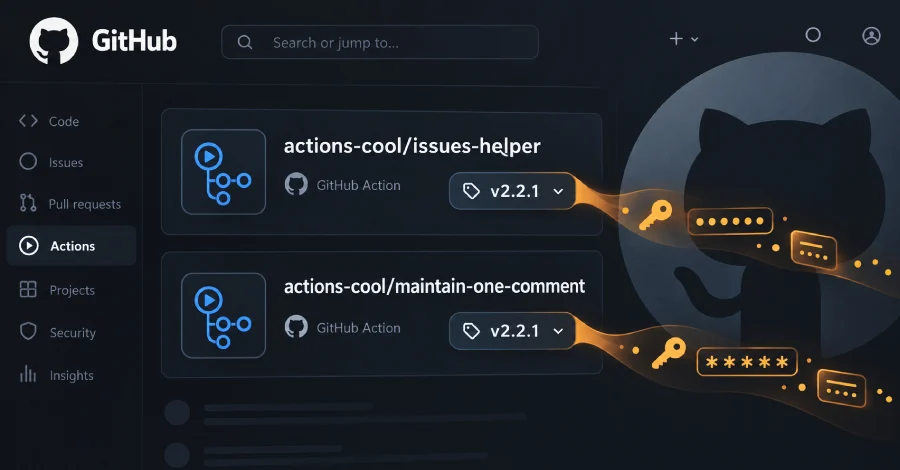
The cybersecurity community is once again scrutinizing the resilience of software supply chain security after two GitHub Actions—previously flagged as malicious—briefly reappeared in the public domain this month. This incident, which occurred on September 16, 2026, highlights a critical vulnerability in how automated CI/CD pipelines handle versioning and repository integrity. Despite being initially neutralized following the widespread May 2026 Mini Shai-Hulud campaign, the sudden reactivation of these repositories allowed the dormant malicious payloads to once again become accessible to any automated workflow relying on them.
Chronology of the Incident
The origins of this security failure trace back to May 18, 2026, when threat actors successfully compromised several GitHub Actions. These tools, designed for routine repository housekeeping—such as closing stale issues, managing comment threads, and updating automated bot responses—were weaponized to exfiltrate sensitive credentials from CI/CD environments.
The malicious code remained embedded within the repositories, waiting for execution. By linking the exfiltration infrastructure to the domain "t.m-kosche[.]com," researchers identified the attackers as part of the "Mini Shai-Hulud" cluster. This same cluster was concurrently linked to malicious activity involving the @antv ecosystem in the npm package repository, signaling a coordinated effort to penetrate developer workflows through multiple vectors.

Following the discovery of the malicious payload, GitHub moved to disable the affected repositories, effectively halting the immediate threat. However, the situation took a concerning turn on September 16, 2026. Between 11:09 a.m. and 6:16 p.m. GMT+2, the repositories were mysteriously re-enabled and became accessible to the public once more.
Because the release tags within these repositories had not been scrubbed or updated to remove the malicious content, the repositories essentially "resumed" their compromised state the moment they were made public. Any CI/CD pipeline configured to reference these actions via version tags—such as "v1" or "latest"—automatically pulled the malicious code upon the next execution cycle, effectively re-infecting the downstream projects without any new action required from the original threat actors.
The Mechanism of the Supply Chain Attack
The vulnerability hinges on the common practice of using mutable tags in GitHub Actions workflows. When a developer references an action using a tag like "v1.0," the system fetches the current state of that tag at the time of execution. If the owner of that repository has updated the tag—or, in this case, if the repository is restored to a state containing a malicious payload—the user’s pipeline pulls that code without validation.
Socket researcher Karlo Zanki, who documented the reappearance, noted that the malicious payload was never removed from the codebases during the period they were disabled. Consequently, the threat remained dormant but ready to fire. "No new code was published and no configuration was changed," Zanki observed. "This incident shows that a mutable tag can be compromised, contained, and then reactivated without any change to your own workflow file."

This creates a "time-bomb" scenario. Organizations that believed they were protected because the malicious repositories had been taken offline were inadvertently exposed to the same threat the moment the platform’s access control settings were toggled. This underscores the fragility of relying on external, third-party infrastructure for mission-critical automation.
Broader Implications for CI/CD Security
The Mini Shai-Hulud incident is emblematic of a broader shift in threat actor strategy. Rather than attempting to break into well-defended production servers, adversaries are increasingly focusing on the "soft underbelly" of the software development lifecycle: the CI/CD pipeline. By compromising tools that developers trust and execute automatically, attackers can achieve high-impact breaches with minimal effort.
The incident carries significant implications for DevSecOps practices:
- The Failure of Implicit Trust: Developers often trust GitHub Actions published by well-known or popular sources. This incident proves that even previously reputable actions can be hijacked and that containment measures taken by platform providers may not be permanent or sufficient if the underlying malicious artifacts are not purged.
- The Necessity of Pinning: The only robust defense against this type of supply chain vulnerability is SHA pinning. By referencing a specific, immutable commit SHA rather than a mutable version tag, developers ensure that their workflows execute the exact code they have audited. If an attacker pushes a new version or restores a compromised one, a SHA-pinned workflow will continue to use the known-good version, protecting the pipeline from unauthorized changes.
- Governance of Automated Workflows: Organizations must maintain an inventory of all third-party actions used in their pipelines. Automated tools should be used to scan for updates, check for changes in repository ownership, and enforce policies that forbid the use of mutable tags in production environments.
Official Responses and Mitigation Strategies
While GitHub has since re-disabled the repositories, displaying the standard notice regarding violations of the platform’s Terms of Service, the incident serves as a stark reminder of the limitations of reactive platform-level security.

Security experts suggest that developers should perform an immediate audit of their GitHub Action workflows. Specifically, they recommend:
- Switching to SHA Pinning: Immediately replace all version tags (e.g.,
actions/checkout@v4) with the corresponding commit hash (e.g.,actions/checkout@1d96c77...). - Dependency Auditing: Use tools that track the provenance of third-party actions and alert developers to changes in the underlying repository source.
- Pipeline Isolation: Ensure that CI/CD environments operate with the principle of least privilege. Sensitive credentials should not be exposed to every action in a workflow, particularly those that do not strictly require them.
The fact that these actions were compromised for months, disabled, and then briefly restored without any remediation of the malicious payload indicates a gap in the cleanup process following such incidents. Philipp Burckhardt, head of threat intelligence at Socket, previously emphasized that the Mini Shai-Hulud activity represents a sophisticated, persistent threat cluster. The ability of these actors to leverage the platform’s own mechanics to keep their payload active—even after platform intervention—is a development that should alarm security teams across the industry.
Conclusion
The September 2026 resurgence of the Mini Shai-Hulud GitHub Actions serves as a definitive case study in the dangers of mutable dependencies. In a modern software ecosystem where code is increasingly assembled from third-party building blocks, the security of the pipeline is just as important as the security of the product itself.
As organizations continue to embrace automation to increase development velocity, they must also embrace the inherent risks that come with it. The "set it and forget it" mentality regarding CI/CD configuration is no longer sustainable. By adopting stricter dependency management practices—most notably the universal adoption of SHA pinning—the developer community can insulate itself against the next iteration of supply chain attacks. The incident serves as a sobering reminder that in the world of software security, trust is not a strategy; verification is the only viable path forward. The brief window of exposure in September may not have led to widespread catastrophe, but it has provided a clear warning: the threat actors are waiting for the next accidental reactivation, and the only way to stay secure is to assume that any external dependency can, and eventually will, be compromised.