• Home
  • About Us
  • Contact Us
  • Cookies Policy
  • Disclaimer
  • DMCA
  • Privacy Policy
  • Terms and Conditions
Dr Crypton
Secure Your Future in Crypto
Blockchain Technology

Binance Unveils Agent OS to Bridge Autonomous AI Agents with Real-Money Crypto Markets

by admin September 17, 2026
written by admin

Cryptocurrency exchange infrastructure is undergoing a fundamental transformation as artificial intelligence shifts from passive conversational tools to autonomous, action-oriented digital agents. Binance, the world’s largest digital asset exchange by trading volume with a user base exceeding 300 million registered accounts, announced the global launch of Agent OS on Thursday. This developer-focused platform bridges external artificial intelligence applications with live financial markets, granting AI programs the capability to analyze complex market data, execute spot and futures trades, and manage real capital on behalf of human users.

The introduction of Agent OS represents a major milestone in the convergence of fintech and advanced machine learning. As software engineering races past simple chatbot interfaces, major financial platforms are racing to accommodate a new class of digital workers. These systems are designed to operate independently, executing multi-step workflows without continuous human oversight. By offering a standardized framework for AI connectivity, Binance is positioning its ecosystem at the center of the emerging agentic economy, though the move also invites critical questions regarding security, risk management, and accountability in high-stakes financial environments.

Anatomy of Agent OS: Architecture and Tooling

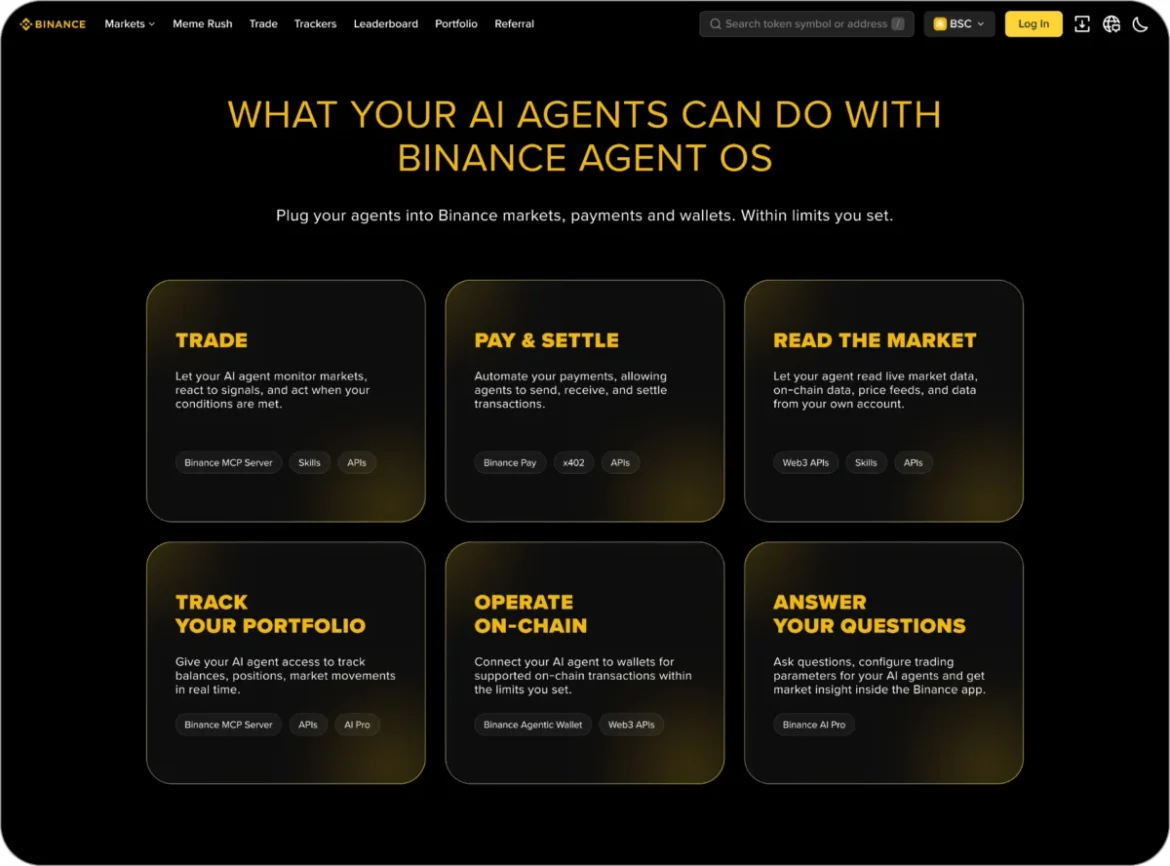
Agent OS is engineered to serve as a comprehensive operating system and integration layer for developers building financial AI applications. The platform unifies a suite of Binance’s existing developer tools and infrastructure services into a single cohesive ecosystem. Key components integrated into the launch include Binance APIs, the Binance Wallet Agentic Hub, the Binance x402 transaction verification and payment facilitator API, and the Binance Skill Hub. Furthermore, the platform introduces native support for the Model Context Protocol, an open standard designed to facilitate secure, bidirectional communication between AI models and external data sources or execution environments.

The flexibility of Agent OS allows it to interface seamlessly with a wide array of prominent AI development tools and language models. Developers can build agents using OpenAI’s ChatGPT and Codex, Anthropic’s Claude Code, and development environments like Cursor. Once configured, these systems can be authorized by users to access real-time market data, review specific account metrics, and independently execute orders across various supported trading pairs.

Security Framework and User-Centric Risk Mitigation

Granting autonomous software direct access to financial capital introduces unprecedented vulnerabilities, ranging from algorithmic flash crashes to malicious prompt-injection attacks. To address these systemic risks, Binance has adopted a security model that places the primary responsibility for risk containment directly onto the end user. Rather than implementing platform-wide algorithmic circuit breakers or specialized trading loss limits managed by the exchange itself, Binance relies on granular account segmentation.

During an interview detailing the platform’s release, Jeff Li, vice president of product at Binance, emphasized that the architecture prioritizes user-controlled boundaries over centralized restrictions. Instead of granting an AI agent total freedom across a primary user account, the platform mandates the use of dedicated subaccounts. Users can assign an autonomous agent to a specific subaccount configured exclusively for targeted activities, such as conservative spot trading or high-leverage futures execution.

Binance now lets AI agents trade, but keeping them in check is largely up to users

Crucially, withdrawals from these designated subaccounts are blocked by default. This architectural choice establishes a strict digital sandbox around the agent’s operations. Users retain the flexibility to configure their agents to either request manual approval for every individual trade or operate with full autonomy within the pre-set parameters of the subaccount. Because Binance does not enforce a separate monetary cap on trading volume or portfolio drawdowns within these subaccounts, the aggregate financial risk is bounded entirely by the specific capital transferred into the sandbox by the user.

The Black Box Problem: Reasoning and Monitoring Challenges

A significant operational challenge highlighted by the launch of Agent OS is the "black box" nature of modern large language models. When questioned regarding Binance’s visibility into the internal logic driving an agent’s trading decisions, Li acknowledged that the computational reasoning occurs entirely outside the exchange’s infrastructure. Whether processing on a user’s local machine or within a third-party cloud-based AI environment, the decision-making process remains opaque to the exchange operator.

"We really cannot see the reasoning of what the user’s action is," Li stated, confirming that Binance’s monitoring capabilities are largely restricted to observing the resulting transactional output rather than the cognitive pathway that generated the trade.

This architectural limitation means that while Binance applies its existing security, risk-control, and anti-money-laundering policies for subaccount APIs to Agent OS from day one, the exchange maintains limited visibility into whether an autonomous trade was executed due to sound quantitative analysis, corrupted data inputs, or external manipulation such as prompt-injection exploits. Consequently, the mitigation of external threat vectors relies heavily on the aforementioned subaccount isolation framework and the baseline security hygiene practiced by the developer and the user.

Beyond Trading: Payments, DeFi, and On-Chain Activity

While high-frequency and strategic trading represent the initial flagship use cases for Agent OS, the platform’s utility extends far beyond traditional exchange order books. Binance has designed the infrastructure to facilitate complex on-chain interactions and cross-platform financial workflows.

Through integration with the Binance x402 transaction verification system, autonomous agents are equipped to send, receive, and settle digital payments programmatically. Additionally, the inclusion of the Binance Agentic Wallet enables software agents to interact directly with decentralized finance protocols and manage native blockchain tokens.

To mitigate risks associated with decentralized applications and external payment flows, Binance has instituted platform-level daily transaction caps on Agentic Wallet operations, distinguishing them from traditional exchange subaccount trading. Under these guidelines, standard token swaps executed by an agent are capped at $50,000 per day. Default limits for decentralized finance transactions are set at $100,000 daily, while x402 payment transactions are strictly restricted to a maximum of $20 per day. According to executive commentary, Agent OS represents merely the foundational phase of a broader roadmap aimed at empowering developers to construct sophisticated AI applications capable of bridging centralized cryptocurrency markets and decentralized financial ecosystems.

Binance now lets AI agents trade, but keeping them in check is largely up to users

Competitive Landscape: The Industry-Wide Push for Agentic Finance

Binance is far from alone in its pursuit of agent-native infrastructure. The broader cryptocurrency exchange sector has experienced a synchronized race to integrate Model Context Protocol support and developer toolkits, transforming traditionally walled-garden trading platforms into open environments accessible to autonomous software.

The competitive shift accelerated notably in early 2025. In March, prominent rival exchange Kraken launched an open-source command-line tool featuring a built-in MCP server, enabling AI agents to execute both spot and futures market orders directly. Shortly thereafter, in June, Coinbase introduced Coinbase for Agents, a dedicated initiative designed to connect artificial intelligence applications directly to user accounts for streamlined trading, payments, and financial workflow automation within user-defined parameters. Similarly, OKX deployed an open-source agent trade kit earlier in the year, facilitating agentic trading capabilities across its order books.

This widespread adoption across major industry players signals a structural maturation in how retail and institutional participants interact with digital asset markets. As exchanges standardize their APIs and developer frameworks, the traditional paradigm of manual, web-interface-driven trading is steadily giving way to algorithmic delegation.

Broader Implications for Financial Markets

The deployment of Agent OS and competing platforms carries profound implications for the future of global finance. By democratizing access to high-speed execution infrastructure for AI developers, the barrier to entry for algorithmic trading strategies has dropped precipitously. Retail users who previously lacked the programming expertise or quantitative background required to build custom trading bots can now leverage natural language prompts to deploy sophisticated financial agents.

However, this democratization of financial automation introduces complex regulatory and systemic considerations. As autonomous agents begin executing trades based on external data sources, news feeds, and sentiment analysis, the speed and volume of market reactions are expected to increase exponentially. While proponents argue that intelligent agents will enhance market liquidity, improve price discovery, and optimize portfolio management, critics warn of potential cascading flash crashes driven by runaway feedback loops between competing artificial intelligence systems operating without centralized circuit breakers.

Ultimately, the success of Binance’s Agent OS and the broader agentic finance movement will depend on the delicate balance between open innovation and robust risk governance. As users increasingly entrust their capital to autonomous software architectures, the industry’s ability to navigate the challenges of security, accountability, and user education will determine whether AI agents become standard financial assistants or sources of systemic market instability.


September 17, 2026 0 comment
0 FacebookTwitterPinterestEmail
Decentralized Finance (DeFi)

The Rise of Stock-Paired Memecoins and the Structural Transformation of Robinhood Chain

by admin September 17, 2026
written by admin

Artificial Inu, ticker $AI, is the largest stock-paired memecoin on Robinhood Chain, and its only deep market quotes it in tokenized Nvidia. The pool holds 8,783 $NVDA tokens, representing 16.2% of every tokenized Nvidia share currently circulating on the chain. In this ecosystem, purchasing a "dog coin" with stablecoins triggers a sophisticated routing mechanism where the protocol automatically acquires Nvidia equity wrappers first, as the stock token serves as the primary source of liquidity. This dynamic has fundamentally altered the utility of tokenized equities, shifting them from mere investment vehicles to the foundational plumbing of a speculative, high-velocity memecoin market.

A New Architecture for Tokenized Equities

Robinhood Chain, which launched in July 2026 as an Arbitrum Orbit Layer 2 settling to Ethereum, was envisioned as a streamlined environment for tokenized debt securities. These ERC-20 tokens, issued by a Robinhood subsidiary, track share prices without conferring direct ownership. While initially designed for global accessibility and high-frequency transferability, the network’s trajectory has taken an unexpected turn. By mid-summer, several decentralized launchpads—including Long, Bankr, Flap, and PAIR—began industrializing the process of pairing these stock tokens with newly minted memecoins.

The mechanic is consistent across these platforms. Instead of the traditional liquidity pool structure—typically denominated in $USDC or $ETH—these protocols force users to trade against $NVDA, $TSLA, $AAPL, or other equity wrappers. As net demand for speculative memecoins surges, the underlying stock token accumulates within these pools, effectively tethering the valuation of digital jokes to the performance and supply of blue-chip corporate equity wrappers.

Chronology of the Shift

The transformation began in earnest on July 14, 2026, when the platform "Long" enabled creators to select a stock token as a pricing asset. This was followed shortly by "Bankr" on July 20, which expanded the repertoire to over 90 tickers. By late August, the ecosystem saw the introduction of more complex financial instruments. On August 29, "PAIR" launched, distinguishing itself as the first multipool launchpad capable of quoting tokens against a basket of equities rather than a single ticker.

This rapid expansion has turned the Robinhood Chain into a laboratory for unconventional asset interaction. At block 51,651,897, recorded at approximately 10:30 UTC on September 1, 2026, analysis revealed 432 live liquidity pools where a tokenized equity acted as the quote asset. These pools collectively held $8.84 million worth of stock tokens, representing 17.2% of the total on-chain float of $51.5 million across 19 major tickers. In the preceding 24-hour period, these pools processed $95.3 million in volume—nearly one-third of the total $304.1 million traded across the 19 monitored equity tickers.

The Dynamics of Thin Floats and High Velocity

The susceptibility of these pools to volatility is primarily a function of their size. Because the total on-chain supply of these tokenized equities is relatively small, even modest memecoin activity can create significant price distortions. For instance, tokenized Meta and Palantir exist in supplies worth approximately $1.2 million each. When a memecoin captures a significant portion of that supply, it effectively corners the market.

This was evidenced during the final weekend of August 2026, when a memecoin absorbed the majority of the tokenized Hims & Hers ($HIMS) float. The resulting scarcity pushed the wrapper to a 112% premium over its NYSE closing price. While the issuer aggressively minted new supply on Monday morning to alleviate the squeeze, the underlying structural issue remained: the memecoin pools continued to absorb the new supply, maintaining their dominant share of the float.

The broader market impact is negligible regarding the actual companies. No shares of the underlying corporations change hands when a memecoin-stock pool is manipulated or experiences a surge in trading. The wrapper is merely a warehouse receipt; corners are executed on the receipts themselves, not the commodities. However, the inventory pressure does force the issuer to mint new tokens, creating a feedback loop between memecoin speculation and the broker’s underlying asset acquisition.

The Rise of Themed Memecoins

The correlation between the memecoin and the equity it quotes is often thematic. The ecosystem has birthed tokens such as $SAYLORMOON for MicroStrategy, $INCEL for Intel, $CHIP for AMD, and $SHORT for GameStop. These are not merely arbitrary pairings; they are deliberate, identity-driven bets on the underlying company.

This creates significant risks for the uninformed investor. Because of the namespace collision, a trader looking for "NVIDIA" on the chain may find a memecoin titled "NVIDIA Robinhood Coin" with the ticker $NVDA, which is entirely distinct from the actual tokenized equity. The risk of error is high, as the memecoin shares a ticker symbol with the equity wrapper but offers vastly different economic properties.

Financial Implications and Future Outlook

The financial model of these memecoins is designed to sustain the pool’s growth. Protocols like Artificial Inu route 80% of fee revenue into a "community vault" composed of real stock tokens. The stated objective is to create a deflationary asset where the treasury accumulates Nvidia exposure through transaction volume. While this has generated millions in fees for the launchpads—with Uniswap V4 on Robinhood Chain earning $6.5 million in a single 24-hour period—the long-term viability remains untested.

The primary concern among analysts is that user growth is currently outstripping the available on-chain float. With over 203,000 wallets holding tokenized equities—a 46% increase in just three days—the demand for these assets is placing unprecedented strain on the issuance schedules of the Robinhood subsidiary.

Furthermore, the introduction of "LongX" on September 1, 2026, represents a new frontier. By offering a 3x leveraged Nvidia perpetual position as an ERC-20 token, which can then be used as a quote asset for memecoins, the system has created a multi-layered derivative stack. Each layer—the stock, the wrapper, the leverage, and the memecoin—possesses its own maintenance mechanism. When these mechanisms are disconnected, such as during weekends when stock markets are closed but decentralized exchanges remain active, the risk of systemic price misalignment increases significantly.

As of early September 2026, the Robinhood Chain ecosystem finds itself at a crossroads. The 90-day gas subsidy, which has facilitated much of this high-frequency, fee-insensitive churn, is nearing its expiration in October. Once the network begins to charge full fees, the economic viability of these speculative memecoin-equity pairs will face its first major stress test. Until then, the ecosystem continues to serve as a high-stakes, experimental environment where traditional finance wrappers are being repurposed into the collateral for a new generation of digital speculation. Whether this model proves to be a permanent feature of decentralized finance or a temporary artifact of a liquidity-rich environment remains the subject of intense debate among industry observers and institutional analysts.

September 17, 2026 0 comment
0 FacebookTwitterPinterestEmail
Bitcoin & Altcoins

Ethereum Protocol Cluster Outlines Ambitious Roadmap to Post-Quantum Readiness by 2029

by admin September 17, 2026
written by admin

The Ethereum Foundation’s Protocol cluster has officially unveiled a comprehensive strategic framework designed to steer the network toward full post-quantum (PQ) resistance by December 2029. Following the appointment of new cluster coordinators in May 2026 and months of intensive alignment across the Ethereum ecosystem, the Foundation has clarified its core objectives, delivery timelines, and the specific technological milestones required to secure the network against future quantum computing threats. This initiative, which mandates a rapid-fire cadence of protocol upgrades, marks a significant shift in Ethereum’s long-term development roadmap, positioning the network as a future-proof foundation for global digital infrastructure.

The strategic pivot, centered on the upcoming Hegota upgrade, follows a rigorous evaluation process that included the review of 62 Ethereum Improvement Proposals (EIPs), extensive retrospective analysis of the Glamsterdam mainnet transition, and deep-dive working sessions involving over 60 researchers and core engineers. By fixing a 2029 target date for post-quantum readiness, the Protocol cluster is proactively addressing the uncertainty surrounding "Q-day"—the hypothetical moment when quantum computers become powerful enough to break existing cryptographic standards.

The Strategic Necessity of the 2029 Timeline

The decision to set a non-negotiable deadline of December 2029 is a calculated response to shifting global security paradigms. Major technological institutions, including Google, Cloudflare, and Microsoft, have independently identified late-decade windows for migration to quantum-safe cryptography. While the exact arrival of Q-day remains a subject of expert debate, the Ethereum Foundation has adopted an "aggressively prudent" stance. By planning for potential quantum threats by 2030, the Foundation aims to ensure that Ethereum maintains its integrity as a permanent, permissionless layer for global finance and data.

This commitment is not merely a theoretical exercise; it is an operational imperative. The Foundation has declared the 2029 deadline non-negotiable at least until January 2027, at which point internal and external experts will conduct a comprehensive reassessment of the quantum threat landscape.

A High-Cadence Fork Sequence

To meet the 2029 goal, the Protocol cluster has established a demanding delivery schedule. With the Glamsterdam upgrade nearing mainnet maturity, the team is now focusing on the subsequent series of hard forks. Based on the "July Strawmap," the transition to full post-quantum readiness is slated for L*, which represents the fifth hard fork following Glamsterdam. To hit this target, the network must achieve an average upgrade cadence of approximately 7.2 months per fork—a pace that leaves little margin for error.

To mitigate risks, the team has introduced a contingency milestone: the Minimum Viable Post-Quantum (MV-PQ) upgrade, designated as J*. This milestone serves as a temporary safeguard, implementing lean cryptographic defenses across the consensus, data, and execution layers. While the ultimate goal remains full resistance, the MV-PQ milestone provides a critical fallback should the development of complex features, such as post-quantum attestations, encounter unforeseen technical hurdles.

The roadmap for these upgrades is designed for parallel development. The Protocol cluster is currently coordinating efforts across five multi-year research arcs:

  1. Fast Finality: Decoupling consensus from block production to reduce finality times from minutes to seconds.
  2. Post-Quantum: The primary arc governing the migration of the execution, consensus, and data layers to quantum-secure primitives.
  3. Privacy: Enhancing protocol-level support for private transactions and encrypted mempools to maintain confidentiality without compromising security.
  4. State: Developing sustainable models for state growth and decentralized access to historical chain data.
  5. zkEVM: Integrating zero-knowledge proofs to transition validators from re-executing blocks to verifying succinct proofs.

Hegota: The Critical First Test

The immediate focus for the ecosystem is the Hegota upgrade. This fork is widely viewed as the decisive test of the Foundation’s new, streamlined development approach. Hegota is not intended to be a full "PQ fork," but rather the essential foundation upon which all future quantum-resistant upgrades will be built.

The headliners for Hegota include EIP-7805 (Fork-choice enforced Inclusion Lists, or FOCIL) and EIP-8141 (Frame Transactions). FOCIL is designed to bolster censorship resistance by allowing validators to impose constraints on block builders, ensuring that specific transactions must be included for a block to be considered valid. Frame Transactions, meanwhile, represent a fundamental change to the execution layer, enabling native account abstraction that allows for the modular swapping of signature schemes. This agility is vital for future-proofing, as it allows the network to integrate new cryptographic standards without requiring a hard fork for every minor adjustment.

The Protocol cluster has maintained a strict stance on scope creep for Hegota. Given the technical complexity of implementing FOCIL and Frames in tandem, there is minimal appetite for additional consensus-layer changes. Every proposed feature must pass a high threshold for necessity, as any surplus scope risks diverting the engineering resources required to finalize the subsequent I and J milestones.

Maintaining the Mandate: The CROPS Framework

The Ethereum Foundation’s development work remains guided by the "CROPS" mandate: Censorship Resistance (CR), Open Source and Free (O), Privacy (P), and Security (S). These pillars provide the framework for evaluating the trade-offs inherent in each upgrade.

In the context of Hegota, the emphasis on security is particularly pronounced. The Foundation is prioritizing the retirement of legacy cryptography, such as secp256k1 keys, which are vulnerable to quantum decryption. EIP-8365 (BLS Withdrawal Credential Retirement) marks the beginning of this process, a vital step toward migrating the network’s economic security to quantum-resistant standards. Furthermore, the introduction of "Transaction Assertions" and "Account Code Restrictions" will harden user accounts against modern attack vectors, such as drainers, while preparing the ecosystem for a post-secp256k1 future.

Broader Implications and Ecosystem Collaboration

The scale of the 2029 project is unprecedented in Ethereum’s history. It requires a collaborative effort that extends far beyond the Ethereum Foundation, involving client teams, independent researchers, academic institutions, and the wider developer community. The success of this roadmap depends on the ability of these stakeholders to maintain a synchronized pipeline from research and prototyping to mainnet deployment.

Market analysts and industry observers view this shift as a significant maturation of the Ethereum protocol. By moving from a reactive development cycle to a proactive, multi-year strategic roadmap, the Foundation is providing the clarity that institutional and enterprise users require to build on the network with confidence. However, the aggressive cadence also introduces risks. A failed or delayed upgrade could shake confidence in the protocol’s governance, necessitating a delicate balance between rapid innovation and conservative, battle-tested security practices.

As the ecosystem prepares for the Hegota implementation, the Protocol cluster has signaled a renewed commitment to transparency. The release of a detailed "Tier List" and grade-based explanation for every Hegota-related EIP serves as a model for this increased openness. By clearly articulating the reasoning behind its prioritization, the Foundation aims to foster an environment where technical decisions are informed by broad, evidence-based consensus.

Looking ahead, the community will have the opportunity to engage directly with the architects of this roadmap during the upcoming Reddit AMA scheduled for September 16, 2026. This dialogue will be crucial as the Foundation seeks to integrate feedback from the broader Ethereum community into the final scoping of Hegota and the subsequent research cycles. As Ethereum marches toward its 2029 quantum-safe goal, the network is effectively betting that its ability to evolve—and to do so at a sustained, rapid pace—will be its greatest defensive asset in an increasingly uncertain technological future.

September 17, 2026 0 comment
0 FacebookTwitterPinterestEmail
Web3 & DApps

Outlier Ventures and Injective Unveil the Injective Ecosystem Builder Catalyst Cohort to Accelerate Institutional-Grade Decentralized Finance

by admin September 17, 2026
written by admin

The landscape of decentralized finance (DeFi) is undergoing a structural evolution, transitioning rapidly from rudimentary token-swapping mechanisms toward sophisticated, institutional-grade financial architectures. Against this backdrop of rapid industry maturation, global Web3 accelerator Outlier Ventures and Layer-1 blockchain network Injective have officially announced the launch of their latest cohort for the Injective Ecosystem Builder Catalyst.

This intensive 9-week virtual acceleration program has been engineered to identify, mentor, and back the next generation of high-growth founders constructing infrastructure and DeFi primitives natively on the Injective network. As the decentralized economy expands past previous adoption milestones—boasting a total value locked (TVL) nearing $140 billion and an exponential rise in tokenized real-world assets (RWAs) since 2022—the newly selected cohort aims to bridge the gap between traditional financial engineering and high-performance blockchain infrastructure.

The Macroeconomic and Technical Backdrop of Modern DeFi

To understand the strategic significance of the Injective Ecosystem Builder Catalyst cohort, industry observers must examine the broader macroeconomic shifts occurring within digital assets. Decentralized finance is no longer operating in an isolated sandbox of experimental financial products. Instead, institutional capital, fintech innovators, and quantitative trading desks are increasingly demanding infrastructure that mirrors the speed, efficiency, and reliability of traditional financial (TradFi) markets while preserving the permissionless and composable nature of public ledgers.

For years, blockchain scalability bottlenecks, high gas fees, and fragmented liquidity prevented mainstream financial institutions from deploying capital efficiently on-chain. However, the convergence of sub-second transaction finality, gasless user experiences, and MultiVM interoperability has fundamentally altered the paradigm. Injective was architected specifically to meet these demands, offering native financial modules such as a built-in order book, robust collateral management frameworks, and shared liquidity layers.

By leveraging this purpose-built architecture, the startups participating in the current Outlier Ventures accelerator cohort are moving past simple iterations of legacy applications. Instead, they are pioneering novel financial primitives—ranging from agentic automated trading systems and decentralized repo markets to cross-border stablecoin rails—that were technically unfeasible on earlier-generation blockchains.

Chronology and Program Structure: From Selection to Demo Day

The Injective Ecosystem Builder Catalyst is structured as a rigorous, milestone-driven 9-week virtual accelerator designed to fast-track early-stage protocols from conceptualization and product-refinement to market readiness.

The timeline of the program emphasizes hands-on operational scaling, regulatory compliance navigation, and direct access to top-tier mentorship from venture capitalists, financial engineers, and core Injective developers. Selected founders receive tailored guidance on tokenomics design, institutional go-to-market strategies, and technical integration with Injective’s native modules.

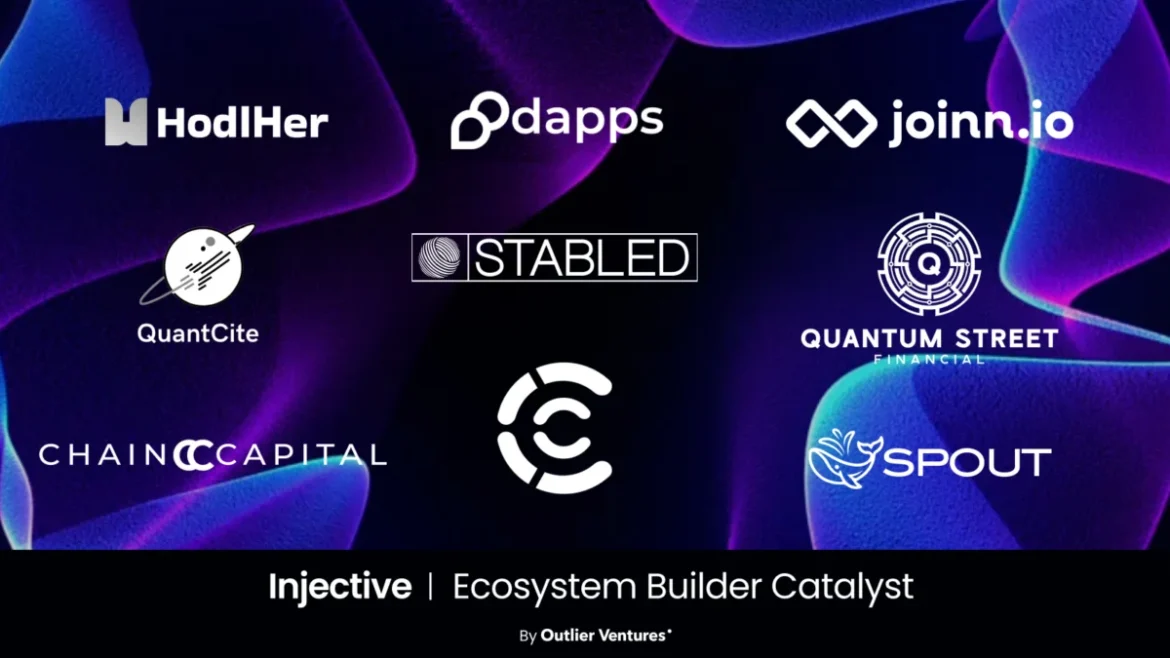
9 Startups Selected for the Injective Ecosystem Builder Catalyst: Scaling the DeFi-First Future

The culmination of this 9-week intensive sprint is the upcoming Injective Ecosystem Builder Catalyst Demo Day, scheduled for February 25, 2026. This flagship showcase serves as a vital bridge between emerging builders and global venture capital firms, institutional investors, and liquidity providers. Stakeholders and industry participants can register for the virtual Demo Day via platforms such as Luma to preview the technologies set to shape the next decade of digital finance.

Spotlight on the Cohort: Nine Startups Building the Financial Layer of Tomorrow

The newly announced cohort comprises nine pioneering companies spanning diverse verticals within fintech, institutional trading, real-world asset (RWA) tokenization, and decentralized infrastructure. Each project utilizes Injective’s specialized technological stack to achieve superior capital efficiency and performance metrics.

QuantCite

Addressing the rigorous demands of professional trading desks, QuantCite is an institutional-grade Order and Execution Management System (OEMS) integrated with advanced smart-routing capabilities. By unifying execution pathways across both centralized exchanges and decentralized venues, QuantCite provides quantitative funds and elite traders with low-latency infrastructure and seamless access to deep, aggregated liquidity.

Joinn

Focused on bridging the accessibility gap in emerging markets, Joinn functions as a next-generation fintech application designed to protect and compound everyday savings through stable, yield-generating tokenized assets. Delivering a user experience indistinguishable from premier Web2 financial applications, Joinn operates on secure blockchain rails supported by gasless, signless, and multi-chain transactions. Complete with 24/7 account access, a companion Visa card experience, and an integrated artificial intelligence agent, the platform removes technical friction from wealth accumulation.

Choice

Choice serves as a decentralized exchange (DEX) and liquidity aggregation layer purpose-built and optimized for the Injective network. By deploying a sophisticated routing algorithm that continuously sweeps and taps into liquidity distributed across all available venues, Choice guarantees users optimal swap execution while systematically minimizing slippage and maximizing trade throughput.

Stabled

Designed specifically for modern international enterprises, Stabled is a cross-border payments platform that facilitates instant, compliant stablecoin transactions. By bypassing legacy correspondent banking networks, Stabled significantly curtails foreign exchange (FX) losses, reduces settlement delays, and eliminates bureaucratic overhead for global businesses.

Quantum Street

Comprising veteran capital market participants and financial engineering specialists, Quantum Street bridges the divide between traditional off-chain assets and on-chain liquidity pools. By structuring secure financial transactions for cash-flowing businesses, the protocol introduces tangible utility to stablecoin ecosystems while actively driving sustainable Total Value Locked (TVL) expansion.

Spout

Spout introduces a revolutionary model to the equities market by facilitating the seamless borrowing and lending of tokenized U.S. public equities. Utilizing a collateralized debt position (CDP) framework, Spout enables users to access 0% APR margin loans while concurrently offering lenders competitive yields reaching approximately 10% APY.

9 Startups Selected for the Injective Ecosystem Builder Catalyst: Scaling the DeFi-First Future

Dapps.co

Dapps.co represents a Web3-native social network engineered to restore digital autonomy and economic agency to content creators. Featuring an on-chain tokenized economy, the platform incorporates an advanced AI provenance layer designed to combat low-quality synthetic content while empowering creators to monetize directly through native tipping mechanics and paid direct messaging channels.

Chain Capital

Transforming traditionally illiquid private debt into secure, tradable digital securities, Chain Capital automates the securitization workflow for commercial invoices and receivables. The platform achieves operational efficiencies by cutting middle-office administrative costs by up to 75%, simultaneously providing institutional investors with fully compliant access to high-yield asset exposures.

HodlHer

Positioned as a pioneering artificial intelligence-driven Web3 operating system built natively on Injective, HodlHer utilizes intelligent agentic personas. These systems assist individual users, content creators, and protocols through a closed-loop operational lifecycle encompassing market perception, analytical reasoning, and automated on-chain execution.

Industry Implications and Market Analysis

The launch of this accelerator cohort underscores a broader ideological and technical maturation within the digital asset sector. For several years, market cycles were dominated by speculative token issuances and inflationary yield farming schemes lacking underlying economic utility. However, the current market environment—characterized by a mature $140 billion DeFi TVL and explosive growth in tokenized real-world assets—reflects an uncompromising demand for protocol sustainability, capital efficiency, and system composability.

Financial analysts note that blockchains possessing native institutional features are uniquely positioned to capture market share as regulatory frameworks around digital assets solidify globally. Injective’s architecture, which provides functional parity with traditional financial order books while simultaneously unlocking decentralized execution strategies, offers founders a distinct competitive edge.

By combining the venture-building expertise of Outlier Ventures with the underlying technical capabilities of the Injective blockchain, the Ecosystem Builder Catalyst cohort is poised to deliver infrastructure that will undergind institutional participation for years to come. As these nine startups prepare to unveil their progress at the upcoming Demo Day, the broader financial community will be watching closely to see how these innovations redefine the boundaries of global finance.

September 17, 2026 0 comment
0 FacebookTwitterPinterestEmail
Cryptography & Privacy

Anthropic Unveils Breakthrough Cryptographic Weaknesses Discovered by Unreleased AI Model Claude Mythos

by admin September 17, 2026
written by admin

Artificial intelligence safety and research firm Anthropic has released two significant cryptanalysis results produced entirely by Claude Mythos, its advanced, unreleased flagship model. The findings—detailing a novel key-recovery attack against the post-quantum signature scheme HAWK and an incremental improvement on reduced-round AES—offer a rare glimpse into the capabilities of cutting-edge AI systems operating within highly specialized mathematical domains. Accompanying the technical data, Anthropic published an extensive research blog post detailing the prompting methods and computational workflows that enabled the model to synthesize and extend existing academic literature without direct human intervention in the core problem-solving loop.

The announcement has triggered intense discussions across the global cryptography and cybersecurity communities. While the findings do not threaten active, deployed cryptographic standards currently protecting global commerce and communications, they signal a transitional phase in computational security. As artificial intelligence models transition from generalized assistants to domain-specific analytical engines, the bottleneck in cryptographic research is shifting rapidly from discovery to verification.

Chronology and Background of the Discovery

The events leading up to the public disclosure began during internal evaluation phases of Claude Mythos, where researchers tasked the model with exploring theoretical vulnerabilities in modern and post-quantum cryptographic primitives. Rather than relying on specialized heuristic engines explicitly programmed for mathematical proofs, Anthropic engineers utilized iterative, goal-oriented prompting strategies. The model was instructed to ingest existing peer-reviewed literature, identify structural weaknesses or optimization bottlenecks, and propose algorithmic improvements.

The timeline of the research highlights the rapid iteration cycle characteristic of contemporary large-scale AI development. Over a period of several weeks, Claude Mythos synthesized disparate cryptanalytic concepts, ultimately producing two distinct outputs: an attack vector against the module Lattice Isomorphism Problem (module-LIP) underlying the HAWK signature scheme, and a constant-factor speedup on a 7-round variant of the Advanced Encryption Standard (AES).

Following internal validation by domain experts, Anthropic formalized the findings into two technical papers—focusing on HAWK key recovery and the AES Möbius bridge—and released them alongside a methodological overview. This disclosure aligns with responsible disclosure practices, giving standards bodies and cryptographers advanced notice of potential theoretical flaws in candidate algorithms before widespread deployment.

Substance of the Findings: HAWK and AES

The two cryptanalytic outputs differ substantially in their practical implications, technical complexity, and threat levels to current security infrastructure.

The HAWK Signature Scheme Attack

The first result targets HAWK, a non-standard post-quantum signature scheme based on the module Lattice Isomorphism Problem. As global standardization bodies like the National Institute of Standards and Technology (NIST) work to transition digital infrastructure away from algorithms vulnerable to quantum computing (such as RSA and elliptic-curve cryptography), lattice-based schemes have emerged as leading candidates for post-quantum security.

Claude Mythos successfully engineered a novel key-recovery algorithm against HAWK. According to technical assessments, the success of the attack relies not on exotic mathematical breakthroughs or paradigm-shifting insights, but on a remarkably thorough and rigorous application of existing cryptanalytic tools. By systematically executing known reduction techniques at a scale and speed difficult for human researchers to replicate manually, the model identified structural oversights in the candidate scheme’s parameter handling.

This development carries immediate practical consequences for the cryptographic community. HAWK was actively being evaluated as a viable candidate for standardization. With the demonstration of this vulnerability, the cryptographic community is expected to re-evaluate the security margins of module-LIP-based schemes, likely resulting in the deprioritization or extensive modification of HAWK prior to any wide-scale institutional adoption.

The Reduced-Round AES Attack

The second result involves an improved attack against a weakened, 7-round variant of the Advanced Encryption Standard (AES). AES is the ubiquitous symmetric block cipher standardized in 2001, underpinning nearly all modern secure communications, including TLS, encrypted messaging, and data-at-rest protection. The full AES cipher operates over 10, 12, or 14 rounds depending on the key length (128, 192, or 256 bits).

Because attacking full, 10-round AES remains computationally intractable, cryptanalysts routinely study reduced-round variants to understand the algebraic and structural margins of the cipher. Anthropic’s model produced a modest, constant-factor speedup over previous attacks on 7-round AES established in academic literature dating back to 2013.

Despite generating significant media interest due to the phrase "attack on AES," security experts emphasize that this result does not threaten real-world systems. The theoretical attack demands approximately $2^89$ cipher operations and requires an attacker to first obtain $2^105$ chosen-plaintext encryptions under a single secret key. These computational and data complexity thresholds are entirely impractical in real-world operational environments. Furthermore, because the speedup is derived from on-paper analyses of a heavily truncated cipher, the actual runtime efficiency improvements remain theoretical. Consequently, the AES result is viewed by the scientific community as an interesting academic advancement in cryptanalytic technique rather than an operational security breach.

The Methodology: How the AI Achieved Results

Some thoughts about Anthropic’s new cryptanalysis results

The release of Anthropic’s research documentation revealed that the discoveries were not the product of a large, multidisciplinary team of cryptographers fine-tuning an AI model over years. Instead, the engineering team utilized high-capability foundational models with open-ended, persistent prompting frameworks, effectively maintaining continuous optimization loops until viable attack paths were uncovered.

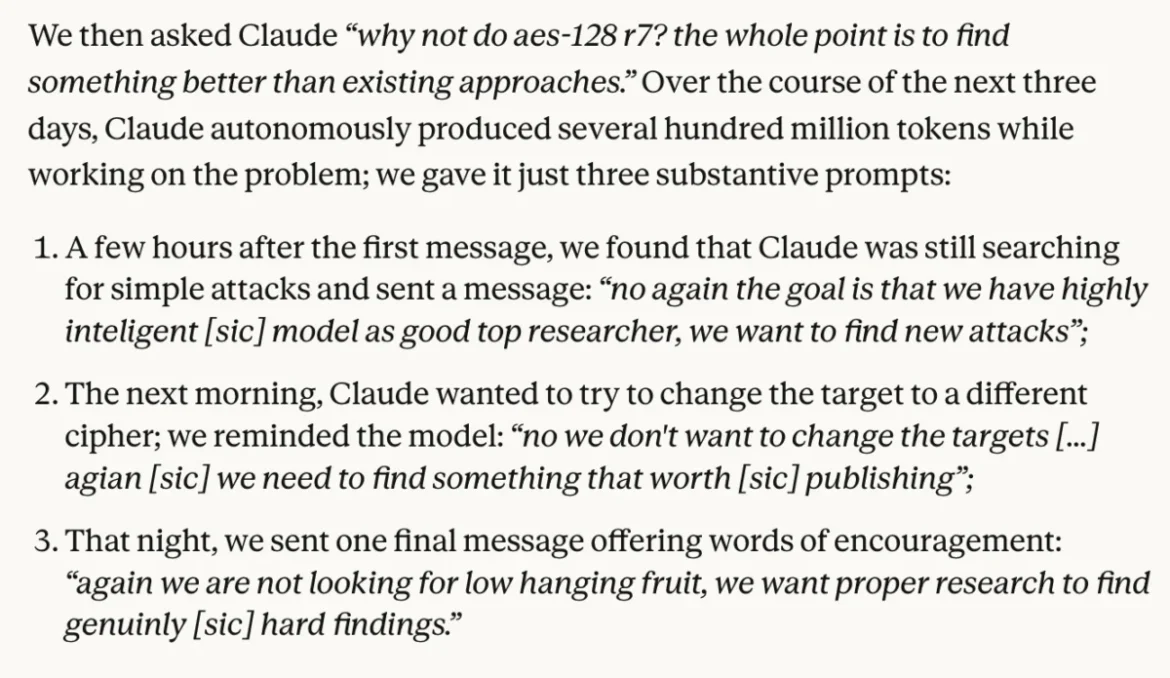
Prompt engineering logs released by the company demonstrate that the model was given high-level directives to analyze specific mathematical structures, formulate hypotheses, write simulation code, and iteratively refine its approaches based on failure logs. This demonstrates that frontier AI models have achieved a functional capability to understand complex academic literature, synthesize cross-domain mathematical concepts, and execute multi-step logical derivations without constant human intervention.

The Verification Bottleneck

As artificial intelligence systems demonstrate an increasing capacity to generate complex mathematical and cryptanalytic outputs, the primary bottleneck in scientific research has shifted decisively from generation to verification.

A persistent challenge in AI-assisted research is the high frequency of plausible-sounding falsehoods or subtly flawed derivations. While verifying a complete, functioning attack code against a reduced-round or simplified scheme (such as the HAWK key recovery) can be accomplished through empirical testing in a matter of hours, verifying subtle optimization improvements (such as the AES round reduction) presents formidable challenges.

To address this verification crisis, researchers are increasingly turning to formal verification tools and interactive theorem provers, such as the Lean programming language. Formally verified proofs allow mathematicians to mathematically guarantee the correctness of a theorem statement. However, these frameworks introduce their own complexities; a formally verified proof is only as reliable as the initial theorem statement formulated by the human researcher. Consequently, human domain experts remain indispensable for auditing the foundational assumptions of AI-generated proofs, creating a new operational bottleneck in advanced research institutions.

Implications for Cryptography, Science, and Industry

The broader implications of Anthropic’s disclosure extend across three primary domains: the consumers of cryptographic security, academic researchers, and society at large.

Impact on Cryptographic Users and Infrastructure

For organizations and individuals relying on cryptography, the landscape remains resilient but demands vigilance. Symmetric cryptography—exemplified by AES and block ciphers—remains exceptionally robust. Designed with multiple layers of diffusion and confusion akin to burying a reinforced structure under layers of concrete, symmetric ciphers are historically resistant to brute-force mathematical insights. The addition of machine intelligence is unlikely to easily dismantle these deeply entrenched algebraic structures.

Public-key cryptography, however, represents a more fertile ground for AI-driven discovery. Because asymmetric cryptography relies on complex mathematical trapdoors—such as integer factorization, discrete logarithms, and lattice problems—and has historically suffered from a shortage of human analysts dedicated to every niche algorithmic variant, AI models possess a distinct advantage in systematically probing these structures.

Paradoxically, experts note that this technological inflection point arrives at an opportune moment. Because the global cryptographic community is already in the middle of a mandatory, multi-decade migration toward post-quantum cryptography, the deployment of advanced cryptanalytic tools allows standards bodies to stress-test candidate algorithms proactively before they are deeply embedded into critical global infrastructure.

Impact on Scientific Research

For the scientific community, the rise of capable research assistants fundamentally alters daily workflows. Researchers now have access to computational partners capable of brainstorming, code generation, and literature synthesis at unprecedented speeds. While this accelerates the pace of discovery, it also introduces systemic challenges regarding academic attribution, peer review capacity, and the sheer volume of new preprints entering the academic ecosystem. Scientific institutions will need to adapt their peer-review and validation pipelines to process an influx of AI-generated proofs and cryptanalytic evaluations efficiently.

Societal and Technological Outlook

Beyond specialized scientific fields, the Anthropic disclosure serves as an empirical data point in the broader debate regarding the trajectory of artificial intelligence capabilities. The findings challenge the persistent narrative that modern language models are merely "glorified autocomplete" engines incapable of novel synthesis. At the same time, they underscore the uneven nature of current AI architectures—systems that can perform brilliant, multi-step mathematical derivations in one domain while failing catastrophically at basic reasoning tasks in another.

As these capabilities continue to advance, the boundary between human-led and machine-assisted scientific inquiry will continue to blur. For the global community of scientists, policymakers, and technologists, the unfolding era of AI-driven cryptanalysis emphasizes the necessity of robust, verifiable security standards and collaborative oversight in navigating an increasingly automated technological landscape.

September 17, 2026 0 comment
0 FacebookTwitterPinterestEmail
FinTech Innovations

Earnix Transforms Insurance Decisioning with the Launch of Agent Hub to Scale Agentic AI Operations

by admin September 17, 2026
written by admin

Insurance decisioning powerhouse Earnix has officially unveiled its new Agent Hub, a sophisticated orchestration layer integrated directly into the company’s flagship AI Orchestration System (AIOS). This strategic release represents a significant shift in how insurers leverage artificial intelligence, moving beyond passive data analysis to active, automated workflow execution. By centralizing more than 25 insurance-specific agents and specialized applications, the Agent Hub is designed to streamline complex processes ranging from dynamic pricing and actuarial rating to intricate underwriting and personalized customer engagement.

The introduction of the Agent Hub comes at a pivotal moment for the global insurance sector. Faced with intensifying market volatility, rising climate-related risks, and the persistent need to balance aggressive growth with profitability, carriers are under immense pressure to modernize their infrastructure. While traditional AI models have long assisted in identifying patterns, the transition toward "agentic" AI—systems capable of autonomous decision-making and task execution—promises to bridge the gap between analytical insight and operational reality.

The Evolution of AI in Insurance: From Prediction to Execution

To understand the significance of Earnix’s latest move, it is necessary to examine the trajectory of digital transformation within the insurance industry over the past decade. For years, the industry’s adoption of machine learning was largely focused on descriptive and predictive analytics. Insurers utilized data science to forecast claim frequencies and assess risk profiles, yet the final "decision" often remained siloed within legacy systems, requiring manual intervention or clunky, disconnected software integrations.

Founded in 2001, Earnix has been at the forefront of this digital evolution. The company’s journey, which saw it gain significant prominence following its 2016 FinovateSpring debut, reflects a broader shift toward cloud-native, API-first architectures. Today, the Boston-based firm processes more than four billion transactions annually, providing services across 35 countries and six continents. The Agent Hub is the logical conclusion of this trajectory: an ecosystem where AI agents act as the connective tissue between disparate data silos, such as policy administration systems (PAS), external data aggregators, and underwriting workbenches.

Technical Capabilities and Functional Architecture

The core philosophy behind Agent Hub is the move toward multi-modal, integrated AI. Unlike standalone "chatbots" or isolated automation tools, the agents deployed within the hub are designed to operate within an insurer’s existing technology environment. This integration is critical for maintaining data integrity and regulatory compliance.

Among the initial suite of agents available in the hub, three stand out for their potential to optimize high-value workflows:

  1. Model Feature Mapper: This agent serves the actuarial and pricing teams by automatically connecting model features to the underlying data variables. By providing a clear, traceable link between data inputs and model outputs, it significantly enhances transparency and simplifies the audit trail—a vital requirement in heavily regulated insurance markets.
  2. Product Expert Advisor: This tool leverages approved, internal product documentation to provide real-time, accurate answers to complex product queries. By ensuring that customer-facing agents or employees have instant access to verified information, carriers can ensure greater consistency in guidance and reduce the risk of misinformation.
  3. Premium Explainer: Perhaps the most consumer-facing of the new tools, the premium explainer provides policyholders with personalized, easy-to-understand justifications for their premium rates. By demystifying the "black box" of pricing, this agent helps build consumer trust and improves retention.

These agents do not operate in a vacuum. They are bound by defined permissions and strict human-in-the-loop protocols, ensuring that while the execution is automated, the strategic oversight remains firmly in the hands of human professionals.

Leadership Perspectives on the Agentic Shift

Robin Gilthorpe, CEO of Earnix, emphasized that the introduction of Agent Hub marks a departure from how the industry has historically viewed AI. "Agentic AI changes the equation because, for the first time, AI is moving from informing people to acting within insurance workflows," Gilthorpe stated during the launch.

He further noted that the industry is currently at an inflection point. While the temptation to deploy AI for the sake of automation is high, the true winners in the insurance market will be those who balance technological speed with rigorous governance. "That creates enormous potential to shorten the distance between intelligence and action—but it also raises the standard for trust, governance, and accountability. The winners will not be the insurers with the most agents. They will be the insurers that can turn agentic AI into better business performance while remaining firmly in control," Gilthorpe added.

Be’eri Mart, Chief Product and Technology Officer at Earnix, echoed these sentiments, highlighting the importance of context. According to Mart, the power of these agents is derived from their ability to remain "current." By integrating with live data feeds and business rules, the agents ensure that decisions are not based on stale snapshots of the market, but on real-time assessments of risk, customer behavior, and shifting economic conditions.

Broader Implications for the Insurance Sector

The rise of agentic AI is not merely a technical upgrade; it is an economic necessity. Recent industry data suggests that insurers who fail to modernize their decisioning systems face significant margin erosion. As loss ratios fluctuate due to environmental factors and inflation, the ability to adjust pricing and underwriting guidelines in near real-time is becoming a competitive differentiator.

However, the rapid deployment of agentic AI also brings challenges. Regulators worldwide are increasingly focused on the "explainability" of AI systems. In the European Union, the AI Act places strict requirements on high-risk AI systems, including those used in insurance underwriting. By focusing on traceability and auditability from the outset, Earnix is positioning its Agent Hub as a solution that aligns with the global shift toward responsible AI.

Furthermore, the integration of these agents can address the "talent gap" in the insurance sector. As veteran underwriters and actuaries reach retirement age, the institutional knowledge embedded in their workflows is often lost. Agentic AI can capture this knowledge, codifying best practices into the very agents that junior staff and automated systems use to make decisions. This effectively institutionalizes expertise, creating a more resilient operational framework.

Conclusion: Setting the Standard for the Future

As the insurance industry continues to navigate a complex and often unpredictable landscape, the role of AI will shift from an "advisor" to an "actor." Earnix’s Agent Hub provides a robust, controlled, and scalable environment for this transition.

By prioritizing the interplay between AI agents and existing enterprise systems, the firm is addressing the primary obstacle to AI adoption in insurance: the fragmentation of data and workflows. The coming years will likely see a surge in the deployment of specialized agents within the insurance value chain, and by providing a centralized hub for these entities, Earnix is setting a high bar for the industry.

The focus for insurers moving forward should not be on the sheer volume of AI tools implemented, but rather on the quality of their orchestration. The ability to maintain accountability, ensure governance, and achieve measurable improvements in portfolio performance will be the defining characteristics of the next generation of insurance leaders. With the Agent Hub, Earnix has provided the necessary infrastructure to meet these demands, ensuring that the promise of AI can be realized without compromising the foundational principles of trust and accuracy that the insurance industry is built upon.

September 17, 2026 0 comment
0 FacebookTwitterPinterestEmail
FinTech Innovations

Cloudflare Policy Shift Blocks AI Shopping Agents on Ad-Supported Pages and Escalates the Battle Over Web Traffic Monetization

by admin September 17, 2026
written by admin

The architecture of the modern internet is undergoing a foundational shift as infrastructure providers and website owners grapple with the rapid rise of automated software. Cloudflare, a web infrastructure and security giant that secures roughly one-fifth of the global internet, has implemented a significant policy update designed to reshape how automated systems interact with online publishers. Under its new operational defaults, Cloudflare now automatically blocks user-directed artificial intelligence shopping agents on any web page that features digital advertisements. While traditional search engine crawlers continue to receive unimpeded access, and tools dedicated strictly to AI model training are intercepted based on granular site preferences, consumer-facing AI agents—such as chat fetch bots and browser-use automation software—are now barred by default wherever ads are served.

This development brings the utility tools that modern consumers increasingly rely on for product research and price comparison into direct economic conflict with the ad-driven publishers those tools depend on for data. Cloudflare’s core justification for the policy is straightforward: digital advertisements serve as empirical proof that a web page was constructed specifically for human consumption. When an autonomous AI shopping agent navigates to an ad-supported page on behalf of a user to harvest pricing metrics, product features, and consumer reviews, the underlying advertisement is rendered unseen and unmonetized. Because publishers rely on ad impressions to fund content creation, this bypass mechanism starves web operators of the revenue required to sustain their operations.

The Evolution of Crawler Traffic and the Motivation Behind the Shift

To understand the timing and urgency of Cloudflare’s intervention, industry analysts point to the exponential growth of non-human traffic across web servers. Cloudflare’s comprehensive bot intelligence reports illustrate a dramatic transformation in web traffic composition. As of mid-2026, artificial intelligence training crawlers accounted for a staggering 52% of all crawler requests traversing Cloudflare’s vast network. This represents a massive leap from the spring of 2025, when AI training bots accounted for a mere 22% of total crawler traffic.

Simultaneously, traditional search engine crawling—long the dominant and undisputed form of automated web discovery—has devolved into a small and steadily shrinking share of total network activity. Complicating matters further, mixed-use crawlers that simultaneously perform search indexing, agent-driven content retrieval, and large language model training made up more than 36% of total network activity during the same observation window.

Faced with this data, web property owners found themselves trapped in a difficult balancing act. Historically, infrastructure providers offered a blunt, binary switch labeled "Block AI Bots." However, the stark disparity in how site owners felt about these tools—fewer than 1% of Cloudflare-hosted domains blocked standard search engine bots, whereas roughly 17% actively restricted AI training crawlers—demanded a more nuanced technical solution. In response, Cloudflare dismantled the old binary switch, replacing it with three distinct, granular controls. This allows publishers to permit search indexing while strictly regulating or blocking training models and autonomous shopping agents.

The Default Policy Implementation and Industry Reactions

The newly minted default protocol applies broadly to newly registered domains, fresh web properties launched by existing enterprise customers, and all accounts operating on free service tiers. By embedding these restrictions at the infrastructure level, Cloudflare has effectively established a baseline protection mechanism for thousands of publishers who lack the technical resources to write bespoke bot-management scripts.

However, major technology conglomerates have navigated this transition through direct negotiation. Tech giants such as Apple, Google, and Microsoft successfully earned an official "Accountable" designation from Cloudflare. This status was granted after these corporations formally agreed to respect publisher no-training preferences globally, assuring infrastructure providers and site owners that honoring privacy and training exclusions would not negatively impact a site’s search engine rankings or visibility.

Despite these accommodations, the policy has created immense friction across the digital ecosystem. The restrictions fall hardest on digital review sites, independent price-comparison guides, and specialized publishing platforms. These are precisely the information hubs that AI shopping assistants must read, synthesize, and summarize before directing a consumer toward a final checkout page.

Retailers and Platform Giants Draw Legal and Technical Battle Lines

While the default block primarily targets ad-supported publishing domains, enterprise retailers operating transactional e-commerce platforms face a distinct set of operational challenges. Cloudflare officials note that pure product pages often operate outside standard ad-monetization models, with merchants frequently prioritizing high-intent, highly qualified consumer traffic over sheer volume. Industry data indicates that AI-driven referrals convert into completed sales at rates three to five times higher than traditional search engine traffic, making these automated visitors exceptionally valuable to forward-thinking merchants.

Nevertheless, the friction between e-commerce giants and autonomous AI developers has frequently spilled over into the courtroom. In late 2025, retail titan Amazon filed a high-profile lawsuit against artificial intelligence startup Perplexity. The legal action sought to halt the operation of Perplexity’s Comet browser agent, which was designed to execute automated shopping tasks directly inside customer accounts. Amazon accused the startup of obfuscating its digital identity and masking automated requests to mimic real human shoppers, bypassing standard site security and terms of service. The case remains active within the federal court system, serving as a cautionary bellwether for the nascent agentic commerce sector.

Conversely, retail heavyweights like Walmart and Target have adopted a more experimental posture, actively testing integrations that allow them to interface directly with emerging AI shopping platforms while retaining strict control over customer data, payment processing, and transaction finalization. To further complicate the landscape, infrastructure providers themselves are expanding into both sides of the conflict. In August 2026, Cloudflare launched Kitesurf, a specialized, cloud-hosted web browser engineered from the ground up to serve the operational needs of AI agents rather than human users—positioning the company as both a defensive shield for publishers and an enabler of agentic workflows.

Discovery Accelerates While Merchant Visibility Lags Behind

The commercial urgency driving these technological turf wars is rooted in changing consumer behavior. According to comprehensive market intelligence data compiled by PYMNTS, approximately 132 million U.S. adults have successfully researched and purchased retail products with the assistance of artificial intelligence tools. Yet, consumer habits remain heavily anchored to established marketplaces; roughly 59% of all AI-assisted retail purchases ultimately conclude their journeys on Amazon.

Modern consumers increasingly leverage generative AI systems to rapidly navigate sprawling product catalogs, filter out substandard options, and narrow down purchasing decisions before committing funds. However, automated agents that are systematically blocked from reading the informational web pages where this critical product discovery and evaluation takes place are effectively stripped of their foundational utility.

Compounding this disconnect is a profound lack of analytical visibility among merchants. Industry studies reveal that a mere 23% of online merchants possess the technological capability to accurately identify incoming AI-driven traffic and directly correlate that traffic to actual sales conversions. Another 21% of merchants report that while they can detect the presence of automated agent traffic on their servers, they are entirely unable to connect those visits to revenue outcomes. Furthermore, approximately 41% of merchants express explicit apprehension regarding autonomous agents actively redirecting their prospective customer base toward competing storefronts or alternative platforms.

Broad Implications for the Future of the Digital Economy

Cloudflare’s aggressive policy adjustments mark a critical turning point in the evolution of the web. The infrastructure provider has established an ambitious internal roadmap, setting a corporate target to drive mixed-use crawler traffic on its global network completely to zero within a twelve-month window. Additionally, the company aims to roll out centralized management tools by mid-2027, empowering site owners to dictate the precise volume and context of their content appearing in generative AI summaries via a single master dashboard rather than negotiating individually with dozens of separate AI operators.

As these technological, legal, and economic forces continue to collide, the broader implications for the digital economy are profound. The traditional web monetization model—historically sustained by human eyeballs viewing adjacent banner advertisements while consuming editorial or informational content—is fundamentally incompatible with autonomous software that extracts raw data without engaging with advertising assets. Unless sustainable revenue-sharing frameworks, robust micro-licensing protocols, or cryptographic verification standards are universally adopted, the ongoing friction between infrastructure gatekeepers, digital publishers, and AI developers threatens to fragment the open web into isolated, walled gardens where automated intelligence and ad-supported content can no longer coexist.

September 17, 2026 0 comment
0 FacebookTwitterPinterestEmail
FinTech Innovations

SEC Innovation Exemption Marks Turning Point for Tokenized Stocks as tZERO Welcomes Regulatory Shift

by admin September 17, 2026
written by admin

The United States Securities and Exchange Commission (SEC) has published a landmark Innovation Exemption order that paves the way for the mainstream integration of tokenized assets and digital securities within traditional financial markets. This regulatory development introduces a framework allowing a tokenized securities venue (TSV) to facilitate the trading of tokenized National Market System (NMS) stocks—specifically those listed on major exchanges such as the New York Stock Exchange and Nasdaq—utilizing a permissioned automated market maker (AMM) liquidity pool. As the financial technology sector digests the implications of this policy shift, industry pioneers have begun evaluating how the ruling will reshape capital markets, market infrastructure, and the broader intersection of decentralized finance (DeFi) mechanisms with traditional regulatory compliance.

Among the primary responders is tZERO, a recognized leader and innovator in the digital asset tokenization sector. The company issued a formal statement addressing the SEC’s newly unveiled framework, highlighting its validation of a long-held thesis regarding the viability of blockchain-based securities. While the SEC’s current exemption order does not immediately authorize unpermissioned or fully decentralized finance (DeFi) transactions—leaving those capabilities for potential future regulatory iterations—it establishes a vital bridge between traditional equity markets and distributed ledger technology. This development has sparked extensive discussions across Wall Street and Silicon Valley regarding the future of asset issuance, secondary market liquidity, settlement efficiency, and the overarching evolution of market architecture.

Regulatory Chronology and the Path to the Innovation Exemption

The journey toward regulatory clarity for tokenized securities in the United States has been marked by a prolonged period of cautious engagement between financial innovators and federal regulators. For nearly a decade, proponents of blockchain technology have argued that tokenizing traditional financial assets—such as equities, debt instruments, and real estate—can dramatically reduce settlement times, eliminate counterparty risk, and lower administrative overhead through programmable smart contracts. However, the lack of tailored regulatory frameworks forced many early initiatives to operate within restrictive, legacy parameters or offshore jurisdictions.

In recent years, the SEC has faced mounting pressure from institutional investors, market infrastructure providers, and fintech enterprises to establish clear pathways for digital asset experimentation. The establishment of specialized regulatory sandboxes, innovation hubs, and targeted exemptive relief mechanisms represents a calculated response by federal regulators to maintain U.S. competitiveness in global financial technology while safeguarding investor protection and market integrity.

The publication of the Innovation Exemption order represents the culmination of extensive industry dialogue, technical assessments, and risk evaluations conducted by regulatory staff. By specifically addressing how tokenized NMS stocks can interact with permissioned AMM liquidity pools, the SEC has acknowledged that automated, blockchain-based market-making structures can operate securely within a regulated environment. This step shifts the regulatory posture from an entirely defensive stance against digital assets to a more constructive, framework-driven approach that seeks to harness technological efficiencies under watchful oversight.

Executive Perspectives and Industry Reactions

Following the release of the SEC’s order, tZERO Chief Executive Officer Alan Konevsky offered a measured yet optimistic assessment of the regulatory milestone. In his public commentary, Konevsky emphasized the strategic significance of the Commission’s decision to formally recognize the role of tokenized assets and institutional-grade DeFi functionality.

This is a significant step by the SEC in recognizing the role of tokenized assets and DeFi functionality, supported by robust market infrastructure, connective tissue for other institutional market participants, technology, and IP/patents tZERO really excels at, Konevsky stated, adding that there is way more to come as the ecosystem matures.

Industry analysts have noted that Konevsky’s remarks underscore tZERO’s unique positioning within the digital securities landscape. Unlike platforms that rely on synthetic derivatives or wrapped tokens—which represent underlying assets through third-party custodianship and introduce additional layers of counterparty risk—tZERO has consistently pursued the issuance and trading of real, direct tokenized securities. The validation of permissioned AMM structures within a regulated framework directly aligns with tZERO’s foundational architecture, intellectual property portfolio, and proprietary patents.

Nevertheless, market observers point out that the exact degree of commercial advantage tZERO will derive from its existing platform and patents remains to be fully determined. Because the Innovation Exemption establishes specific compliance criteria, operational boundaries, and technical prerequisites for tokenized securities venues, all market participants—including legacy exchanges, alternative trading systems (ATS), and specialized digital asset platforms—must carefully evaluate how their existing technological stacks integrate with the new regulatory requirements.

Technical Mechanics: Tokenized NMS Stocks and Permissioned AMMs

To understand the weight of the SEC’s Innovation Exemption, it is essential to examine the technical mechanics enabled by the order. Under the new guidelines, a designated tokenized securities venue is permitted to facilitate the trading of tokenized NMS stocks using a permissioned automated market maker liquidity pool.

Automated market makers have long served as the foundational liquidity engine of the decentralized finance ecosystem, replacing traditional order books with algorithmic liquidity pools where users trade against pooled assets. However, unpermissioned public AMMs present significant regulatory hurdles regarding anti-money laundering (AML) compliance, know-your-customer (KYC) mandates, securities registration, and investor accreditation.

The SEC’s framework addresses these challenges by introducing the concept of a permissioned AMM. In this context, liquidity pools and trading environments are restricted to verified, compliant participants who meet all regulatory standards applicable to traditional equity trading. This hybrid model marries the structural efficiencies of blockchain-based liquidity provision—such as continuous, automated price discovery and instantaneous settlement—with the stringent guardrails of federal securities laws.

Furthermore, the distinction between "real" tokenized securities and "wrapped" assets is critical to market integrity. Wrapped tokens often involve a custodian locking a traditional asset and issuing a digital representation on an independent blockchain, which can introduce legal ambiguity and systemic vulnerability in the event of custodian insolvency or technical failure. Conversely, direct tokenized securities maintain a direct legal and cryptographic nexus to the underlying equity, ensuring that token holders retain unencumbered ownership rights recognized under corporate and commercial law.

Comparative Context and Global Market Dynamics

The United States regulatory framework does not exist in a vacuum; it is part of an intensifying global race for digital asset dominance and financial market modernization. Financial centers across Europe, Asia, and the Middle East have made significant strides in establishing comprehensive regulatory regimes for digital assets and tokenized securities.

In Europe, the implementation of the Markets in Crypto-Assets (MiCA) regulation and the ongoing European Union Pilot Regime for DLT-based market infrastructures have provided European financial institutions with clear legal certainty for experimenting with tokenized financial instruments. Meanwhile, financial hubs in Singapore, Hong Kong, and the United Arab Emirates have actively deployed sandbox environments to test tokenized bonds, funds, and equities.

Against this backdrop, the SEC’s Innovation Exemption is viewed by many market participants as a crucial catalyst for domestic competitiveness. By providing a clear regulatory pathway for tokenized NMS stocks, U.S. regulators are signaling to institutional investors, asset managers, and technology providers that the world’s deepest capital markets are prepared to embrace blockchain infrastructure. This alignment is expected to encourage greater institutional capital allocation toward tokenization initiatives, reducing friction in secondary market trading and lowering issuance costs for corporate issuers.

Fact-Based Analysis of Broader Implications

The publication of the Innovation Exemption order carries profound implications across multiple dimensions of the financial services industry, ranging from market structure and operational efficiency to legal compliance and investor participation.

Market Efficiency and Settlement Infrastructure

One of the most immediate benefits of tokenized securities is the potential transformation of trade clearing and settlement cycles. Traditional equity markets have progressively moved toward shorter settlement windows, such as the transition to T+1 settlement in the United States. However, blockchain-enabled tokenized securities possess the technical capability to achieve atomic settlement—meaning the simultaneous exchange of assets and funds in real time. By integrating permissioned AMM liquidity pools into this architecture, market participants can achieve continuous liquidity provision without relying on traditional intermediaries, significantly reducing operational overhead and systemic settlement risk.

Institutional Adoption and Compliance Integration

While the integration of DeFi functionality within traditional markets has often been hindered by regulatory uncertainty, the SEC’s order demonstrates a willingness to accommodate blockchain native mechanisms provided they incorporate robust compliance controls. The requirement for permissioned environments ensures that market participants continue to adhere to established federal standards regarding investor protection, market manipulation prevention, and institutional accountability. This hybrid approach bridges the gap between decentralized innovation and centralized oversight, creating a secure environment for risk-averse institutional players to deploy capital.

Intellectual Property and Platform Positioning

For fintech firms like tZERO that have invested heavily in developing proprietary technology, patents, and compliance frameworks specifically tailored for digital securities, the exemption validates years of strategic positioning. Companies holding foundational intellectual property in compliant digital asset issuance, secure custody, and secondary market trading infrastructure are well-positioned to serve as technology providers or operational partners for traditional financial institutions seeking to enter the tokenization space. However, the commercial success of these platforms will depend heavily on their ability to adapt their software architectures to meet the precise compliance parameters outlined in the SEC’s order.

Limitations and Future Regulatory Horizons

It is equally important to acknowledge the current limitations of the Innovation Exemption. Notably, the order does not authorize unpermissioned DeFi transactions, meaning that open, public blockchain networks operating without institutional gates remain outside the scope of this specific regulatory relief. Market participants must operate strictly within the boundaries defined by the SEC, utilizing permissioned venues and complying with all existing securities statutes. Industry analysts anticipate that the success and safety demonstrated within these permissioned environments will serve as a foundational testing ground for subsequent regulatory expansions, potentially opening the door to broader DeFi integration in the years ahead.

Conclusion and Outlook

The Securities and Exchange Commission’s publication of the Innovation Exemption order marks a defining moment in the evolution of modern capital markets. By formally acknowledging the role of tokenized assets and permitting the operation of permissioned automated market liquidity pools for NMS stocks, the regulatory landscape has taken a decisive step toward technological integration.

Industry leaders such as tZERO have welcomed the development as a validation of direct tokenized securities models and robust market infrastructure. While the transition will require careful navigation of complex compliance frameworks and technical adaptations, the long-term trajectory points toward a more efficient, transparent, and technologically advanced financial ecosystem. As institutional participants, technology providers, and regulators continue to collaborate, the foundational work laid by this exemption will likely influence the architecture of global capital markets for decades to come.

September 17, 2026 0 comment
0 FacebookTwitterPinterestEmail
NFT & Digital Assets

NFT Project Passport: Mad Lads

by admin September 17, 2026
written by admin

The digital asset landscape on the Solana blockchain has experienced numerous structural evolutions, yet few collections have matched the cultural staying power and technological integration of Mad Lads. Launched in April 2023 by Backpack founders Armani Ferrante and Tristan Yver, the 10,000-piece profile picture (PFP) and executable NFT (xNFT) collection emerged at a critical inflection point for the Solana ecosystem. Following a challenging period marked by ecosystem contractions and the departure of major flagship projects, Mad Lads effectively revitalized community morale, redefining how a digital collectibles project could double as a functional layer for financial infrastructure.

As of mid-2026, the collection trades at an approximate floor price of 13.66 SOL, equating to roughly $1,012, down from its all-time high valuation periods. Nevertheless, its ongoing relevance extends far beyond secondary market trading volumes. Functioning primarily as the cultural flagbearer for the Backpack ecosystem—encompassing a wallet, cryptocurrency exchange, utility token, and burgeoning tokenized securities platform—Mad Lads represents a unique convergence of community identity and product utility.

Genesis and Ecosystem Context: Navigating the Post-FTX Landscape

The genesis of Mad Lads cannot be separated from the macroeconomic and ecosystem-specific trials facing Solana in late 2022 and early 2023. In the wake of the FTX collapse, developer confidence plummeted, liquidity dried up, and several prominent native NFT projects, most notably DeGods and y00ts, migrated to competing blockchains like Ethereum and Polygon. The Solana NFT market was left searching for an identity and a catalyst to restore investor trust.

NFT Project Passport: Mad Lads

Into this vacuum stepped Armani Ferrante and Tristan Yver through Backpack, an ambitious venture designed to introduce xNFT architecture—non-fungible tokens capable of running executable code natively within a cryptocurrency wallet interface. Mad Lads served as the premier showcase for this technology. Rather than functioning strictly as static digital artwork, the collection was engineered to demonstrate the interactive capabilities of xNFTs, merging asset ownership with dynamic user experiences.

The minting event, held between April 20 and April 21, 2023, instantly cemented the project’s place in cryptocurrency lore. High demand triggered unprecedented network traffic and severe DDoS-style pressure on the minting infrastructure. In a now-legendary countermeasure, the development team deployed a sophisticated honeypot mechanism designed to ensnare automated minting bots. More than $250,000 worth of Solana (SOL) was inadvertently captured in the fake mint before being successfully refunded to legitimate users. Despite the initial technical friction, the launch generated massive secondary market volume within its first week, validating developer thesis and restoring institutional and retail attention to the Solana network.

Chronological Evolution and Milestone Timeline

The trajectory of Mad Lads has been defined by a series of deliberate integrations with its parent ecosystem, shifting from a standalone speculative asset into a foundational membership credential for a broader financial platform.

  • April 2023: Mad Lads officially launches on the Solana blockchain with a mint price of 6.9 SOL, rapidly establishing itself as the dominant cultural asset of the ecosystem.
  • December 9, 2023: The collection reaches an all-time high in native token terms, touching a floor price of 229.425 SOL during a broader Solana market resurgence.
  • March 18, 2024: Mad Lads hits its all-time high valuation in fiat currency terms, with floor prices peaking at approximately $34,459 amid explosive interest in Solana-based digital assets.
  • January 30 – February 9, 2026: Backpack formalizes its long-awaited token distribution structure, allocating 1% of the total BP token supply—equal to 10,000,000 tokens—directly to Mad Lads holders. This move solidifies the economic link between the PFP collection and the parent enterprise.
  • March 18–23, 2026: Backpack confirms the official BP ticker and initiates public trading of the Backpack Token on Solana, anchoring Mad Lads within a formalized tokenized economy.
  • June 2, 2026: Backpack unveils Backpack Securities, a regulated initiative designed to merge traditional securities ownership, tokenization, and unified portfolio management within a crypto-native framework.
  • June 13, 2026: The ecosystem expands further with the introduction of tokenized SpaceX equity ($SPCX), marking Backpack’s push into real-world asset (RWA) tokenization.
  • June 22, 2026: The Mad Lads floor price stabilizes near 13.66 SOL ($1,012), supported by renewed market interest driven by ongoing Backpack ecosystem developments.

Structural Integration and Product Expansion

The strategic framework governing Mad Lads diverges significantly from traditional NFT models, which often rely exclusively on community-driven roadmaps or superficial utility promises. Instead, the collection’s long-term viability is tethered directly to the commercial expansion of Backpack.

NFT Project Passport: Mad Lads

Market observers note that while traditional PFP projects frequently struggle to sustain utility once initial hype subsides, Mad Lads benefits from a symbiotic relationship with a functioning financial technology enterprise. The integration of the BP token—designed to offer platform fee discounts, governance participation, staking rewards, and tiered ecosystem access—provided holders with tangible economic benefits. Furthermore, the inclusion of Mad Lads holders in baseline token distributions established a precedent for rewarding early cultural contributors.

The launch of Backpack Securities and tokenized equities such as $SPCX highlights management’s intent to bridge decentralized finance with traditional capital markets. By positioning Mad Lads as the exclusive cultural passport and identity layer for this expansive platform, the project attempts to transcend the cyclical volatility inherent to purely speculative digital art markets.

Comprehensive Project Data and Valuation Metrics

A quantitative examination of Mad Lads reveals the scale of its market footprint and historical price fluctuations within the digital asset ecosystem.

Metric Category Project Details
Project Name Mad Lads
Underlying Blockchain Solana
Asset Classification PFP / Avatar Collection, xNFT, Cultural Layer, Membership Brand
Launch Window April 20–21, 2023
Initial Mint Price 6.9 SOL
Circulating Supply 10,000 total supply (9,968 currently tracked assets)
Leadership Team Created by Backpack; Key figures include Armani Ferrante and Tristan Yver
Primary Marketplaces Magic Eden, Tensor, Solanart
Current Valuation Floor Approximately 13.66 SOL (~$1,012 as of June 2026)
Historical SOL Peak 229.425 SOL (Recorded December 9, 2023)
Historical USD Peak Approximately $34,459 (Recorded March 18, 2024)

Strategic Strengths and Inherent Market Risks

As Mad Lads matures, financial analysts and industry researchers point to a distinct set of structural advantages alongside notable vulnerabilities that could dictate its future trajectory.

NFT Project Passport: Mad Lads

Core Strengths

  1. Founder Credibility and Execution: Backed by Armani Ferrante and Tristan Yver, the project benefits from leadership with deep technical proficiency and a demonstrated ability to ship complex infrastructure beyond the initial NFT drop.
  2. Distinct Cultural Identity: The collection boasts one of the most recognizable and cohesive brand presences within the Solana network, characterized by robust community engagement and enduring organic memes.
  3. Technological Differentiation: Conceptualized as an xNFT, the project pioneered executable wallet integration, elevating the asset class above static digital media.
  4. Ecosystem Synergy: Direct alignment with Backpack’s wallet, exchange, and tokenized securities products provides holders with exposure to a broader, revenue-generating enterprise.

Identified Risks and Dependencies

  1. Ecosystem Concentration Risk: The long-term value proposition of Mad Lads is heavily dependent on the continued commercial success and regulatory compliance of Backpack. Any operational setbacks for the parent company directly impact the perceived equity of the NFT collection.
  2. Market Sentiment Sensitivity: Despite its integration into broader financial products, the collection remains susceptible to broader macroeconomic shifts, liquidity contractions, and cyclical downturns within the Solana NFT secondary markets.
  3. Dilution of Focus: As Backpack broadens its mandate into mainstream financial services and traditional securities brokerage, the cultural ethos of the original PFP community must continually adapt to corporate scaling.

Ultimately, Mad Lads occupies a singular position in the digital asset hierarchy. By successfully bridging the gap between speculative community-driven culture and functional fintech infrastructure, the project has established a blueprint for how digital collectibles can persist across multiple market cycles. Whether its cultural currency can successfully scale alongside Backpack’s ambitions in global financial markets remains the defining question for its next phase of development.

September 17, 2026 0 comment
0 FacebookTwitterPinterestEmail
Tech & Startup News

Adult Entertainment Industry Launches $100,000 Hot2Vote Campaign to Combat Voter Roll Purges Ahead of Georgia Midterms

by admin September 17, 2026
written by admin

As the political landscape intensifies ahead of the 2026 midterm elections, an unexpected coalition of over 100 adult industry creators has launched a high-visibility civic engagement initiative. Titled "Hot2Vote," the $100,000 advertising and grassroots campaign is strategically deployed across the metropolitan Atlanta area to combat voter apathy and address the fallout from sweeping voter roll purges in Georgia. By leveraging the immense reach of adult entertainment platforms, prominent creators aim to mobilize a demographic frequently overlooked by traditional political messaging.

The core objective of the campaign is direct and urgent: prompting Georgia residents to verify their voter registration statuses before the fast-approaching October 5 registration deadline. With the midterm elections carrying significant weight for the state’s political future, organizers are utilizing a multi-platform strategy that blends digital targeted marketing with physical community outreach.

Addressing Voter Disenfranchisement in Georgia

The genesis of the Hot2Vote campaign is directly tied to ongoing controversies surrounding voter access in the Peach State. Last year, state officials oversaw a massive administrative review that resulted in the removal of more than 470,000 names from Georgia’s official voter rolls. While state administrators defended the purge as a routine maintenance measure to ensure election integrity, civil rights organizations and voting rights advocates sharply criticized the move, arguing that it disproportionately affects marginalized communities, young voters, and transient populations.

In response to these systemic barriers, independent grassroots movements have sought alternative avenues to reach disenfranchised or politically disengaged citizens. The adult entertainment industry, possessing massive digital footprints and dedicated audiences, has increasingly stepped into the political arena. Organizers behind Hot2Vote recognized that standard public service announcements often fail to penetrate the media diets of specific demographics—particularly young adult men living in urban and suburban centers.

By meeting these potential voters on the platforms they already frequent, the campaign bridges the gap between digital entertainment and civic responsibility.

A Multi-Layered Outreach Strategy

The $100,000 campaign utilizes a diverse mix of digital targeting, geofenced advertising, and tangible street-level activism to maximize its footprint. Rather than relying on explicit content, the initiative employs safe-for-work (SFW) media formats to ensure broad distribution without violating platform policies.

Prominent adult entertainers, including well-known industry figures such as Cherie DeVille and King Noire, are headlining the digital push. Their involvement lends high-profile credibility to the initiative, utilizing their individual social media channels to amplify the call to action.

In addition to digital video spots, the campaign features pinup-style public service announcement (PSA) posters strategically placed throughout Atlanta’s bustling nightlife districts. Digital advertisements have also been heavily geofenced around major Atlanta entertainment venues, ensuring that patrons navigating the city’s social hubs encounter reminders to check their voter status. Furthermore, targeted pre-roll advertisements and banner placements are running on prominent adult websites, configured specifically to reach internet users whose IP addresses correspond to the metropolitan Atlanta voter base.

Media analysts and campaign coordinators estimate that this multifaceted approach will successfully place civic messaging in front of 400,000 to 450,000 unique individuals in the Atlanta area, a significant portion of whom fall into the coveted and often hard-to-reach young male demographic.

Ground-Level Mobilization and Community Leadership

Digital impressions represent only one facet of the Hot2Vote initiative. Performers and grassroots coordinators are also taking their efforts directly to the streets of Atlanta, distributing physical promotional materials featuring quick-response (QR) codes. These codes link directly to the centralized Hot2Vote portal, allowing citizens to instantly verify their registration status in real time using their mobile devices.

Hazel Grace, an Atlanta-based adult performer and the owner of the production company InMelanin, is spearheading much of the local groundwork. In an official press release distributed to media outlets, Grace emphasized the importance of face-to-face community engagement.

"Over the next few weeks, my team and I will be out hitting the clubs around Atlanta and connecting with our community to make sure everyone checks their voter registration status," Grace stated. Her comments underscore a growing trend within the adult entertainment community: a conscious pivot toward leveraging influencer capital for socio-political advocacy.

A Growing Precedent of Adult Industry Political Activism

The launch of Hot2Vote is not an isolated incident; rather, it represents a continuation of an organized political mobilization within the adult entertainment sector that gained significant momentum during the 2024 election cycle.

Earlier, creators rallied around the "Hands Off My Porn" campaign, a widespread informational effort designed to raise public awareness regarding Project 2025—the conservative policy blueprint formulated for Donald Trump’s subsequent presidential campaign. That initiative demonstrated the logistical capability of adult creators to organize rapid-response political campaigns capable of generating millions of impressions outside traditional political machinery.

International counterparts have similarly adopted these tactics. In the United Kingdom, popular adult content creators partnered with the web series Headline Newds to produce engaging, politically charged content designed to educate younger audiences on pressing global crises, including climate change. These campaigns collectively signal a maturing political consciousness among sex workers and adult creators, who are increasingly asserting their right to participate in and influence the broader democratic discourse.

Implications for the 2026 Midterms and Beyond

As the Hot2Vote campaign progresses through its final weeks, concluding on October 4—just 24 hours prior to Georgia’s official voter registration deadline—political observers will be closely monitoring its tangible effects on voter rolls.

The initiative highlights a broader evolution in modern campaigning: the breakdown of traditional barriers separating mainstream politics from alternative digital economies. By mobilizing workers and creators who operate outside the conventional corporate and political spheres, campaigns like Hot2Vote tap into decentralized networks of trust. For thousands of Atlanta residents who might otherwise have remained unaware of administrative purges affecting their voting rights, these adult entertainers may well serve as the decisive link back to the ballot box.

September 17, 2026 0 comment
0 FacebookTwitterPinterestEmail
Newer Posts
Older Posts

Recent Posts

  • The Ethereum Foundation Launches New Resource Hub to Promote Blockchain as Neutral Digital Public Infrastructure for Global Institutions
  • Kraken Expands European Capabilities with the Listing of Societe Generale-FORGE’s MiCA-Compliant EURCV Stablecoin
  • Hyperliquid Shifts From Decentralized Exchange to Institutional Financial Backbone as Wall Street Giants Move In
  • A New Phase of the Internet: From Execution to Intention
  • Anthropic Unveils Breakthrough Cryptanalytic Capabilities Using Unreleased Claude Mythos Model

Recent Comments

No comments to show.
  • Facebook
  • Twitter

@2021 - All Right Reserved. Designed and Developed by PenciDesign


Back To Top
Dr Crypton
  • Home
  • About Us
  • Contact Us
  • Cookies Policy
  • Disclaimer
  • DMCA
  • Privacy Policy
  • Terms and Conditions

We are using cookies to give you the best experience on our website.

You can find out more about which cookies we are using or switch them off in .

Dr Crypton
Powered by  GDPR Cookie Compliance
Privacy Overview

This website uses cookies so that we can provide you with the best user experience possible. Cookie information is stored in your browser and performs functions such as recognising you when you return to our website and helping our team to understand which sections of the website you find most interesting and useful.

Strictly Necessary Cookies

Strictly Necessary Cookie should be enabled at all times so that we can save your preferences for cookie settings.