• Home
  • About Us
  • Contact Us
  • Cookies Policy
  • Disclaimer
  • DMCA
  • Privacy Policy
  • Terms and Conditions
Dr Crypton
Secure Your Future in Crypto
Blockchain Technology

Crypto’s Maturation: From Hype to Policy at ETH Denver

by admin April 15, 2026
written by admin

The landscape of cryptocurrency is undergoing a profound transformation, moving beyond the speculative fervor of past bull markets towards a period marked by regulatory scrutiny, strategic corporate re-engagement, and a sharper focus on sustainable utility. This evolving narrative was a dominant theme at ETH Denver last week, one of the crypto industry’s most significant annual gatherings, where conversations shifted noticeably from pure technological innovation to the intricate dance between groundbreaking technology and the policy frameworks attempting to govern it. The prevailing sentiment among attendees and industry leaders, including those contributing to TechCrunch’s Equity podcast, indicated that the industry’s previous "hype cycle" is, at best, taking an extended pause, paving the way for a more mature and resilient phase.

ETH Denver: A Barometer for the Industry’s Evolution

ETH Denver, widely recognized as the world’s largest and longest-running Ethereum event, serves as a crucial barometer for the broader cryptocurrency and blockchain industry. Originating in 2018, the event has grown exponentially, attracting thousands of developers, entrepreneurs, investors, and policymakers. In its early years, ETH Denver was a hotbed of innovation, characterized by hackathons showcasing nascent decentralized finance (DeFi) protocols, non-fungible token (NFT) projects, and ambitious scaling solutions for the Ethereum network. The atmosphere was often electric with optimism, fueled by soaring asset prices and the promise of a decentralized future.

However, the 2024 iteration of ETH Denver presented a markedly different tone. While innovation remained central, the undercurrent of discussions frequently returned to Washington D.C., and the increasing influence of legislative and regulatory bodies on the crypto ecosystem. This shift reflects a broader industry realization: for blockchain technology to achieve mainstream adoption and fulfill its transformative potential, it must navigate and ultimately integrate with existing financial and legal structures. The event underscored a collective pivot from an insular, tech-first approach to one that actively seeks dialogue and clarity from traditional institutions.

The Intensifying Scrutiny on Stablecoins and Tether

Central to the policy discussions at ETH Denver was the escalating scrutiny surrounding stablecoins, particularly Tether (USDT). Stablecoins, cryptocurrencies designed to maintain a stable value relative to a fiat currency like the US dollar, have become indispensable in the crypto economy. They serve as a vital bridge between the volatile world of cryptocurrencies and traditional finance, facilitating trading, lending, and payments within decentralized applications. Tether, the largest stablecoin by market capitalization, has long been a subject of debate due to persistent questions regarding the composition and sufficiency of its reserves. Critics and regulators alike have voiced concerns about its opacity, potential for systemic risk, and its role in facilitating illicit financial activities.

The past few years have seen a concerted effort by global regulators to establish clear frameworks for stablecoins. In the United States, proposed legislation, such as the various stablecoin bills debated in Congress, aims to mandate stricter reserve requirements, regular audits, and clearer oversight mechanisms. The collapse of TerraUSD (UST) in May 2022, an algorithmic stablecoin that depegged dramatically, served as a stark reminder of the potential vulnerabilities within the stablecoin market and intensified calls for robust regulation. For Tether, this means facing heightened pressure to provide verifiable, real-time attestations of its reserves, which reportedly consist of a mix of cash, commercial paper, treasury bills, and other assets. The implications of stricter stablecoin regulation are far-reaching, potentially impacting liquidity across DeFi protocols, the operational costs for stablecoin issuers, and the very structure of crypto exchanges.

Regulatory Winds from Washington: A Broader Context

The "Washington buzz" at ETH Denver extended beyond stablecoins to the overall regulatory environment for digital assets. The U.S. Securities and Exchange Commission (SEC), under Chairman Gary Gensler, has maintained an aggressive stance, classifying many cryptocurrencies as unregistered securities and initiating numerous enforcement actions against exchanges and token issuers. The SEC’s "regulation by enforcement" approach has been a consistent point of contention for the industry, which advocates for clear legislative guidelines rather than retrospective legal action.

Conversely, the Commodity Futures Trading Commission (CFTC) has asserted jurisdiction over certain digital assets, particularly Bitcoin and Ethereum, as commodities. This jurisdictional tug-of-war highlights the complexity of categorizing digital assets within existing legal frameworks. Legislative efforts, such as the bipartisan Financial Innovation and Technology for the 21st Century (FIT21) Act, represent attempts to provide a comprehensive regulatory framework, delineating roles for the SEC and CFTC and establishing consumer protections. While progress has been slow, the ongoing dialogue and lobbying efforts from crypto industry groups underscore a maturing sector’s desire for legal certainty. Globally, regions like the European Union have moved ahead with comprehensive frameworks like the Markets in Crypto-Assets (MiCA) regulation, setting a precedent for how major economies might approach digital asset oversight. This global fragmentation of regulatory approaches further complicates the operational landscape for international crypto businesses.

Corporate Re-engagement: Stripe’s Return and Institutional Interest

Amidst the regulatory tightening, a notable trend is the strategic re-engagement of established technology and financial companies with the crypto space. Stripe, a prominent online payment processing platform, serves as a prime example. Stripe initially embraced Bitcoin payments in 2014 but discontinued support in 2018, citing volatility and scalability issues. Its recent re-entry into the crypto conversation, potentially by integrating stablecoin payments (such as USDC) or offering other blockchain-based services, signals a renewed confidence in the underlying technology and a recognition of crypto’s growing utility.

Stripe’s involvement is significant because it brings institutional credibility and robust infrastructure to the crypto ecosystem. Its extensive network of businesses and developers could accelerate the adoption of digital assets for everyday transactions and business operations. Beyond Stripe, numerous traditional finance giants – from BlackRock launching Bitcoin ETFs to major banks exploring tokenized assets – are increasingly integrating blockchain technology into their offerings. This institutional embrace, though cautious and often heavily regulated, indicates a fundamental shift away from viewing crypto as a niche, speculative asset class towards recognizing its potential as a foundational technology for financial services. This strategic re-engagement often focuses on areas with clearer regulatory pathways, such as asset tokenization, enterprise blockchain solutions, and regulated stablecoin services, rather than purely speculative trading.

The End of the Hype Cycle: What’s "Built to Last"?

The conversation at ETH Denver, and indeed across the industry, reflects a collective acknowledgment that the frenzied "hype cycle" of 2020-2021 has definitively ended. The era of meme coins, questionable NFT projects, and unsustainable DeFi yields driven purely by speculative interest has given way to a more pragmatic and discerning environment. The subsequent "crypto winter" of 2022-2023, marked by significant price corrections and high-profile bankruptcies (e.g., FTX, Celsius, Terra/Luna), purged many unsustainable projects and speculative investors from the market.

This period of consolidation has forced startups to re-evaluate their business models and focus on fundamental value creation. Startups now finding traction are typically those addressing real-world problems with robust technology, clear use cases, and a credible path to profitability and regulatory compliance. Examples include projects focused on:

  • Real-World Asset (RWA) Tokenization: Bringing tangible assets like real estate, commodities, or bonds onto the blockchain to improve liquidity and accessibility.
  • Enterprise Blockchain Solutions: Companies leveraging blockchain for supply chain management, identity verification, or data security within existing industries.
  • Decentralized Infrastructure: Projects building essential tools, privacy solutions, or interoperability layers for the broader Web3 ecosystem.
  • Gaming and Entertainment: Developing immersive experiences with genuine utility for NFTs and tokens, moving beyond simple collectibles.

Conversely, startups that "flame out" are often those built on speculative tokenomics, lacking a genuine product-market fit, or unable to navigate the increasingly complex regulatory landscape. Insufficient funding in a tighter venture capital market, coupled with a lack of sustainable revenue models, has also contributed to many failures. The new mantra is "built to last," emphasizing projects with strong fundamentals, a commitment to security, genuine decentralization where appropriate, a vibrant community, and a clear understanding of their regulatory obligations.

Expert Insights from TechCrunch’s Equity Podcast

To delve deeper into these transformative shifts, TechCrunch’s Equity podcast brought together Rebecca Bellan, a senior reporter covering business, policy, and AI, and Jacquelyn Melinek, CEO of Token Relations and host of the Talking Tokens and Crypto in America podcasts. Their discussion likely centered on synthesizing the complex interplay of technological innovation, market dynamics, and regulatory pressures observed at ETH Denver.

Jacquelyn Melinek, with her background in crypto relations and dedicated podcasts, would offer a nuanced perspective on the industry’s adaptation to heightened policy interest. She would likely emphasize how companies are now proactively engaging with regulators, building compliance into their core strategies, and focusing on education to demystify complex blockchain concepts for policymakers. Her insights would highlight the increasing importance of robust legal and lobbying teams within crypto organizations, a stark contrast to the earlier ethos of regulatory avoidance. Melinek would likely argue that the "bear market cleanse" has forced projects to articulate clearer value propositions, moving beyond abstract decentralization to demonstrate tangible benefits for users and businesses.

Rebecca Bellan, leveraging her expertise in broader tech trends and policy, would likely provide a contextual analysis, drawing parallels between the crypto industry’s maturation and other disruptive technologies that have faced regulatory hurdles, such as AI or early internet companies. She would explore the delicate balance between fostering innovation and implementing necessary consumer protections, examining whether current regulatory approaches risk stifling nascent technologies or if they are essential for long-term stability and adoption. Bellan’s contribution would also likely touch upon the geopolitical implications of crypto regulation, noting how different nations’ approaches could shape global financial landscapes and technological leadership.

Together, their conversation would explore the practical implications of these shifts: for venture capitalists, who are now exercising greater due diligence and prioritizing projects with clear regulatory paths; for developers, who must now consider compliance from the outset; and for the end-users, who stand to benefit from a more secure and regulated ecosystem, albeit potentially at the cost of some early-stage experimentation. The podcast would likely conclude that while the "wild west" era of crypto may be over, the industry is entering a more sustainable, if challenging, phase of growth defined by utility, compliance, and institutional integration.

Broader Impact and Future Implications

The themes emerging from ETH Denver and discussed by industry experts like Melinek and Bellan paint a picture of an industry undergoing a necessary and profound maturation. This phase is characterized by:

  • Increased Professionalization: Crypto companies are adopting more traditional corporate governance, legal structures, and compliance departments.
  • Focus on Real-World Utility: The emphasis is shifting from speculative assets to applications that solve genuine problems for individuals, businesses, and governments.
  • Convergence with Traditional Finance: The lines between traditional financial institutions and the crypto sector are blurring, leading to more integrated products and services.
  • Global Regulatory Harmonization (or Fragmentation): While an ultimate global framework remains elusive, ongoing dialogues and regional developments are shaping the future of digital asset regulation.
  • Cautious Optimism for Innovation: While regulatory burdens can be significant, they are also seen by many as necessary to build trust and attract broader adoption, ultimately fostering more sustainable and impactful innovation.

The future of crypto will likely be less about rapid, speculative gains and more about incremental, impactful development within a clearer, albeit still evolving, regulatory landscape. Projects that prioritize utility, security, and a proactive approach to compliance are best positioned to thrive in this new environment. The discussions at ETH Denver and analyses on platforms like TechCrunch’s Equity podcast serve as crucial signposts, guiding the industry through its complex journey from fringe technology to a potentially integral component of the global financial and digital infrastructure.

For those keen to understand the intricacies of this evolving market, the full episode of TechCrunch’s Equity podcast offers an in-depth exploration. Listeners can subscribe to Equity on YouTube, Apple Podcasts, Overcast, Spotify, and all major podcast platforms. Further updates and discussions can also be followed on X and Threads via @EquityPod.


April 15, 2026 0 comment
0 FacebookTwitterPinterestEmail
Blockchain Technology

Polygon-Based MKgirl NFT Collection Surges to $1.1 Million in Daily Sales Amidst Dynamic Market Shifts and Key Blockchain Milestones

by admin April 14, 2026
written by admin

The non-fungible token (NFT) market witnessed a significant surge on August 25, highlighted by the rapid ascent of the Polygon-based collection, MKgirl, which commanded daily sales of US$1.1 million. This impressive performance placed MKgirl at the forefront of daily NFT sales, signaling a vibrant, albeit concentrated, trading environment within the digital collectibles landscape. The collection, launched just a day prior on August 24, quickly captured market attention, accumulating 421 total transactions. Notably, this substantial sales volume was generated by only four unique sellers, as reported by CryptoSlam data, suggesting concentrated trading activity potentially involving a few high-volume participants or early investors. Despite its nascent status, MKgirl had already attracted 233 active owners, indicative of a burgeoning community and speculative interest surrounding its debut.

The robust activity surrounding MKgirl unfolded against a backdrop of broader market developments, including established collections hitting significant all-time sales milestones and various blockchain networks solidifying their positions in the competitive NFT ecosystem. This period underscores the ongoing evolution of digital asset ownership, characterized by both speculative frenzies for new projects and sustained interest in blue-chip collections and utility-driven NFTs.

MKgirl’s Explosive Debut and the Dynamics of New Collections

The emergence of MKgirl on the Polygon network as the leading daily sales performer on August 25 offers a compelling case study in the volatile yet potentially lucrative nature of new NFT launches. Achieving US$1.1 million in sales within hours of its official debut speaks to several market dynamics. First, it highlights the continued appetite among certain segments of NFT investors for novel projects, particularly those leveraging scalable and cost-effective blockchains like Polygon. Polygon, an Ethereum scaling solution, has gained traction due to its lower transaction fees and faster processing times compared to the main Ethereum network, making it an attractive platform for new collections and a broader range of participants.

The concentration of sales among only four unique sellers, despite 421 transactions, suggests a phenomenon often observed in early-stage NFT markets: "whale" activity or strategic "flipping." In such scenarios, a small number of well-capitalized investors or early adopters might rapidly buy and sell assets to generate momentum, influence floor prices, or profit from immediate price appreciation. This can create an illusion of widespread demand while the underlying ownership base remains relatively small. For MKgirl, with 233 active owners, this suggests a mix of genuine early adopters and strategic traders positioning themselves for future growth. The collection’s rapid rise, though impressive, also serves as a reminder of the inherent risks associated with highly concentrated trading, where price stability can be more susceptible to the actions of a few key players.

Market analysts often point to such rapid ascensions as indicators of speculative bubbles, but they also acknowledge the potential for genuine innovation or strong community backing that can propel certain projects to sustained success. The initial buzz generated by MKgirl will likely be followed by scrutiny regarding its roadmap, utility, and ability to expand its unique owner base to foster long-term value.

DMarket Nears Half-Billion Mark and Mythos Chain’s Ascent

Following MKgirl in daily sales was DMarket, an established player in the digital assets space, which recorded nearly US$792,000 across a substantial 27,387 transactions on August 25. This volume underscores DMarket’s consistent activity and broader participation base compared to the concentrated trading seen with MKgirl. More significantly, DMarket’s all-time sales volume edged closer to the US$495 million mark, placing it less than US$5 million away from joining the exclusive "half-billion dollar club" for NFT collections. This imminent milestone is not merely a numerical achievement but a testament to DMarket’s sustained relevance and utility within its ecosystem, primarily focused on gaming and in-game item trading.

DMarket operates on Mythos Chain, which itself achieved a monumental milestone over the weekend by becoming the 11th network to cross the US$500 million mark in all-time sales volume. The Mythos Chain’s success is intricately linked to DMarket’s performance, highlighting the growing synergy between dedicated blockchain infrastructure and specialized NFT marketplaces. Mythos Chain, often associated with the burgeoning GameFi sector, provides a robust and scalable environment for digital assets pertinent to gaming. Its crossing of the half-billion dollar threshold signifies the increasing maturity and economic impact of blockchain-based gaming and the associated digital economies. Industry observers suggest that the performance of platforms like DMarket and chains like Mythos indicates a significant shift towards integrating NFTs into mainstream gaming, offering players true ownership of in-game assets and fostering new economic models. This trend is expected to continue as more traditional gaming companies explore blockchain integration, potentially expanding the overall market for gaming NFTs significantly.

Blue-Chip Dominance: CryptoPunks’ Enduring Value

Maintaining its status as a blue-chip NFT collection, Ethereum-based CryptoPunks secured the third spot in daily sales with over US$604,000 from just seven transactions. This striking contrast—high value from very few transactions—epitomizes the premium nature and investment-grade status of CryptoPunks within the NFT market. Each transaction, therefore, represented a significant capital outlay, reflecting the collection’s established prestige and perceived long-term value.

CryptoPunks, launched in 2017 by Larva Labs, are widely regarded as one of the pioneering NFT projects and a foundational element of the modern digital art movement. Their historical significance, scarcity (10,000 unique Punks), and cultural impact have cemented their position as digital collectibles with enduring appeal among high-net-worth individuals and serious collectors. Their all-time sales volume stands at an impressive US$2.87 billion, making them the third-highest-grossing collection in the industry’s history. This consistent high performance, even during periods of market volatility, underscores the "store of value" characteristic that certain top-tier NFTs have developed, akin to traditional fine art or rare collectibles. The continued demand for CryptoPunks, despite broader market fluctuations, is often cited by analysts as evidence of a maturing segment within the NFT space where provenance and cultural significance command substantial premiums.

Diverse Landscape: Immutable, Ethereum, and Solana Contenders

The top daily sales chart further showcased the diverse ecosystem of NFTs, spanning multiple blockchains and use cases. The Guild of Guardians Heroes collection on Immutable X, a layer-2 scaling solution for Ethereum optimized for gaming, ranked fourth with US$541,450 in sales. This performance highlights Immutable X’s growing importance as a platform for blockchain-native games and associated digital assets, catering to a niche but rapidly expanding gaming audience.

Pudgy Penguins, another prominent Ethereum-based collection known for its distinctive avian avatars and growing brand presence, took the fifth spot with sales of US$447,641. The collection has successfully cultivated a strong community and is actively expanding its intellectual property into various ventures, including physical toys and entertainment, demonstrating a pathway for NFT projects to extend beyond purely digital ownership.

Solana, a high-throughput blockchain, also demonstrated its continued relevance with two collections in the top seven. Solana Monkey Business, a well-established collection on the network, ranked sixth with sales of US$371,874. Following closely, the DogeZuki Collection, also hosted on Solana, secured the seventh position with sales of US$324,468. Solana’s presence in the top ranks underscores its competitive advantage in speed and lower transaction costs, which has attracted a significant number of NFT projects and users, offering an alternative to Ethereum’s ecosystem, particularly for more accessible and frequently traded collectibles.

Blockchain Dominance: Ethereum Leads, Solana and Polygon Gain Ground

On August 25, Ethereum maintained its leading position among all blockchains in terms of total NFT sales, accumulating US$4.06 million. While still dominant, this represented a slight decrease from the previous day’s US$4.22 million, suggesting minor fluctuations in daily trading volume. Ethereum’s enduring leadership is primarily attributed to its first-mover advantage, robust developer ecosystem, and the presence of the vast majority of blue-chip and high-value NFT collections. Its established security and decentralization continue to make it the preferred choice for many high-stakes transactions and long-term asset storage.

However, the landscape is becoming increasingly competitive. Solana emerged as the second-ranking blockchain with US$2.2 million in daily sales, showcasing its growing market share and the success of its native NFT ecosystem. Solana’s appeal lies in its high transaction speeds and low fees, making it an attractive platform for projects requiring frequent interactions or catering to a broader user base less willing to pay Ethereum’s often higher gas fees.

Polygon trailed closely at third with US$2.18 million in daily sales. Polygon’s strong performance, particularly with the explosive debut of MKgirl, solidifies its position as a major contender in the NFT space. As an Ethereum layer-2 solution, Polygon offers a compelling balance of Ethereum’s security benefits with enhanced scalability and reduced costs, making it a favorable environment for new projects, gaming NFTs, and broader mainstream adoption initiatives. The combined performance of Solana and Polygon highlights a significant trend: while Ethereum remains the undisputed leader, alternative layer-1 and layer-2 solutions are rapidly carving out substantial portions of the NFT market by addressing specific needs related to speed, cost, and specialized use cases like gaming.

Broader Implications and Future Outlook

The daily sales figures from August 25 paint a vivid picture of a dynamic and evolving NFT market. The rapid rise of new collections like MKgirl demonstrates the speculative fervor and potential for quick gains, while the sustained performance of DMarket and CryptoPunks highlights the growing maturity of specific niches (gaming) and the enduring value of established "blue-chip" assets. The significant milestones achieved by Mythos Chain and the diverse representation of blockchains in the top sales underscore the increasing fragmentation and specialization within the NFT ecosystem.

Key implications derived from these trends include:

  1. Market Maturation and Diversification: The NFT market is moving beyond a singular focus on PFP (profile picture) collections. Gaming NFTs, utility-driven tokens, and digital collectibles with real-world integrations are gaining significant traction, indicating a diversification of use cases and value propositions.
  2. Blockchain Competition and Specialization: While Ethereum remains dominant, the strong performances of Solana and Polygon, alongside dedicated chains like Mythos, signal a multi-chain future for NFTs. Each blockchain is finding its niche, catering to different types of projects and user preferences based on factors like cost, speed, and developer tools.
  3. Investment Concentration and Risk: The high sales volume generated by a few sellers for new collections like MKgirl points to concentrated investment and potential market manipulation or "flipping" strategies. This underscores the speculative nature of early-stage NFT investments and the importance of due diligence for prospective buyers.
  4. Gaming as a Growth Engine: The nearing US$500 million milestone for DMarket and Mythos Chain clearly positions gaming as a pivotal driver for NFT adoption and blockchain technology. As major gaming studios explore Web3 integration, the volume and value of gaming-related NFTs are expected to surge.
  5. Enduring Value of Blue-Chips: CryptoPunks’ consistent high-value sales, despite low transaction counts, reinforces the concept of "digital scarcity" and "historical significance" as critical drivers of value for top-tier NFT collections, akin to traditional art markets. These assets are increasingly viewed as long-term investments and cultural artifacts.

In conclusion, August 25 served as a microcosm of the broader NFT market: a blend of speculative excitement for new entrants, steady growth in utility-focused sectors like gaming, and unwavering demand for established digital artifacts. As the ecosystem continues to mature, market participants will likely observe further specialization across blockchains, a continuous search for innovation in NFT utility, and an ongoing debate about valuation models in this rapidly evolving digital economy. The sustained interest and significant capital flowing into this space suggest that NFTs are cementing their role as a fundamental component of the future digital landscape.

April 14, 2026 0 comment
0 FacebookTwitterPinterestEmail
Blockchain Technology

Congressional Gridlock Stymies Digital Asset Legislation While Crypto Firms Navigate Security Threats, Financial Woes, and Internal Strife

by admin April 13, 2026
written by admin

The United States digital asset landscape remains mired in legislative uncertainty, as critical market structure legislation continues to stall in Congress, while major cryptocurrency exchanges contend with significant security challenges and financial pressures. Concurrently, a high-profile, Trump-linked decentralized finance (DeFi) project faces intense scrutiny over its operational transparency and asset management, underscoring the complex and often contentious environment defining the sector. This confluence of political inertia, market volatility, and internal controversies paints a multifaceted picture of an industry grappling with maturity, regulatory oversight, and public perception.

Legislative Limbo: The CLARITY Act’s Rocky Path

The much-anticipated CLARITY Act, a pivotal piece of digital asset market structure legislation, faces renewed delays following Congress’s return from its Easter recess. Originally envisioned to provide a comprehensive regulatory framework for cryptocurrencies in the U.S., the bill’s journey has been fraught with political infighting and industry pushback. A scheduled markup session in mid-January was abruptly canceled after Coinbase (NASDAQ: COIN), one of the largest digital asset exchanges, unexpectedly withdrew its support. This withdrawal highlighted a deep-seated disagreement within the industry and with traditional financial institutions regarding the treatment of stablecoin yields.

The core of this contention revolves around the practice of crypto platforms offering "rewards" or "yield" to users holding stablecoins. Coinbase, for instance, reportedly derives a significant portion—one-fifth—of its revenue from such offerings. Traditional banks, however, are vehemently opposing this, advocating for crypto platforms to be subjected to the same "yield" prohibition faced by stablecoin issuers under the GENIUS Act, which Congress passed last year. Their argument centers on preventing unfair competition, mitigating systemic risk, and ensuring a level playing field across financial services. The White House has actively engaged in these discussions, reportedly pressuring banks to concede ground, yet a durable compromise remains elusive. While White House crypto advisor Patrick Witt expressed "hopeful" sentiment on CoinDesk TV about a stablecoin compromise being reached, he conceded that resolving this issue was a "must-have" prerequisite for addressing other outstanding matters. The continuous back-and-forth, with neither side willing to fully capitulate, reflects the high stakes involved in defining the future operational parameters of digital asset businesses. The impasse risks leaving the U.S. behind other nations that have moved more decisively on crypto regulation.

Beyond stablecoin yields, several other critical issues continue to impede the CLARITY Act’s progress. Democrats have consistently championed two non-negotiable points: the "quorum" issue, aimed at ensuring minority party representation on federal agencies overseeing digital assets, and the perennially

April 13, 2026 0 comment
0 FacebookTwitterPinterestEmail
Artificial Intelligence & Tech

The Evolution of Financial Contact Centres From Cost-Cutting Hubs to Experience-Led Growth Engines

by admin April 11, 2026
written by admin

The global financial services landscape is currently undergoing a fundamental structural transformation, moving away from traditional cost-reduction models toward a strategy defined by the total customer experience (CX). Historically, contact centres within banks, insurance firms, and investment houses were viewed as "cost centres"—necessary burdens designed to handle queries, complaints, and fraud alerts within the rigid confines of 9-to-5 operating hours. However, a shift in consumer expectations and the rise of agile fintech competitors have forced a re-evaluation of these departments. Today, the contact centre is being reimagined as a "customer experience centre," a primary touchpoint where technology-driven empathy and omnichannel integration serve as the new benchmarks for institutional success.

For decades, the efficacy of a financial contact centre was measured through inward-facing Key Performance Indicators (KPIs). Metrics such as Average Handle Time (AHT), call volumes, queue durations, and abandonment rates dictated operational strategy. While these metrics were effective at driving down immediate operational costs, they often failed to address the root causes of customer dissatisfaction. In the modern era, where digital transparency allows consumers to broadcast their frustrations to a global audience instantly, these legacy metrics are no longer sustainable. Financial institutions are now pivoting toward outward-facing metrics, such as Net Promoter Scores (NPS) and Customer Effort Scores (CES), acknowledging that high-quality service is the most potent driver of brand loyalty and market share acquisition.

A Chronology of Transformation in Financial Communication

To understand the current state of the industry, one must look at the chronological progression of how financial institutions have interacted with their clients. In the pre-digital era, banking was a physical and synchronous experience; customers visited branches or made phone calls during strictly defined business hours. The early 2000s introduced basic internet banking, but the contact centre remained a siloed entity, often disconnected from the data generated by emerging digital platforms.

The 2010s marked a significant turning point with the "Fintech Revolution." The emergence of challenger banks—digitally native institutions that prioritized user interface (UI) and user experience (UX)—raised the bar for the entire sector. These new players reduced complex processes, such as loan applications or account openings, from week-long ordeals to mere minutes. By the early 2020s, accelerated by the global shift toward remote services during the pandemic, traditional banks were forced to accelerate their digital maturity. This led to the current era of "Hyper-Personalization," where the goal is to provide a seamless transition between mobile apps, webchats, and human agents, ensuring that the customer’s context is never lost.

Navigating the Diverse Needs of the Modern Consumer

The modern financial consumer is no longer a monolithic entity. Today’s institutions must serve a multi-generational demographic with vastly different technological preferences. On one end of the spectrum are traditional customers who value the security and familiarity of landline communication and physical branch visits. On the other end is a burgeoning generation of tech-savvy, socially connected individuals who demand instant, mobile-first, and self-service options.

How data and AI will transform contact centres for financial services

Research indicates that for this younger demographic, empathy and "hyper-personal" connections are the primary drivers of brand affinity. They do not merely want their problems solved; they want to feel understood throughout their financial journey. The risk of failing to meet these expectations is high. A single negative experience can lead to "silent churn," where a customer moves their assets to a competitor without a formal complaint, or worse, shares their frustration via social media, causing significant reputational damage. Consequently, the mandate for modern contact centres is clear: the more an organization knows about its customer, the more effectively it can tailor its service to meet specific, individual needs.

Breaking Down Technical and Operational Silos

One of the greatest hurdles to achieving a superior customer experience is the presence of organizational silos. Many financial institutions have invested in a variety of customer-facing channels over the years, such as social media teams, instant messaging platforms, and webchat services. However, these tools are often operated by different vendors and managed by disparate departments.

This fragmentation results in "trapped data." When a customer initiates a query on a mobile app and later calls a contact centre, the agent often has no visibility into the previous digital interaction. This forces the customer to repeat their information, increasing frustration and time-to-resolution. Industry analysis suggests that organizations that successfully unify these silos are significantly more likely to improve their customer journey outcomes. By integrating data across all touchpoints, employees are empowered to be more collaborative and productive. They can surface a holistic view of the customer’s history, purchase patterns, and previous complaints, allowing for a more informed and impactful interaction.

The Strategic Integration of AI and Automated Self-Service

The rise of automated self-service technology is perhaps the most significant technological shift in the history of contact centres. In the past, every customer query, no matter how simple, required the intervention of a human agent. This created bottlenecks and prevented agents from focusing on complex cases that required emotional intelligence and nuanced decision-making.

The current implementation of AI-powered virtual assistants and conversational AI is changing this dynamic. By leveraging data-based insights, institutions can now identify routine queries—such as balance checks, password resets, or transaction histories—and direct them toward autonomous self-service channels.

Modern virtual assistants are far more sophisticated than the rigid "press 1 for sales" menus of the past. They can harness real-time data to understand the context of a customer’s demand. If a query proves too complex for the AI, the system can transfer the interaction to a human agent, carrying over all the collected data so the conversation can continue seamlessly. Furthermore, AI is now being utilized for "pre-authentication." Using voice-biometric technology, a system can verify a customer’s identity by comparing their voice against a stored profile before they even reach an agent. This not only saves valuable time but also provides a robust layer of security against identity theft and fraud.

How data and AI will transform contact centres for financial services

Security, Compliance, and the Role of the Cloud

For financial institutions, the transition to modern contact centres is inextricably linked to data security. Banks and insurers handle sensitive information ranging from mortgage details to total liquid wealth, making them prime targets for cyber-attacks. Historically, the perceived risk of data breaches made many institutions hesitant to move away from on-premise legacy servers.

However, the tide has turned. Maintaining and securing aging IT infrastructure is now often more expensive and riskier than migrating to the cloud. Leading institutions are increasingly partnering with major cloud providers, such as Microsoft through its Azure platform, to manage their contact centre operations. These providers invest billions annually in cybersecurity, offering protections against fraud and Denial-of-Service (DoS) attacks that individual banks would struggle to match.

Moreover, cloud environments facilitate easier compliance with evolving financial regulations, such as GDPR in Europe or various anti-money laundering (AML) directives globally. By using a trusted cloud foundation, institutions can provide transparent evidence that data is being handled securely, thereby sharing the burden of regulatory responsibility with their technology partners.

Impact and Implications: The All-in-One Solution

The broader implication of this shift is the necessity for an integrated, all-in-one platform. A 2021 Forrester report commissioned by Microsoft revealed a startling statistic: approximately 74 percent of contact centre agents in large organizations must use four or more different applications to service a single customer. This "swivel-chair" environment leads to agent burnout and a disjointed experience for the consumer.

The solution lies in platforms like Microsoft Dynamics 365 Customer Service, which unify initial contact, AI-driven self-service, agent-guided case management, and back-office collaboration through tools like Microsoft Teams. When an agent has a 360-degree view of the customer on a single screen, they can provide a frictionless service that converts a frustrated caller into a long-lasting brand advocate.

In conclusion, the transformation of the financial contact centre is not merely a technological upgrade; it is a strategic imperative. As the ease of switching banks increases, the quality of the customer experience becomes the primary differentiator. Financial institutions that embrace cloud-native, AI-integrated, and omnichannel strategies will not only reduce their operational overhead but will also build the deep-seated trust and loyalty required to thrive in an increasingly competitive digital economy. The future of banking is no longer just about managing transactions; it is about mastering the moments that matter in a customer’s life.

April 11, 2026 0 comment
0 FacebookTwitterPinterestEmail
Artificial Intelligence & Tech

New ways to balance cost and reliability in the Gemini API

by admin April 10, 2026
written by admin

Google has officially expanded the capabilities of its Gemini API by introducing two distinct service tiers—Flex and Priority—designed to provide developers with more granular control over the economic and performance aspects of their artificial intelligence applications. This update, announced by Lucia Loher, Product Manager for the Gemini API, and Hussein Hassan Harrirou from the Gemini API Engineering team, represents a strategic shift in how the company delivers Large Language Model (LLM) services to the global developer community. By offering these tiers through a single, unified interface, Google aims to streamline the development of complex, autonomous agents that require different levels of urgency and cost-efficiency.

As the landscape of generative artificial intelligence evolves from simple conversational interfaces into multifaceted autonomous systems, developers have increasingly struggled with the logistical burden of managing varied workloads. Traditionally, this required maintaining two separate architectural paths: standard synchronous serving for real-time interactions and the asynchronous Batch API for high-volume, non-urgent tasks. The introduction of Flex and Priority tiers is intended to bridge this gap, allowing developers to route different types of logic through the same synchronous endpoints while optimizing for either speed or savings.

The Strategic Shift Toward Agentic Workflows

The move toward specialized inference tiers reflects a broader trend in the AI industry: the rise of "agentic" workflows. Unlike traditional chatbots that respond to a single prompt, AI agents often perform long-running background tasks, such as scanning massive datasets, summarizing long-form content, or orchestrating multi-step reasoning processes. These tasks do not always require the sub-second latency expected by a human user in a live chat. Conversely, critical enterprise functions—such as real-time security triaging or financial transaction monitoring—demand the highest possible reliability, even during periods of extreme network congestion.

By providing Flex and Priority options, Google is acknowledging that a "one size fits all" approach to API pricing and performance is no longer sufficient for the modern enterprise. Developers can now programmatically assign a "service tier" to each specific request, ensuring that background "thinking" tasks are processed at a lower cost, while user-facing "action" tasks are given the highest priority.

Flex Inference: Optimizing for High-Volume Innovation

The Flex Inference tier is positioned as a cost-optimized solution for developers managing workloads that are tolerant of slight variations in latency. According to the announcement, the Flex tier allows for a 50% reduction in costs compared to standard rates. This makes it an ideal choice for startups and enterprises looking to scale their AI operations without incurring prohibitive expenses.

The primary advantage of Flex Inference is its ability to handle background jobs—such as document summarization, data extraction, and offline content generation—without the administrative overhead associated with traditional batch processing. In the past, using a Batch API often meant dealing with delayed start times, complex job status monitoring, and the inability to receive a direct response. With Flex, these jobs are still handled via standard synchronous requests, but they are processed using excess capacity within Google’s infrastructure.

For developers, the implementation is straightforward. By adding a simple configuration parameter to the API request, they can specify "flex" as the service tier. This allows for immediate integration into existing codebases. The tier is currently available for all paid users of the Gemini API and supports both the GenerateContent and Interactions API endpoints, providing a flexible foundation for a wide range of non-critical applications.

Priority Inference: Ensuring Reliability for Mission-Critical Apps

On the opposite end of the spectrum, the Priority Inference tier is designed for applications where downtime or latency spikes are not an option. While this tier comes at a premium price point, it offers the highest level of assurance that traffic will not be preempted or throttled, even during peak platform usage.

Reliability has become a central concern for enterprises deploying LLMs in production. In a shared-cloud environment, a sudden surge in global demand can lead to increased latency or temporary service interruptions for standard users. Priority Inference mitigates this risk by reserving dedicated resources for the user’s most critical traffic. This is particularly vital for applications in sectors like healthcare, cybersecurity, and customer service, where a delayed response can have significant real-world consequences.

Priority Inference is currently accessible to developers with Tier 2 and Tier 3 paid projects. Like the Flex tier, it can be activated via the service_tier parameter in the API request. By providing this level of "VIP" access, Google is positioning the Gemini API as a robust alternative for enterprise-grade applications that require consistent, high-speed performance.

Technical Implementation and Developer Accessibility

Google has prioritized ease of use in the rollout of these new tiers. The unified interface means that developers do not need to learn new SDKs or radically alter their infrastructure. The integration is handled through a single metadata field in the request configuration.

For example, a developer building a security platform might use the Priority tier for triage alerts to ensure immediate action. Simultaneously, the same platform might use the Flex tier to analyze historical logs for long-term trend reporting. This dual-track approach allows for a highly optimized resource allocation strategy within a single application.

To support the transition, Google has released updated documentation and a "cookbook" of runnable code examples on GitHub. These resources provide practical guidance on how to implement the service_tier parameter and how to monitor which tier served a particular request through SDK headers. This transparency is intended to help developers audit their usage and fine-tune their cost-to-performance ratios.

Comparative Market Analysis

The introduction of these tiers places Google in a highly competitive position against other major AI providers, such as OpenAI and Amazon Web Services (AWS). OpenAI has long offered a Batch API that provides a 50% discount for non-urgent tasks, but it lacks the synchronous flexibility of Google’s new Flex tier. AWS Bedrock, meanwhile, offers "Provisioned Throughput" for guaranteed performance, which is similar in spirit to Google’s Priority tier but often requires longer-term commitments or more complex setup.

By integrating these controls directly into the synchronous API, Google is reducing the friction of cloud resource management. This move is likely to appeal to developers who want the simplicity of a pay-as-you-go model but require the sophisticated controls typically found in enterprise-managed services.

Economic and Industry Implications

The broader implications of this update are significant for the AI economy. As the "cost of intelligence" continues to be a major hurdle for AI adoption, the ability to slash inference costs by 50% for background tasks could unlock new categories of applications that were previously too expensive to be viable.

Furthermore, the introduction of a Priority tier signals a maturation of the AI market. We are moving away from the "experimental" phase of generative AI, where users tolerated occasional instability, into a "production" phase where reliability is a non-negotiable requirement for business integration. Google’s infrastructure-led approach leverages its massive global data center footprint to offer these differentiated service levels, a feat that smaller AI startups may find difficult to replicate.

Chronology of Gemini API Evolution

This announcement is the latest in a series of rapid updates to the Gemini ecosystem.

  • December 2023: Google introduced Gemini 1.0, its most capable AI model at the time.
  • February 2024: The launch of Gemini 1.5 Pro featured a breakthrough 1-million-token context window.
  • May 2024: Google introduced Gemini 1.5 Flash, a lighter, faster model optimized for speed and efficiency.
  • Late 2024: Pricing updates introduced more competitive rates and the transition to a more robust paid-tier structure (Tier 1, 2, and 3).
  • Current Update: The launch of Flex and Priority inference tiers marks the transition toward sophisticated workload management.

Looking Ahead: The Future of Inference Management

As AI models become more integrated into the fabric of digital infrastructure, the management of inference resources will likely become as common as managing CPU or storage tiers in traditional cloud computing. Industry analysts suggest that we may eventually see even more specialized tiers, such as "Eco-Tiers" optimized for carbon footprint or "Sovereign Tiers" for specific geographic data compliance.

For now, the Flex and Priority tiers provide a necessary toolkit for developers to navigate the current complexities of AI deployment. By balancing the need for low-cost experimentation with the demand for high-reliability production, Google is strengthening its position as a primary provider for the next generation of AI-driven software.

Developers interested in exploring these new options can find detailed pricing breakdowns on the Gemini API documentation site. As the AI sector continues to move toward autonomous agents, these advanced controls will be essential for creating sustainable, scalable, and reliable intelligent systems.

April 10, 2026 0 comment
0 FacebookTwitterPinterestEmail
Artificial Intelligence & Tech

A Practical Guide to Choosing the Right Quantum SDK

by admin April 10, 2026
written by admin

The rapid transition of quantum computing from theoretical physics to practical software development has triggered an unprecedented proliferation of Software Development Kits (SDKs) designed to abstract complex quantum mechanics into manageable programming frameworks. As global technology giants and specialized startups compete for dominance in the "Quantum Decade," the abundance of Python-based packages has created a paradox of choice for developers, researchers, and enterprise architects. This ecosystem, while rich in innovation, presents a fragmented landscape where the selection of a development tool is no longer merely a matter of preference, but a strategic decision dictated by the specific requirements of the intended application. From IBM’s Qiskit to Xanadu’s PennyLane and Google’s Cirq, the current market features distinct tools tailored for education, hardware optimization, machine learning, and pure research, necessitating a rigorous evaluation of each platform’s capabilities and long-term viability.

The Evolution of Quantum Programming: A Historical Chronology

The development of quantum software has mirrored the advancement of quantum hardware, moving from low-level gate manipulations to high-level algorithmic abstractions. The timeline of this evolution highlights the strategic shifts in how the industry approaches quantum problem-solving.

In 2017, IBM launched Qiskit, which fundamentally changed the accessibility of quantum computing by providing a Python-based interface to real quantum hardware via the cloud. This move established the "circuit-based" model as the primary way for developers to interact with qubits. Shortly thereafter, in 2018, Google released Cirq, focusing on the needs of researchers working with Noisy Intermediate-Scale Quantum (NISQ) devices. Simultaneously, Xanadu introduced PennyLane, anticipating the convergence of quantum computing and artificial intelligence.

By 2019, the entry of Amazon Web Services (AWS) with Amazon Braket marked a shift toward hardware-agnostic cloud platforms, allowing users to experiment with various qubit modalities—superconducting, trapped ion, and photonic—under a single unified interface. This chronological progression illustrates a move from proprietary, hardware-locked tools toward a more diverse and specialized software market.

Qiskit: The Institutional Standard for Education and General Development

IBM’s Qiskit remains the most widely adopted SDK in the quantum community, serving as the de facto entry point for the majority of new practitioners. Its dominance is supported by a robust ecosystem that includes the IBM Quantum Experience, which provides free access to a fleet of superconducting quantum processors.

Journalistic analysis of the platform suggests that Qiskit’s primary strength lies in its comprehensive nature. It is structured into several modules—Terra (the foundation), Aer (simulators), and specialized application modules—that mirror traditional computer science hierarchies. For developers, the workflow is intuitive: one defines a quantum circuit, applies gates such as the Hadamard or CNOT to create superposition and entanglement, and executes the job on either a local simulator or a remote device.

However, the "general-purpose" nature of Qiskit has led to criticisms regarding its complexity. Industry experts note that as the framework has grown, it has become "heavy," with some application-specific functions suffering from inconsistent documentation. While it is the premier tool for learning the fundamentals and conducting standard circuit-based research, it is often viewed as less efficient for highly specialized tasks like gradient-based optimization in machine learning.

PennyLane and the Rise of Quantum Machine Learning (QML)

As the tech industry seeks "quantum advantage," the intersection of quantum computing and machine learning has emerged as a high-priority frontier. PennyLane, developed by the Canadian startup Xanadu, has established itself as the leading SDK for this specific niche. Unlike Qiskit, which treats quantum circuits as static entities to be executed, PennyLane treats them as differentiable programs.

This distinction is critical for hybrid quantum-classical algorithms. In a typical QML workflow, a classical optimizer adjusts the parameters of a quantum circuit to minimize a cost function. PennyLane’s architecture is built specifically to handle these gradients, integrating seamlessly with popular classical libraries like PyTorch and TensorFlow.

Market data indicates that PennyLane’s adoption is growing rapidly among data scientists and AI researchers. While its hardware-centric features may not be as deep as those of its competitors, its ability to bridge the gap between neural networks and quantum circuits makes it an indispensable tool for the development of variational algorithms.

Cirq: Low-Level Control for High-Level Research

Google’s Cirq occupies a unique position in the ecosystem, prioritizing "NISQ-era" research and hardware-aware design. While Qiskit aims for a degree of abstraction that hides the underlying hardware’s messiness, Cirq encourages the developer to work "close to the metal."

Cirq is designed for those who need to understand the specific topology of a quantum processor. It allows for fine-grained control over gate timing, qubit placement, and error mitigation strategies. This makes it the preferred tool for researchers who are developing new algorithms or testing the limits of current hardware.

Industry analysts point out that while Cirq’s learning curve is steeper than Qiskit’s, the level of control it offers is vital for academic breakthroughs. It does not provide the same "hand-holding" as more education-focused platforms, but for the development of hardware-efficient circuits, it remains a gold standard.

Amazon Braket and the Democratization of Hardware Access

The emergence of Amazon Braket represents the "cloud-ification" of the quantum stack. Rather than building a unique programming paradigm, Braket acts as a broker between developers and various hardware providers, including IonQ, Rigetti, and QuEra.

The strategic implication of Braket is the reduction of vendor lock-in. A developer can write a circuit once and, with minimal changes, test it on a superconducting processor and then on a trapped-ion machine. This cross-platform capability is essential for benchmarking and determining which hardware modality is best suited for specific industrial problems, such as logistics optimization or molecular simulation. Supporting data suggests that enterprise users are increasingly leaning toward Braket for its integration with the broader AWS suite, allowing quantum experiments to be part of a larger classical data pipeline.

Specialized Frameworks and Interoperability Tools

Beyond the "Big Four," the quantum software landscape includes highly specialized tools that address specific physical architectures or niche mathematical problems:

  1. D-Wave Ocean: Dedicated to quantum annealing. Unlike gate-based SDKs, Ocean is used for solving combinatorial optimization problems by mapping them to an Ising model or Quadratic Unconstrained Binary Optimization (QUBO) problem.
  2. Strawberry Fields: Also developed by Xanadu, this SDK focuses on continuous-variable quantum computing, which uses light (photons) rather than discrete qubits. This is essential for the development of photonic quantum computers.
  3. qBraid: Addressing the problem of fragmentation, qBraid serves as a meta-platform that allows users to switch between SDKs and convert circuits from one framework to another (e.g., from Qiskit to Cirq) without rewriting entire codebases.

Strategic Implications and Future Outlook

The current state of the quantum SDK market reflects a healthy, albeit complex, period of rapid innovation. For the global tech industry, the lack of a single "winner" in the software space is both a challenge and an opportunity.

From a workforce perspective, the diversity of tools necessitates a multi-lingual approach to quantum programming. Educational institutions are increasingly tasked with teaching the underlying principles of quantum information science rather than just the syntax of a specific library, ensuring that the next generation of engineers can adapt as the "best" tools evolve.

From an enterprise standpoint, the choice of an SDK is now a risk-management decision. Companies must balance the community support and hardware access of Qiskit against the specialized optimization capabilities of PennyLane or the hardware flexibility of Braket.

As the industry moves toward the "Fault-Tolerant" era, where quantum computers will have millions of qubits and robust error correction, we can expect a period of consolidation. Just as the classical computing world eventually standardized around a few key operating systems and languages, the quantum world will likely see its SDKs merge or develop deeper interoperability layers.

For now, the ecosystem remains a "researcher’s playground" and a "developer’s puzzle." The consensus among industry leaders is clear: the question is no longer whether quantum computing is possible, but which software framework will most efficiently unlock its potential. The current abundance of SDKs is not a sign of confusion, but a testament to the diverse range of problems that quantum computing is poised to solve, from drug discovery and material science to the future of artificial intelligence. Selecting the right tool today is the first step toward building the quantum applications of tomorrow.

April 10, 2026 0 comment
0 FacebookTwitterPinterestEmail
Artificial Intelligence & Tech

Decoding the .claude Folder: The Essential Guide to AI State Management in Modern Development Workflows

by admin April 9, 2026
written by admin

As the integration of Large Language Models (LLMs) moves from browser-based interfaces into local development environments, developers are increasingly encountering a new artifact in their project directories: the .claude folder. This hidden directory, typically generated by command-line interface (CLI) tools, agent frameworks, or integrated development environment (IDE) extensions powered by Anthropic’s Claude models, represents a significant shift in how artificial intelligence interacts with local codebases. Far from being a mere temporary cache, the .claude folder serves as the operational nerve center for agentic workflows, acting as a bridge between the stateless nature of cloud-based LLMs and the stateful requirements of complex software engineering tasks.

The emergence of this folder coincides with the rapid adoption of "Agentic AI"—systems capable of planning, executing, and refining multi-step tasks autonomously. For these agents to function effectively within a local project, they require a persistent memory of previous actions, configuration settings, and context that the API itself does not inherently store. Understanding the architecture, purpose, and management of the .claude folder is now a requisite skill for developers looking to optimize their use of AI-driven development tools while maintaining project hygiene and security.

The Technical Rationale for Local State Persistence

At the heart of the .claude folder’s existence is the fundamental limitation of Large Language Models: statelessness. Every time a request is sent to an LLM like Claude 3.5 Sonnet, the model processes that request in isolation unless a history of the conversation is explicitly provided. In a web chat interface, the platform manages this history on its servers. However, when using Claude as a local development tool—where it might be tasked with refactoring a specific module, debugging a test suite, or generating documentation—the model needs a localized "working memory" to ensure consistency across multiple execution runs.

The .claude folder functions similarly to the .git directory for version control or the .vscode folder for editor settings. It provides a standardized location for tools to store metadata that does not belong in the source code itself but is essential for the tool’s operation. By localizing this data, developers can ensure that the AI "remembers" the specific constraints of a project, the progress of a multi-hour coding task, and the specific preferences defined by the user.

Anatomy of the .claude Directory: A Technical Breakdown

While the exact contents of a .claude folder can vary depending on the specific tool or framework in use, most implementations follow a structured pattern designed for rapid read/write access. The folder is prefixed with a dot, a standard Unix-like convention for hiding configuration files from the default directory view, emphasizing its role as a background system resource.

Configuration and Environment Settings

The config.json file is perhaps the most critical component. This file defines the operational parameters for the Claude integration within that specific project. It may contain instructions on which model version to use (e.g., Claude 3 Opus vs. Claude 3.5 Sonnet), token limits for individual sessions, and "system prompts" that define the AI’s persona and rules of engagement. By storing these locally, the tool ensures that every developer working on the project—or every subsequent run by the same developer—adheres to the same logical framework.

Context and Working Memory

The memory/ or context/ subdirectories act as the long-term storage for the agent. In these folders, the system stores snippets of relevant code, summaries of previous interactions, and documentation that the model has "read" and might need to reference again. This is particularly important for managing "context window" efficiency. Rather than sending the entire codebase to the API with every query—which would be prohibitively expensive and slow—the system uses the local memory folder to perform RAG (Retrieval-Augmented Generation), sending only the most relevant pieces of information.

Breaking Down the .claude Folder

Agent Definitions and Task Workflows

In more advanced agentic frameworks, an agents/ folder may exist within the .claude directory. This contains structured definitions for specific sub-agents. For example, a project might have a "Testing Agent" defined by a specific set of prompts and a "Security Auditor Agent" defined by another. These files allow the system to switch between specialized roles without requiring the user to re-input complex instructions.

Execution Logs and Telemetry

The logs/ directory provides a historical record of every interaction between the local tool and the Claude API. These logs are indispensable for debugging when an AI agent produces unexpected results or fails to complete a task. They capture the raw prompts sent to the model and the structured responses received, allowing developers to audit the AI’s decision-making process.

Performance Optimization through Caching

The cache/ folder is used to store intermediate results and expensive computations. If the AI has already analyzed a large library or performed a complex calculation, the results are stored here to speed up future interactions. This reduces latency and minimizes the number of API calls, leading to a more responsive developer experience.

The Operational Lifecycle: How the Folder Functions

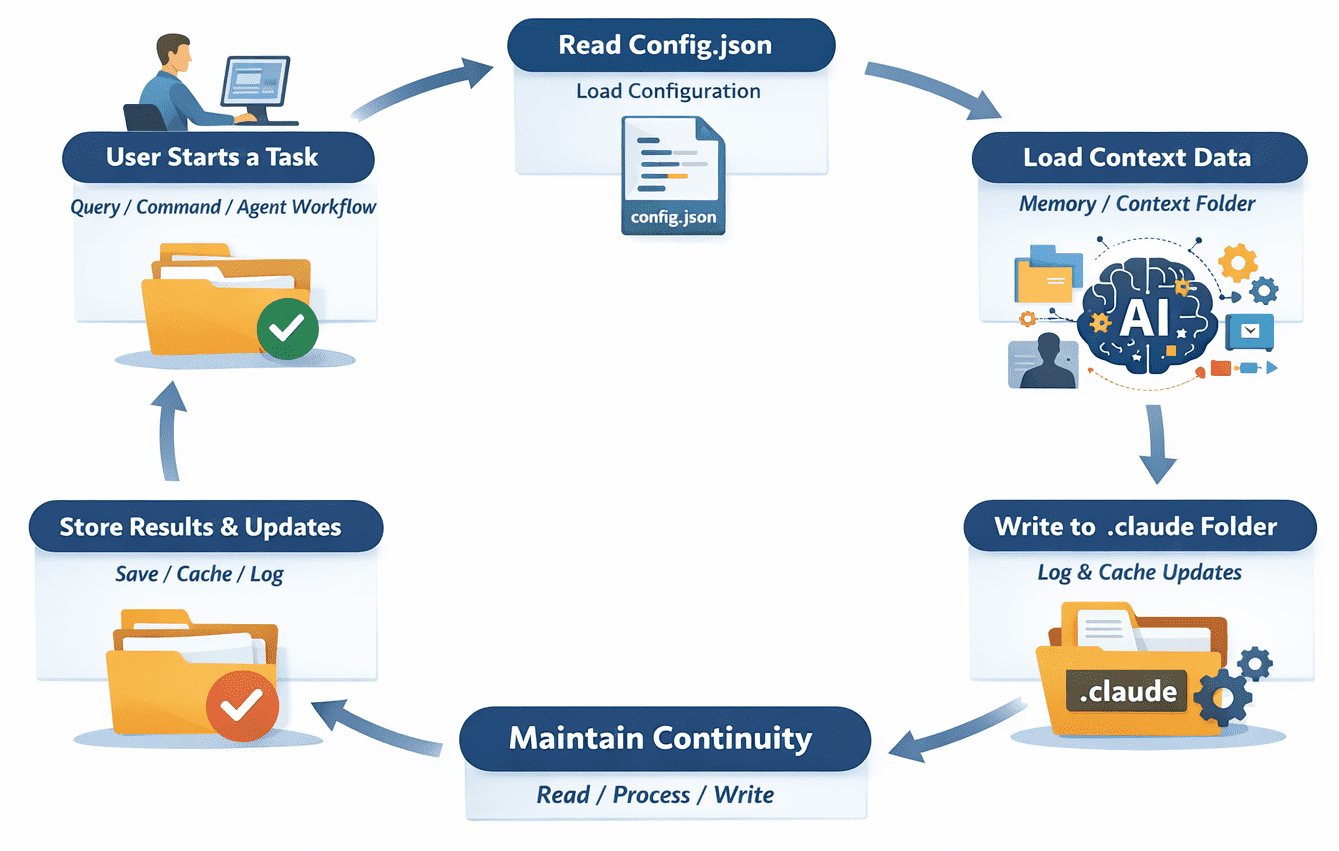
The lifecycle of the .claude folder begins the moment a Claude-powered command is executed within a project directory. The process typically follows a predictable chronology:

  1. Initialization: The tool checks for the existence of the .claude folder. If absent, it creates the directory structure and populates it with default configuration files.
  2. Context Loading: Before sending a request to the Anthropic API, the tool reads from config.json and the memory/ folder. It gathers the necessary context to make the prompt as accurate as possible.
  3. Task Execution: The AI performs the requested work. If it is a multi-step process, the tool may write intermediate "checkpoints" to the folder to ensure that progress is not lost if the process is interrupted.
  4. State Update: Once the task is complete, the tool updates the logs, refreshes the cache, and potentially updates the memory files with new information learned during the session.
  5. Persistence: The folder remains in the directory, ready to provide continuity for the next command, whether it occurs seconds or days later.

Data Efficiency and Cost Implications

One of the primary benefits of the .claude folder is its impact on cost management. API usage is billed based on "tokens"—units of text processed by the model. Without the local state management provided by the .claude folder, developers would often find themselves repeating context in every prompt to ensure the model has enough information to act correctly.

By utilizing local caching and structured memory, these tools can reduce the "input token" count significantly. Supporting data suggests that efficient context management via local state can reduce API costs by 30% to 50% in large-scale projects by preventing the redundant transmission of static codebase information. Furthermore, by storing "embeddings" (mathematical representations of text) locally, the system can perform local searches to find relevant code before ever contacting the cloud, further optimizing performance.

Security Protocols and Management Best Practices

The convenience of the .claude folder brings with it several security and project management challenges. Because the folder can contain sensitive information—including snippets of proprietary code, internal documentation, and occasionally API-related metadata—proper handling is essential.

The .gitignore Mandate

The most critical best practice is to add .claude/ to the project’s .gitignore file. In almost all scenarios, this folder represents local state that is specific to an individual developer’s machine and session. Committing this folder to a shared repository like GitHub can lead to "repository bloat" and, more seriously, the accidental exposure of sensitive telemetry or private configuration.

Breaking Down the .claude Folder

Data Privacy and Log Management

Developers must be aware that the logs/ directory within .claude may contain plain-text records of sensitive data processed during an AI session. In corporate environments with strict data privacy requirements, it is recommended to periodically purge these logs or use tools that support encrypted local storage.

Resetting the AI State

When an AI agent becomes "confused" or begins producing hallucinated results, it is often due to corrupted or outdated context stored within the .claude folder. In such cases, deleting the folder is a safe and effective troubleshooting step. Upon the next command execution, the tool will recreate the folder with a clean state, effectively "rebooting" the AI’s local memory.

Broader Impact on the Software Development Life Cycle (SDLC)

The normalization of the .claude folder signals a broader evolution in the SDLC. We are moving toward a future where "Project State" includes not just the source code and the git history, but also the "AI Context State."

Industry analysts suggest that as these tools mature, the way we share project context among teams may change. While the .claude folder itself should remain local, the definitions of the agents and the structured prompts it contains might eventually be version-controlled in a sanitized format. This would allow teams to share "AI coding standards" as easily as they currently share linting rules or formatting configurations.

Furthermore, the existence of this folder highlights the increasing importance of local-first AI. By keeping the working state on the developer’s machine rather than in a centralized cloud database, developers maintain a higher degree of sovereignty over their data and their workflow. It represents a middle ground between the total privacy of local LLMs (which may lack the reasoning power of Claude) and the convenience of cloud-based AI.

Conclusion

The .claude folder is more than a byproduct of modern AI tooling; it is a foundational component of the next generation of software development. By providing a dedicated space for configuration, memory, and logs, it enables Claude to function as a sophisticated, context-aware collaborator rather than a simple text generator.

As developers continue to integrate AI more deeply into their daily routines, the ability to inspect, manage, and secure the .claude directory will become as routine as managing a .env file or a node_modules folder. Embracing this local state management is the key to unlocking the full potential of agentic AI, ensuring that every interaction with the model is faster, smarter, and more aligned with the specific needs of the project at hand. In the rapidly changing landscape of artificial intelligence, the .claude folder stands as a testament to the need for persistence in an increasingly automated world.

April 9, 2026 0 comment
0 FacebookTwitterPinterestEmail
Tech & Startup News

Stephen Colbert Reacts to Donald Trumps AI Jesus Post and the Ensuing Condemnation from the Knights Templar

by admin April 8, 2026
written by admin

The intersection of artificial intelligence, religious iconography, and high-level geopolitics reached a surreal climax this week as President Donald Trump faced a wave of criticism following a series of controversial social media posts and public statements. The situation, which began with the sharing of an AI-generated image on Truth Social, has escalated into a multifaceted controversy involving the Vatican, an ancient order of knighthood, and shifting public approval ratings. Late-night host Stephen Colbert addressed the events during his Tuesday broadcast, characterizing the sequence of events as perhaps the most unconventional period in modern American political history.

The controversy originated when President Trump shared an image depicting himself in a likeness traditionally associated with Jesus Christ. While the post was quickly removed following an immediate backlash from various religious organizations, the digital footprint of the image sparked a broader conversation regarding the use of generative AI in political messaging and the boundaries of religious reverence in the public square.

The AI Image Controversy and the White House Response

On April 14, 2026, President Trump addressed reporters outside the Oval Office, attempting to clarify the intent behind the now-deleted Truth Social post. When questioned about the image, which critics labeled as "recreational blasphemy," the President offered an unconventional explanation. He suggested that he had not initially recognized the religious nature of the AI-generated figure, claiming instead that he believed the image portrayed him as a medical professional.

"I thought it was me as a doctor," the President stated to the press corps, a claim that was met with skepticism by media analysts and religious scholars alike. The image, which featured long hair, robes, and a glowing aura, was widely interpreted as a Messianic representation. The President’s "U-turn" on the imagery did little to quell the mounting criticism, as the post had already been archived and disseminated across various global platforms.

Stephen Colbert, during his monologue on The Late Show, highlighted the absurdity of the explanation. "If you just woke up from a coma and that report was the first thing you saw, you’d ask the doctor to put you back in," Colbert remarked. He further noted that the removal of the post served only to amplify its reach, a phenomenon often referred to as the Streisand Effect.

The Intervention of the Knights Templar

In perhaps the most unexpected development of the week, the Sovereign Military Order of the Temple of Jerusalem, more commonly known as the Knights Templar, issued a formal statement condemning the President’s social media activity. The organization, which traces its spiritual lineage back to the medieval crusading order, demanded a public apology for what they described as a disrespectful appropriation of sacred imagery.

"The Knights Templar said they condemn it wholeheartedly," Colbert noted during his program. "We’re officially trapped in a Dan Brown movie. Quick! Somebody find Tom Hanks and give him a terrible haircut."

The involvement of the Knights Templar adds a layer of historical and symbolic gravity to the situation. While the modern iteration of the order primarily focuses on charitable works and the preservation of Christian history in the Holy Land, their public rebuke of a sitting U.S. President is a rare occurrence. Historians suggest that the move reflects a growing concern among traditionalist organizations regarding the secularization and "gamification" of religious symbols for political gain.

Feud with the Holy See: Trump vs. Pope Leo XIV

The tension between the White House and religious authorities extended beyond the Knights Templar. In the days leading up to the AI image controversy, President Trump engaged in a series of online attacks directed at Pope Leo XIV. The friction reportedly stems from the Pope’s recent encyclical on global peace and social welfare, which some in the administration viewed as a critique of current U.S. foreign policy.

The President’s criticisms of the Pontiff were particularly notable given the Pope’s current standing in American public opinion. According to a recent NBC News favorability poll, Pope Leo XIV holds the highest approval rating of any public figure in the United States. The data suggests that the Pope’s message of reconciliation and his focus on humanitarian aid have resonated across traditional partisan lines.

Stephen Colbert reacts to Trump's AI Jesus post angering the Knights Templar

Colbert pointed out the irony of the President’s antagonism toward a figure who shares some superficial similarities in terms of lifestyle. "It’s got to piss Trump off to learn that the most popular guy on the planet lives in a palace dripping with gold and wears an insane hat and it’s not him," Colbert joked.

Statistical Analysis: The NBC Approval Poll

The NBC poll referenced by Colbert provides a unique snapshot of the American zeitgeist in early 2026. The survey, which sampled 1,200 registered voters, revealed a significant gap between religious/cultural figures and traditional political leaders.

  1. Pope Leo XIV: 68% Favorability
  2. Stephen Colbert: 54% Favorability
  3. Donald Trump: 41% Favorability

The fact that a late-night comedian and a religious leader outrank the sitting President in favorability suggests a period of profound political fatigue among the electorate. For Colbert, the poll results provided a moment of levity. "Colbert trailed only Pope Leo in favorability," he said, quoting the report. "Forgive me, I lied. I actually found that quite pleasurable."

Analysts suggest that the high favorability of non-political figures is a reaction to the highly polarized nature of the current administration’s tenure, which has been marked by ongoing conflicts and unconventional diplomatic strategies.

Chronology of a Tumultuous 24 Hours

To understand the scale of the current controversy, it is necessary to examine the sequence of events that unfolded over the 24-hour period described by Colbert as "the weirdest weird that ever weirded."

  • 08:00 AM: Reports emerge that the President utilized a commercial delivery service to order McDonald’s to the White House, an act that drew attention to his continued reliance on fast-food chains despite official dietary recommendations from the White House physician.
  • 10:30 AM: The President receives a high-level briefing on the escalating tensions between the United States, Israel, and Iran. The geopolitical situation remains volatile following a series of cyber-attacks and regional skirmishes.
  • 01:00 PM: The President posts the AI-generated "Jesus" image to Truth Social. Within minutes, the post goes viral, drawing condemnation from theologians and praise from his core digital base.
  • 03:00 PM: The Knights Templar issue their official statement via social media and press release, demanding a retraction and an apology.
  • 05:00 PM: The President deletes the post and issues a series of tweets attacking Pope Leo XIV, questioning the Pontiff’s influence and the Vatican’s wealth.
  • 06:30 PM: During an impromptu press gaggle, the President offers the "doctor" defense for the deleted image.
  • 11:35 PM: Stephen Colbert’s monologue airs, synthesizing the day’s events for a national audience.

Broader Implications and the Role of AI in Politics

The "AI Jesus" incident highlights a growing challenge for the 2026 political landscape: the regulation and ethical use of generative artificial intelligence. As AI tools become more sophisticated, the ability to create hyper-realistic or intentionally provocative imagery has outpaced the development of social norms and legal frameworks.

Political strategists argue that such imagery is designed to provoke an emotional response and maintain "engagement" in an increasingly crowded digital attention economy. However, the backlash from organizations like the Knights Templar and the Catholic Church indicates that there are still significant cultural "third rails" that can trigger widespread condemnation.

Furthermore, the juxtaposition of serious national security issues—such as the U.S.-Iran conflict—with seemingly trivial social media controversies has led to concerns regarding the "distraction factor" in modern governance. Critics argue that the focus on AI imagery and celebrity feuds diminishes the gravity of the military and diplomatic challenges facing the nation.

Conclusion: The New Normal of Political Discourse

As the dust settles on this latest episode, the broader impact on the Trump administration’s relationship with religious voters remains to be seen. While the President has historically enjoyed strong support from certain evangelical blocks, the direct conflict with the Vatican and the condemnation from traditional orders like the Knights Templar may signal a fracture in his broader coalition.

The role of late-night satire, as exemplified by Stephen Colbert, continues to serve as a primary lens through which a significant portion of the public processes these events. By framing the administration’s actions within the context of pop culture—referencing Dan Brown and Tom Hanks—satirists highlight the increasingly cinematic and surreal nature of 21st-century American politics.

For now, the White House appears focused on moving past the incident, but with the digital ghost of the AI image still circulating and the Knights Templar standing firm in their demand for an apology, the "weirdest weird" may have lasting consequences for the President’s public standing and the future of political communication.

April 8, 2026 0 comment
0 FacebookTwitterPinterestEmail
Tech & Startup News

The Growing Tax Ambiguity Surrounding Prediction Markets and the IRS Quest for Regulatory Clarity

by admin April 8, 2026
written by admin

The meteoric rise of prediction markets as a mainstream financial phenomenon has outpaced the development of a coherent tax framework, leaving thousands of American traders in a state of profound regulatory uncertainty. As platforms like Kalshi and Polymarket see record-breaking volumes, the Internal Revenue Service (IRS) is simultaneously undergoing a technological overhaul, signaling a future where non-compliance—even if accidental—will be increasingly difficult to hide. For the modern trader, the intersection of decentralized finance, event-based wagering, and federal tax law has become a labyrinth of conflicting definitions and onerous reporting requirements.

The Mechanical Burden of Prediction Market Taxation

For individual traders who classify their prediction market activities as gambling, the administrative burden is significant. Under current IRS guidelines, gambling winnings must be reported as "Other Income" on Schedule 1 of Form 1040. Unlike capital gains from stocks or bonds, where a taxpayer can often report a net profit or loss for the year, gambling activities require a "per session" accounting method. This means that a trader cannot simply subtract their total losses from their total winnings at the end of the year and report the difference. Instead, they are theoretically required to maintain a meticulous log of every individual wager, the time of the "session," and the specific outcome of each contract.

Nate Meininger, a prominent Phoenix-based trader active in these markets, highlights the absurdity of the current situation. While he has joked on social media that a lack of explicit guidance might excuse a lack of reporting, the reality is far more complex. Meininger relies on tax documents provided by regulated platforms like Kalshi and consults with professional accountants to ensure compliance. However, he admits that the granular level of tracking demanded by the "per session" rule is virtually impossible for high-frequency traders. "I don’t track it myself," Meininger noted. "That seems like a lot of work."

This sentiment is echoed across the industry. For a trader making hundreds of micro-bets on political outcomes, economic indicators, or weather events, the manual tracking of every transaction represents a logistical nightmare. The discrepancy between the high-speed nature of digital trading and the archaic reporting requirements of the tax code is a primary source of friction for early adopters.

The Offshore Complication and the VPN Trap

While domestic platforms like Kalshi operate under the oversight of the Commodity Futures Trading Commission (CFTC) and provide users with 1099-K or 1099-MISC forms, the situation is far more perilous for those using offshore or decentralized platforms. Polymarket, the world’s largest prediction market by volume, is technically prohibited from serving US-based users. Despite this, many American traders access the platform via Virtual Private Networks (VPNs).

Because Polymarket is a decentralized, blockchain-based platform, it does not issue traditional tax documentation to its users. This places the entirety of the reporting burden on the individual. Under US law, citizens are required to report all global income regardless of the source or the legality of the platform used to earn it. The IRS does not distinguish between "legal" winnings from a CFTC-regulated exchange and "illegal" or "unlicensed" winnings from an offshore crypto-based platform; both are taxable.

"The offshore exchanges are harder," Meininger explains. Without a consolidated tax form, traders must manually reconstruct their transaction history from blockchain explorers—a task that requires significant technical literacy. Furthermore, by reporting income from a platform they are legally barred from using, traders find themselves in a catch-22, potentially alerting authorities to their use of unlicensed financial services while attempting to remain compliant with tax laws.

The IRS Modernization and the Palantir Factor

The ambiguity of prediction market taxes is colliding with a new era of IRS enforcement. The agency is currently in the midst of a multi-year modernization effort, fueled by funding from the Inflation Reduction Act and overseen, in part, by efficiency-focused initiatives. A key component of this modernization is the integration of advanced data analytics to identify high-value auditing targets.

Recent reports indicate that the IRS paid Palantir, a data analytics firm known for its work in defense and intelligence, $1.8 million to refine a custom tool designed to flag potential tax evasion. This tool is specifically engineered to identify "high-value" cases where a taxpayer’s lifestyle or digital footprint does not align with their reported income. For prediction market traders who may be moving large sums of cryptocurrency in and out of digital wallets, these sophisticated algorithms represent a significant increase in the risk of an audit.

Furthermore, the involvement of the Department of Government Efficiency (DOGE) in streamlining government processes suggests that the IRS will continue to pivot toward automated enforcement. As the agency becomes more adept at tracking "off-ramp" transactions—where cryptocurrency is converted back into US dollars—the ability for prediction market traders to remain "under the radar" is rapidly diminishing.

Chronology: The Regulatory Lag and the Crypto Precedent

The current confusion surrounding prediction markets mirrors the early days of the cryptocurrency boom. A look at the timeline of crypto regulation reveals a pattern of administrative delay that often leaves taxpayers in a vulnerable position for years.

  • 2009: Bitcoin is launched, creating the first decentralized digital asset.
  • 2014: Five years after Bitcoin’s inception, the IRS issues Notice 2014-21, its first formal guidance, declaring that virtual currency will be treated as property for federal tax purposes.
  • 2019: The IRS adds a specific question to Form 1040 asking taxpayers if they engaged in any virtual currency transactions. This marks a shift toward aggressive enforcement.
  • 2021: The Infrastructure Investment and Jobs Act is signed into law, expanding the definition of "brokers" to include crypto exchanges, mandating that they report transaction data to the IRS.
  • 2023: Regulations are finalized, legally obligating crypto exchanges to send tax forms (such as the 1099-DA) to both users and the IRS.
  • 2024: Prediction markets reach record volumes during the US election cycle, yet no specific IRS "Notice" or guidance has been issued specifically for event-contract trading.

This timeline suggests a significant lag between the adoption of a new financial technology and the implementation of clear tax rules. In the interim, the IRS often relies on existing, albeit ill-fitting, categories like "gambling" or "property" to fill the void.

Analysis of Implications: Gambling vs. Commodities

A central point of contention that will likely define the future of prediction market taxation is whether these contracts should be classified as gambling or as financial derivatives (commodities).

If classified as gambling, traders face the "per session" reporting rule and cannot deduct net losses against other types of income (beyond the extent of their winnings). If classified as commodities or "Section 1256 contracts," traders would benefit from much more favorable tax treatment, including the "60/40 rule," where 60% of gains are taxed at the lower long-term capital gains rate and 40% at the short-term rate, regardless of how long the position was held.

The legal battle between Kalshi and the CFTC has already touched on this. By successfully arguing that its election contracts are "event contracts" rather than "gaming," Kalshi has moved the needle toward a financial-instrument classification. However, the IRS is not bound by the CFTC’s definitions. Until the IRS issues a formal ruling, traders remain in a state of "tax limbo," where they must choose between filing as gamblers (safe but expensive) or filing as investors (risky but potentially more accurate).

Broader Impact and the Future of Compliance

The current state of affairs creates a "compliance gap" where even well-intentioned citizens are likely to make errors on their tax returns. Meininger’s observation that "it would be odd for the IRS to expect someone to know something that’s impossible to know" highlights the ethical and practical dilemma facing the agency. If the rules are not clearly defined, aggressive enforcement can be seen as punitive rather than corrective.

However, the trend is clear: the IRS is moving toward a "report everything" model. The expansion of 1099 reporting requirements and the use of AI-driven audit tools mean that the window for "betting on leniency" is closing. For the prediction market industry to reach its full potential as a tool for price discovery and hedging, it requires a tax code that recognizes the unique nature of event contracts.

In the coming years, we can expect the IRS to follow the crypto roadmap: first, a period of silence; second, a broad warning (Notice); third, a specific question on the tax return; and finally, a mandate for exchanges to report data directly to the government. Until then, traders are left to navigate the fog, balancing the thrill of the market against the looming shadow of an increasingly sophisticated and data-hungry tax authority. The "impossible to know" phase is nearing its end, and the era of automated accountability is beginning.

April 8, 2026 0 comment
0 FacebookTwitterPinterestEmail
Tech & Startup News

Reid Hoffman Endorses Tokenmaxxing as Silicon Valley Debates Measuring Employee AI Engagement

by admin April 7, 2026
written by admin

The landscape of corporate productivity is undergoing a radical transformation as artificial intelligence becomes deeply integrated into the daily workflows of Silicon Valley’s largest enterprises. At the center of this shift is a controversial new metric known as "tokenmaxxing," a practice where companies track the volume of AI data processed by individual employees to gauge their level of technological adoption. While the concept has sparked intense internal debate at firms like Meta, LinkedIn co-founder and veteran venture capitalist Reid Hoffman has emerged as a prominent defender of the practice, suggesting that monitoring token usage is a vital, if imperfect, tool for navigating the burgeoning AI era.

The emergence of tokenmaxxing marks a significant milestone in the evolution of workplace analytics. For decades, tech companies have struggled to find quantitative measures for intellectual labor, moving from lines of code written to the number of Jira tickets closed. Now, as Large Language Models (LLMs) become the primary interface for software engineering, marketing, and administrative tasks, the "token" has become the new unit of account. This shift has not been without friction, as evidenced by Meta’s recent decision to shutter its internal AI token leaderboard following a series of leaks that exposed the company’s internal competitive culture to the public.

Understanding the Mechanics of Tokenmaxxing

To understand the debate surrounding tokenmaxxing, one must first understand the technical foundation of the metric. In the context of large language models, a "token" is the fundamental unit of text processing. Rather than reading word-for-word, AI models break down text into smaller chunks—ranging from a few characters to a whole word. For example, the word "apple" might be one token, while a more complex word like "friendship" might be split into two. On average, 1,000 tokens represent approximately 750 words.

Because AI providers like OpenAI, Anthropic, and Google charge enterprise customers based on the number of tokens processed, this data is readily available to IT departments. "Tokenmaxxing" refers to the deliberate effort by employees or managers to maximize this usage. The term utilizes the "maxxing" suffix—a piece of Gen Z slang derived from internet subcultures that refers to the extreme optimization of a specific trait, such as "looksmaxxing" (optimizing physical appearance) or "sleepmaxxing" (optimizing sleep hygiene).

In a corporate environment, a tokenmaxxing dashboard allows leadership to see which departments or individuals are "burning" the most tokens. Proponents argue that high token usage is a proxy for high engagement with AI tools, suggesting that those at the top of the leaderboard are the most forward-thinking members of the workforce. Critics, however, argue that it is a "vanity metric" that rewards volume over value, potentially encouraging employees to engage in performative AI usage to appear productive.

The Meta Controversy and the Shutdown of the Leaderboard

The debate reached a fever pitch in mid-April 2026, following reports that Meta Platforms Inc. had established an internal "tokenmaxxing" dashboard. The dashboard was designed to foster a spirit of "friendly competition" among engineers, ranking them based on how many tokens they generated through the company’s internal AI assistants and Llama-based tools.

However, the initiative backfired when the existence of the leaderboard was leaked to the press. Internal communications revealed that some engineers were deeply uncomfortable with the metric, comparing it to ranking employees based on how much company money they spent or how many hours they kept their screen active. The backlash highlighted a growing rift within the tech giant: while leadership, including CEO Mark Zuckerberg, has pushed for a "Year of Efficiency" and a total pivot toward AI, the rank-and-file workforce expressed skepticism toward metrics that do not account for the quality of output.

Days after the news broke, Meta leadership shuttered the dashboard. The company’s retreat signaled a potential cooling of the tokenmaxxing trend—until Reid Hoffman weighed in, providing a high-profile endorsement of the underlying philosophy.

Reid Hoffman’s Defense of AI Experimentation

Speaking at Semafor’s World Economy Summit, Reid Hoffman offered a nuanced defense of tracking AI usage. Hoffman, a partner at Greylock Partners and a former board member of OpenAI, is widely regarded as one of the most influential voices in the AI revolution. His perspective carries weight not just because of his venture capital background, but because of his role as an early advocate for the integration of AI into human professional life.

During an interview at the summit, Hoffman addressed the challenges companies face when trying to modernize their workforces. While he avoided using the slang term "tokenmaxxing," he explicitly supported the idea of using token dashboards as a management tool.

"You should be getting people at all different kinds of functions actually engaging and experimenting [with AI]," Hoffman stated. "Here’s one of the things that is a good dashboard to be looking at—it doesn’t mean it’s a perfect example of productivity, but… how much token usage are people actually doing as they’re doing it?"

Hoffman acknowledged the flaws in the metric, noting that high token usage does not inherently equal high-quality work. He suggested that some users might be using a high volume of tokens in "random or exploratory ways." However, he argued that this exploration is exactly what companies should be encouraging in the current technological climate. In Hoffman’s view, the risk of "wasting" tokens on failed experiments is far lower than the risk of a workforce that refuses to engage with the technology at all.

"Some of it will be experiments that’ll fail—that’s fine," Hoffman added. "But it’s in that loop, and you want a wide variety of people using it essentially, collectively, and simultaneously."

The Counter-Argument: The Perils of Gamifying Productivity

Despite Hoffman’s optimism, many management experts and software engineers remain wary of token-based KPIs. The primary criticism of tokenmaxxing is that it falls victim to Goodhart’s Law: "When a measure becomes a target, it ceases to be a good measure."

If employees know they are being judged on token volume, they may be incentivized to generate unnecessarily long AI responses, use AI for tasks that are more efficiently done manually, or even run automated scripts to "ping" the AI model throughout the day. This creates a "noise" problem where the company pays for increased API costs without seeing a corresponding increase in revenue or innovation.

Furthermore, there is the issue of "AI hallucinations" and quality control. An employee who "tokenmaxxes" by generating 50,000 words of AI-written marketing copy in an hour may appear more productive than a colleague who spends four hours carefully prompting an AI to produce one perfect, fact-checked paragraph. If the metric only tracks tokens, the former employee wins, despite potentially creating a liability for the company.

Historical precedents in the tech industry suggest that such metrics can lead to toxic work cultures. In the 1980s and 90s, some software firms attempted to pay engineers by the line of code (LOC). This led to "bloated" software, as engineers wrote verbose, inefficient code to maximize their earnings. Tokenmaxxing, critics argue, is simply the 21st-century version of the LOC fallacy.

Strategic Implementation: Beyond the Leaderboard

Hoffman’s advice to companies extended beyond mere tracking. He proposed a holistic strategy for AI integration that emphasizes cultural shifts over raw data. For Hoffman, the goal is not just to use AI, but to create a "feedback loop" where the entire organization learns from individual experiments.

He suggested that companies should implement weekly "check-ins" to discuss AI usage. "It doesn’t have to be everyone, all the time with each other—but a group check-in about ‘what did we try to do new this week, to use AI for both personal and group and company productivity, and what did we learn?’" Hoffman said.

This approach attempts to bridge the gap between the quantitative data of a token dashboard and the qualitative value of actual work. By combining the "what" (token usage) with the "how" (weekly learning sessions), companies can identify which AI use cases are actually driving value. For example, a legal department might find that using tokens to summarize 200-page contracts is a massive productivity win, while a creative team might find that using AI for initial brainstorming is useful, but using it for final drafts is counterproductive.

Economic and Organizational Implications

The tokenmaxxing debate arrives at a time when the economic stakes of AI are higher than ever. Enterprise spending on generative AI is projected to reach hundreds of billions of dollars by the end of the decade. For Fortune 500 companies, AI token costs are becoming a significant line item in the IT budget, rivaling cloud computing expenses.

From a management perspective, the push for tokenmaxxing is a symptom of "AI FOMO" (fear of missing out). CEOs are under immense pressure from boards and shareholders to prove that their organizations are not being left behind by the AI revolution. In this high-pressure environment, a token leaderboard provides a tangible, albeit flawed, piece of evidence that the workforce is evolving.

However, the broader implication of this trend is the potential for a new "digital divide" within the workplace. Employees who are naturally tech-savvy or who work in roles easily augmented by LLMs will find it easy to "max" their tokens. Those in more tactile, high-empathy, or specialized roles may find themselves at the bottom of the leaderboard, regardless of their actual contribution to the company’s bottom line.

Conclusion: The Future of the AI-Driven Workplace

As the dust settles on Meta’s dashboard controversy, the concept of tokenmaxxing is unlikely to disappear. Instead, it will likely evolve from a crude competitive leaderboard into a more sophisticated component of workforce analytics. Reid Hoffman’s endorsement suggests that for the leaders of Silicon Valley, the benefits of encouraging aggressive AI experimentation outweigh the risks of imperfect measurement.

The challenge for modern corporations will be to find the "Goldilocks zone" of AI tracking—monitoring usage enough to ensure the company’s investment in AI is being utilized, without creating a performative culture that prioritizes quantity over substance. As Hoffman noted, the "loop" of experimentation and learning is the true engine of productivity in the AI age. Whether that loop is measured in tokens, hours, or innovations, the companies that master it will be the ones that define the next decade of the global economy.

For now, tokenmaxxing remains a polarizing symbol of the "move fast and break things" ethos applied to the era of generative AI. It serves as a reminder that as we build more intelligent machines, the way we measure human intelligence and effort must also undergo a profound, and often uncomfortable, transformation.

April 7, 2026 0 comment
0 FacebookTwitterPinterestEmail
Newer Posts
Older Posts

Recent Posts

  • EF Protocol Cluster Releases Unified Tier List for Hegotäel Upgrade
  • Kraken Expands Its Digital Asset Offerings With the Official Launch of KOR Protocol Token Trading
  • Zcash Ecosystem Faces Pivotal Week with Network Upgrade 7 and Landmark Governance Restructuring
  • Navigating the Digital Identity Crisis: An Illustrated Primer on Anonymous Authentication in the Age of AI and Age-Verification Laws
  • Verifone Integrates Visa Featurespace Adaptive AI to Revolutionize Global Fraud Detection and Payment Security

Recent Comments

No comments to show.
  • Facebook
  • Twitter

@2021 - All Right Reserved. Designed and Developed by PenciDesign


Back To Top
Dr Crypton
  • Home
  • About Us
  • Contact Us
  • Cookies Policy
  • Disclaimer
  • DMCA
  • Privacy Policy
  • Terms and Conditions

We are using cookies to give you the best experience on our website.

You can find out more about which cookies we are using or switch them off in .

Dr Crypton
Powered by  GDPR Cookie Compliance
Privacy Overview

This website uses cookies so that we can provide you with the best user experience possible. Cookie information is stored in your browser and performs functions such as recognising you when you return to our website and helping our team to understand which sections of the website you find most interesting and useful.

Strictly Necessary Cookies

Strictly Necessary Cookie should be enabled at all times so that we can save your preferences for cookie settings.