
The crypto liquidity supplier market is heading for a shakeout. That’s the choice of three-quarters of institutional OTC members surveyed by Finery Markets, a crypto liquidity network whose recent annual enlighten describes 2026 because the year when consolidation stress turns into inconceivable to ignore.
Liquidity Provider Numbers Anticipated to Tumble
Six in ten OTC market members mentioned they quiz the collection of active liquidity services to shrink earlier than the live of 2026, with 25% predicting an outright decrease and an additional 37% forecasting a exiguous contraction. Most efficient 32% of respondents quiz recent entrants to offset losses.
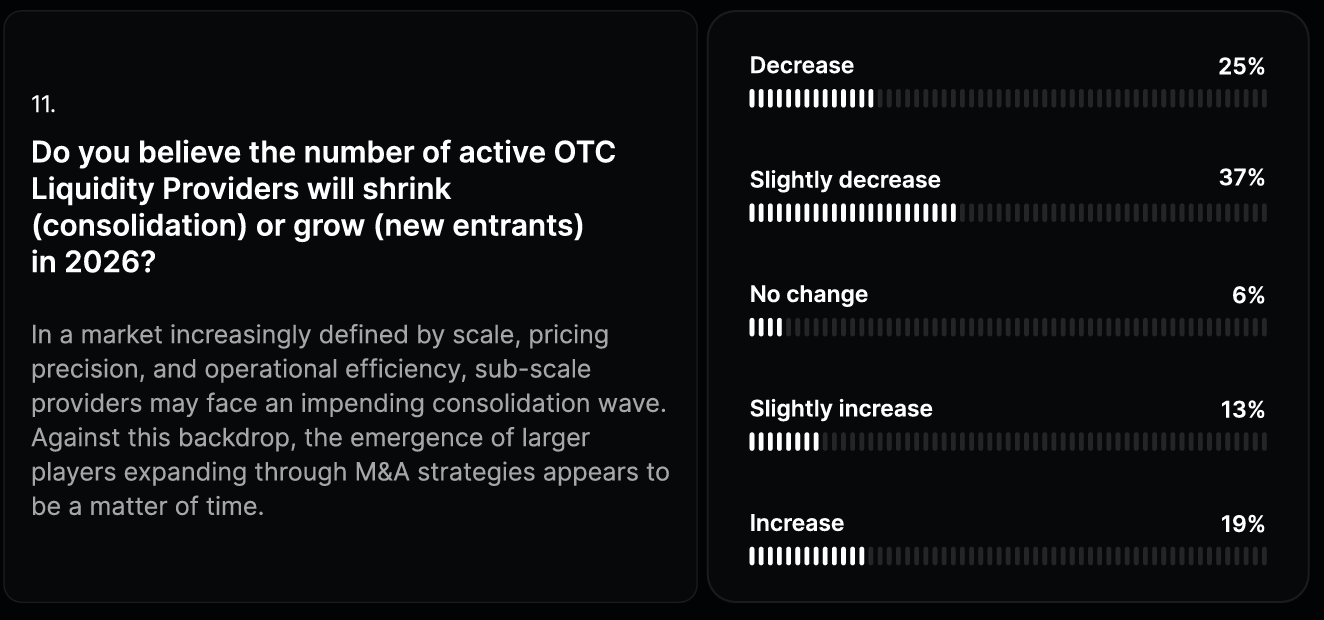
“In a market increasingly defined by scale, pricing precision, and operational efficiency, sub-scale services might well face an impending consolidation wave,” the enlighten states.
For CFD brokers that depend on a fragmented pool of crypto liquidity services to energy their pricing engines, fewer active market makers formulation narrowing competitive stress on spreads, larger concentration chance in liquidity sourcing, and reduced negotiating leverage on execution quality.
B2Broker’s chance final November to shuffle straight away into Finery Markets’ ECN for its institutional crypto OTC offering is an early example of how some corporations are responding to this structural stress.
Zodia Custody’s integration with Finery Markets, announced in April 2025, equally shows a broader trend of institutional gamers building bid connectivity into electronic liquidity networks in preference to routing through primitive intermediaries.
Margin Compression Already Biting
The anticipated consolidation is no longer hypothetical. Finery Markets chanced on that 75% of surveyed corporations reported essential margin compression in 2025, with half of describing their margins as having reduced and a quarter reporting a exiguous decrease. Excellent 8% mentioned they had improved.
The corporations weathering the stress simplest are these investing in technology to change human overhead. Algorithmic pricing and submit-alternate automation every ranked because the #1 technology investment priority for 31% of surveyed members heading into 2026.
[#highlighted-links#]
That sample will be familiar to someone who adopted the retail FX enterprise through its bear compression cycle within the 2010s. The enlighten itself draws the parallel explicitly, describing the latest OTC crypto market as mirroring the structural migration of the $9.6 trillion day-to-day FX market against electronic, regulated liquidity streams. X Commence Hub’s growth of its institutional crypto OTC liquidity pool earlier this year shows that identical good judgment utilized to a CFD-going through context.
The $27 Trillion Case Towards Legacy Rails
The trapped capital figure sits on the center of a broader case the enlighten makes about stablecoin settlement. Faded SWIFT and SEPA infrastructure, it argues, forces institutions to pre-field capital for the duration of venues days earlier than it is wished, producing a “fragmentation tax” on every agency that cannot rebalance in trusty time.
“The live of trapped capital: primitive rails race away an estimated $27 trillion trapped in pre-funded accounts,” the enlighten states. “Stablecoin-generation atomic settlement (T+0) enables for correct-in-time liquidity, releasing up institutional capital for instantaneous redeployment.”
Annual stablecoin transaction volumes now exceed $57 trillion, and stablecoins’ piece of institutional OTC transaction quantity grew from 23% in 2023 to 78% in 2025, in step with the enlighten. Transactions now settle in under one 2nd for decrease than one cent on Ethereum and Layer 2 networks, when compared with the 24-hour or longer settlement cycles popular on legacy banking platforms.
FinanceMagnates.com reported in January that stablecoins are increasingly being adopted as a settlement instrument on the broker degree, with corporations under stress to adapt their assist-place of enterprise infrastructure accordingly. A separate analysis from June 2025 detailed how CFD brokers are particularly turning to stablecoins for execrable-border payments, citing cost reduction and settlement shuffle as main drivers.