

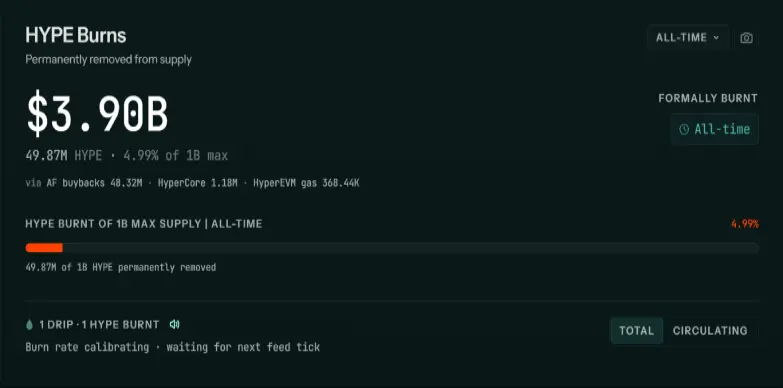
The native cryptocurrency of the Hyperliquid decentralized exchange (DEX), HYPE, has experienced a significant market rally, climbing more than 16% over the past 24 hours to reach a trading price of $92. This bullish momentum follows a watershed moment in the intersection of traditional finance and decentralized technology: the formalization of a strategic partnership between the Intercontinental Exchange (ICE)—the parent company of the New York Stock Exchange—and fintech developer trade[XYZ]. This collaboration aims to construct a U.S.-regulated, 24/7 perpetual futures market leveraging Hyperliquid’s core infrastructure. Beyond the institutional validation provided by the ICE deal, the asset’s price action is being bolstered by a aggressive, protocol-driven deflationary mechanism that has effectively removed nearly 5% of the total HYPE token supply from circulation.
The announcement on October 29th marks a pivotal shift in how global financial giants are approaching blockchain settlement. By integrating with Hyperliquid’s specialized Layer 1 architecture, ICE and trade[XYZ] are signaling that decentralized protocols can meet the stringent compliance and performance requirements necessary for regulated, onshore financial instruments.
Chronology of the ICE and Trade[XYZ] Integration
The genesis of this partnership traces back to the evolving demand for high-speed, continuous trading environments that operate outside the constraints of traditional exchange hours. Trade[XYZ], a firm specializing in the development of blockchain-based financial applications, identified Hyperliquid as the optimal settlement layer due to its high throughput and low-latency matching engine.
On October 29th, the official announcement confirmed that ICE had completed a strategic equity investment in trade[XYZ]. This financial backing was accompanied by a clear strategic mandate: to build a domestic derivatives platform that offers perpetual futures contracts to U.S. retail investors. While the project is currently in the development phase, the framework relies heavily on Hyperliquid’s proprietary HIP-3 (Hyperliquid Improvement Proposal 3) protocol.
The timeline for the implementation remains subject to rigorous regulatory oversight. The partners have emphasized that the launch is contingent upon receiving the necessary authorizations from U.S. financial regulators. The project has garnered significant attention from the investment community, bolstered by the involvement of prominent macro investor Stan Druckenmiller, whose participation as an early-stage external investor underscores the potential viability of this model in the eyes of institutional-grade market participants.

The Role of HIP-3 in Regulatory Compliance
At the core of this integration is the HIP-3 technical architecture. Traditionally, decentralized exchanges have faced significant hurdles in entering regulated markets because their permissionless nature conflicts with strict Know-Your-Customer (KYC) and Anti-Money-Laundering (AML) mandates. HIP-3 solves this by creating a bifurcated approach to protocol management.
Standard HIP-3 deployments, which underpin the current offshore operations of trade[XYZ], operate under a permissionless framework. However, the modified version intended for the U.S. market introduces an on-chain allowlist. This feature allows the deploying entity—in this case, the entity regulated by U.S. authorities—to manage access directly at the protocol level.
This structural separation is critical. It allows the platform to maintain the high-speed performance and transparency of a decentralized ledger while strictly adhering to sovereign, local regulations. The technological settlement layer remains decentralized and immutable, yet the access layer is governed by a centralized, compliant authority. This hybrid model represents a potential blueprint for future institutional adoption of blockchain technology, as it addresses the primary friction points of security, compliance, and speed.
Economic Impact: Deflationary Pressure and Tokenomics
The rally in HYPE is not purely speculative; it is fundamentally supported by the network’s internal economic activity. The Hyperliquid network has executed a substantial reduction in its token supply, permanently destroying 49.87 million HYPE tokens. This action effectively wiped out 4.99% of the absolute 1 billion token cap, a move that has significantly tightened the circulating supply of the asset.
This deflationary pressure is a direct result of the network’s programmatic monetization. Hyperliquid’s smart contract architecture includes an automated buyback engine that utilizes revenue generated from protocol fees. Over the past 24 hours alone, the network recorded approximately $1.69 million in protocol fees. This revenue was funneled directly into the buyback engine, which subsequently acquired and incinerated 19,700 HYPE tokens.
The scale of this operation is substantial. With a cumulative lifetime revenue of roughly $1.38 billion, the network has established a consistent flow of capital that supports the token’s value proposition. As transactional volume on the exchange increases—particularly with the anticipated influx of users from the new U.S.-regulated platform—the frequency and size of these buybacks are expected to rise, creating a compounding effect on the token’s scarcity.
Market Analysis and Technical Outlook
From a technical perspective, the recent 19.5% gain—moving the price from a floor of $76.24 to $91.14 over the last five days—marks a significant shift in market sentiment. The asset has successfully cleared the overhead resistance level at $88.11, a barrier that had previously capped bullish attempts. Furthermore, the price has reclaimed its 20-day and 50-day exponential moving averages (EMAs), which are widely interpreted by traders as indicators of sustained trend strength.
Market analysts are now focusing on the $108.2 price target. For this to materialize, the current buying pressure must remain consistent as the market digests the news of the ICE partnership. Should the asset maintain its current support levels, a breakthrough toward the $108 mark would represent an 18.75% increase from its current position. This potential move is being closely monitored, as it would likely signal a breakout from a long-standing consolidation channel, potentially establishing a new, higher trading range for the asset.
Broader Implications for Decentralized Finance
The partnership between ICE and trade[XYZ] signifies a broader industry trend: the transition from "DeFi for the sake of decentralization" to "DeFi for the sake of efficiency." By integrating with Hyperliquid, institutional players are acknowledging that the backend infrastructure of decentralized finance—specifically its matching engines and settlement layers—can outperform legacy systems in terms of efficiency, cost, and availability.
The separation of retail functionality from ICE’s primary institutional futures business is a strategic necessity. By keeping the offshore markets separate from the U.S. domestic deployment, the partners are mitigating systemic risk and ensuring that the two ecosystems do not interfere with one another’s regulatory status. This modular approach allows for innovation in the retail sector without jeopardizing the stability of the institutional core.
Furthermore, the involvement of established financial entities like ICE brings a level of legitimacy to the HYPE token that was previously absent. As more institutional capital flows into the ecosystem, the focus is shifting toward the sustainability of the underlying protocol. The fact that Hyperliquid has generated over $1 billion in revenue and is actively managing its supply through a transparent, automated mechanism provides a compelling narrative for long-term investors.
Conclusion
The rally in HYPE reflects a confluence of institutional validation and strong, automated tokenomics. As the industry moves closer to the launch of the first U.S.-regulated, blockchain-based perpetual futures market, the role of Hyperliquid as the foundational layer becomes increasingly significant. While the regulatory path forward for trade[XYZ] remains the primary variable to watch, the technical progress, combined with the aggressive deflationary strategy, suggests that the project is well-positioned to remain at the forefront of the integration between traditional and decentralized finance. Traders and investors alike will continue to look for further clarity on the timeline of the U.S. launch as a primary catalyst for the next phase of the asset’s market development.

