
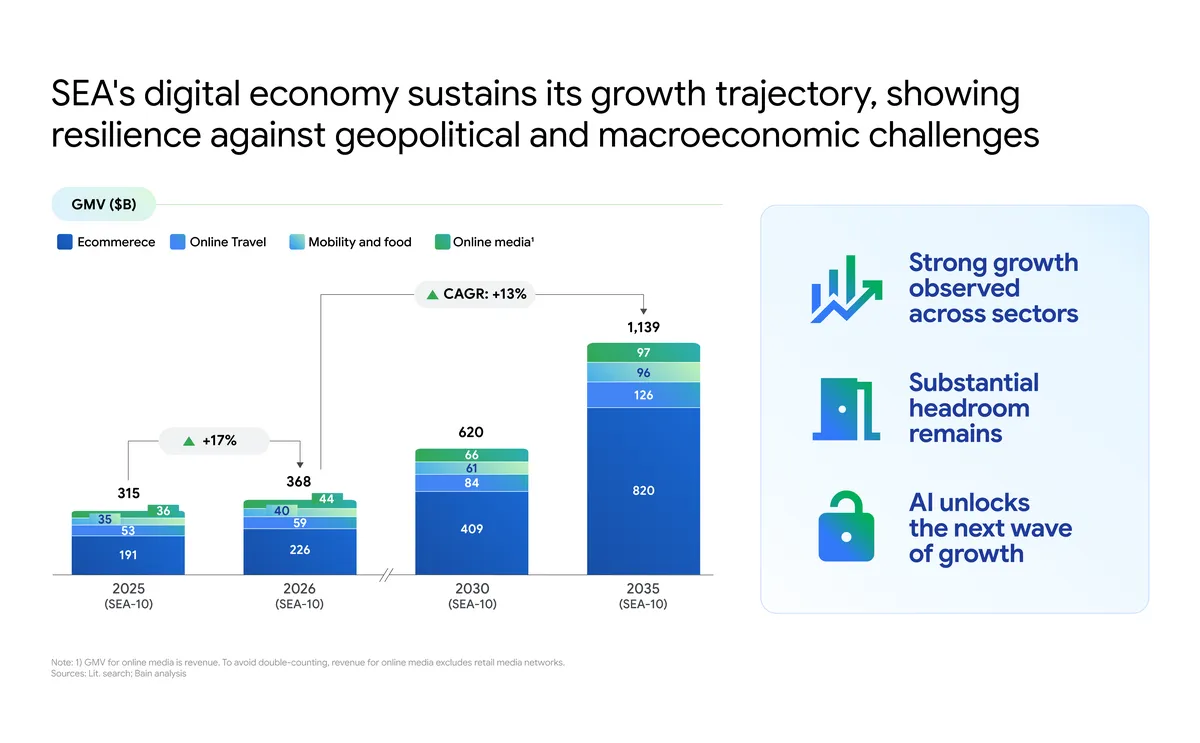
The digital landscape of Southeast Asia is undergoing a profound transformation as generative artificial intelligence shifts from a novel experimental tool to a fundamental pillar of daily life. According to the 11th edition of the annual e-Conomy SEA report, titled Building the Intelligent Economy, the region’s digital economy is projected to reach a Gross Merchandise Value (GMV) of $368 billion in 2026. This represents a robust 17% year-on-year growth, signaling that the region remains firmly on a trajectory to surpass the $1 trillion milestone by 2035.
The report, compiled through a collaborative effort by Google, Temasek, and Bain & Company, highlights that 243 million people—or approximately 58% of the working population in Southeast Asia—are now regular users of generative AI. This rate of adoption is historically unprecedented, scaling four times faster than the initial rollout of mobile internet across the region.
A Chronology of Digital Acceleration
To understand the current momentum, one must look at the evolution of the digital economy over the past decade. When the first e-Conomy SEA report was published, the focus was primarily on internet penetration and the initial rise of ride-hailing and e-commerce platforms. Over the last eleven years, the report has tracked the maturity of the ecosystem, moving from a period of rapid customer acquisition to a phase defined by profitability and, most recently, the integration of intelligent automation.
In 2020, the COVID-19 pandemic acted as a massive catalyst for digital services, forcing a sudden shift toward online grocery, digital banking, and remote work. By 2022, the conversation shifted toward unit economics and sustainable growth. Now, in 2026, the focus has pivoted entirely toward "agentic commerce"—a state where AI systems do not just provide information, but actively execute tasks and make decisions on behalf of the consumer.
Sectoral Analysis: The AI Dividend
The $368 billion valuation is underpinned by growth across five primary digital pillars, all of which are being reshaped by AI-driven efficiencies:
E-commerce: The Backbone of the Economy
With a GMV of $226 billion and 18% year-on-year growth, e-commerce remains the largest contributor to the regional digital economy. The integration of multimodal discovery tools—where users can search using images or voice—combined with in-app AI assistants, has streamlined the path to purchase. Data suggests that these personalized experiences result in a 10% higher conversion rate and can drive order volume uplifts of up to 75% for merchants who leverage AI-powered product recommendations.
Online Travel and Media
The travel sector, valued at $59 billion with 10% annual growth, is witnessing a behavioral shift. While traditional search engines remain the primary planning tool, generative AI has surpassed social media as the second-most-used utility for organizing complex itineraries. In the realm of online media, which has reached $44 billion in revenue, the implementation of AI has optimized content feeds. Commerce media is now a $4 billion market, with AI-driven ad relevance yielding a 10% to 20% improvement in quality engagement metrics.

Mobility and Digital Finance
The mobility and food delivery sector, worth $40 billion, continues to expand by 15% annually, driven by predictive routing and smarter, pooled-ride algorithms. Simultaneously, digital financial services have hit a Gross Transaction Value (GTV) of $1.65 trillion, a 16% increase. AI is playing a critical role here, particularly in real-time fraud detection and the democratization of credit access, allowing for more personalized financial advice that complements human-led services.
The Rise of Agentic Commerce and Consumer Trust
A critical finding in the 2026 report is the transition toward "agentic commerce." As users become more familiar with AI, they are increasingly comfortable delegating complex financial or shopping tasks to autonomous agents. Surveys indicate that 75% of users are willing to let AI agents compare prices and complete transactions autonomously.
This willingness is bolstered by a significant increase in public trust. Approximately 62% of Southeast Asians report higher trust in AI tools compared to the previous year. This trust is not blind; it is driven by three measurable factors: a proven track record of AI performance (56%), increased personal familiarity with the technology (55%), and verifiable output accuracy (53%).
However, the report identifies clear requirements for this trust to translate into widespread commercial adoption. To maintain this momentum, users are demanding specific safeguards: 44% of respondents prioritize robust privacy protections, 36% seek transparency regarding AI limitations, and 30% insist on the ability to manually override or reverse agentic transactions.
Broader Implications and Future Infrastructure
The projected 60-fold surge in regional AI usage by 2030 will require significant structural adjustments. The "Intelligent Economy" is not merely about software; it is about the underlying architecture that supports it. For the region to scale effectively, experts point to four critical areas of development:
- Data Infrastructure and Sovereignty: As the volume of tokens processed by AI models grows, the region must invest in data centers and high-speed connectivity that can handle localized, low-latency AI demands.
- Regulatory Frameworks: There is a pressing need for harmonized regional policies that balance innovation with consumer protection, particularly concerning data privacy and the accountability of autonomous agents.
- Talent Reskilling: The rapid shift toward an AI-driven economy necessitates a workforce capable of managing and collaborating with AI tools. Governments and private enterprises are under pressure to launch comprehensive upskilling initiatives.
- Energy Sustainability: As AI computation is energy-intensive, the growth of the digital economy must be decoupled from carbon emissions, requiring a strategic shift toward renewable energy sources for the tech infrastructure.
Perspectives on the Digital Future
Nitin Gajria, Managing Director for Southeast Asia and South Asia Frontier Markets, noted that the speed of this transition is reflective of the region’s digital-first culture. "Southeast Asia has proven time and again that it is a hub for rapid digital adoption," industry analysts observe. "The transition from the mobile-first era to the AI-first era is happening faster here than perhaps anywhere else in the world, largely because the infrastructure built over the last decade is ready to be augmented by intelligence."
While the path to $1 trillion in GMV by 2035 is clear, the report cautions that the region’s leaders must remain vigilant. The competitive advantage of Southeast Asia will depend on how effectively these nations can foster a collaborative environment between regulators, technology providers, and the private sector. The "intelligent economy" promises a more efficient, personalized, and accessible financial and retail system, but its success will be measured by its ability to integrate into the daily lives of citizens while maintaining the high standards of safety and transparency they now demand.
As the region moves into 2027 and beyond, the focus will likely shift from the "why" of AI adoption to the "how." With $368 billion in GMV serving as the current baseline, the digital economy of Southeast Asia is no longer a peripheral sector; it is the primary engine of the region’s future growth, setting a global benchmark for how emerging markets can leapfrog traditional development hurdles through the power of generative technology.

