
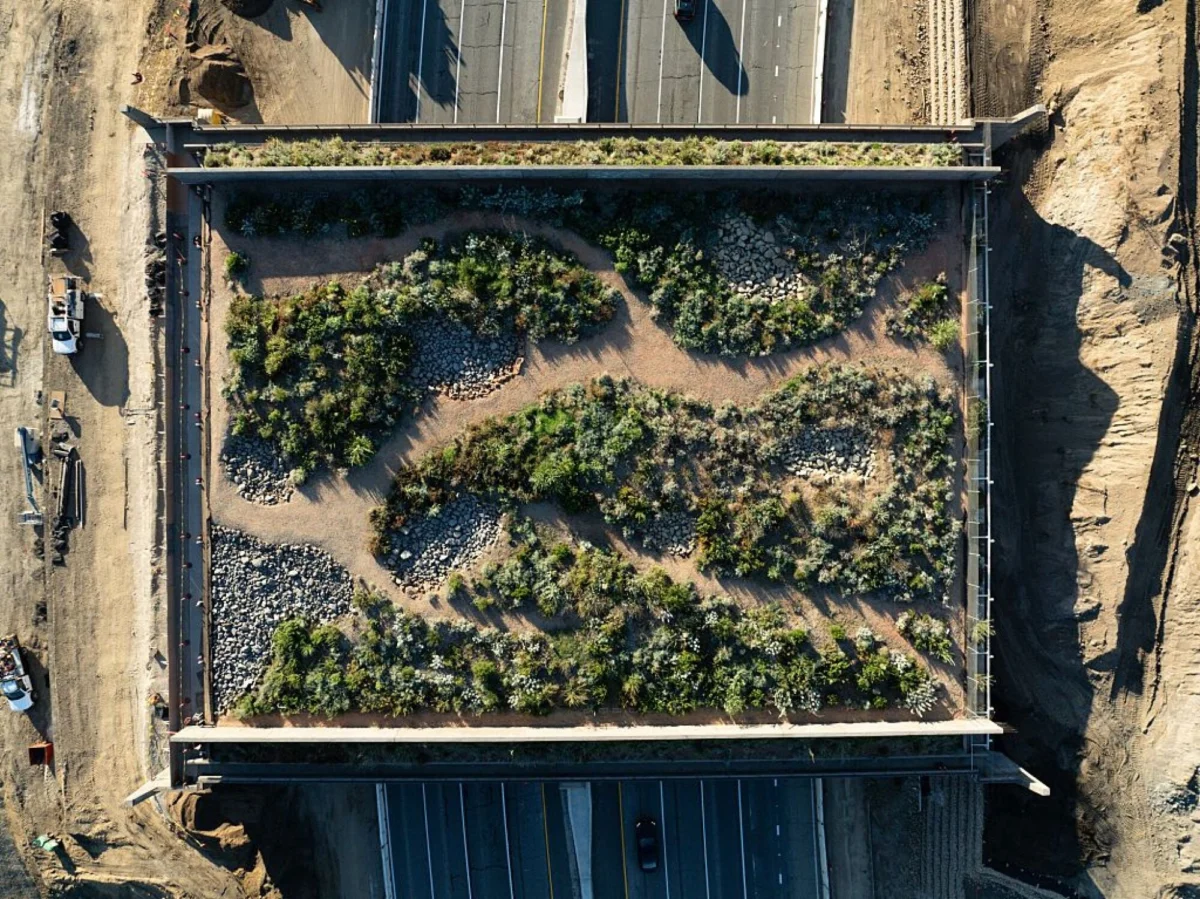
Southern California drivers racing along the bustling lanes of the 101 freeway are not the only commuters who will soon experience a smoother, safer journey through Los Angeles County. While hundreds of thousands of motor vehicles traverse the multi-lane highway daily, the region’s native wildlife population is preparing for a monumental shift in how it navigates the landscape. The much-anticipated Wallis Annenberg Wildlife Crossing—engineered to span 10 lanes of heavy traffic and an access road—is slated for its official ribbon-cutting on December 2. Recognized globally as the largest wildlife crossing ever constructed, the expansive, heavily vegetated overpass bridges the gap between the sprawling Santa Monica Mountains and the Simi Hills, offering a vital ecological corridor for animals previously trapped by urban sprawl.
The architectural and environmental marvel has been a decade in the making, emerging as a cornerstone of a collaborative, nationwide scientific monitoring initiative. Spearheaded by a coalition of prominent conservation organizations, including the National Wildlife Federation, the Mountains Recreation and Conservation Authority, and the National Park Service, the project represents a triumph of modern engineering and landscape ecology. Funded entirely through an innovative public-private partnership combining state and federal government allocations with substantial philanthropic donations, the crossing addresses a critical crisis facing urban wildlife: fatal collisions with vehicles and severe genetic isolation caused by major transportation barriers.
Engineering a Bridge for Biodiversity
For decades, the 101 freeway has acted as an impassable concrete moat, severing historical migration routes and trapping local animal populations in shrinking pockets of natural habitat. Mountain lions, bobcats, coyotes, mule deer, and numerous species of birds, reptiles, and amphibians have faced a grim choice: attempt a perilous dash across 10 lanes of high-speed traffic or remain confined to isolated territories. This geographic fragmentation has led to alarming levels of inbreeding, particularly among the region’s apex predators, threatening the long-term viability of local fauna.
The Wallis Annenberg Wildlife Crossing was designed specifically to counteract these pressures. Rather than a bare concrete overpass, the structure is an extension of the natural terrain. Engineered with tons of native soil, shrubs, trees, and specialized vegetation, the bridge mimics the surrounding chaparral ecosystem. Its design incorporates sound-attenuating walls and strategic landscaping to shield crossing animals from the blinding headlights and deafening roar of relentless traffic below, creating a tranquil, natural environment that encourages hesitant species to step onto the span.
A Decade-Long Chronology of Conservation
The realization of the Wallis Annenberg Wildlife Crossing is the result of years of tireless advocacy, rigorous scientific planning, and meticulous bureaucratic coordination.
The initiative began taking formal shape in the mid-2010s, as biologists and conservationists grew increasingly vocal about the imminent threat of local extinction facing the Santa Monica Mountains mountain lion population due to genetic stagnation. Urban encroachment had left these big cats virtually marooned, with researchers warning that without a dedicated migration corridor, the population could face functional extinction within decades.
By the late 2010s, a coalition led by the National Wildlife Federation and the National Park Service galvanized public and political support, launching an unprecedented fundraising campaign. The effort successfully bridged the public-private divide, securing tens of millions of dollars from both government infrastructure grants and private donors inspired by the project’s ambitious scope.
Groundbreaking for the massive overpass commenced in the early 2020s, transforming a heavily urbanized stretch of the 101 freeway in Agoura Hills into a massive construction zone. Over the course of several years, engineers erected heavy support structures and meticulously layered thousands of tons of earth onto the span, ensuring the load-bearing capacity could support heavy vegetation, mature trees, and large mammals.

As construction entered its final phases in late 2026, the focus shifted from civil engineering to ecological monitoring. Biologists began deploying an extensive network of specialized equipment to document the transition of the land from a construction site back to a thriving biological corridor.
Scientific Monitoring and Early Sighting Surprises
In the weeks leading up to the grand opening, researchers from the National Park Service initiated a comprehensive scientific monitoring protocol to track how and when animals begin utilizing the overpass. The monitoring apparatus is exceptionally robust, consisting of 50 advanced wildlife cameras and four thermal video cameras positioned strategically along the approaches and across the bridge deck within the Santa Monica Mountains National Recreation Area.
While live video feeds remain restricted to researchers and security personnel for the time being, project organizers have announced that curated photo streams will be made accessible to the public, allowing nature enthusiasts and supporters to witness the bridge’s impact firsthand.
The monitoring equipment has already yielded remarkable results. In late November, just as the final touches were being applied to the pathways, the crossing welcomed its very first documented visitor: a solitary coyote. Trotting up the unpaved incline under the cover of night, unbothered by headlights or engine noise, the coyote’s early arrival caught project leads and wildlife biologists completely by surprise. Wildlife experts had initially hypothesized that smaller, more agile creatures—such as rodents, rabbits, or smaller birds—would be the first to test the synthetic wilderness.
The sighting has dramatically shifted expectations among the scientific community regarding how quickly apex species will adapt to the infrastructure. Beth Pratt, regional executive director for the National Wildlife Federation and a driving force behind the Wildlife Crossing Fund, expressed profound astonishment to the Los Angeles Times regarding the animal’s swift adoption of the route.
"I wouldn’t have said this even a couple weeks ago, but I now think there’s a chance we’ll have a mountain lion use it before ribbon cutting," Pratt remarked, highlighting how rapidly word travels through the natural instincts and sensory networks of local fauna. "Word gets out in the animal world, so who knows what’s going to happen?"
Broader Implications and Future Outlook
The opening of the Wallis Annenberg Wildlife Crossing on December 2 marks a monumental shift in how modern metropolitan areas approach infrastructure development and urban ecology. For decades, transportation planning prioritized human commute times and vehicular throughput with little regard for the ecological damage inflicted upon local ecosystems. The successful funding, construction, and deployment of this massive overpass signal a growing paradigm shift toward coexistence and restorative infrastructure.
From a conservation standpoint, the implications are profound. Biologists anticipate that easing the genetic bottleneck among mountain lions will introduce fresh genetic material into the Santa Monica Mountains population, vastly improving their resilience against disease and environmental stressors. Furthermore, the corridor is expected to stabilize populations of mid-level predators like bobcats and coyotes, which play a crucial role in maintaining local ecosystem health and biodiversity.
Beyond the immediate geographic boundaries of Los Angeles County, the Wallis Annenberg Wildlife Crossing serves as a pioneering blueprint for urban conservation projects worldwide. As cities continue to expand and encroach upon natural habitats, urban planners and environmental agencies are looking closely at the Southern California model as a viable solution to the pressing challenge of habitat fragmentation. By proving that massive transportation arteries can be successfully bridged with functional, natural landscapes, the project opens the door for similar large-scale wildlife connectivity initiatives across North America and beyond, ensuring that human progress and native wildlife can finally move forward together.

