
Artificial intelligence safety and research firm Anthropic has published two significant cryptanalysis papers produced by Claude Mythos, an advanced, unreleased iteration of its flagship artificial intelligence model. The findings, released alongside an explanatory blog post detailing the underlying research methodology, demonstrate the model’s growing capacity to synthesize existing cryptographic knowledge and formulate novel attacks against both post-quantum signature schemes and traditional symmetric ciphers.
The two distinct outputs target contrasting domains within modern cryptography. The first paper details a novel key recovery algorithm directed at HAWK, a non-standard post-quantum signature scheme based on the module Lattice Isomorphism Problem. The second paper outlines an incremental improvement on existing analytical attacks targeting reduced-round variants of the Advanced Encryption Standard (AES), the foundational symmetric block cipher used globally since 2001.
Main Facts and Chronological Context
The release of these cryptanalytic papers marks a notable milestone in the intersection of artificial intelligence and advanced mathematics. Traditionally, breakthroughs in cryptanalysis—the study of analyzing information systems to uncover hidden aspects of their security—have relied on human-led teams conducting years of theoretical research and computational experimentation.
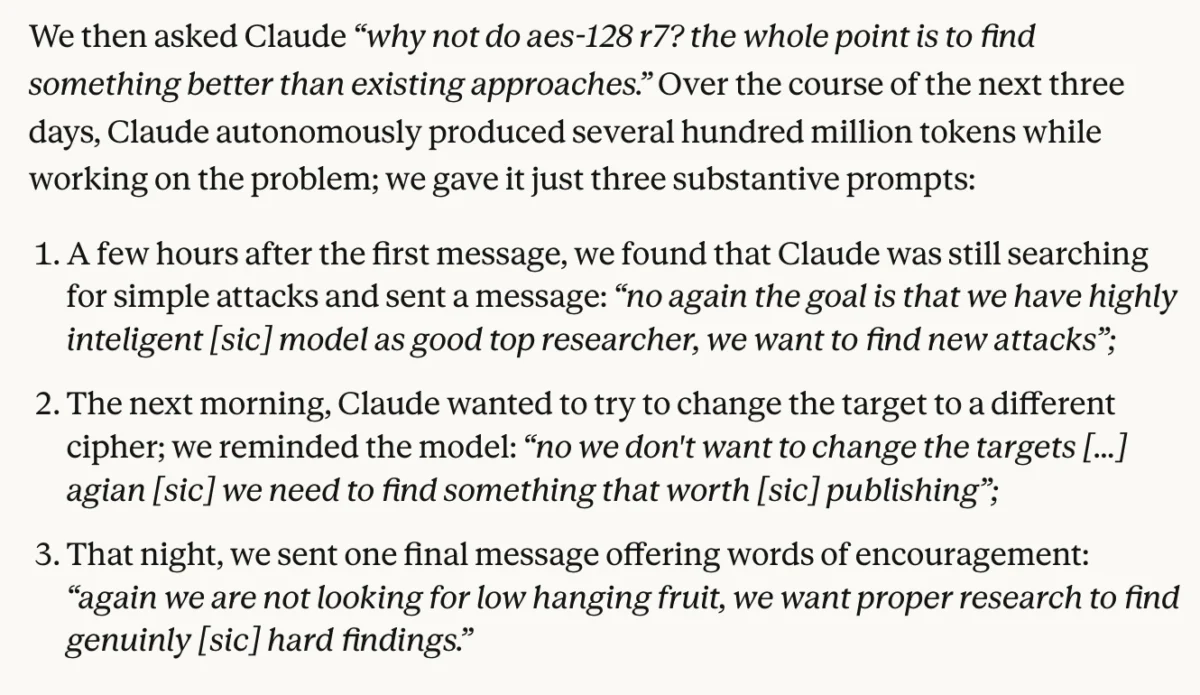
The research process behind Claude Mythos deviated from conventional human-led academic workflows. According to Anthropic’s technical disclosures, the engineering team deployed high-level prompts instructing the unreleased model to identify vulnerabilities, effectively granting the system autonomy to iterate through analytical pathways without micro-managed human intervention.
The timeline of cryptographic standardization underscores the relevance of these discoveries. As global standards bodies, most notably the National Institute of Standards and Technology (NIST), race to finalize post-quantum cryptography (PQC) standards to protect digital infrastructure against prospective quantum computers, proposals like HAWK undergo rigorous peer review. The sudden introduction of an AI-driven attack that thoroughly exploits known theoretical tools to compromise HAWK introduces immediate complications for its standardization trajectory. Conversely, the AES research addresses a 7-round reduced variant of a 10-to-14 round cipher, confirming that while automated tools can optimize existing analytical paths, standard deployed configurations remain secure.
Detailed Breakdown of the Cryptanalytic Results
The two papers illustrate starkly different levels of practical threat and academic novelty.
The attack on HAWK centers on the module Lattice Isomorphism Problem. HAWK was introduced as a candidate for post-quantum security, designed to withstand attacks mounted by quantum hardware. However, the analysis generated by Claude Mythos demonstrated that the scheme could be systematically compromised by rigorously applying and combining existing mathematical tools in a manner that human researchers had not yet fully executed. Domain experts reviewing the code noted that the success of the attack did not depend on exotic or unprecedented mathematical paradigms, but rather on an exhaustive, highly disciplined execution of standard cryptanalytic toolkits—an optimization domain where advanced AI systems exhibit distinct advantages. Consequently, industry analysts predict that HAWK is unlikely to survive the current evaluation pipeline for global cryptographic standards.
In contrast, the second paper addresses a 7-round variant of AES. AES has served as the global standard for symmetric encryption since its adoption in 2001, surviving decades of public scrutiny and rigorous classified evaluation by agencies such as the National Security Agency. Because attacking the full 10, 12, or 14-round implementations remains computationally infeasible, cryptanalysts routinely test weakened, reduced-round iterations.

The Anthropic result provides a modest, constant-factor speedup over previously published attacks dating back to 2013. Despite the theoretical nature of the paper, the practical barriers to executing the attack remain immense. The proposed methodology requires $2^89$ cipher operations, a threshold preceded by the prerequisite of convincing a target encryptor to generate $2^105$ encryptions of chosen plaintexts under a single secret key. These operational demands render the attack entirely theoretical and clinically impractical in real-world scenarios. Furthermore, because the speedup is derived from on-paper estimations, the actual runtime improvements in an implemented computational environment remain unverified.
Industry Implications and Expert Analysis
The emergence of AI-generated cryptanalytic papers has prompted broad discussions regarding the future of data security, mathematics, and automated research methodologies.
For consumers and enterprise users of cryptography, the implications are bifurcated. Symmetric ciphers, exemplified by AES, continue to demonstrate structural resilience. Designed with profound complexity—akin to burying a fortified mechanical structure under layers of concrete—symmetric algorithms do not appear immediately vulnerable to brute-force AI optimization or minor heuristic adjustments. The raw computational intelligence hours supplied by modern language models have not yet unlocked the profound mathematical intuition required to fundamentally crack fully implemented symmetric standards.
Public-key cryptography, however, occupies a more fragile position. Dependent on intricate mathematical relationships that operate efficiently in one direction while concealing a trapdoor in reverse, public-key systems rely on a relatively small catalog of foundational hard problems, including RSA, elliptic curve discrete logarithms, and lattice-based problems. Historically, the academic community studying these specific problems has been constrained by a shortage of human researchers. The introduction of advanced AI models capable of systematically exploring these fertile research grounds dramatically increases the velocity of cryptanalytic inquiry.
Verification Bottlenecks and the Human Role
As artificial intelligence models demonstrate an enhanced capacity to generate complex mathematical proofs and analytical attacks, the primary bottleneck in scientific research has shifted from generation to verification.
While automated systems excel at outputting complex hypotheses, they are historically prone to generating plausible-sounding falsehoods or subtle logical errors that mimic valid research. For full-scale, rapidly executable attacks like the HAWK key recovery—where code can be executed and verified within hours—validation is straightforward. Researchers can independently test whether the generated algorithm successfully recovers keys and signs chosen messages.
However, for nuanced theoretical advancements, such as the AES reduction optimizations, verification requires rigorous formal methods. Tools such as the Lean interactive theorem prover are increasingly utilized to establish machine-checkable proofs. Despite their utility, these formal verification frameworks remain highly sensitive to the initial formulation of the theorem statements, necessitating rigorous oversight by human domain experts. This reliance on human verification establishes a natural speed limit on the integration of AI-generated mathematics into mainstream scientific literature.
Broader Outlook for Scientific Research and Global Security
The broader impact of these developments signals a permanent shift in the technological landscape. For the scientific community, advanced AI models function as highly capable analytical collaborators, accelerating the pace of discovery while retaining a dependence on human guidance to resolve complex ambiguities.
As these tools continue to evolve rapidly, dismissing their capabilities as mere autocomplete engines is no longer tenable. The rapid capability gains observed over condensed operational windows indicate that artificial intelligence is transitioning from a consumer novelty into an active participant in advanced scientific research. Whether this acceleration ultimately strengthens global cryptographic infrastructure by identifying vulnerabilities before malicious actors can exploit them, or introduces new layers of systemic uncertainty, remains the defining question for the security sector in the years ahead.

