
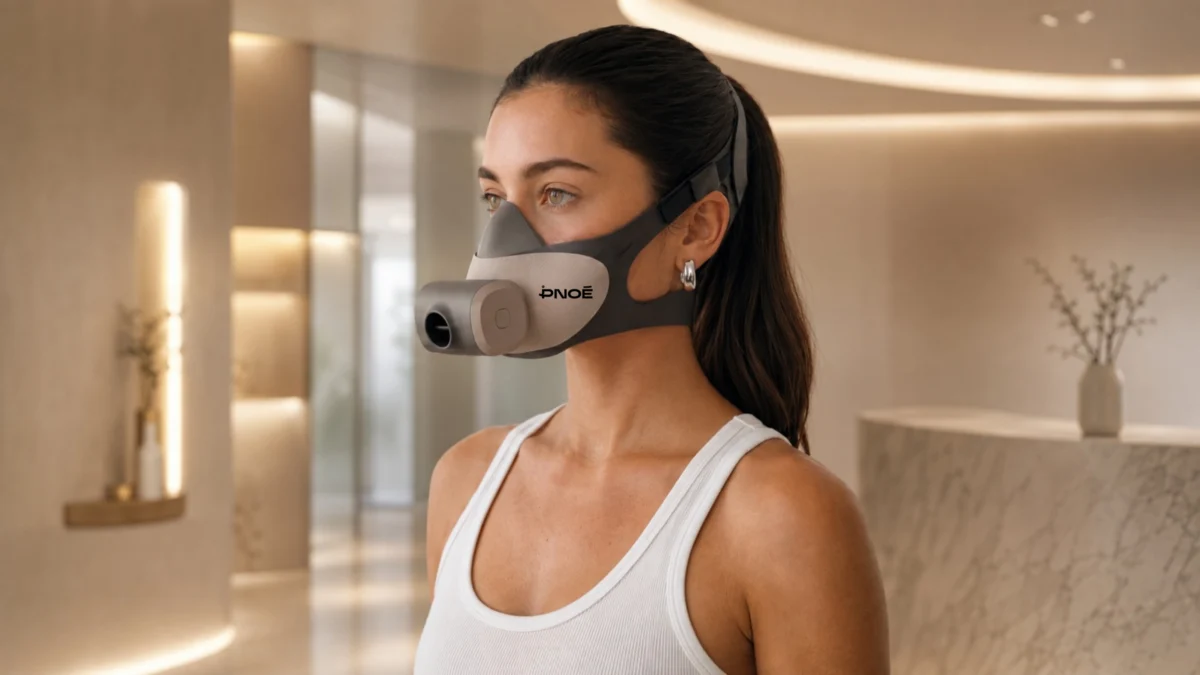
At first glance, the newest device developed by health-tech firm PNOĒ resembles something out of a comic book, bearing a striking resemblance to the mask worn by Bane, the hulking nemesis of Batman. Covering the nose and mouth and securing tightly around the back of the head, the apparatus’s outward appearance belies a far more benign and health-conscious purpose. The device is engineered to measure the volume of oxygen consumed and carbon dioxide exhaled by an individual, subsequently transforming those physiological metrics into actionable insights regarding nutrition, athletic training, and overall health optimization.
Headquartered in Malden, Massachusetts, with significant operational facilities in Athens, Greece, PNOĒ is preparing for the commercial rollout of its flagship product, the PNOĒ 2.0, slated for release on October 1. The defining advancement of this iteration is its capacity for self-administration. Unlike its predecessor, which necessitated the presence of a trained clinical operator, the new device allows users to independently conduct a full metabolic assessment. According to co-founder and chief executive officer Apostolos Atsalakis, a gym member simply needs to put on the mask, press a button, remain seated, and breathe normally for an eight-minute period.
This operational shift carries profound commercial implications. By removing the requirement for specialized technician oversight, PNOĒ has opened up entirely new distribution channels. Fitness centers lacking dedicated sports science personnel, wellness spas, and even retail pharmacies could soon host the self-service testing units, dramatically widening consumer access to advanced physiological profiling.
The Science and Evolution of Metabolic Testing
The fundamental science underpinning PNOĒ’s technology is rooted in established physiology rather than novel experimentation. Metabolic testing—which analyzes the chemical composition of exhaled breath to determine how the human body converts macronutrients into cellular energy—has been utilized in scientific research for over a century. For decades, cardiopulmonary exercise testing (CPET) using metabolic carts has served as the gold standard for quantifying VO₂ max, defined as the maximum volume of oxygen an individual can utilize during intense exertion. Cardiorespiratory fitness, as measured by VO₂ max, is widely recognized by the medical community as a primary indicator of overall cardiovascular health and longevity.
However, historical access to these insights has been severely restricted. Traditional metabolic testing equipment is notoriously bulky, expensive, and complex, confining its use largely to elite sports science laboratories, university research departments, and specialized executive health clinics. For the past decade, PNOĒ has sought to bridge this gap by packing laboratory-grade accuracy into a portable ecosystem, complemented by proprietary software that translates raw gas-exchange data into personalized lifestyle protocols.
By capturing 23 distinct physiological biomarkers during a single test, the platform evaluates metrics that extend far beyond standard VO₂ max calculations. These include resting metabolic rate (RMR), which quantifies the baseline caloric expenditure of the body at rest, and metabolic flexibility, a measure of how efficiently the metabolism shifts between burning fats and carbohydrates for fuel. Atsalakis emphasizes that these granular data points address critical questions that routine blood panels cannot answer, such as exact daily caloric requirements and optimal training zones for fat loss or endurance.
Market Timing and the Longevity Boom
The commercial timing of the PNOĒ 2.0 launch coincides with a cultural and economic surge in the "longevity" sector. Over recent years, VO₂ max has transitioned from an obscure athletic metric into a mainstream wellness buzzword, propelled by emerging clinical research linking high cardiorespiratory fitness to significantly lower all-cause mortality rates. Industry analysts note that consumers are increasingly shifting their health paradigms from mere lifespan extension—living longer—to healthspan extension, which prioritizes maintaining physical and cognitive vitality well into old age.
Atsalakis describes VO₂ max as one of the most robust predictors of human longevity, positioning his company’s diagnostic output as a foundational scorecard for the modern wellness movement. This consumer appetite has fueled rapid growth for the startup, which currently employs 110 people and reports annual revenue growth exceeding 100 percent, alongside achieving recent profitability.
Engineering the Hardware and Addressing Post-Pandemic Realities
Redesigning the hardware for self-administration required an extensive development cycle. Partnering with Milan-based Design Group Italia, the engineering team went through numerous iterations to streamline the device, reducing its overall size and internal component count to enhance reliability.
Furthermore, the design addresses a critical psychological hurdle accelerated by the COVID-19 pandemic: hygiene and shared equipment anxiety. The PNOĒ 2.0 separates the delicate electronic sensors from the silicone mask and head straps. While the costly digital hardware can be shared among multiple users within a facility, each customer retains their own personal mask, ensuring sanitary conditions without imposing prohibitive costs on gym operators.
Regulatory Positioning and Clinical Ambitions
Despite its clinical-grade precision, PNOĒ maintains a conservative regulatory stance. The device has not sought or received clearance from the U.S. Food and Drug Administration (FDA) as a medical diagnostic tool. Consequently, the company explicitly refrains from issuing medical diagnoses or therapeutic prescriptions.
Atsalakis compares the device to standard consumer body-composition scales or smart fitness trackers rather than clinical medical equipment. "A doctor cannot prescribe medication based on our results," he noted during a recent briefing.
Nevertheless, the long-term roadmap for the company hints at deeper clinical integration. Medical researchers have long investigated whether volatile organic compounds and gas concentrations in human breath can serve as early biomarkers for systemic pathologies, including various forms of oncology. Atsalakis acknowledges that while the company’s accumulating dataset holds immense potential for disease detection, full clinical diagnostic capabilities remain several years away, contingent upon rigorous validation studies and complex regulatory pathways.
Foundational Origins and Venture Capital Backing
The roots of PNOĒ trace back to the academic research of Apostolos Atsalakis during his doctoral studies in sensing technologies at the University of Cambridge. Fascinated by the emerging wave of consumer wearables and the untapped diagnostic potential of human respiration, Atsalakis partnered with his childhood friend, Panos Papadiamantis—now serving as chief product officer—to conceptualize the venture.
The startup gained early institutional validation by participating in Y Combinator’s Winter 2019 accelerator cohort, entering the market before the modern longevity venture capital boom fully took hold. To date, PNOĒ has secured approximately $22 million in total equity financing. This includes a recently closed $11 million funding round backed by prominent investors such as specialized venture fund 50 Years and Google Maps co-founder Lars Rasmussen, who is based in Athens.
Business-to-Business Distribution Model
PNOĒ operates strictly on a business-to-business (B2B) commercial model, selling its testing ecosystem directly to organizations that subsequently offer the service to end consumers. The company’s client roster includes high-profile brands such as Equinox—where the technology is deployed across nearly all club locations—alongside Four Seasons hotels, Red Bull, the National Basketball Association (NBA), the Mount Sinai Health System, and med-spa franchise Restore Hyper Wellness.
Geographically, the United States constitutes the vast majority of the company’s footprint, accounting for approximately 85 percent of total revenue. Atsalakis characterizes the U.S. market as "by far the most advanced globally" for longevity-focused products and services. Concurrently, PNOĒ is actively expanding its operational presence across Europe and leveraging distribution partners to enter markets in Latin America and Asia.
For corporate clients, PNOĒ packages its offering as a comprehensive "business in a box" subscription model, priced between $400 and over $1,000 per month depending on scale. This fee structure encompasses the hardware units, diagnostic software licenses, staff training programs, and marketing collateral. Crucially, the software integrates directly into the commercial offerings of the host business, enabling a fitness club, hotel spa, or wellness clinic to automatically recommend specific personal training packages, nutritional supplements, or recovery treatments based on the results of the eight-minute breath test.
Competitive Landscape and Future Outlook
PNOĒ occupies a distinct middle tier within the broader health technology landscape. At the consumer end of the spectrum, wrist-worn wearables from manufacturers like Apple, Garmin, and Whoop estimate cardiovascular metrics such as VO₂ max via algorithmic analysis of heart rate variability. Dedicated consumer breath-analysis gadgets, such as Lumen, track metabolic state via localized respiratory samples. Conversely, at the high end of the market, traditional metabolic carts remain entrenched in specialized clinical research environments.
By positioning its testing protocol as an accessible onboarding tool—bridging the gap between casual fitness tracking and exhaustive clinical evaluations—PNOĒ has carved out a scalable niche in the booming wellness economy.
Looking ahead, the company plans to initiate a Series B funding round within the next six to twelve months to fuel international expansion and accelerate market penetration. As the PNOĒ 2.0 prepares for its October debut, the startup is poised to test whether consumers are ready to embrace laboratory-grade metabolic health profiling—Bane-like appearance notwithstanding—as a routine part of their daily fitness regimens.

