
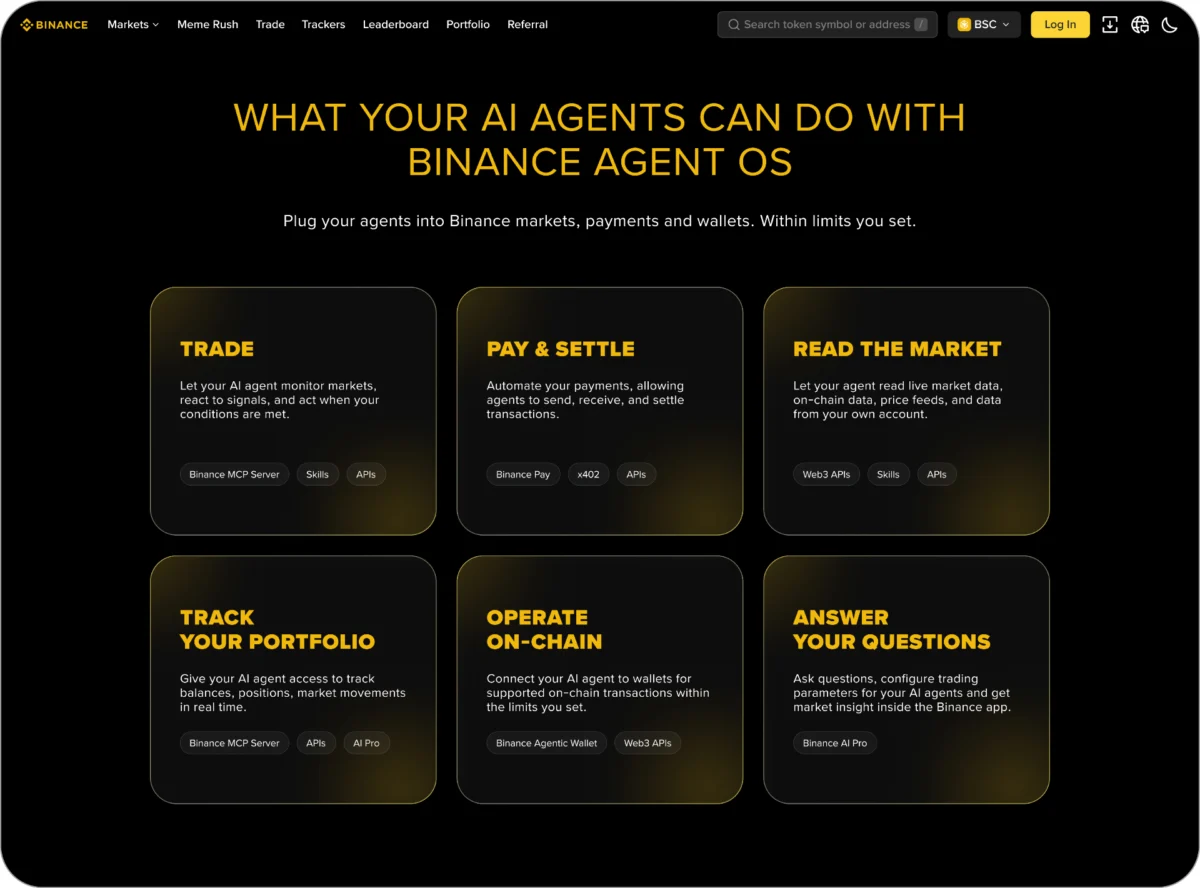
Cryptocurrency exchange infrastructure is undergoing a fundamental transformation as artificial intelligence shifts from passive conversational tools to autonomous, action-oriented digital agents. Binance, the world’s largest digital asset exchange by trading volume with a user base exceeding 300 million registered accounts, announced the global launch of Agent OS on Thursday. This developer-focused platform bridges external artificial intelligence applications with live financial markets, granting AI programs the capability to analyze complex market data, execute spot and futures trades, and manage real capital on behalf of human users.
The introduction of Agent OS represents a major milestone in the convergence of fintech and advanced machine learning. As software engineering races past simple chatbot interfaces, major financial platforms are racing to accommodate a new class of digital workers. These systems are designed to operate independently, executing multi-step workflows without continuous human oversight. By offering a standardized framework for AI connectivity, Binance is positioning its ecosystem at the center of the emerging agentic economy, though the move also invites critical questions regarding security, risk management, and accountability in high-stakes financial environments.
Anatomy of Agent OS: Architecture and Tooling
Agent OS is engineered to serve as a comprehensive operating system and integration layer for developers building financial AI applications. The platform unifies a suite of Binance’s existing developer tools and infrastructure services into a single cohesive ecosystem. Key components integrated into the launch include Binance APIs, the Binance Wallet Agentic Hub, the Binance x402 transaction verification and payment facilitator API, and the Binance Skill Hub. Furthermore, the platform introduces native support for the Model Context Protocol, an open standard designed to facilitate secure, bidirectional communication between AI models and external data sources or execution environments.
The flexibility of Agent OS allows it to interface seamlessly with a wide array of prominent AI development tools and language models. Developers can build agents using OpenAI’s ChatGPT and Codex, Anthropic’s Claude Code, and development environments like Cursor. Once configured, these systems can be authorized by users to access real-time market data, review specific account metrics, and independently execute orders across various supported trading pairs.
Security Framework and User-Centric Risk Mitigation
Granting autonomous software direct access to financial capital introduces unprecedented vulnerabilities, ranging from algorithmic flash crashes to malicious prompt-injection attacks. To address these systemic risks, Binance has adopted a security model that places the primary responsibility for risk containment directly onto the end user. Rather than implementing platform-wide algorithmic circuit breakers or specialized trading loss limits managed by the exchange itself, Binance relies on granular account segmentation.
During an interview detailing the platform’s release, Jeff Li, vice president of product at Binance, emphasized that the architecture prioritizes user-controlled boundaries over centralized restrictions. Instead of granting an AI agent total freedom across a primary user account, the platform mandates the use of dedicated subaccounts. Users can assign an autonomous agent to a specific subaccount configured exclusively for targeted activities, such as conservative spot trading or high-leverage futures execution.
Crucially, withdrawals from these designated subaccounts are blocked by default. This architectural choice establishes a strict digital sandbox around the agent’s operations. Users retain the flexibility to configure their agents to either request manual approval for every individual trade or operate with full autonomy within the pre-set parameters of the subaccount. Because Binance does not enforce a separate monetary cap on trading volume or portfolio drawdowns within these subaccounts, the aggregate financial risk is bounded entirely by the specific capital transferred into the sandbox by the user.
The Black Box Problem: Reasoning and Monitoring Challenges
A significant operational challenge highlighted by the launch of Agent OS is the "black box" nature of modern large language models. When questioned regarding Binance’s visibility into the internal logic driving an agent’s trading decisions, Li acknowledged that the computational reasoning occurs entirely outside the exchange’s infrastructure. Whether processing on a user’s local machine or within a third-party cloud-based AI environment, the decision-making process remains opaque to the exchange operator.
"We really cannot see the reasoning of what the user’s action is," Li stated, confirming that Binance’s monitoring capabilities are largely restricted to observing the resulting transactional output rather than the cognitive pathway that generated the trade.
This architectural limitation means that while Binance applies its existing security, risk-control, and anti-money-laundering policies for subaccount APIs to Agent OS from day one, the exchange maintains limited visibility into whether an autonomous trade was executed due to sound quantitative analysis, corrupted data inputs, or external manipulation such as prompt-injection exploits. Consequently, the mitigation of external threat vectors relies heavily on the aforementioned subaccount isolation framework and the baseline security hygiene practiced by the developer and the user.
Beyond Trading: Payments, DeFi, and On-Chain Activity
While high-frequency and strategic trading represent the initial flagship use cases for Agent OS, the platform’s utility extends far beyond traditional exchange order books. Binance has designed the infrastructure to facilitate complex on-chain interactions and cross-platform financial workflows.
Through integration with the Binance x402 transaction verification system, autonomous agents are equipped to send, receive, and settle digital payments programmatically. Additionally, the inclusion of the Binance Agentic Wallet enables software agents to interact directly with decentralized finance protocols and manage native blockchain tokens.
To mitigate risks associated with decentralized applications and external payment flows, Binance has instituted platform-level daily transaction caps on Agentic Wallet operations, distinguishing them from traditional exchange subaccount trading. Under these guidelines, standard token swaps executed by an agent are capped at $50,000 per day. Default limits for decentralized finance transactions are set at $100,000 daily, while x402 payment transactions are strictly restricted to a maximum of $20 per day. According to executive commentary, Agent OS represents merely the foundational phase of a broader roadmap aimed at empowering developers to construct sophisticated AI applications capable of bridging centralized cryptocurrency markets and decentralized financial ecosystems.

Competitive Landscape: The Industry-Wide Push for Agentic Finance
Binance is far from alone in its pursuit of agent-native infrastructure. The broader cryptocurrency exchange sector has experienced a synchronized race to integrate Model Context Protocol support and developer toolkits, transforming traditionally walled-garden trading platforms into open environments accessible to autonomous software.
The competitive shift accelerated notably in early 2025. In March, prominent rival exchange Kraken launched an open-source command-line tool featuring a built-in MCP server, enabling AI agents to execute both spot and futures market orders directly. Shortly thereafter, in June, Coinbase introduced Coinbase for Agents, a dedicated initiative designed to connect artificial intelligence applications directly to user accounts for streamlined trading, payments, and financial workflow automation within user-defined parameters. Similarly, OKX deployed an open-source agent trade kit earlier in the year, facilitating agentic trading capabilities across its order books.
This widespread adoption across major industry players signals a structural maturation in how retail and institutional participants interact with digital asset markets. As exchanges standardize their APIs and developer frameworks, the traditional paradigm of manual, web-interface-driven trading is steadily giving way to algorithmic delegation.
Broader Implications for Financial Markets
The deployment of Agent OS and competing platforms carries profound implications for the future of global finance. By democratizing access to high-speed execution infrastructure for AI developers, the barrier to entry for algorithmic trading strategies has dropped precipitously. Retail users who previously lacked the programming expertise or quantitative background required to build custom trading bots can now leverage natural language prompts to deploy sophisticated financial agents.
However, this democratization of financial automation introduces complex regulatory and systemic considerations. As autonomous agents begin executing trades based on external data sources, news feeds, and sentiment analysis, the speed and volume of market reactions are expected to increase exponentially. While proponents argue that intelligent agents will enhance market liquidity, improve price discovery, and optimize portfolio management, critics warn of potential cascading flash crashes driven by runaway feedback loops between competing artificial intelligence systems operating without centralized circuit breakers.
Ultimately, the success of Binance’s Agent OS and the broader agentic finance movement will depend on the delicate balance between open innovation and robust risk governance. As users increasingly entrust their capital to autonomous software architectures, the industry’s ability to navigate the challenges of security, accountability, and user education will determine whether AI agents become standard financial assistants or sources of systemic market instability.

